
Recent from talks
Turbo-BASIC XL
Knowledge base stats:
Talk channels stats:
Members stats:
Turbo-BASIC XL
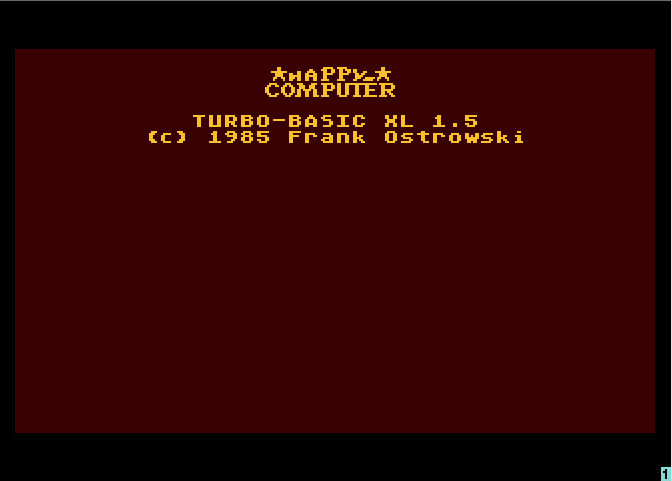
Turbo-BASIC XL is an enhanced version of the BASIC programming language for Atari 8-bit computers.[citation needed] It is a compatible superset of the Atari BASIC that shipped with the computers.[citation needed] Turbo-Basic XL was developed by Frank Ostrowski and published in the December 1985 issue of German computer magazine Happy Computer. A version for the 400/800 models was released shortly after as Frost Basic 1.4. Several modified versions working with different DOS systems have been released by other authors.[citation needed]
Turbo-Basic XL greatly improves execution speed over Atari BASIC. An Atari BASIC program loaded into Turbo-BASIC, with no changes made, would generally run about three to four times as fast. A Turbo-Basic XL compiler created binary executables, further speeding up program performance to about ten times faster than Atari BASIC. Turbo-Basic XL also includes an expanded editor, support for named procedures, WHILE...ENDWHILE and similar block constructs, and added access to the underlying hardware, which, among other things, allowed operation of attached floppy drives without exiting to DOS.[citation needed]
Ostrowski soon got a job with GFA Systemtechnik GmbH (at the time known as Integral Hydraulik) where he adapted Turbo-Basic XL into GFA BASIC for the Atari ST, which became one of the more popular BASICs on that platform.[citation needed]
The poor execution speed of Atari BASIC, which shipped with all Atari 8-bit models, led to a market for 3rd party BASIC interpreters and compilers with better performance or more commands. Among them was an official port of Microsoft BASIC sold by Atari, Inc. and several improved versions released by Optimized Systems Software, who had written the original Atari BASIC under contract. There were also Atari BASIC compilers from several companies.
Turbo-Basic XL was a late entry to this list, first published in December 1985 as type-in program in Happy Computer magazine. It came in both interpreter and compiler versions. Turbo-Basic XL takes advantage of the extra memory of the XL (and later XE) series machines, preventing it from running on the original 400 and 800. A version supporting those systems was later released as Frost BASIC (short for "Frank Ostrowski").
The internal disk-related commands are tied to particular versions of DOS. A number of ports to different versions of DOS became available.
The most notable feature of Turbo-Basic was its dramatically improved speed; an unmodified Atari BASIC program loaded into Turbo-Basic would normally run three to five times faster, and the speed advantage improved as the program size grew.[citation needed] It also had a compiler that increased the speed of listings[disambiguation needed] by a factor of 15 to 20. This was due largely to a series of improvements on well-known problems in the original Atari BASIC code.
In most BASICs, GOTO was handled by reading the associated line number and then searching through the program for that line of code. In MS-derived BASICs the line numbers were stored as 16-bit integers and numeric constants in the code in their original ASCII format. When a line like GOTO 1000 was encountered, the interpreter would use special code to convert the four ASCII characters "1000" into 16-bit integer format and then search for it. Atari BASIC worked differently, converting all numeric constants to a 6-byte floating-point format when the line was entered. This meant the "1000" was no longer in ASCII format and had to be converted from floating-point to integer format. The code for doing so was not well optimized and could take over 2 ms (average 1-1.5 ms).
Hub AI
Turbo-BASIC XL AI simulator
(@Turbo-BASIC XL_simulator)
Turbo-BASIC XL
Turbo-BASIC XL is an enhanced version of the BASIC programming language for Atari 8-bit computers.[citation needed] It is a compatible superset of the Atari BASIC that shipped with the computers.[citation needed] Turbo-Basic XL was developed by Frank Ostrowski and published in the December 1985 issue of German computer magazine Happy Computer. A version for the 400/800 models was released shortly after as Frost Basic 1.4. Several modified versions working with different DOS systems have been released by other authors.[citation needed]
Turbo-Basic XL greatly improves execution speed over Atari BASIC. An Atari BASIC program loaded into Turbo-BASIC, with no changes made, would generally run about three to four times as fast. A Turbo-Basic XL compiler created binary executables, further speeding up program performance to about ten times faster than Atari BASIC. Turbo-Basic XL also includes an expanded editor, support for named procedures, WHILE...ENDWHILE and similar block constructs, and added access to the underlying hardware, which, among other things, allowed operation of attached floppy drives without exiting to DOS.[citation needed]
Ostrowski soon got a job with GFA Systemtechnik GmbH (at the time known as Integral Hydraulik) where he adapted Turbo-Basic XL into GFA BASIC for the Atari ST, which became one of the more popular BASICs on that platform.[citation needed]
The poor execution speed of Atari BASIC, which shipped with all Atari 8-bit models, led to a market for 3rd party BASIC interpreters and compilers with better performance or more commands. Among them was an official port of Microsoft BASIC sold by Atari, Inc. and several improved versions released by Optimized Systems Software, who had written the original Atari BASIC under contract. There were also Atari BASIC compilers from several companies.
Turbo-Basic XL was a late entry to this list, first published in December 1985 as type-in program in Happy Computer magazine. It came in both interpreter and compiler versions. Turbo-Basic XL takes advantage of the extra memory of the XL (and later XE) series machines, preventing it from running on the original 400 and 800. A version supporting those systems was later released as Frost BASIC (short for "Frank Ostrowski").
The internal disk-related commands are tied to particular versions of DOS. A number of ports to different versions of DOS became available.
The most notable feature of Turbo-Basic was its dramatically improved speed; an unmodified Atari BASIC program loaded into Turbo-Basic would normally run three to five times faster, and the speed advantage improved as the program size grew.[citation needed] It also had a compiler that increased the speed of listings[disambiguation needed] by a factor of 15 to 20. This was due largely to a series of improvements on well-known problems in the original Atari BASIC code.
In most BASICs, GOTO was handled by reading the associated line number and then searching through the program for that line of code. In MS-derived BASICs the line numbers were stored as 16-bit integers and numeric constants in the code in their original ASCII format. When a line like GOTO 1000 was encountered, the interpreter would use special code to convert the four ASCII characters "1000" into 16-bit integer format and then search for it. Atari BASIC worked differently, converting all numeric constants to a 6-byte floating-point format when the line was entered. This meant the "1000" was no longer in ASCII format and had to be converted from floating-point to integer format. The code for doing so was not well optimized and could take over 2 ms (average 1-1.5 ms).
Recent media