Hubbry Logo
Turkey shootTurkey shootMain
Open search
Turkey shoot
Community hub
Turkey shoot
logo
8 pages, 0 posts
0 subscribers
Be the first to start a discussion here.
Turkey shoot
Turkey shoot
from Wikipedia
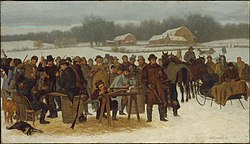
Turkey Shoot by J. W. Ehninger (1879)

A turkey shoot is a sport shooting event featuring marksmanship competitions, with turkeys as prizes. Originally, the turkeys were themselves restrained and put in place to serve as the targets, while modern versions employ standard paper targets. "Turkey shoot" is also in common use as an idiomatic term for an extremely one-sided battle or contest.[1]

Sport usage

[edit]

Turkey shoots in America date back at least to the early 19th century. James Fenimore Cooper's The Pioneers (1823) prominently depicts one, describing it as an "ancient amusement" associated with Christmas.[2] Shoots were common throughout the holiday season, providing birds to adorn dinner tables for Thanksgiving, Christmas, and New Year's Day.[3][4]

In the original format, a live turkey was caged or bound in a stationary position behind a stump or other barrier, with only its head and neck protruding. Contestants, paying a set fee per attempt, vied to land a shot on the bird's exposed parts. The first to do so would immediately claim the prize.[5] Rifles were typically used, at varying ranges depending on the expected skill and number of shooters, but generally between 100 and 200 yards.[6][7]

Shooting Turkeys on Christmas Day (1873)

Over time, concerns arose about the ethics of killing live, restrained animals for sport. This "cruel amusement" was condemned by some Christian speakers as a vice on the same level as "horse-racing, cock-fighting, gouging of eyes, beastly intemperance, profanity, etc."[8] At the urging of Henry Bergh, founder of the ASPCA, some organizers attempted to reduce the birds' suffering by having them humanely slaughtered beforehand, then using their severed heads as the targets.[9] Others moved entirely to a paper target format, where shooters earned their pick from a pool of prize birds in order of their accuracy scores.[4] However, as shoots were locally organized according to custom, and not subject to any central regulation, all three models (live, "dead head", and target) were widely practiced in parallel.[10] Live-turkey shoots persisted into the 20th century, as depicted in the 1941 Gary Cooper film Sergeant York.[11]

Turkey shoots are still popular in the rural United States today.[12] A modern derivation, sometimes more generically known as a meat shoot, is held using shotguns aimed at paper targets about 25–35 yards away. The winner is chosen according to the pellet hole closest to the target's center. The inherent randomness of a shotgun's pellet spray pattern makes this format more approachable for inexperienced shooters.[13]

Military usage

[edit]

In military situations, a turkey shoot occurs when a one side outguns the other to the point of the battle being extremely lopsided, as in the following famous examples:

See also

[edit]

References

[edit]
Revisions and contributorsEdit on WikipediaRead on Wikipedia
from Grokipedia
A turkey shoot is a marksmanship contest, typically held at festive gatherings , in which participants fire rifles or shotguns at moving targets to win turkeys as prizes, with the targets originally consisting of live turkeys restrained such that only their heads were exposed. These events date back to at least the early , with the earliest recorded reference appearing in 1812, and they remain a popular rural tradition, particularly around holidays like , often using paper targets simulating turkey heads to determine winners based on shot proximity to the bullseye. The format varies regionally but generally involves multiple rounds where entrants pay a small per shot, with ammunition and targets supplied by organizers, fostering community for clubs or charities. Originally lethal to live birds, modern iterations prioritize safety and ethics by employing inanimate targets, though the name and competitive spirit preserve the historical essence of testing shooting accuracy under controlled, easy conditions—hence the term's extension into slang for any straightforward, low-risk endeavor, a usage popularized among U.S. military personnel during .

Origins and Etymology

Historical Roots in Marksmanship Events

Turkey shoot events trace their origins to 19th-century America, where they functioned as informal marksmanship competitions centered on shooting restrained live turkeys for prizes. In these contests, domestic turkeys were typically tied to logs, posts, or trees with their heads exposed, requiring participants to demonstrate precision by aiming for the head with or shotguns to claim the bird without damaging the body excessively. Such events honed skills essential for settlers and hunters, reflecting the abundance of wild turkeys in North American forests and the cultural emphasis on through firearm proficiency. Wild turkeys, though challenging to hunt in their natural due to keen senses, served as symbolic in these controlled settings, underscoring marksmanship as a test of accuracy under simplified conditions. By the mid-19th century, turkey shoots gained popularity as community gatherings, often tied to holidays like or , with artistic depictions such as T.H. Matteson's 1857 painting The Turkey Shoot illustrating participants in period attire engaging in the activity. These competitions not only provided and prizes but also fostered social bonds among rural populations, evolving from pure skill tests to include elements of wagering and . Over time, concerns for prompted a shift from live targets to paper silhouettes or bull's-eyes representing turkeys, preserving the marksmanship focus while adapting to modern sensibilities; early 20th-century examples, like the Breschini shoots held annually from 1911 to 1925 in , continued this tradition with live birds until broader reforms took hold.

Transition to Idiomatic Expression

The literal practice of turkey shoots in 19th-century America involved participants firing rifles at domesticated turkeys restrained behind logs, with only the birds' heads exposed as targets, creating a controlled environment that minimized movement and evasion compared to . This setup, common at community gatherings or fairs as early as the , ensured relatively straightforward marksmanship tests where skilled shooters could reliably hit vital areas, often securing prizes in the form of the turkeys themselves. The inherent ease of such contests—contrasting with the challenge of pursuing agile wild turkeys—fostered an association between "turkey shoots" and predictable, low-risk successes in . By the early , this imagery of immobilized targets began extending metaphorically beyond literal events to describe any scenario offering unchallenged dominance, particularly in competitive or combative contexts where opponents lacked effective countermeasures. The phrase's idiomatic shift gained traction during among U.S. military personnel, who applied it to lopsided engagements resembling the confined vulnerability of log-bound turkeys. A pivotal example occurred in the on June 19–20, 1944, dubbed the "Great Marianas Turkey Shoot" by American aviators after they downed over 600 Japanese while losing fewer than 30 of their own, exploiting enemy pilots' inexperience and aircraft limitations in a manner evocative of the original contest's asymmetry. This wartime solidified the term's broader connotation of effortless victory, detached from agrarian traditions and adaptable to , , or tactics where superiority rendered resistance futile. Postwar cultural dissemination through media and veteran accounts further entrenched the idiom, decoupling it from rural marksmanship while preserving the core notion of targets presented without defensive options. Unlike more neutral hunting idioms, "turkey shoot" inherently implies engineered vulnerability, reflecting causal dynamics of preparation and mismatch rather than mere luck, as evidenced in its exclusion from contexts of mutual contest. This evolution underscores a pragmatic linguistic adaptation, prioritizing descriptive accuracy over romanticized notions of fair play in historical slang development.

Literal Applications

Traditional Turkey Shoot Events

Traditional turkey shoot events consist of competitive marksmanship contests where participants vie to win live or frozen turkeys as prizes, typically held in rural American communities prior to or . Originating in colonial frontier settlements, these gatherings involved frontiersmen in buckskin attire using long rifles to fire from standing positions at distances of approximately 60 yards. Targets originally included restrained live turkeys tethered behind logs or tied in pens, with shooters aiming to hit closest to a marked center, such as charred cross-lines on wood or the bird's body. Early practices emphasized simplicity and skill, prohibiting aids like rests or bipods, and classifying entries by rifle type, such as uniform long rifles without scopes. In one documented series from 1911 to 1925 at the Breschini Emporium in Blanco, California—tied to the Monterey County Swiss Rifle Club's marksmanship heritage—up to 5,000 attendees participated in shooting live turkeys, accompanied by raffles, barbecues, and betting, drawing crowds larger than the local Salinas population of under 5,000. These events served both recreational and practical purposes, supplying holiday poultry while fostering community bonds through informal competitions. By the early 19th century, variations included shooting at live turkeys from 25 to 35 yards in penned setups, reflecting a blend of hunting prowess and festive preparation. Prizes extended beyond turkeys to hams or beef, awarded to the most accurate shooters in rounds determined by proximity to the bullseye. Such traditions, rooted in pre-industrial rural life, persisted as seasonal rituals to hone marksmanship amid , with historical accounts from the 1800s depicting communal shoots for celebratory gatherings.

Modern Adaptations and Regional Variations

In contemporary turkey shoot events, organizers have largely transitioned from targeting live restrained birds—practiced historically—to shooting at stationary paper or cardboard targets resembling turkeys, typically at distances of 50 to 60 feet, to align with standards and enhance participant safety. This adaptation preserves the competitive essence while reducing ethical concerns, with winners receiving frozen turkeys or other meat prizes donated by local suppliers. Events often incorporate progressive elimination formats, such as a "two-life" system where targets must be hit twice to eliminate a participant, fostering prolonged engagement and skill demonstration over single-shot luck. Safety protocols have been standardized, mandating eye and ear protection, supervised loading, and restrictions on aids like bipods or to emphasize traditional marksmanship with stock shotguns in gauges from 12 to .410. Regional variations reflect local traditions and club preferences across the , particularly in rural Southern and Midwestern communities where events peak around holidays like . In the South, such as at clubs in , shoots emphasize revival of communal gatherings with family-friendly rules allowing minors under adult supervision, often using black-powder or muzzleloaders alongside modern shotguns for historical flair. events, documented as early as the mid-20th century but continuing today, favor use over shotguns in some iterations, adapting to terrain with longer ranges up to 100 yards and incorporating group competitions for hams or cash alongside turkeys. Midwestern sportsmen's clubs, like those in , enforce strict "sportsman" rules prohibiting rests or magnified sights to test unaided accuracy, while Northeastern variants may integrate trapshooting elements for broader appeal. These differences arise from state regulations and cultural emphases, with Southern shoots often larger and more festive, drawing crowds for social bonding, whereas others prioritize precision training for hunters. Despite modernization calls to sustain participation amid declining rural populations, core elements like one-shot-per-round bidding remain consistent nationwide.

Idiomatic Usage in Sports

Definition and Contextual Application

In the context of , a "turkey shoot" idiomatically describes a lopsided contest in which one or competitor secures an overwhelmingly easy victory due to a stark disparity in skill, preparation, or execution, rendering the opposition's efforts futile. This usage, attested in English since 1968, evokes the image of literal turkey shoots where birds serve as slow-moving, predictable targets for marksmen, symbolizing a of minimal resistance and high probability. The term finds application in sports commentary and journalism to highlight games dominated by offensive prowess against feeble defense, often in team-based disciplines like , , or soccer, where unchallenged scoring opportunities accumulate rapidly. For instance, in , repeated easy baskets stemming from lapses in opponent coverage can transform the match into what analysts call a turkey shoot, underscoring not just the scoreline but the perceptual ease of dominance. Similarly, in broader athletic rivalries, it denotes mismatches where the favored side exploits weaknesses methodically, as in a or battle analogized to sports outcomes for their one-sided nature. Contextually, the phrase underscores causal factors like talent gaps, fatigue, or strategic mismatches rather than mere chance, distinguishing it from closer contests; it appears in post-game analyses to quantify blowouts, such as final scores exceeding 20-30 points in professional leagues, without implying any controversy in the result. Its informal tone suits broadcast media over formal reports, yet it maintains precision in conveying empirical dominance verifiable through statistics like points per possession or defensive efficiency metrics.

Notable Examples in Professional Sports

In American football, a prominent instance of the "turkey shoot" idiom applied to a professional game was the New England Patriots' 49-19 rout of the New York Jets on November 22, 2012, at MetLife Stadium, where the Jets' repeated mistakes— including turnovers and defensive lapses—enabled the Patriots to score at will, prompting contemporary coverage to label it a "turkey shoot." The Patriots led 31-3 at halftime, capitalizing on four Jets turnovers, which underscored the one-sided nature of the contest and marked head coach Bill Belichick's 200th regular-season victory. The term has also surfaced in other professional contexts to describe dominant performances, such as in , where Leo Ruiz's lopsided final win over Tim Landwehr in the 2018 Turkey Shoot Pro-Am was depicted as a "turkey shoot" for its ease, though the event's name itself evokes the . In cricket, commentators have used it for batting exhibitions on favorable pitches, as in the 2023 test match at , where conditions turned the game into a "turkey shoot" for batsmen after initial seam-friendly play. These applications highlight the 's flexibility for contests where one side faces minimal resistance, often due to opponent errors or environmental advantages rather than superior play alone.

Idiomatic Usage in Military Contexts

Definition and Tactical Implications

In military terminology, a "turkey shoot" denotes a combat engagement characterized by extreme asymmetry, where one force possesses such overwhelming superiority in firepower, technology, positioning, or surprise that the opposing side suffers disproportionate losses with minimal effective resistance, akin to the ease of shooting confined, defenseless turkeys in traditional marksmanship contests. This idiom, originating from American hunting practices but adapted to describe lopsided battles, implies targets that are effectively static or predictable, allowing attackers to rack up kills methodically and with low risk to themselves. Tactically, such scenarios often arise from factors like air or naval dominance enabling unchallenged strikes, as seen in carrier-based operations where enemy aircraft launch piecemeal into superior defenses, resulting in near-total attrition rates— for instance, loss ratios exceeding 10:1 in documented aerial encounters. Ground applications include pursuits of disorganized retreats, where exposed columns become vulnerable to precision fires from standoff weapons, amplifying destructive efficiency while conserving and reducing exposure to counterattacks. This dynamic favors forces with real-time intelligence and mobility, turning potential stalemates into routs by exploiting disarray or logistical failures. The implications extend to strategic morale and : victors achieve rapid through sunk costs in enemy , potentially shortening campaigns, but the ease can foster underestimation of adaptive threats if vigilance lapses, as unchallenged dominance may erode training rigor or prompt enemy doctrinal shifts toward evasion over confrontation. Commanders must balance exploitation with sustainment, ensuring that the "shoot" does not devolve into overextension, as historical precedents demonstrate that while turkey shoots decisively degrade capabilities, they hinge on maintained qualitative edges like pilot proficiency or .

World War II Examples

The Battle of the Philippine Sea, fought from June 19 to 20, 1944, featured an aerial engagement dubbed the "Great Marianas Turkey Shoot" by U.S. Navy aviators due to the overwhelming dominance of American carrier-based aircraft over Japanese forces. In this phase, U.S. pilots from Task Force 58, comprising 15 aircraft carriers under Admiral Marc Mitscher, intercepted waves of approximately 430 Japanese aircraft launched from nine carriers of Vice Admiral Jisaburō Ozawa's Mobile Fleet. The disparity arose from superior U.S. radar-directed interceptions, experienced pilots, and the Hellcat fighter's effectiveness, resulting in the downing of 645 Japanese planes—nearly three times the number of U.S. aircraft losses of 123—while Japanese pilots, many hastily trained amid shortages, struggled with coordination and obsolete tactics. This lopsided outcome crippled Japan's naval air arm, preventing effective strikes on U.S. invasion forces targeting Saipan and Guam. The nickname "Marianas Turkey Shoot" originated from the ease with which U.S. fighters dispatched Japanese formations, likened to shooting stationary targets, as pilots reported minimal evasive maneuvers by inexperienced airmen flying aircraft like the Zero, which were outmatched in dogfights. U.S. losses were exacerbated by aggressive pursuit leading to fuel exhaustion during Mitscher's dusk recovery operation, but no carriers were lost in the air battle, contrasting with Japan's sinking of three carriers in subsequent submarine and surface actions. Japanese records confirm over 600 aircraft destroyed, with Admiral Ozawa's fleet withdrawing after failing to inflict significant damage, marking a strategic turning point that ensured Allied control of the central Pacific. No other World War II engagements were as prominently labeled a "turkey shoot," though the term's application here underscored the tactical imbalance from Japan's pilot attrition since Midway and the U.S.'s industrial superiority in producing 11,000+ aircraft monthly by 1944. The event's one-sided nature reflected broader causal factors, including Japan's resource constraints and failure to adapt amid escalating attrition rates exceeding 80% in prior carrier battles.

Post-World War II Examples

One prominent post-World War II application occurred during the Korean War's defense of the Pusan Perimeter. On August 11, 1950, U.S. Marine Corps aircraft from carriers including , alongside U.S. Air Force F-51 Mustangs, conducted missions near Kosong that decimated a North Korean column of approximately 100 vehicles, including tanks and trucks, with an estimated 64 vehicles destroyed or damaged in a single afternoon. Marine pilots reported the engagement as the "Kosong Turkey Shoot" due to the lack of effective enemy antiaircraft fire and the ease of targeting exposed ground forces, contributing to the stabilization of the UN line before the Inchon landing. This action exemplified early jet-age air dominance over poorly defended mechanized units. In the , U.S. Marines operating near the described a series of engagements on April 24, 1967, as a "turkey shoot." Riverine patrols and helicopter gunships from the 9th Marine Amphibious Brigade targeted North Vietnamese Army supply convoys attempting to cross the Ben Hai River, destroying multiple trucks, sampans, and anti-aircraft positions with minimal American casualties. The term captured the one-sided nature of the interdiction, where Marine AH-1 Cobra gunships and supporting artillery overwhelmed enemy movements in open terrain, sinking two boats and halting a resupply effort amid dense foliage that offered little concealment. The 1991 Gulf War featured multiple instances, notably the Battle of Bubiyan from January 29-30. U.S. Navy and surface action groups, including destroyers and frigates, engaged Iraqi naval forces fleeing toward through the shallow waters north of , sinking or disabling up to 80 vessels—including missile boats, patrol craft, and amphibious ships—with precision-guided munitions and naval gunfire, while suffering no coalition losses. U.S. personnel dubbed it the "Bubiyan Turkey Shoot" for the trapped Iraqi fleet's inability to maneuver or return effective fire, effectively neutralizing Saddam Hussein's surface navy as a threat. Similarly, on February 26-27, coalition aircraft struck retreating Iraqi divisions along Highway 80 (the "") from to , destroying over 300 vehicles in hours-long attacks by A-10 Thunderbolts and F-16s, which pilots likened to a "turkey shoot" owing to the convoys' congestion and lack of air cover. Estimates placed Iraqi military dead at 300-1,000, with the strikes hastening the on February 28.

References

Add your contribution
Related Hubs
User Avatar
No comments yet.