Hubbry Logo
TuteloTuteloMain
Open search
Tutelo
Community hub
Tutelo
logo
8 pages, 0 posts
0 subscribers
Be the first to start a discussion here.
Tutelo
Tutelo
from Wikipedia

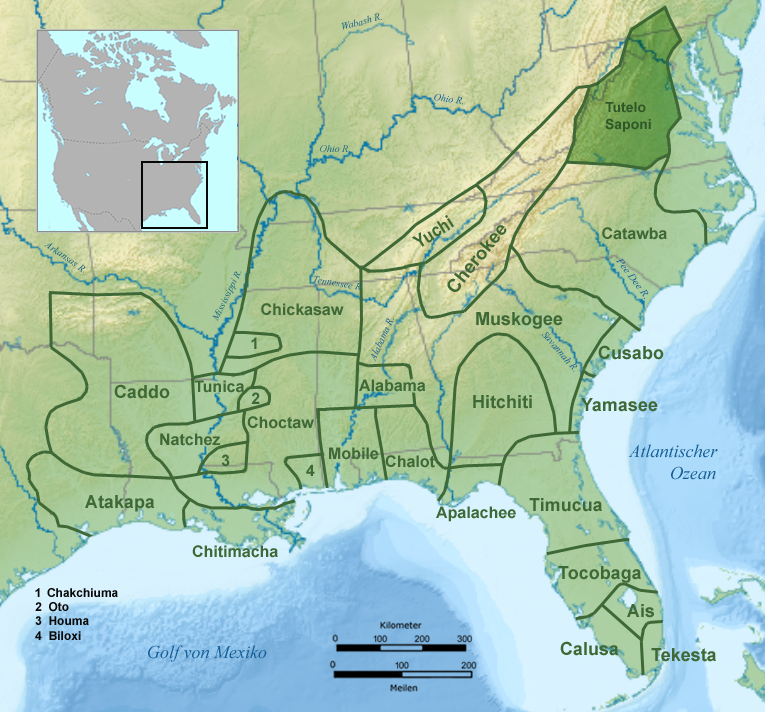
The Tutelo (also Totero, Totteroy, Tutera; Yesan in Tutelo) were Native American people living above the Fall Line in present-day Virginia and West Virginia. They spoke a dialect of the Siouan Tutelo language thought to be similar to that of their neighbors, the Monacan and Manahoac nations.

Key Information

Under pressure from English settlers and Seneca Iroquois, they joined with other Virginia Siouan tribes in the late 17th century and became collectively known as the Nahyssan. By 1740, they had largely left Virginia and migrated north to seek protection from their former Iroquois opponents. They were adopted by the Cayuga tribe of New York in 1753.[2][1] Ultimately, their descendants migrated into Canada.[1]

Name

[edit]

The English name Tutelo comes from the Algonquian variant of the name that the Iroquois used for all the Virginia Siouan tribes: Toderochrone (with many variant spellings). The Tutelo autonym (name for themselves) was Yesañ, Yesáh, Yesáng, Yesą, Yesan, Yesah, or Yesang. This may also be connected with the name Nahyssan, as well as earlier colonial-era spellings, such as Monahassanough (John Smith).[3]

The name Oniasont appeared on 17th-century French maps. Amateur historian Charles A. Hanna believed that name of the Nahyssan recorded in West Virginia and western Virginia during the same period, i.e. the Tutelo, a Siouan language-speaking people. Others theorize that Honniasont may have been considered an Iroquoian language.

Crops

[edit]

Aside from getting many native plants from their natural habitat, the Tutelo people have been linked to Tutelo Strawberry Corn and may have grown predecessor varieties of Boston Mallow Squash and Oronoco Tobacco. Boston Mallow was developed by horticulturalists in Boston, MA in the 19th century from seed said to have been traceable back to a group of Natives in the vicinity of Buffalo, NY around the end of the Revolutionary War. Some documents seem to suggest the Iroquois had sent a group of people there to reestablish farms ravaged during the war and they were led by the then chief of the Tutelo and may have therefore been mostly Tutelo. [4]

Corn would have been a fairly recent arrival to their home region at the time of contact and they probably did not come to Virginia with it, as they may have with other seed varieties. This shows in their word for corn- mandahe- seemingly being an amalgamation of the Algonquian word Mandamin and the Iroquoian word nehe.

History

[edit]

Precontact

[edit]

Tutelo oral history states that they originated in Ohio and likely only a few centuries before European arrival. Their language shares many loan words with the Mosopelea language, the only Fort Ancient language on record, suggesting that they were once neighboring cultures. Since Tutelo housing was similar to that of Monongahela culture, and their burial mounds were similar to those found in northeast Ohio and western Pennsylvania.

17th century

[edit]

The Tutelo historic homeland was said to include the area of the Big Sandy River on the West VirginiaKentucky border, which they called the "Totteroy River." The Iroquois drove them from this region during the later Beaver Wars (c. 1670), after which the Iroquois established the Ohio Valley as their hunting ground by right of conquest. Charles Hanna believed their name, first appearing as Oniasont on 17th-century French maps, to be a variation of the name of the tribe recorded in West Virginia and western Virginia at the same time period, as Nahyssan and Monahassanough, i.e. the Tutelo, a Siouan language-speaking people.[3]

Although previously known to the Virginia colonists by their other names, a form of Tutelo first appeared in Virginia records in 1671, when the Batts and Fallam expedition noted their visit to "Totero Town" near what is now Salem, Virginia. A few years later, the Tutelo joined the Saponi to live on islands located where the Dan and Staunton rivers join to become the Roanoke River. It was just above the territory of the Occaneechi.[5] For a time, the Tutelo had a settlement on the banks of the New River. Many of the sherds collected there and the small triangular points, suggest a mid- to late 16th-century or an early 17th-century date.[6]

Between 1671 and 1701, Tutelo abandoned their homelands and joined the Occaneechi.[1]

18th century

[edit]

In 1701, they were noted as living at the headwaters of the Yadkin River in North Carolina. After 1714, the Saponi and Tutelo, collectively known as a Nahyssan, resided at Junkatapurse around Fort Christanna in Brunswick County, Virginia, near the border with North Carolina.[5]

After the signing of the 1722 Treaty of Albany, the Iroquois ceased their attacks upon the Tutelo.[7] In the 1730s, Tutelo people moved north to Shamokin, Pennsylvania,[1] and sought the protection of the Oneida viceroy, Shickellamy (had a Tutelo wife).[7] After 1753, the Cayuga formally agreed to take in the Tutelo, who moved to the south side of Cayuga Lake and eastern Cayuga Inlet,[1] near present-day Ithaca, New York.[2]

The Tutelo village of Coreorgonel was located near present-day Ithaca, New York and Buttermilk Falls State Park.[8] There they lived under the protection of the Cayuga until Coreorgonel, along with many other Iroquois towns, was destroyed during the American Revolutionary War by the Sullivan Expedition of 1779. It was retaliation for British-Iroquois raids against the American rebels.[9]

The Tutelo went with the Iroquois to Canada, where the British offered land for resettlement at what became known as the Six Nations of the Grand River First Nation. In 1785, 75 Tutelos lived among 1,200 residents on the Six Nations reserve.[10] They continued to live among the Cayuga and were eventually absorbed by them through intermarriage.[11] The last known full-blooded Tutelo speaker, Nikonha or Waskiteng ("Old Mosquito") died in 1870 at the age of 105.[12] He had given extensive linguistic material to the scholar Horatio Hale, who confirmed the Tutelo language as a Siouan language. His father's name was Onusowa, a Tutelo chief who established a village in New York state. Their village was attacked during the Sullivan Expedition, an American operation to destroy the pro-British elements of the Six Nations in New York.

19th century

[edit]

John Key, also known as Gostango (meaning "Below the Rock") and Nastabon ("One Step") survived Nikonha as the last recorded fluent speaker of the Tutelo language. He died on March 23, 1898, at 78 years old. Chief John Buck (Onondaga/Tutelo, ca. 1818–1893) was a Haudenosaunee firekeeper at the Oshweken Longhouse on the Six Nations Reserve in Ontario. He recounted Tutelo stories to American ethnologists John Napoleon Brinton Hewitt and Frank Speck.[13]

See also

[edit]

Notes

[edit]

References

[edit]
[edit]
Revisions and contributorsEdit on WikipediaRead on Wikipedia
from Grokipedia
The Tutelo were a small Native American tribe of the Siouan language family, historically occupying the region of present-day and , where they resided in villages along rivers such as the James, Roanoke, and Yadkin. Closely allied with the , , and other groups in loose confederacies like the Monacan or Saponi-Tutelo, the Tutelo practiced mixed subsistence of agriculture, supplemented by hunting large game including deer, , and buffalo, as well as gathering wild and . Their society featured matrilineal clans, longhouses in some periods, and technologies such as , , and dugout canoes. European contact began in the late 17th century, with the Tutelo noted by explorers like John Lawson in 1701; colonial expansion and devastating Iroquois raids from the north prompted their relocation to Fort Christanna in 1714 under a treaty, followed by further northward migrations to and New York by the 1740s. In 1722, via the Treaty of Albany, they allied with the (Haudenosaunee), gaining protection as the "Nodericia" or Tedarighroones and integrating with the Cayuga nation; by 1779, survivors had resettled at the Grand River Reserve in , , where epidemics like in the 1830s and 1840s reduced their numbers severely. The Tutelo-Saponi language, classified in the Virginian branch of Eastern Siouan, persisted among a few speakers into the late , with the last fluent individual, Nikonha, dying around ; documentation by linguists like Horatio Hale preserved vocabulary and grammar, aiding partial revival efforts among descendants today. Though the tribe assimilated into the Six Nations without federal recognition as a distinct entity, Tutelo lineage endures in mixed-heritage families at the reserve, numbering a few dozen identified pure descendants by the 1930s.

Identity and Terminology

Names and Etymology

The ethnonym "Tutelo" originates from an Iroquoian term, rendered as Todirich-roone or similar variants by early European observers, which the Iroquois employed as a collective label for Siouan-speaking tribes inhabiting Virginia and the Carolinas, including the Tutelo, Saponi, and Catawba. This exonym entered English usage to denote a specific group, though its precise etymology and meaning remain undetermined; anthropologist Horatio Hale observed in 1883 that the term lacked discernible significance to either the Tutelo themselves or the Iroquois, suggesting it may derive from a borrowed southern Indigenous form. Colonial records from 1671 mark the earliest documented application of a Tutelo-like name in Virginia, reflecting interactions amid broader regional tribal designations. The Tutelo autonym, or self-designation, was Yesan (or Yesang), a term extended generically to affiliated Siouan groups rather than strictly one ; variants such as Monahassanugh and Nahyssan appear in 17th- and 18th-century accounts, likely phonetic adaptations by explorers like John Lawson. Other historical appellations include Totero, Totteroy, Tutera, Kattera, and Shateras, often arising from orthographic variations in European transcriptions of Iroquoian or Algonquian intermediaries. No verified meaning for Yesan has been established in surviving linguistic records, underscoring the challenges in reconstructing pre-contact Siouan nomenclature amid post-European disruptions.

Traditional Territory and Origins

Precontact Locations and Migrations

The Tutelo, a Siouan-speaking people closely allied with the , occupied the region of present-day and prior to European contact in the early . Their primary territories encompassed the upper Roanoke River valley in southwestern , extending to the Dan and Staunton Rivers where these waterways converge, as well as areas near the James and Rivanna Rivers. These locations placed them in hilly, forested terrain suitable for semi-sedentary village life, with settlements often situated in riverine swamps or near mountain foothills for defensive advantages. Linguistic evidence, including the Tutelo language's affinity to Dakota and other Siouan dialects documented by Horatio Hale, supports an eastern origin for the Tutelo-Saponi subgroup within the broader Siouan family. Archaeological data remains limited, with pottery styles and mound sites in the Virginia Piedmont not conclusively distinguishing Siouan groups from neighbors, though some researchers link regional artifacts to proto-Siouan populations. Hypotheses of precontact migrations posit an origin in the upper Ohio Valley, followed by southward movement across the into the Virginia Piedmont, potentially via the Big Sandy River valley in present-day . This dispersal, estimated to predate 1600 CE, may have been influenced by buffalo hunting patterns or pressures from northern tribes, as suggested by early linguistic distributions and exploratory accounts, though direct archaeological confirmation is absent and the theory relies on comparative . Alternative views propose a longer indigenous presence on the Atlantic slope without northern migration, emphasizing local adaptation over translocation.

Subsistence and Material Culture

Agriculture and Crops

The Tutelo, as Eastern Siouan speakers in the region of and , relied on as a key component of their , cultivating crops in small gardens adjacent to settlements and larger communal fields. Women primarily managed planting, tending, and harvesting, employing matrilocal practices that integrated family labor into the agricultural cycle. Maize (corn) served as the staple crop, yielding large communal harvests that were collectively protected and distributed among tribe members according to need, supplemented by beans, squash, pumpkins, , and various vegetables forming the foundational "Three Sisters" system. This method leveraged complementary growth patterns—maize providing stalks for beans to climb, squash shading soil to suppress weeds—enhancing and yield efficiency in the nutrient-rich soils. Wild plants, including nuts, berries, grapes, plums, and tubers, augmented cultivated produce through seasonal gathering. The Tutelo developed or preserved distinctive maize varieties, notably Tutelo Strawberry Popcorn, a small-eared, red-kerneled type adapted for popping and ceremonial use, which archaeological and ethnographic records link to their pre-contact practices in the Southeast. Harvested crops were stored in household granaries or dried over fires for preservation, supporting year-round sustenance amid seasonal variability. Rituals, including harvest ceremonies like the geiniwasondage (Four Nights Dance), invoked spiritual assurance of bountiful yields, reflecting maize's central role in cosmology and economy.

Hunting, Gathering, and Trade

The Tutelo relied on as a key component of their subsistence, targeting large game such as deer, which provided meat, hides, and bones for tools. Hunters employed bows and arrows as primary weapons, with possible use of blowguns adapted from neighboring groups for smaller prey like birds and squirrels. Small game, including rabbits and turkeys, supplemented the diet through trapping and communal drives, while seasonal waterfowl hunts occurred near rivers and wetlands. Gathering activities focused on wild plants, fruits, and aquatic resources, particularly in their habitats along waterways. Communities collected nuts, berries, and roots such as those from persimmons and trees, which were staples during non-agricultural seasons. Proximity to rivers enabled harvesting of via weirs, nets, and spears, alongside oysters and from coastal-influenced streams, contributing significantly to protein intake. These foraging practices were communal and gender-divided, with women often leading collection to ensure food security amid variable harvests. Trade networks connected the Tutelo to neighboring Siouan groups like the and , utilizing established Piedmont-to-Blue Ridge trails for exchanging goods. Archaeological evidence of copper jewelry indicates long-distance procurement from northern sources, likely bartered for local deerskins, flint, or foodstuffs. These exchanges fostered alliances but diminished post-contact due to disruptions and European competition by the early 1700s.

Historical Developments

17th Century: European Contact and Iroquois Pressures

The Tutelo, also known as Totero or Tutera, first encountered Europeans through exploratory expeditions in the Virginia Piedmont during the 1670s. In 1670, German explorer John Lederer reached Tutelo settlements while traversing the Roanoke River watershed, marking one of the earliest documented contacts with these Siouan-speaking people inhabiting areas above the Fall Line, including regions near modern Salem in Roanoke County, Virginia. The following year, in 1671, the Batts-Fallam expedition, commissioned by Virginia authorities, visited a Tutelo town situated in a fertile swamp between a tributary and the main Roanoke River, surrounded by mountains, where traders engaged with local inhabitants. These interactions introduced trade goods but also exposed the Tutelo to colonial expansion and diseases, though direct settlement pressures remained limited in the mid-century. Associated closely with the and other Siouan groups like the , the Tutelo participated in emerging colonial networks, with the formally recognized as tributary Indians under Virginia's governor by 1677, implying protective alliances amid intertribal conflicts. However, these ties offered scant buffer against escalating external threats. The Tutelo's territory, spanning the upper Roanoke and headwaters, positioned them vulnerably to northern incursions. Iroquois expansion, fueled by the Beaver Wars (circa 1628–1701), imposed severe pressures on the Tutelo and allies through raids for captives and peltry to sustain fur trade monopolies with Europeans. Seneca war parties targeted southern Siouan tribes, including a documented 1686 expedition against the Tutelo, prompting defensive alliances with groups like the Sapona and Keyauwees. These conflicts, part of broader Iroquois campaigns southward from New York, displaced Tutelo communities eastward and southward by the century's close, as northern Siouan speakers fled repeated harassment by Seneca and Cayuga forces. Population strains compounded these migrations, with allied Siouan groups totaling around 750 individuals by early 1701 amid ongoing threats.

18th Century: Northern Migrations and Iroquois Adoption

In the early 18th century, the Tutelo, allied with the Saponi, faced relentless raids from the Iroquois Confederacy, prompting northward migrations from their traditional Piedmont Virginia and North Carolina territories to seek refuge. Following the 1722 Treaty of Albany, which established peace between colonial governments and the Iroquois, the Tutelo relocated to Shamokin (present-day Sunbury, Pennsylvania) on the Susquehanna River under Iroquois protection, marking a strategic alliance with their former adversaries. By the 1740s, approximately 150 Tutelo and individuals resided at Shamokin, comprising half of the roughly 300 Indians there, as their southern populations dwindled from warfare, disease, and displacement. This interim settlement facilitated further integration, with the groups gradually moving toward lands in New York. In 1753, the Cayuga nation formally adopted the Tutelo into the Confederacy (Haudenosaunee), granting them status as a protected kin group and allowing settlement near . Adoption entailed cultural incorporation, including retention of Tutelo rituals like spirit adoption ceremonies for the deceased, while intermarriage with Cayuga accelerated linguistic and social assimilation. By 1771, the primary Tutelo village was established about two miles south of modern , solidifying their position within the Six Nations despite ongoing vulnerabilities to colonial encroachments. This phase represented a pragmatic survival strategy, transforming enmity into alliance amid demographic decline.

19th Century: Relocation to Canada and Population Decline

Following the , the Tutelo, who had been incorporated into the Cayuga nation, consolidated their presence on the Six Nations of the Grand River reserve in present-day , , where British authorities granted land to Loyalist allies including adopted groups like the Tutelo. A census recorded 74 Tutelo residents on the reserve, divided into "Upper" and "Lower" bands, amid a total population of approximately 1,200 Indigenous people. By the 1810 Grand River Indian census, their numbers had risen slightly to 82 individuals, reflecting 53 in the Upper band and 29 in the Lower band, indicating some recovery after earlier disruptions but still a small, vulnerable group reliant on Cayuga protection. The Tutelo established distinct settlements on the reserve, such as at Tutela Heights along the Grand River's western bank, where they initially numbered around 200 upon arrival but faced ongoing assimilation pressures through intermarriage with Iroquois hosts. This relocation to Canada marked the end of their independent migrations northward, as they integrated into the Six Nations framework, abandoning prior territories in New York and Pennsylvania amid U.S. expansion and Iroquois defeats. Population decline accelerated in the mid-19th century due to devastating epidemics; the 1832 outbreak killed a majority of the remaining Tutelo, and a second wave in 1848 further reduced survivors, prompting the abandonment of Tutela Heights and merger with the Cayuga band. By 1843, despite a temporary rebound to about 40 persons after earlier losses around 1813–1815 linked to the , the group's distinct identity eroded as intermarriage intensified and disease compounded low birth rates and prior war casualties. The death of Nikonha (also known as Waskiteng or "Old Mosquito"), the last full-blooded Tutelo and fluent speaker of their Siouan language, in 1871 at approximately age 106, symbolized the effective end of the Tutelo as a distinct ethnic population, with descendants thereafter tracing mixed Cayuga-Tutelo heritage within the Six Nations.

Social Structure and Warfare

Kinship, Governance, and Daily Life

The Tutelo maintained a matrilineal kinship system, with descent, inheritance, and clan membership traced through the female line; women held ownership of land and property. Society was organized into four exogamous clans or gentes—Pash, Sepoy, Askarin, and Maraskarin—each named after female ancestors of human origin, prohibiting marriage within the same clan or village to prevent incest. Kinship terminology followed a bifurcate collateral and merging pattern for siblings and cousins, reflecting the emphasis on maternal lines. Polygyny occurred among higher-status individuals, while marriage involved a bride price of gifts to the bride's parents; divorce was permissible, with children remaining with the mother in matrilocal residences. Governance operated through a structure featuring a primary chief advised by a of elders, alongside specialized roles such as shamans for spiritual matters and war captains for affairs; authority emphasized consensus via gatherings rather than strict hereditary succession. Villages, typically comprising 200 to 250 residents, utilized longhouses for deliberations and communal decision-making. Leadership focused on maintaining social harmony and defense, with chiefs selected based on merit and counsel input rather than automatic inheritance. Daily life revolved around gendered divisions of labor, with men responsible for and warfare using bows and arrows to procure game such as deer, elk, and buffalo, while women managed , crafting, and centered on corn cultivation in adjacent gardens. Families resided in lodges supplemented by and gathering wild foods, fostering self-sufficient households amid high that encouraged larger numbers of children. Social reinforced matrilineal ties through exogamous marriages and communal rituals honoring bonds, though specific pre-contact practices were later influenced by migrations and alliances.

Intertribal Conflicts and Alliances

The Tutelo maintained close alliances with neighboring Siouan-speaking tribes, including the , , Keyauwee, and Eno, forming part of broader Nahyssan or Monacan confederacies in the and . These groups shared linguistic affinities, with Tutelo and dialects being substantially identical, and coordinated defensively by relocating to shared island settlements along the Roanoke River by 1676 to counter external threats. In 1714, the Tutelo joined the and at Fort Christanna under a colonial treaty, consolidating their positions for mutual protection amid encroaching pressures. Intertribal conflicts primarily involved prolonged warfare with Iroquoian tribes, especially the Seneca and Cayuga, whose raids from the north devastated Tutelo settlements and forced repeated southward displacements starting in the late 17th century. By 1701, the Tutelo, Saponi, and allies had united to capture Iroquois prisoners in retaliation, though Iroquois incursions persisted, including a 1733 incident where a Tutelo king and two warriors repelled a large party from a cave stronghold. Isolated tensions arose with other groups, such as mutual killings prompting a 1709 Nottoway proposal to eradicate the Tutelo, reflecting sporadic kinship-based disputes. The Piedmont region also served as a corridor for broader intertribal warfare, with Catawba and Cherokee parties transiting to strike Iroquois targets, indirectly heightening local vulnerabilities. These hostilities culminated in the Tutelo seeking refuge with former adversaries following the 1722 Albany Treaty, which halted raids on southern tribes. By 1744, Tutelo and groups migrated north to , under auspices, receiving temporary Tuscarora protection en route. Full integration occurred in 1753 when the Tutelo were admitted as tributaries to the League, settling under Cayuga patronage near , by 1771, marking a strategic alliance born of survival necessities.

Language and Linguistics

Classification and Features

The , often grouped with as Tutelo-Saponi, belongs to the , specifically the Eastern Siouan branch within the Southeastern or Ohio Valley subgroup. It shares cognates and structural features with other Eastern Siouan languages such as Biloxi, Ofo, and Catawba, tracing descent from Proto-Siouan, while diverging from Western branches like Dakota through innovations in and morphology. Tutelo exhibits a phonological system characteristic of Siouan languages, with five oral vowels (/i/, /e/, /a/, /o/, /u/) and three to four nasal vowels, distinguished by length (e.g., /i/ vs. /iː/ as minimal pairs for "directional" vs. "arrive there"). The consonant inventory comprises 14 phonemes, including aspirated stops (/pʰ/, /tʰ/, /kʰ/), unaspirated stops (/p/, /t/, /k/), nasals (/m/, /n/), fricatives (/s/, /x/, /h/), lateral (/l/), glides (/w/, /y/), and glottal stop (/ʔ/), but lacks glottalized stops (merged in Tutelo) and sounds like /f/, /v/, or /r/; words typically end in vowels. Morphologically, Tutelo is agglutinative, stacking prefixes for pronominal actors and patients in an active-stative system (e.g., wa- "1sg actor," wi- "1sg patient"), instrumentals (e.g., la- "by mouth," lu- "by hand"), and locatives (e.g., a- "on," o- "locative") onto verbs, with suffixes marking tense (-ta future), aspect (-wa realis, -p progressive), mode (-hiye causative), and plurality (-pu 2pl). Nouns incorporate possessive pronouns via affixes (e.g., hisep migitowi "my axe") but lack inherent plural marking, often using reduplication in adjectives for plurality (e.g., ati api "good house" to ati apipisel "good houses"). Earlier analysis by Hale (1883) described it as inflected due to pronominal incorporation and verb transitions, contrasting it with agglutinative Western Siouan languages like Dakota, though modern descriptions emphasize agglutination with fusional elements in prefixes. Syntactically, Tutelo employs a basic Subject-Object-Verb (SOV) (e.g., minewa waqtakai "the man sees me"), with optional subjects, postpositional phrases for relations, and subordination via particles like li- "if" for complex sentences; verb phrases dominate, incorporating much nominal content. Compared to Western Siouan relatives like or Dakota, Tutelo shows morphological simplification, such as merged phonemes and reduced inflectional categories, while retaining shared instrumental prefixes and aspect markers.

Documentation, Loss, and Revival Efforts

Documentation of the Tutelo language began in the late 19th century with philologist Horatio Hale, who recorded vocabulary, grammar, and syntax from Nikonha, a full-blooded Tutelo speaker at the Six Nations Reserve in Ontario, publishing a brief grammar and extensive word list in 1883 that confirmed its Siouan affiliation. Salvage efforts intensified in the early 20th century, as anthropologists Edward Sapir and Leo Frachtenberg compiled fragmentary vocabularies from remnant speakers among the Tutelo descendants at Six Nations, while Frank G. Speck documented additional linguistic data alongside cultural practices from individuals like Chief Samuel Johns and the Buck family. Later recordings included Marianne Mithun's 1982 audio work with Albert Green, one of the final partial speakers, preserving phonetic details of surviving forms. The Tutelo language experienced rapid loss following European contact and tribal migrations, with fluent transmission ceasing among core communities by the early 1900s; Nikonha, the last fluent speaker in traditional Tutelo territories, died in 1871 at age 106, after providing Hale's primary data. By 1907, only a few semi-speakers remained, including members of the Buck family and Andrew Sprague, after which the language no longer functioned as a vernacular, though isolated knowledge persisted among mixed-heritage descendants at Six Nations and elsewhere until Albert Green's contributions in the 1980s marked the effective end of native attestation. Factors contributing to extinction included population decline from warfare, disease, and assimilation into Iroquoian groups, rendering systematic intergenerational use impossible by the mid-20th century. Revival initiatives emerged in the late , driven by descendants in and tribes such as the and . Marty Richardson, a Haliwa-Saponi member, began teaching reconstructed Tutelo-Saponi classes in the , drawing on historical vocabularies to instruct small groups and foster basic conversational skills. Karenne Wood, a Monacan linguist, has utilized 19th-century documentation, including Hale's grammar and word lists, to develop structured lessons and resources aimed at community education. In 2021, the Living Tongues Institute for Endangered Languages awarded a grant to a team including Marvin Richardson, Corey Justin Roberts, and others to create the Tutelo-Saponi Monacan Living Dictionary, a digital platform compiling over 3,000 words and phrases with audio recordings, images, and videos by the end of 2023, targeted at enrolled members of the Monacan, Haliwa-Saponi, Band, and related groups. Recent scholarship has focused on verb morphology reconstruction, addressing gaps in historical data to support fuller grammatical revival, though efforts remain constrained by limited source material and reliance on comparative Siouan linguistics. These projects emphasize community-led reclamation, prioritizing cultural continuity over full fluency restoration given the language's dormant status for over a century.

Modern Descendants and Legacy

Contemporary Communities

Descendants of the Tutelo primarily persist through assimilation into other Indigenous groups, with no distinct Tutelo political entity existing today. In , many Tutelo were formally adopted by the Cayuga Nation in 1753 and later relocated to the Grand River Reserve (Six Nations Territory) in following the . Historical records document Tutelo individuals maintaining cultural practices, such as spirit adoption ceremonies, into the early at this reserve, where the was spoken by elders until at least the . Figures like Chief Samuel Johns, a self-identified Tutelo descendant, corresponded with anthropologists in the mid-20th century, affirming ongoing kinship ties within the Cayuga and broader Six Nations community. These descendants, now numbering in the hundreds among mixed lineages, identify primarily as Cayuga or Haudenosaunee, with Tutelo heritage preserved through oral traditions and genealogical records rather than separate enrollment. In the United States, Tutelo ancestry is claimed by several state-recognized tribes associated with the broader Saponi confederacy, particularly along the Virginia-North Carolina border. The Haliwa-Saponi Indian Tribe, recognized by North Carolina in 1965, has approximately 4,300 enrolled members primarily in Halifax and Warren Counties, tracing descent from Saponi, Tutelo, Nansemond, and Tuscarora peoples through documented migrations and intermarriages post-18th century. Genealogical evidence supports over 80% of members linking to these Eastern Siouan groups via 19th- and 20th-century records, though federal recognition remains pending. The tribe maintains cultural continuity through annual powwows and community centers, emphasizing shared Siouan heritage. Related groups, such as the Occaneechi Band of the Saponi Nation in Alamance County, North Carolina, and scattered Saponi descendants in Virginia counties like Brunswick and Mecklenburg, also invoke Tutelo ties, often through historical alliances documented in colonial accounts. Language revitalization efforts represent a key aspect of contemporary Tutelo-Saponi identity in the U.S. The Tutelo-Saponi dialect, last fluently spoken in the mid-20th century, is being reconstructed by tribal members like Marvin Richardson, who teaches classes drawing on archival recordings and linguistic analyses. As of 2025, Richardson, one of few semi-fluent speakers, leads workshops for Haliwa-Saponi youth, focusing on and grammar from sources like 19th-century ethnographer Horatio Hale's documentation. These initiatives, supported by tribal programs, aim to counter near-extinction following historical displacements, though full fluency remains limited to a handful of individuals. Challenges include reliance on fragmented historical data and integration into English-dominant communities, with progress measured by community immersion events rather than widespread proficiency.

Cultural Persistence and Revitalization Challenges

Following their adoption by the Cayuga band of the at the Grand River Reserve (Six Nations) in during the 18th and 19th centuries, Tutelo descendants maintained a remnant population of approximately 60 individuals across eight families into the 1930s, preserving elements of tribal identity under leaders like Chief Samuel Johns, who asserted Tutelo ancestry and sovereignty in correspondence with anthropologist Frank G. from 1934 to 1935. Specific cultural practices, such as the Tutelo Spirit Adoption Ceremony—performed to ritually replace deceased members—and other dieho ono rituals, were incorporated into broader ceremonialism, with the Spirit Adoption observed as late as 1951 following the death of a Tutelo descendant. These adaptations represent hybridized persistence rather than isolated retention, as Tutelo elements enriched Cayuga traditions amid intermarriage and shared governance within the Haudenosaunee confederacy. However, assimilation posed severe challenges to distinct Tutelo cultural continuity, exacerbated by 19th-century epidemics—including a devastating plague in 1848 that eliminated the as a separate political entity—and relentless pressures from expansion, leading to obscured identity and population dispersal. By the late 19th century, fluent command of the had ceased, with the last known speaker, Nikonha, dying in 1871 after providing limited vocabulary to ethnologist Horatio Hale; subsequent records indicate no full revival of oral transmission, only fragmentary documentation. This linguistic extinction severed access to embedded cultural knowledge, including oral histories, songs, and protocols, while integration into dominant society diluted Tutelo-specific governance and daily practices, reducing them to ceremonial vestiges. Modern revitalization efforts, concentrated among southern descendant communities like the state-recognized Monacan Indian Nation in Virginia and Haliwa-Saponi Indian Tribe in North Carolina (with around 4,000 enrolled members), center on language reconstruction to anchor broader cultural reclamation, as linguistic heritage underpins tribal identity and intergenerational ties. Initiatives include the Tutelo-Saponi Monacan Living Dictionary, a grant-funded digital tool launched around 2021 with over 3,000 reconstructed words, phrases, audio, and media, developed by a team led by Dr. Marvin Richardson of the Haliwa-Saponi alongside linguists from the Living Tongues Institute. Richardson's Haliwa-Saponi Historic Legacy Project, active since at least 2019, involves weekly classes in Hollister, North Carolina, teaching reconstructed Tutelo-Saponi through Siouan dictionaries, songs, and powwow announcements, with applications for linguists to expand vocabulary for contemporary concepts like "toaster." Key challenges include the absence of native speakers for authentic pronunciation and semantic depth, reliance on incomplete 19th-century records (e.g., grammar sketches and word lists), and the labor-intensive creation of neologisms without cultural consensus, which risks diluting original meanings. Community engagement remains limited to small groups, such as Richardson's classes with teens and elders, hindering widespread adoption, while hybridized legacies at Six Nations complicate southern claims by emphasizing Iroquois over Tutelo elements. Despite fostering youth pride—as seen in Monacan cultural programs—these grassroots projects face funding constraints and the broader threat of further erosion without institutional support or federal recognition, underscoring the tension between documented persistence and proactive revival in sustaining Tutelo heritage.

References

Add your contribution
Related Hubs
User Avatar
No comments yet.