


Community hub
Recent from talks
Contribute something
Nothing was collected or created yet.
Shellfish
View on Wikipedia


Shellfish, in colloquial and fisheries usage, are exoskeleton-bearing aquatic invertebrates used as food, including various species of molluscs, crustaceans, and echinoderms. Although most kinds of shellfish are harvested from saltwater environments, some are found in freshwater. In addition, a few species of land crabs are eaten, for example Cardisoma guanhumi in the Caribbean. Shellfish are among the most common food allergens.[1]
Due to narrowing in the meaning of the English word fish over the centuries, shellfish no longer fall under what is usually considered fish.[2] Most shellfish are low on the food chain and eat a diet composed primarily of phytoplankton and zooplankton.[3] Many varieties of shellfish, and crustaceans in particular, are actually closely related to insects and arachnids; crustaceans make up one of the main subphyla of the phylum Arthropoda. Molluscs include cephalopods (squids, octopuses, cuttlefish) and bivalves (clams, oysters), as well as gastropods (aquatic species such as whelks and winkles; land species such as snails and slugs).
Molluscs used as a food source by humans include many species of clams, mussels, oysters, winkles, and scallops. Some crustaceans that are commonly eaten are shrimp, lobsters, crayfish, crabs and barnacles.[4] Echinoderms are not as frequently harvested for food as molluscs and crustaceans; however, sea urchin gonads are quite popular in many parts of the world, where the live delicacy is harder to transport.[5][6]
Though some shellfish harvesting has been unsustainable, and shrimp farming has been destructive in some parts of the world, shellfish farming can be important to environmental restoration, by developing reefs, filtering water and eating biomass.
Terminology
[edit]
The term "shellfish" is used both broadly and specifically. In common parlance, as in "having shellfish for dinner", it can refer to anything from clams and oysters to lobster and shrimp. For regulatory purposes it is often narrowly defined as filter-feeding molluscs such as clams, mussels, and oyster to the exclusion of crustaceans and all else.[7]
Although the term is primarily applied to marine species, edible freshwater invertebrates such as crayfish and river mussels are also sometimes grouped under the umbrella term "shellfish".
Although their shells may differ, all shellfish are invertebrates. As non-mammalian animals that spend their entire lives in water they are "fish" in an informal sense; however, the term "finfish" is sometimes used to distinguish fish, animals defined by having vertebrae, from shellfish in modern terminology.
The word "shellfish" is both singular and plural; the rarely used "shellfishes" is sometimes employed to distinguish among various types of shellfish.[8]
Shellfish in various cuisines
[edit]Archaeological finds have shown that humans have been making use of shellfish as a food item for hundreds of thousands of years. In the present, shellfish dishes are a feature of almost all the cuisines of the world, providing an important source of protein in many cuisines around the world, especially in the countries with coastal areas.

In Japan
[edit]In Japanese cuisine, chefs often use shellfish and their roe in different dishes. Sushi (vinegared rice, topped with other ingredients, including shellfish, fish, meat and vegetables) features both raw and cooked shellfish. Sashimi primarily consists of very fresh raw seafood, sliced into thin pieces. Both sushi and sashimi are served with soy sauce and wasabi paste (a Japanese horseradish root, a spice with extremely strong, hot flavor), thinly sliced pickled ginger root, and a simple garnish such as shiso (a kitchen herb, member of the mint family) or finely shredded daikon radish, or both.
In the United States
[edit]
Lobster in particular is a great delicacy in the United States, where families in the Northeast region make them into the centerpiece of a clam bake, usually for special occasions. Lobsters are eaten on much of the East Coast; the American lobster ranges from Newfoundland down to about the Carolinas, but is most often associated with Maine. A typical meal involves boiling the lobster with some slight seasoning and then serving it with drawn butter, baked potato, and corn on the cob.
Clamming is done both commercially and recreationally along the Northeast coastline of the US. Various type of clams are incorporated into the cuisine of New England. The soft-shelled clam is eaten either fried or steamed (and then called "steamers"). Many types of clams can be used for clam chowder, but the quahog, a hard shelled clam also known as a chowder clam, is often used because the long cooking time softens its tougher meat.
The Chesapeake Bay and Maryland region has generally been associated more with crabs, but in recent years the area has been trying to reduce its catch of blue crabs, as wild populations have been depleted. This has not, however, stemmed the demand: Maryland-style crabcakes are still a well known treat in crabhouses all over the bay, though the catch now comes from points farther south.[citation needed]
.jpg)
In the Southeast, and particularly the gulf states, shrimping is an important industry. Copious amounts of shrimp are harvested each year in the Gulf of Mexico and the Atlantic Ocean to satisfy a national demand for shrimp. Locally, prawns and shrimp are often deep fried; in the Cajun and Creole kitchens of Louisiana, shrimp and prawns are a common addition to traditional recipes like jambalaya and certain stews. Crawfish are a well known and much eaten delicacy there, often boiled in huge pots and heavily spiced.[9]
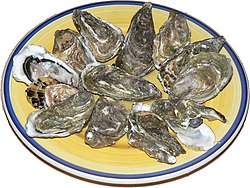
In many major cities with active fishing ports, raw oyster bars are also a feature of shellfish consumption. When served freshly shucked (opened) and iced, one may find a liquid inside the shell, called the liquor. Some believe that oysters have the properties of an aphrodisiac.[10]
Inter-tidal herbivorous shellfish such as mussels and clams can help people reach a healthy balance of omega-3 and omega-6 fats in their diets, instead of the current Western diets.[11] For this reason, the eating of shellfish is often encouraged by dietitians.


Some popular dishes using shellfish:
Religious dietary restrictions
[edit]The Torah forbids the consumption of shellfish (i.e. the only permitted seafood is fish with fins and scales), in the books of Leviticus and Deuteronomy.[12] Jews (of all religious traditions) who fully observe the dietary laws thus do not eat shellfish, neither do Seventh-day Adventists, who also follow Jewish dietary law.
Shia Islamic schools of thought vary on whether (and which types of) shellfish may be acceptable.[13] Sunni Muslims, except Hanafis, view them as halal.[14][15][16]
Allergy
[edit]Approximately 1% of the population is estimated to suffer from shellfish allergy,[17] which is more common in teenage and adult life than very early childhood.[18]
There is some evidence that shellfish intolerance exists in an unknown proportion of the population. The symptoms of this do not include the immune and respiratory symptoms of an allergic reaction, such as hives, hyperventilation, or anaphylaxis, but do involve gastrointestinal distress, such as nausea, abdominal cramps, and diarrhea.[19] Similar symptoms can come from foodborne illness or as part of a toxic effect.[20]
Toxic content
[edit]Some shellfish, such as whelk, contain arsenic. A sample of whelk was found to have a total content of arsenic at 15.42 mg/kg of which 1% is inorganic arsenic.[21]
Shellfish caught in Alaska can cause paralytic shellfish poisoning (PSP).[22] PSP is caused by toxins, namely saxitoxin, released by dinoflagellates, a type of protista (also considered algae), which are extremely poisonous (1000 times more potent than cyanide) and can lead to death by paralyzing the breathing muscles. Due to warming oceans, algae blooms have become more widespread,[23] thereby increasing the likelihood of intoxications of various types.
Ecosystem services and reef-building
[edit]Shellfish of various kinds contribute to the formation of reefs, such as when millions of oysters or mussels aggregate together. Reefs provide habitat for numerous other species, bury carbon, contributing to climate change mitigation,[24] and defend the shore against erosion, floods and waves.[25][26] Conversely, when they are destroyed or exploited, carbon can be released into the atmosphere, simultaneously increasing the likelihood of severe weather while removing the natural defence against its consequences.[24][27] In addition, some shellfish are known for filtering water, removing suspended particles and contaminants, which contributes to both quality and clarity.[28] These benefits cascade to other species that are helpful to humankind such as seagrasses.[28]
See also
[edit]References
[edit]- ^ "Shellfish Alergies". Cleveland Clinic. Retrieved 25 August 2009.
- ^ "Shellfish Reefs". The Marine Diaries. 2 August 2021. Retrieved 15 July 2024.
- ^ "Manual on the Production and Use of Live Food for Aquaculture". Food and Agriculture Organization of the United Nations. Retrieved 25 August 2009.
- ^ "Shellfish climbs up the popularity ladder; the category is gaining chefs' attention for one-of-a-kind signature menu items". Archived from the original on 5 November 2012. Retrieved 25 August 2009.
- ^ Fabricant, Florence (1998). "Sea urchin makes waves, popularity increases on American menus". Nation's Restaurant News via BNET. Archived from the original on 24 May 2012. Retrieved 25 August 2009.
- ^ "The sea urchin market in Japan". Marine Fisheries Review via BNET. 1989. Archived from the original on 24 May 2012. Retrieved 25 August 2009.
- ^ Maryland Shellfish Harvesting Areas Archived 11 October 2006 at the Wayback Machine, Maryland Department of the Environment
- ^ Festing, Sally (1999). Fishermen: A Community living from the Sea (Revised ed.). Stamford: Shaun Tyas. p. 119. ISBN 978-1-900289-22-1.
- ^ McClain, W. Ray; Romaire, Robert P. (30 April 1996). "Reducing Population Density to Effect a Greater Production of Large Crawfish". Journal of Applied Aquaculture. 5 (4): 1–15. Bibcode:1996JApAq...5d...1M. doi:10.1300/j028v05n04_01. ISSN 1045-4438.
- ^ O'Connor, Anahad (10 May 2005). "The Claim: Oysters Are Aphrodisiacs". The New York Times. ISSN 0362-4331. Retrieved 31 January 2018.
- ^ Robson, Anthony (2006). "Shellfish view of omega-3 and sustainable fisheries". Nature. 444 (7122): 1002. Bibcode:2006Natur.444.1002R. doi:10.1038/4441002d.
- ^ Leviticus 11:9–12
- ^ "Question and Answer: Meat".
- ^ "حكم أكل القواقع".
- ^ "حكم أكل " الحلزون " ، وهل يجوز طبخه حيّاً؟".
- ^ "Is Seafood Halal Or Haram? (Crab, Lobster, Shark, Octopus)". 27 April 2022. Archived from the original on 25 December 2022. Retrieved 25 December 2022.
- ^ Moonesinghe H, Mackenzie H, Venter C, Kilburn S, Turner P, Weir K, Dean T (September 2016). "Prevalence of fish and shellfish allergy: A systematic review". Ann Allergy Asthma Immunol. 117 (3): 264–72.e4. doi:10.1016/j.anai.2016.07.015. hdl:10044/1/45844. PMID 27613460.
- ^ Wai CY, Leung NY, Chu KH, Leung PS, Leung AS, Wong GW, Leung TF (March 2020). "Overcoming Shellfish Allergy: How Far Have We Come?". Int J Mol Sci. 21 (6): 2234. doi:10.3390/ijms21062234. PMC 7139905. PMID 32210187.
- ^ Firszt, K.; Sebastien, K.; Gleich, G. J.; Wagner, L. A. (February 2012). "Delayed Gastrointestinal Symptoms after Ingesting Shrimp in the Absence of IgE Sensitization". The Journal of Allergy and Clinical Immunology. 129 (2): AB170. doi:10.1016/j.jaci.2011.12.398.
- ^ Woo, Chee; Bahna, Sami (June 2011). "Not all shellfish "allergy" is allergy!". Clinical and Translational Allergy. 1 (1): 3. doi:10.1186/2045-7022-1-3. PMC 3294628. PMID 22410209.
- ^ "82/05 October 2005 Arsenic in fish and shellfish" (PDF). Government of the United Kingdom. 8 September 2010. Archived from the original (PDF) on 21 July 2013. Retrieved 6 April 2013.
- ^ "Fact sheet" (PDF). dhss.alaska.gov. Archived from the original (PDF) on 12 July 2018. Retrieved 16 June 2020.
- ^ Meyer, Robinson (12 December 2018). "An Upheaval at the Ends of the World". The Atlantic. Retrieved 16 June 2020.
- ^ a b Fodrie, F. Joel; Rodriguez, Antonio B.; Gittman, Rachel K.; Grabowski, Jonathan H.; Lindquist, Niels. L.; Peterson, Charles H.; Piehler, Michael F.; Ridge, Justin T. (26 July 2017). "Oyster reefs as carbon sources and sinks". Proceedings of the Royal Society B: Biological Sciences. 284 (1859) 20170891. doi:10.1098/rspb.2017.0891. ISSN 0962-8452. PMC 5543224. PMID 28747477.
- ^ Chowdhury, Mohammed Shah Nawaz; Walles, Brenda; Sharifuzzaman, S. M.; Shahadat Hossain, M.; Ysebaert, Tom; Smaal, Aad C. (12 June 2019). "Oyster breakwater reefs promote adjacent mudflat stability and salt marsh growth in a monsoon dominated subtropical coast". Scientific Reports. 9 (1): 8549. Bibcode:2019NatSR...9.8549C. doi:10.1038/s41598-019-44925-6. ISSN 2045-2322. PMC 6561949. PMID 31189886.
- ^ Walles, Brenda; Salvador de Paiva, João; van Prooijen, Bram C.; Ysebaert, Tom; Smaal, Aad C. (1 May 2015). "The Ecosystem Engineer Crassostrea gigas Affects Tidal Flat Morphology Beyond the Boundary of Their Reef Structures". Estuaries and Coasts. 38 (3): 941–950. Bibcode:2015EstCo..38..941W. doi:10.1007/s12237-014-9860-z. ISSN 1559-2731. S2CID 85817134.
- ^ "Shellfish reefs: Australia's untold environmental disaster". phys.org. Retrieved 13 October 2021.
- ^ a b Ramsar (2011). "Wetlands Ecosystem Services Factsheet 5: Water Purification" (PDF). ramsar.org. Retrieved 13 October 2021.
Sources
[edit]- Pawley, Andrew (2004) "Are crustaceans shellfish? A whiff of scandal in English lexicography" Australian Style, 12 (1): 1–3.
External links
[edit]
- BC Shellfish Growers Association
- East Coast Shellfish Growers Association
- Pacific Coast Shellfish Growers Association
- Shellfish News
- Shellfish Gallery
- Shellfish Guide Archived 4 March 2016 at the Wayback Machine
- Freshwater and Marine Image Bank—Shellfish[permanent dead link] at the University of Washington Libraries, Digital Collection
- Nutrition Facts for Various Shellfish Archived 6 March 2016 at the Wayback Machine
| Fish | |
|---|---|
| Shellfish | |
| Other seafood | |
| Processed seafood | |
| Seafood dishes | |
| Health hazards | |
| Advisory services | |
| Animal welfare | |
| Related topics | |


| Poultry |   | ||||
|---|---|---|---|---|---|
| Livestock | |||||
| Game | |||||
| Fish | |||||
| Shellfish and other seafood | |||||
| Insects | |||||
| Cuts and preparation |
| ||||
| List articles |
| ||||
| Ethics and psychology | |||||
| Alternatives | |||||
| Meat science | |||||
| Meat industry | |||||
| Related subjects | |||||
| Authority control databases: National |
|---|

Shellfish
View on GrokipediaDefinition and Classification
Biological Definition
Shellfish encompass a polyphyletic assemblage of aquatic invertebrates characterized by the possession of a hard external shell or exoskeleton, primarily drawn from the phylum Mollusca and the subphylum Crustacea within phylum Arthropoda.[11] These organisms lack a vertebral column, distinguishing them from finfish, and their shells typically consist of calcium carbonate (in mollusks) or chitin reinforced with calcium (in crustaceans).[2] The designation "shellfish" is not a monophyletic clade in cladistic taxonomy but a pragmatic grouping often tied to ecological roles, such as benthic filter-feeding or scavenging, and human utilization rather than shared evolutionary ancestry.[11] Molluscan shellfish, belonging to phylum Mollusca, exhibit soft-bodied anatomy protected by a calcareous shell secreted by a mantle tissue, with over 85,000 described species, though only a fraction are commonly harvested.[12] Key subclasses include Bivalvia (e.g., oysters, clams, mussels, and scallops, featuring two hinged valves and often siphons for filter-feeding), Gastropoda (e.g., abalone, whelks, and periwinkles, with a single coiled shell and a muscular foot for locomotion), and Cephalopoda (e.g., squid, octopus, and cuttlefish, with reduced or absent external shells but internal chitinous structures like pens or beaks).[13] These groups demonstrate adaptations such as radulae for rasping food in gastropods or jet propulsion via siphons in cephalopods, reflecting divergent evolutionary paths within Mollusca dating back to the Cambrian period around 540 million years ago.[2] Crustacean shellfish, from class Malacostraca (predominantly order Decapoda), feature jointed appendages, segmented bodies, and a chitinous exoskeleton molted periodically for growth, with approximately 50,000 species, many marine.[12] Prominent examples include shrimp (suborder Dendrobranchiata and Caridea), crabs (infraorder Brachyura with reduced tails), and lobsters (infraorder Astacidea or Achelata, possessing large claws and elongated bodies).[13] Their bilateral symmetry, gills for respiration, and compound eyes support active predation or detritivory in coastal and deep-sea habitats.[11] Occasionally, the term extends to other shelled invertebrates like certain echinoderms (e.g., sea urchins from phylum Echinodermata), though these are radially symmetric and lack true shells, underscoring the term's informal boundaries.[11]Major Taxonomic Groups
Shellfish, as a culinary and informal biological category, primarily comprise aquatic invertebrates from the phylum Mollusca and the subphylum Crustacea (within phylum Arthropoda), characterized by calcified exoskeletons or shells for protection.[14][15] These groups are not monophyletic, reflecting convergent evolution of shelled body plans rather than shared ancestry, with Mollusca encompassing soft-bodied animals with a mantle-secreted shell and Crustacea featuring chitinous exoskeletons and jointed appendages.[16][17] Edible species from these taxa dominate global fisheries, with Mollusca contributing over 17 million metric tons annually in aquaculture and capture as of 2020 data.[18] Phylum Mollusca, the second-largest animal phylum with approximately 85,000 described species, includes the most diverse shellfish forms, unified by a body plan featuring a head-foot, visceral mass, and mantle that secretes a calcareous shell in many lineages.[16] Relevant classes for shellfish are:- Class Bivalvia (bivalves): These hinge two-valved shells with a ligament and adductor muscles, lacking a distinct head; examples include oysters (Ostreidae family, over 70 species commercially harvested), clams (Veneridae family, such as the hard clam Mercenaria mercenaria), mussels (Mytilidae family, e.g., blue mussel Mytilus edulis), and scallops (Pectinidae family). Bivalves filter-feed via siphons and gills, comprising about 10,000 species, with global production exceeding 15 million tons yearly.[19][18][20]
- Class Gastropoda (gastropods): Featuring a single, often spiral shell and a radula for feeding, edible forms include whelks (Buccinidae family), periwinkles (Littorinidae family), and abalone (Haliotidae family, with seven species in Haliotis genus yielding mother-of-pearl). These bottom-dwellers or grazers number over 60,000 species, supporting fisheries in regions like the Indo-Pacific.[16][17]
- Class Cephalopoda (cephalopods): Advanced mollusks with prominent heads, eight or ten arms bearing suckers, and internal or reduced shells (e.g., cuttlebone in cuttlefish); edible species include squid (Loliginidae and Ommastrephidae families, over 300 species), octopus (Octopodidae family), and cuttlefish (Sepiidae family). Unlike other mollusks, many lack external shells in adulthood, leading to occasional exclusion from strict shellfish definitions, yet they yield over 4 million tons in annual catches due to paralarval life stages and jet propulsion.[14][18]
Culinary and Regulatory Distinctions
Shellfish are culinarily distinguished from finfish by preparation techniques that address their shells, high moisture content (75-80%), and low fat levels (2-5%), requiring rapid cooking to maintain tenderness and avoid toughness. Bivalves like clams and mussels are typically steamed or boiled until shells open, signaling edibility, while crustaceans such as shrimp and lobster undergo brief boiling, grilling, or deep-frying.[23][24] Deep-frying is prevalent for shellfish including oysters and shrimp, enhancing crisp textures absent in finfish preparations that favor filleting, baking, or roasting for even cooking.[24] Regulatory frameworks impose stricter controls on shellfish, especially molluscan bivalves, due to their filter-feeding behavior, which bioaccumulates bacteria, viruses, and algal toxins like those causing paralytic shellfish poisoning, unlike finfish that derive nutrients through ingestion rather than filtration. In the United States, the FDA's Fish and Fishery Products Hazards and Controls guidance outlines distinct pathogen controls for harvest areas, with molluscan shellfish subject to the National Shellfish Sanitation Program involving water quality classification into approved, conditionally approved, restricted, or prohibited zones based on fecal coliform testing and biotoxin monitoring.[25][26] Finfish regulations under HACCP emphasize processing risks such as scombrotoxin formation or anisakid parasites, with harvest site assessments less rigorous absent filter-feeding vulnerabilities.[25][27] Shellfish harvest, transport, and sale face additional Interstate Shellfish Sanitation Conference oversight, including depuration processes to purge contaminants, measures not standard for finfish.[28] These protocols reflect empirical data on outbreak incidences, with shellfish linked to higher Vibrio and norovirus risks from contaminated waters.[26]Biology and Physiology
Anatomy and Adaptations
Shellfish exhibit diverse anatomical structures adapted to aquatic environments, primarily falling into molluscan groups (bivalves and gastropods) and crustaceans, with shells or exoskeletons providing protection against predators and environmental stresses. Mollusks generally possess a soft body divided into a head-foot region, visceral mass, and mantle, while crustaceans feature a hardened, segmented exoskeleton and jointed appendages for mobility and manipulation. These features enable adaptations such as filter feeding, burrowing, and active predation, reflecting evolutionary responses to predation pressure and habitat variability in marine, estuarine, and freshwater systems.[16][29][30] In bivalve mollusks, such as clams, oysters, and mussels, the body is laterally compressed and enclosed within two hinged valves forming a calcareous shell secreted by the mantle epithelium, connected dorsally by a ligament and closed ventrally by strong adductor muscles to prevent intrusion by predators. A wedge-shaped muscular foot, often hatchet-like, facilitates burrowing into soft sediments, while stationary species like oysters use a reduced foot and byssal threads for substrate attachment. The mantle cavity houses enlarged gills (ctenidia) that function in both respiration—facilitating oxygen-carbon dioxide exchange—and filter feeding, where cilia and mucus trap planktonic particles from water drawn in via incurrent siphons, directing them to labial palps for sorting before ingestion in a complete digestive tract lacking a radula. These adaptations support sessile or infaunal lifestyles, enhancing survival in turbulent, particle-rich waters by minimizing exposure and maximizing energy efficiency in nutrient capture.[16][29] Gastropod shellfish, including snails and whelks, feature a single, typically coiled univalve shell for protection, often sealed by a calcareous operculum attached to the foot, with the body undergoing torsion—a 180-degree rotation of the visceral mass—resulting in asymmetry and coiling of organs. The broad, ventral muscular foot secretes mucus for gliding locomotion over substrates, while a protrusible radula, a chitinous ribbon with teeth, enables scraping algae, drilling prey shells, or rasping tissues, adapting to herbivorous, detritivorous, or carnivorous diets. Respiration occurs via gills in the mantle cavity for aquatic forms or a vascularized lung-like cavity in amphibious species, supporting transitions to intertidal zones where desiccation resistance is key. Such structures facilitate mobility and opportunistic feeding in varied microhabitats, from rocky shores to soft bottoms.[29] Crustacean shellfish, predominantly decapods like shrimp, crabs, and lobsters, possess a chitinous exoskeleton reinforced with calcium carbonate, segmented into cephalothorax and abdomen, providing rigid armor against physical damage and osmotic regulation in saline environments. Paired, biramous appendages include sensory antennae, crushing mandibles, maxillae for food handling, pereopods for walking or swimming, and abdominal pleopods for propulsion or brooding eggs, with specialized chelipeds in larger species for defense and prey capture. Aquatic respiration relies on gills housed in branchial chambers, while compound eyes offer wide-field vision for predator evasion. A critical adaptation is ecdysis (molting), where the old exoskeleton is shed to accommodate growth, allowing 40-80% volume increase post-molt despite temporary vulnerability, enabling rapid size attainment in high-predation ecosystems. These traits underpin diverse ecological roles, from benthic scavenging to pelagic swimming.[30]Physiology and Metabolism
Shellfish, encompassing mollusks and crustaceans, exhibit open circulatory systems where hemolymph bathes tissues directly, facilitating nutrient and oxygen transport without a closed vascular network.[31] In bivalve mollusks, such as mussels and oysters, the heart pumps hemolymph through vessels to gills for gas exchange, with metabolic rates closely tied to environmental oxygen availability.[32] Crustaceans, including shrimp and crabs, possess similar open systems but with more active hearts and antennal glands for ion regulation, supporting higher metabolic demands during molting and locomotion.[33][34] Metabolic processes in shellfish primarily rely on aerobic respiration via gills, producing ATP through mitochondrial oxidative phosphorylation, though many species shift to anaerobic glycolysis under hypoxia to maintain energy homeostasis. Bivalves demonstrate pronounced metabolic depression during anoxia, reducing oxygen consumption by up to 90% in species like the ribbed mussel Geukensia demissa, correlating with enhanced hypoxia tolerance compared to crustaceans.[32][35] In crustaceans, metabolic rates elevate post-molt due to chitin synthesis and muscle rebuilding, with fiber types in striated muscles enabling burst activity via asynchronous contraction mechanisms.[33] Environmental stressors like acidification alter these pathways; for instance, lowered pH reduces metabolic efficiency in bivalves by disrupting carbonate ion availability for calcification-linked energy demands.[36] Osmoregulation integrates with metabolism, as ion transport across gills consumes significant ATP, particularly in euryhaline crustaceans that hyper-regulate in dilute media via Na+/K+-ATPase pumps.[37] Marine bivalves act as osmoconformers, minimizing energy expenditure by matching hemolymph osmolality to seawater (approximately 1000 mOsm), while estuarine species like fiddler crabs actively osmoregulate to prevent ionic imbalances that could elevate basal metabolic costs by 20-30%.[34][38] Detoxification of biotoxins or metals further burdens metabolism, with bivalves metabolizing algal toxins via enzymatic hydrolysis in the digestive gland, diverting resources from growth.[39]| Metabolic Adaptation | Bivalve Mollusks Example | Crustacean Example | Key Mechanism |
|---|---|---|---|
| Hypoxia Response | Metabolic depression to 10% of normoxic rate | Moderate rate reduction with lactate accumulation | Anaerobic glycolysis dominance[40][32] |
| Osmoregulatory Cost | Low (osmoconforming) | High (active ion pumping) | Gill ATPase activity[37][34] |
| Stress-Induced Shift | Reduced ATP from acidification | Elevated post-molt energy for exoskeleton | Pathway reprogramming (e.g., sphingolipid metabolism)[41][33] |
Reproduction and Life Cycles
Shellfish reproduction is predominantly sexual, with most species exhibiting gonochorism (separate sexes) or sequential hermaphroditism, though strategies vary widely across taxonomic groups to optimize survival in marine environments.[42] Bivalve mollusks, such as oysters and clams, often function as protandrous hermaphrodites, maturing first as males before switching to females, facilitating broadcast spawning where eggs and sperm are released into the water column for external fertilization.[42] This method relies on synchronized gamete release triggered by environmental cues like temperature and lunar cycles, producing millions of eggs per female in species like the Pacific oyster (Crassostrea gigas), though fertilization success is low due to dilution in open water.[18] Life cycles of bivalves typically involve a planktonic larval phase lasting 2–4 weeks, beginning with trochophore larvae that develop into veliger stages equipped with a velum for swimming and feeding on phytoplankton.[18] The veliger metamorphoses into a pediveliger, which seeks suitable substrates for settlement using chemosensory cues, transitioning to a benthic juvenile stage; this metamorphosis is a high-mortality bottleneck, with survival rates often below 1% from egg to settlement.[18] Gastropod shellfish, including abalone and whelks, show greater diversity: many deposit eggs in protective capsules or masses on substrates, with development ranging from direct (no free larva) in some intertidal species to pelagic larvae in others, influenced by evolutionary adaptations to predation pressure.[43] Cephalopod shellfish like squid and octopus employ internal fertilization via spermatophores, with females laying egg clusters guarded until hatching; most exhibit semelparity, reproducing once before death, and hatchlings emerge as miniature adults or paralarvae with abbreviated planktonic phases.[44] Crustacean shellfish, such as shrimp, crabs, and lobsters, are gonochoristic and typically feature internal fertilization, with females brooding eggs under the abdomen (e.g., in the ovarian groove of decapods) until hatching.[45] Larval development is complex, often involving multiple zoeal stages (up to 8–12 molts) where planktonic larvae feed on algae and zooplankton, followed by mysis or post-larval stages before metamorphosis to benthic juveniles; for instance, blue crabs (Callinectes sapidus) undergo 7 zoeal stages over 31–49 days, with dispersal aiding gene flow but exposing larvae to high predation.[45] Some tropical species abbreviate or bypass free larval stages via direct development in egg cases, reducing dispersal but enhancing local adaptation.[46] Environmental factors like salinity and temperature critically influence gonadal maturation and larval viability across groups, with climate-driven shifts potentially altering cycles in exploited populations.[43]Habitats and Distribution
Natural Environments
Shellfish species, including bivalve mollusks, gastropods, cephalopods, and decapod crustaceans, predominantly inhabit marine environments spanning intertidal zones to abyssal depths, with adaptations enabling occupation of diverse substrates such as rocky shores, sandy sediments, coral reefs, and pelagic waters. Bivalves like oysters (Crassostrea spp.) and mussels (Mytilus spp.) typically anchor to hard substrates in estuarine and coastal intertidal areas, where they filter-feed on plankton amid fluctuating salinity and tidal flows, while clams (Mercenaria spp.) burrow into soft sediments of bays and ocean floors for protection and access to infaunal food sources.[47][48] Gastropods occupy intertidal rocks, seagrass beds, and subtidal zones, with some species extending to deep-sea hydrothermal vents characterized by chemosynthetic bacterial mats. Cephalopods, such as squid (Loligo spp.), octopuses (Octopus spp.), and cuttlefish (Sepia spp.), are exclusively marine, ranging from coastal benthic habitats with rocky dens to epipelagic and mesopelagic realms, where active swimming facilitates predation on fish and smaller invertebrates.[49][50] Decapod crustaceans exhibit broad distribution: shrimp and prawns thrive in mangroves, estuaries, and continental shelves; crabs scuttle across intertidal mudflats and subtidal reefs; lobsters seek crevices in rocky coastal bottoms.[51] Certain shellfish extend into freshwater systems, particularly unionid bivalves (freshwater mussels) and astacid crustaceans (crayfish), which reside in rivers, streams, lakes, and ponds with stable flows and gravelly or silty substrates conducive to burrowing and glochidial larval attachment to fish hosts for dispersal. These species, numbering around 1,000 globally excluding Antarctica, filter water and stabilize sediments but face habitat constraints from pollution and impoundments, as adults anchor in watersheds exceeding 75 km² for optimal current-mediated feeding.[52][53][54] Terrestrial incursions are rare among edible shellfish, limited to semi-terrestrial crabs in mangal forests, though these represent exceptions to the predominantly aquatic niche. Overall, shellfish distributions reflect evolutionary adaptations to salinity gradients, oxygen levels, and predation pressures, with marine dominance underscoring their role in coastal ecosystem engineering, such as reef formation by aggregating bivalves that mitigate wave energy and enhance biodiversity.[49][51]| Major Shellfish Group | Primary Natural Environments | Key Adaptations |
|---|---|---|
| Bivalves (e.g., oysters, clams, mussels) | Estuaries, coastal sediments, intertidal zones | Sessile attachment or burrowing; filter-feeding via siphons |
| Cephalopods (e.g., squid, octopus) | Pelagic oceans, benthic reefs, deep sea | Jet propulsion for mobility; camouflage in variable light/depths |
| Decapod Crustaceans (e.g., shrimp, crabs, lobsters) | Mangroves, shelves, rocky bottoms, some freshwater streams | Exoskeleton for protection; scavenging or active hunting |
| Freshwater Mussels & Crayfish | Rivers, lakes with flowing water | Larval parasitism on fish; burrowing in stable substrates |
Global Species Distribution
Shellfish species, primarily consisting of mollusks (bivalves, gastropods, and cephalopods) and decapod crustaceans, exhibit a cosmopolitan marine distribution across all major ocean basins, from Arctic and Antarctic waters to equatorial tropics, with a pronounced latitudinal gradient in species richness peaking toward the equator. This pattern aligns with broader marine biodiversity trends driven by factors such as temperature stability, habitat heterogeneity in coral reefs and shelves, and historical evolutionary radiations in tropical settings. While a small subset occupies freshwater or brackish environments—such as certain unionid mussels and astacid crayfish—the overwhelming majority, exceeding 90% for both major groups, are confined to saline habitats, reflecting adaptations to osmotic regulation and planktonic dispersal mechanisms.[55][56] The Indo-West Pacific, encompassing the Coral Triangle and adjacent seas, serves as the preeminent hotspot for shellfish diversity, hosting the highest concentrations of bivalve, gastropod, and cephalopod species due to expansive shallow-water ecosystems and connectivity via ocean currents. Bivalves, numbering in the thousands of described species, show elevated richness in western Pacific shelf provinces, where up to 55% of families exhibit peak exploited diversity. Similarly, coastal cephalopods achieve maximum species counts in the Central Indo-Pacific realm, supported by productive upwelling and reef-associated niches. Decapod crustaceans mirror this distribution, with over 17,000 species globally as of 2022, the bulk concentrated in tropical marine shallows across Indo-Pacific and Atlantic tropics, though deep-sea and polar forms extend range limits.[57][58][59] Regional variations reflect biogeographic barriers and historical events, such as the closure of the Isthmus of Panama, which bifurcated Atlantic-Pacific faunas, resulting in lower diversity in the Eastern Pacific and Atlantic compared to the Indo-Pacific. Temperate zones, including the Mediterranean and North Atlantic, harbor fewer but often endemic species adapted to seasonal fluctuations, while polar regions feature depauperate assemblages dominated by cold-tolerant bivalves and amphipods. Invasive introductions and climate-driven shifts are altering these patterns, but baseline distributions underscore the Indo-Pacific's role as the evolutionary cradle for most shellfish lineages.[60][61]Invasive Species and Range Shifts
Several bivalve and crustacean species within shellfish taxa have established invasive populations outside their native ranges, primarily through human-mediated vectors such as ballast water discharge from ships and hull fouling. The zebra mussel (Dreissena polymorpha), native to Eurasia, was first detected in North America in Lake St. Clair in 1988 and has since spread to over 900 water bodies across the United States and Canada, forming dense colonies that filter plankton at rates exceeding 1 liter per mussel per day, thereby depleting food resources for native filter feeders like unionid mussels and altering trophic dynamics.[62] [63] These mussels attach to hard substrates, including infrastructure like water intake pipes, causing annual economic damages estimated at over $1 billion in North America from maintenance and lost hydropower efficiency.[64] Similarly, the European green crab (Carcinus maenas), introduced to the U.S. East Coast around 1817 and later to the West Coast in the 1990s via shipping, preys voraciously on juvenile bivalves such as soft-shell clams (Mya arenaria) and oysters, contributing to declines in commercial shellfish harvests; for instance, it has been linked to $22 million in annual damages to East Coast shellfisheries through direct predation and habitat disruption, including burrowing that erodes eelgrass beds essential for native species recruitment.[65] [66] [67] The Pacific oyster (Crassostrea gigas), originally from Asia and widely introduced for aquaculture, exemplifies both invasive establishment and climate-facilitated spread; self-sustaining populations have proliferated in non-native regions like Europe since the 1970s, outcompeting native oysters through faster growth and tolerance to varied salinities.[68] Ecological impacts include smothering of intertidal habitats and shifts in benthic community structure, though effects vary by local conditions, with some studies showing limited alteration to native assemblages in certain ecosystems.[68] Management challenges persist due to high reproductive output, with females releasing up to 100 million eggs annually, exacerbating spread via larval dispersal.[69] Ocean warming associated with climate change has driven observable range shifts in multiple shellfish species, often toward poleward latitudes or deeper waters, though empirical data indicate variability rather than uniform directional movement. For example, the Pacific oyster has accelerated its poleward expansion in the Northern Hemisphere, with modeling projecting recruitment suitability increasing across European exclusive economic zones under moderate warming scenarios (RCP 4.5), potentially reducing time to maturity by up to 60 days and enabling establishment in previously unsuitable northern sites like the British Isles.[69] [70] In North American waters, surf clams (Spisula solidissima) have shifted seaward by approximately 7 km per decade since the 1990s in response to bottom temperature rises of 1–2°C, compressing habitats and pressuring fisheries that harvest over 10,000 metric tons annually from Mid-Atlantic stocks.[71] Crustacean shellfish, such as snow crabs (Chionoecetes opilio), exhibit northern expansions in the Bering Sea, correlating with sea surface temperature anomalies exceeding 2°C above historical averages since 2018, though subsequent contractions occurred amid extreme heatwaves, highlighting non-linear responses influenced by predation and prey availability.[72] Meta-analyses of marine species distributions reveal that only about 46% of documented shellfish and related invertebrate shifts align with expected poleward patterns, underscoring the role of dispersal barriers, ocean currents, and species-specific thermal tolerances in modulating outcomes.[73] These shifts can exacerbate invasive risks, as warming facilitates larval survival and settlement in novel areas, potentially amplifying ecological disruptions from established non-natives.[74]Production Methods
Wild Harvesting Techniques
Wild harvesting of shellfish employs species-specific methods adapted to their benthic or intertidal habitats, primarily targeting bivalve mollusks such as oysters, clams, mussels, and scallops, as well as crustacean species including lobsters, crabs, and shrimp.[75] These techniques range from low-impact hand-gathering in shallow waters to mechanized seabed disturbance via dredging or trawling, with gear selection influenced by depth, substrate type, and regulatory quotas to minimize bycatch and habitat damage.[76] Commercial operations often use vessels from 25 to 180 feet in length, deploying gear seasonally based on migration patterns and spawning cycles.[77] For bivalves in intertidal or shallow subtidal zones, hand raking and tonging predominate. Rakes, manual tools with tines, are dragged through sediment to collect clams or oysters, as practiced by harvesters walking beaches or using small skiffs in regions like Alaska for Pacific razor clams.[78] Tongs, consisting of two long-handled rakes connected by a chain or hinge, allow operators to scrape and lift oysters from reefs without fully disturbing the seabed, a method historically used in Chesapeake Bay since the 19th century for sustainable yield.[75] Mussels are typically hand-picked from rocky shores during low tide, relying on manual detachment from substrates.[79] In deeper subtidal areas, dredging captures larger volumes of bivalves like scallops and clams. A dredge, a heavy metal frame with a bag or basket, is towed along the seafloor by vessels, raking up shellfish in a single pass; for Atlantic sea scallops, turtle deflector-style dredges are standard, harvesting year-round under quotas set by NOAA Fisheries.[80] This method yields high efficiency but can compact sediments and increase bycatch, prompting restrictions in sensitive areas.[76] Alternatively, scuba diving enables selective hand-harvesting of scallops or abalone, as in Maine state waters where divers target prime specimens, reducing habitat impact compared to mechanical gear.[81] Crustacean harvesting centers on baited traps and pots for lobsters and crabs, deployed in arrays from vessels and retrieved after intervals of hours to days. Lobster pots, wire or wooden enclosures with funnel entrances and bait chambers, are weighted and buoyed, capturing American lobsters in waters up to 200 meters deep off New England; similar designs target Dungeness crabs on the Pacific coast.[77] Shrimp, often wild-caught in estuaries or offshore, are primarily harvested via bottom trawls—cone-shaped nets dragged at low speeds to envelop schools, with otter boards holding the mouth open against the seabed.[82] These passive and active gears incorporate escape vents or biodegradable panels to release undersized individuals, aligning with size limits enforced by bodies like the Marine Stewardship Council.[76]Aquaculture Systems
Shellfish aquaculture systems are adapted to the biological requirements of bivalve mollusks and crustaceans, emphasizing low-input methods for filter-feeders like oysters, mussels, clams, and scallops, while higher-intensity approaches suit predatory or detritivorous species such as shrimp, crabs, and lobsters. Bivalve systems often integrate with coastal ecosystems, leveraging natural currents for oxygenation and nutrient delivery, whereas crustacean farming frequently requires supplemental feeding and disease management. Global production relies on these methods, with mollusks and crustaceans contributing significantly to aquaculture output, though exact shares vary by region and year.[83][84] Bivalve aquaculture predominantly uses bottom, off-bottom, and suspended culture techniques. In bottom culture, seed stock is broadcast onto prepared seabed substrates in intertidal or shallow subtidal areas, allowing self-attachment and growth; this method suits hard clams (Mercenaria mercenaria) and Pacific oysters (Crassostrea gigas), with densities optimized to reduce competition and predation. Off-bottom systems elevate shellfish via racks, trays, or mesh bags on stakes or poles, protecting against sediment burial and benthic predators while facilitating harvest; common for oysters and soft-shell clams. Suspended culture employs longlines, rafts, or ropes where shellfish attach or are netted, enabling high densities and water column utilization; mussels (Mytilus edulis) thrive on rope droppers, filtering phytoplankton directly from currents. These systems often begin with hatchery-produced spat, involving algal feeds for larvae and nursery upwelling for juveniles before transfer to grow-out sites.[85][86][85] Crustacean systems contrast with bivalve approaches due to active feeding needs and territorial behaviors. Shrimp aquaculture, led by whiteleg shrimp (Litopenaeus vannamei), centers on earthen pond operations in tropical coastal zones, featuring aeration, probiotics, and partial water exchange to control ammonia and pathogens; intensive ponds yield up to 20-30 tons per hectare annually, though biofloc and recirculating aquaculture systems (RAS) reduce effluent by recycling water through biofilters. Mud crab (Scylla serrata) farming uses pond or cage fattening of wild-caught peeler crabs, with emerging vertical RAS for juveniles to mitigate cannibalism via compartmentalization. Lobster culture, such as for American lobster (Homarus americanus), remains experimental and land-based, employing RAS with individual compartments for post-larval stages to achieve survival rates above 50% through precise temperature (18-22°C) and salinity control. Disease outbreaks, including white spot syndrome in shrimp, underscore the need for biosecure, closed systems in crustacean production.[83][87][88]| System Type | Primary Species | Key Features | Advantages | Challenges |
|---|---|---|---|---|
| Bottom Culture | Clams, Oysters | Broadcast seed on seabed | Low cost, natural integration | Predation, siltation |
| Suspended Culture | Mussels, Scallops | Ropes/longlines in water column | High density, water quality improvement | Biofouling, storms |
| Pond Aquaculture | Shrimp | Aerated coastal ponds | High yields | Disease, effluent |
| RAS | Crabs, Lobsters | Recirculating tanks | Biosecurity, land-based | Energy intensive, scale-limited |
Recent Technological Advances
In precision aquaculture for shellfish, particularly oysters, researchers have developed robotics-based monitoring and smart-harvesting systems to enable automated data collection and selective harvesting, reducing manual labor while optimizing growth conditions. A University of Maryland project, funded by USDA NIFA and presented in 2023, integrates artificial intelligence with underwater robotics to assess shellfish health, density, and environmental factors in real-time, aiming for a 10% production increase equivalent to $11 million in annual revenue for Maryland's oyster industry alone.[90] This builds on a 2020 USDA NIFA $10 million grant to UMCES and UMD, which advanced autonomous underwater vehicles for sensor-based surveying, drone technologies for early disease detection, vision-guided cultivation, and GPS-enabled harvesting to enhance efficiency in bottom-culture oyster systems.[91] Offshore oyster farming has seen innovations in water-column cultivation gear, such as the Grain Ocean Roll Bag, Solar Oyster Production systems, and FlipFarm automation, which suspend oysters above sediments to improve water flow, minimize biofouling and predator damage, and accelerate growth to marketable size in 1 to 1.5 years compared to 2 years in traditional bottom methods. These technologies, detailed in 2024 University of Florida IFAS research, automate flipping and positioning via solar-powered mechanisms, cutting labor needs, though high initial costs limit adoption in regions like Florida; they are operational in Maine, France, and Chesapeake Bay.[92] Genetic and genomic tools have advanced shellfish breeding for traits like disease resistance and growth rate, with genomic selection outperforming traditional methods in estimating breeding values for oysters, as shown in 2023-2024 USDA ARS projects enabling faster trait improvement.[93][94] CRISPR-based editing has targeted economic traits in aquaculture species, including shellfish, to enhance growth and reduce disease susceptibility, with applications in creating sterile lines via genome editing reported in 2025 studies.[95] Disease management integrates IoT sensors, transcriptomics, and nanotechnology for early detection and wellbeing enhancement, as reviewed in 2023, supporting sustainable production by mitigating pathogens without broad antibiotics.[96]Economic Importance
Global Market Overview
The global shellfish market, including crustaceans such as shrimp, crabs, and lobsters, and molluscs like oysters, mussels, clams, and cephalopods, was valued at USD 48.2 billion in 2022.[97] Production volumes for key species highlight aquaculture's dominance, with whiteleg shrimp reaching 6.8 million tonnes and cupped oysters 6.2 million tonnes in 2022, contributing to overall shellfish output estimated at over 25 million tonnes annually.[98] China leads production for both categories, accounting for a substantial share through intensive farming systems, followed by countries like India and Vietnam for shrimp and Spain and Chile for certain bivalves.[99][100] Shrimp commands the largest market share among shellfish species, driven by high demand and efficient aquaculture scalability, while bivalves like mussels and oysters provide volume through low-input farming.[101] International trade underscores shellfish's economic role, with crustaceans comprising 22 percent of global aquatic exports by value and overall fishery product trade valued at over USD 116 billion for relevant categories in 2023.[102][103] However, 2023 saw a 4.3 percent decline in global fishery trade volume to 65 million tonnes, attributed to supply chain disruptions, inflation, and reduced demand in key markets like China.[104] Projections indicate steady growth, with the market expected to expand at a 3.1 percent CAGR to USD 61.5 billion by 2030, fueled by rising protein needs and premium pricing for sustainable products, though challenges like disease outbreaks and environmental regulations persist.[97] Major importing regions, including the United States and European Union, rely heavily on Asian exports, amplifying trade dependencies and vulnerabilities to production fluctuations.[105]Employment and Trade Impacts
The global shellfish trade, encompassing crustaceans like shrimp and mollusks such as oysters, mussels, clams, and scallops, forms a vital component of international seafood commerce, with the overall market valued at $48.2 billion in 2022 and projected to reach $61.5 billion by 2030 at a compound annual growth rate of 3.1%.[97] Shrimp dominates this trade by volume and value, representing one of the most internationally exchanged seafood products; global shrimp imports declined by 1.6% in volume and 5.9% in value in 2024, yet China and the United States accounted for a substantial combined share of the market.[105] Major shrimp exporters include China, Ecuador, India, Indonesia, and Vietnam, which leverage aquaculture and wild capture to supply demand in high-import regions like North America and Europe, generating foreign exchange earnings that bolster economic stability in these developing economies.[105] [106] Bivalve shellfish trade, though smaller in scale, supports specialized regional economies; for instance, global oyster trade totaled $379 million in 2023, down 1.04% from 2022, with France as the leading exporter at $144 million, followed by Canada ($67.7 million) and Ireland ($43.6 million), while the United States imported $74 million worth.[107] Mussels and clams exhibit similar patterns, with exporters like Spain, Chile, and China driving volumes through aquaculture innovations, contributing to South-South trade growth in fisheries products, which reached $186 billion overall in 2022.[108] These trade dynamics often result in deficits for net importers; in the United States, total seafood imports exceeded exports by $20.3 billion in 2023, with shellfish comprising a key portion amid rising demand for premium products like lobster and scallops.[109] Employment in the shellfish sector spans wild harvesting, aquaculture operations, processing, and logistics, forming a backbone for coastal and rural livelihoods worldwide as part of the broader 61.8 million primary-sector jobs in fisheries and aquaculture recorded in 2022.[110] Aquaculture, which has surpassed wild harvest in economic impact for shellfish in regions like North Carolina—providing $27 million in value and 532 jobs as of 2021—emphasizes low-input bivalve farming that generates stable employment with fewer environmental externalities compared to finfish operations.[111] In the United States, shellfish aquaculture supports over 22,000 jobs nationally across $4 billion in annual output, with state-level examples including 909 jobs and $11.9 million in compensation in Massachusetts (2013 data, reflecting multiplier effects) and 379 jobs in Connecticut in 2022.[112] [113] [114] Globally, shrimp farming in Asia employs millions in labor-intensive processing and pond management, often providing opportunities for women in post-harvest activities, though challenges like disease outbreaks and market volatility can disrupt job stability.[105] These activities yield broader economic multipliers, with each direct job in shellfish production supporting indirect employment in supply chains; for example, U.S. shellfish aquaculture generates $81.2 million in total output impacts when including processing and distribution.[115] Trade liberalization and technological advances, such as improved hatchery systems, enhance competitiveness for exporters but expose workers to risks from import competition and regulatory shifts, as seen in declining U.S. wild harvest jobs offset by aquaculture growth.[111] Overall, the sector promotes food system resilience and rural development, particularly in exporting nations where it offsets agricultural vulnerabilities through diversified earnings.[108]Contributions to Food Security
Shellfish, encompassing molluscs and crustaceans, play a significant role in enhancing global food security through sustainable protein production and nutrient-dense food sources. In 2022, global aquaculture production reached 130.9 million tonnes, with aquatic animals accounting for 94.4 million tonnes, of which molluscs and crustaceans form a substantial share, including 17.7 million tonnes of molluscs (primarily bivalves) and 11.2 million tonnes of crustaceans reported in prior assessments.[116][110] This output positions shellfish as a key component of the sector's growth, which outpaces other animal proteins and contributes approximately 17% of the world's intake of animal protein.[84] Their production has expanded rapidly, with shellfish aquaculture rising from 2.76 million tonnes in 1985 to 27 million tonnes in 2018, driven by demand in regions like East Asia.[84] Bivalve molluscs, such as oysters and mussels, offer particular advantages for food security due to their low-input farming systems, which rely on natural filtration rather than external feeds, minimizing environmental footprints compared to finfish or livestock aquaculture.[84] These systems enhance ecosystem services, including water quality improvement through nutrient uptake, supporting resilient coastal food production amid climate pressures. Crustaceans like shrimp contribute high-value protein but require more intensive management; nonetheless, their global output bolsters supply chains, with aquaculture meeting over 50% of demand for species like penaeid shrimp.[117] In low-income countries, where over 3.2 billion people derive at least 20% of animal protein from aquatic sources, shellfish provide affordable, accessible nutrition, helping bridge gaps left by stagnating wild capture fisheries.[110] Nutritionally, shellfish deliver high-quality protein (13-18% crude protein content), essential amino acids, omega-3 fatty acids, and micronutrients like zinc, iodine, and vitamin B12, which are vital for combating malnutrition in developing regions.[84] Per capita aquatic food consumption reached 20.7 kg in 2022, with shellfish's density in bioavailable nutrients addressing deficiencies prevalent in coastal and island communities.[110] Projections indicate continued expansion, potentially closing demand-supply imbalances as population growth strains terrestrial proteins, with shellfish's scalability offering a pathway to sustained security without proportional resource intensification.[84]Nutritional Value and Health Effects
Macronutrients and Micronutrients
Shellfish are primarily composed of high-quality protein, which typically accounts for 15 to 25 grams per 100 grams of edible portion across species such as shrimp, clams, oysters, and mussels, providing complete amino acid profiles suitable for muscle repair and maintenance.[118] [119] Carbohydrates are negligible, often under 5 grams per 100 grams, rendering shellfish suitable for low-carbohydrate diets.[1] Fat content varies but remains low overall, with most species deriving 15% or fewer calories from fat, predominantly polyunsaturated forms including omega-3 fatty acids like EPA and DHA in crustaceans such as crab and shrimp.[120] [119] Micronutrient profiles are notably dense, with shellfish serving as superior sources of vitamin B12; for instance, cooked clams provide over 1,000% of the adult daily value per 100 grams, far exceeding requirements for neurological function and red blood cell formation.[119] [121] Selenium content is high, averaging 40-90 micrograms per 100 grams in oysters and mussels, supporting antioxidant defense and thyroid health.[122] [123] Zinc levels, particularly elevated in oysters at 60-90 milligrams per 100 grams, aid immune function and wound healing, while iron in clams and mussels contributes to oxygen transport, though bioavailability may be enhanced by vitamin C pairing.[121] [118] Other trace elements like copper, iodine, and magnesium are abundant in bivalves, with iodine supporting metabolic regulation.[124] [123]| Nutrient | Typical Range per 100g Edible Portion (Cooked) | Key Species Examples | Daily Value Contribution |
|---|---|---|---|
| Protein | 15-25g | Shrimp (20g), Clams (25g) | 30-50% |
| Total Fat | 1-6g (mostly unsaturated) | Crab (1g), Mussels (4g) | <10% calories from fat |
| Vitamin B12 | 10-100μg | Oysters (15μg), Clams (100μg) | >400% |
| Selenium | 40-90μg | Mussels (90μg), Shrimp (40μg) | 70-160% |
| Zinc | 1-90mg | Oysters (90mg), Crab (3mg) | 10-800% |
| Iron | 2-7mg | Clams (3mg), Scallops (2mg) | 10-40% |