



Community hub
Recent from talks
Knowledge base stats:
Talk channels stats:
Members stats:
University of Salamanca
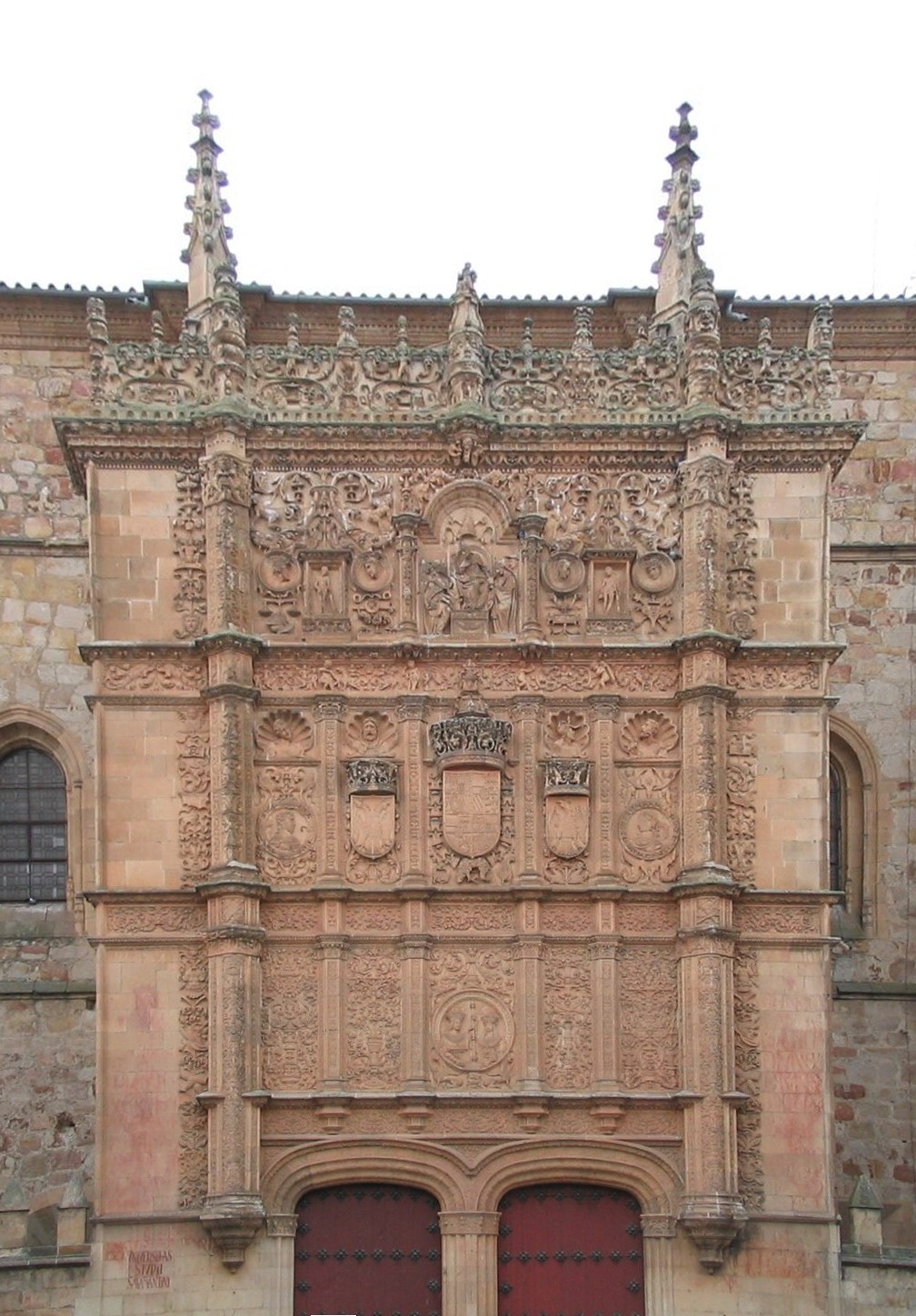
The University of Salamanca (Spanish: Universidad de Salamanca) is a public research university in Salamanca, Spain. Founded in 1218 by King Alfonso IX, it is the oldest university in the Hispanic world and the fourth oldest in the world in continuous operation. It has over 30,000 students from 50 different nationalities.
Prior to the foundation of the university, Salamanca was home to a cathedral school, known to have been in existence by 1130. The university was founded as a studium generale by the Leonese king Alfonso IX in 1218 as the scholas Salamanticae, with the actual creation of the university (or the transformation of the existing school into the university) occurring between August 1218 and the following winter. A further royal charter from King Alfonso X, dated 8 May 1254, established rules for the organisation and financial endowment of the university, and referred to it for the first time by that name. A papal bull of Alexander IV in 1255 confirmed the Royal Charter of Alfonso X and granted universal recognition to the university's degrees.
The historical phrases Quod natura non dat, Salmantica non praestat (what nature does not give, Salamanca does not lend, in Latin) and Multos et doctissimos Salmantica habet (many and very versed Salamanca has) give an idea of the prestige the institution rapidly acquired.[failed verification]
In the reign of King Ferdinand II of Aragon and Queen Isabella I of Castile, the Spanish government was revamped. Contemporary with the Spanish Inquisition, the expulsion of the Jews and Muslims, and the conquest of Granada, there was a certain professionalization of the apparatus of the state. This involved the massive employment of "letrados", i.e., bureaucrats and lawyers, who were "licenciados" (university graduates), particularly, of Salamanca, and the newly founded University of Alcalá. These men staffed the various councils of state, including, eventually, the Consejo de Indias and Casa de Contratacion, the two highest bodies in metropolitan Spain for the government of the Spanish Empire in the New World.[citation needed]
While Columbus was lobbying the King and Queen for a contract to seek out a western route to the Indies, he made his case to a council of geographers at the University of Salamanca. While the geographers were skeptical of Columbus and his voyage calculations, the University of Salamanca always defended the theory of unknown territories to the west, and supported Columbus' voyage, believing that new territories may be discovered. In the next century, the morality and laws of colonization in the Indies were debated by the School of Salamanca, along with the development of the study of science, geography and cartography of the Americas, and as well as the study of general subjects of economics, philosophy and theology.[citation needed]
Salamanca's colleges (Colegios Mayores) were founded as charitable institutions to enable poor scholars to attend the university. By the eighteenth century they had become closed corporations controlled by the families of their founders, and dominated the university between them. Most were destroyed by Napoleon's troops. In the 19th century, the Spanish government dissolved the university's faculties of canon law and theology. They were later reestablished in the 1940s as part of the Pontifical University of Salamanca.[citation needed]
The faculty renovated the theology department, laid the foundation for modern-day law, international law, modern economic science and actively participated in the Council of Trent. The school's mathematicians studied the calendar reform, commissioned by Pope Gregory XIII and proposed the solution that was later implemented. By 1580, 6,500 new students had arrived at Salamanca each year, amongst the graduates were state officials of the Spanish monarchy administration. It was also during this period when the first female university students were probably admitted, Beatriz Galindo and Luisa de Medrano, the latter probably being the first woman ever to give classes at a university.
In popular belief, the university was associated with sorcery. A certain cave in Salamanca was considered the site of a school of black magic. In Spanish, Salamanca may mean "cave", "an evil iguana" and "hand trick" and the salamanquesa (Tarentola mauritanica, the Spanish name is also derived from "salamander") is a reptile with magical attributes in Spanish tradition. In Romanian folklore, the devil runs a school of black magic named Scholomance.
Hub AI
University of Salamanca AI simulator
(@University of Salamanca_simulator)
University of Salamanca
The University of Salamanca (Spanish: Universidad de Salamanca) is a public research university in Salamanca, Spain. Founded in 1218 by King Alfonso IX, it is the oldest university in the Hispanic world and the fourth oldest in the world in continuous operation. It has over 30,000 students from 50 different nationalities.
Prior to the foundation of the university, Salamanca was home to a cathedral school, known to have been in existence by 1130. The university was founded as a studium generale by the Leonese king Alfonso IX in 1218 as the scholas Salamanticae, with the actual creation of the university (or the transformation of the existing school into the university) occurring between August 1218 and the following winter. A further royal charter from King Alfonso X, dated 8 May 1254, established rules for the organisation and financial endowment of the university, and referred to it for the first time by that name. A papal bull of Alexander IV in 1255 confirmed the Royal Charter of Alfonso X and granted universal recognition to the university's degrees.
The historical phrases Quod natura non dat, Salmantica non praestat (what nature does not give, Salamanca does not lend, in Latin) and Multos et doctissimos Salmantica habet (many and very versed Salamanca has) give an idea of the prestige the institution rapidly acquired.[failed verification]
In the reign of King Ferdinand II of Aragon and Queen Isabella I of Castile, the Spanish government was revamped. Contemporary with the Spanish Inquisition, the expulsion of the Jews and Muslims, and the conquest of Granada, there was a certain professionalization of the apparatus of the state. This involved the massive employment of "letrados", i.e., bureaucrats and lawyers, who were "licenciados" (university graduates), particularly, of Salamanca, and the newly founded University of Alcalá. These men staffed the various councils of state, including, eventually, the Consejo de Indias and Casa de Contratacion, the two highest bodies in metropolitan Spain for the government of the Spanish Empire in the New World.[citation needed]
While Columbus was lobbying the King and Queen for a contract to seek out a western route to the Indies, he made his case to a council of geographers at the University of Salamanca. While the geographers were skeptical of Columbus and his voyage calculations, the University of Salamanca always defended the theory of unknown territories to the west, and supported Columbus' voyage, believing that new territories may be discovered. In the next century, the morality and laws of colonization in the Indies were debated by the School of Salamanca, along with the development of the study of science, geography and cartography of the Americas, and as well as the study of general subjects of economics, philosophy and theology.[citation needed]
Salamanca's colleges (Colegios Mayores) were founded as charitable institutions to enable poor scholars to attend the university. By the eighteenth century they had become closed corporations controlled by the families of their founders, and dominated the university between them. Most were destroyed by Napoleon's troops. In the 19th century, the Spanish government dissolved the university's faculties of canon law and theology. They were later reestablished in the 1940s as part of the Pontifical University of Salamanca.[citation needed]
The faculty renovated the theology department, laid the foundation for modern-day law, international law, modern economic science and actively participated in the Council of Trent. The school's mathematicians studied the calendar reform, commissioned by Pope Gregory XIII and proposed the solution that was later implemented. By 1580, 6,500 new students had arrived at Salamanca each year, amongst the graduates were state officials of the Spanish monarchy administration. It was also during this period when the first female university students were probably admitted, Beatriz Galindo and Luisa de Medrano, the latter probably being the first woman ever to give classes at a university.
In popular belief, the university was associated with sorcery. A certain cave in Salamanca was considered the site of a school of black magic. In Spanish, Salamanca may mean "cave", "an evil iguana" and "hand trick" and the salamanquesa (Tarentola mauritanica, the Spanish name is also derived from "salamander") is a reptile with magical attributes in Spanish tradition. In Romanian folklore, the devil runs a school of black magic named Scholomance.