
Recent from talks
Untermensch
Knowledge base stats:
Talk channels stats:
Members stats:
Untermensch
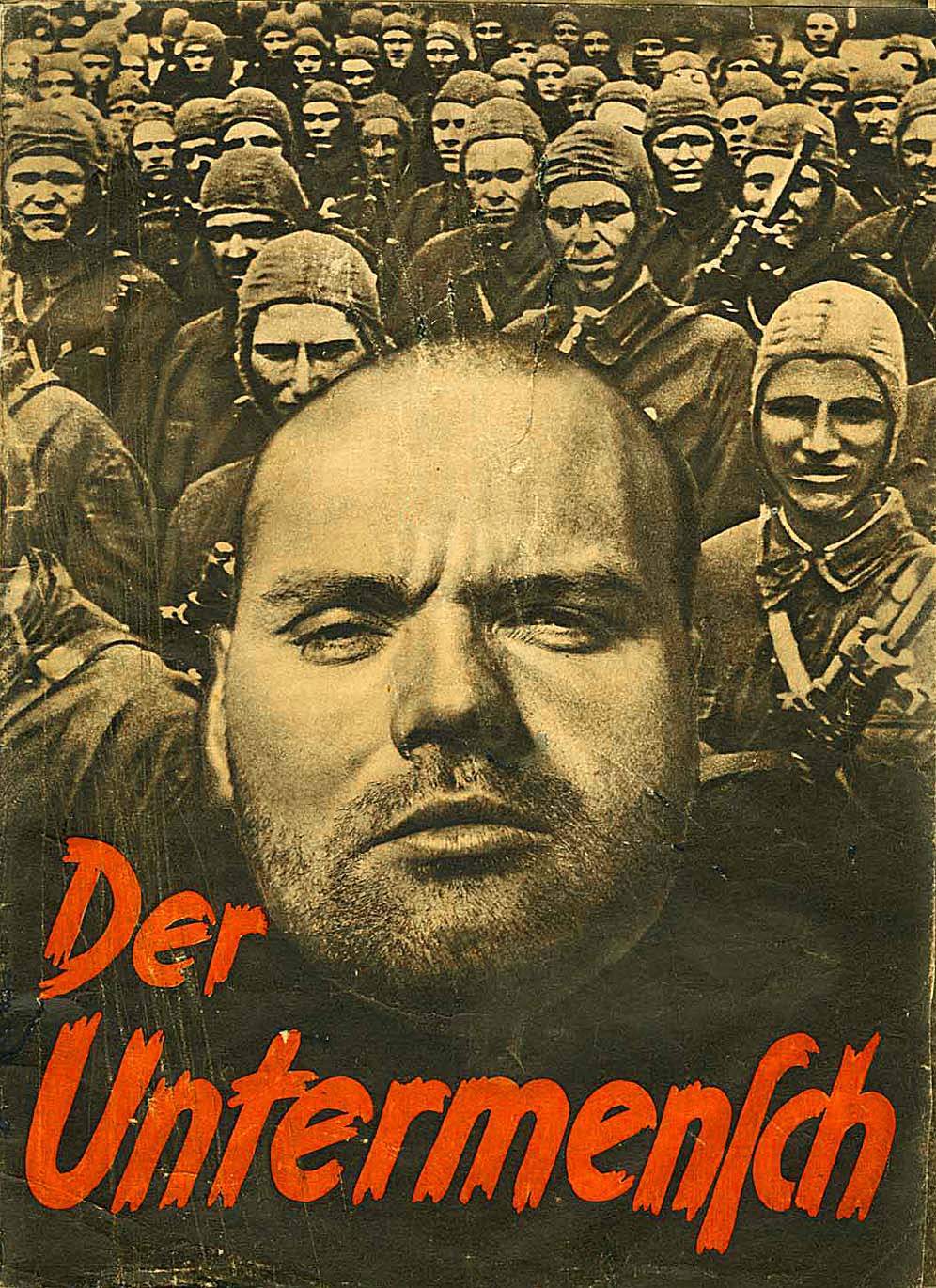
Untermensch (German pronunciation: [ˈʔʊntɐˌmɛnʃ] ⓘ; plural: Untermenschen) is a German-language word literally meaning 'underman', 'sub-man', or 'subhuman', which was extensively used by Germany's Nazi Party to refer to their opponents and non-Aryan people they deemed as inferior. It was mainly used against "the masses from the East", that is Jews, Roma, and Slavs (mainly ethnic Poles, Belarusians, Ukrainians, Russians and Serbs).
The term was also applied to "Mischling" (persons of mixed "Aryan" and non-Aryan ancestry) and black people. The physically and mentally disabled, homosexuals, transgender, political dissidents and - on rare instances - POWs from Western Allied armies, were also considered Untermenschen who were to be exterminated in the Holocaust. According to the Generalplan Ost, the Slavic population of East-Central Europe was to be reduced in part through mass murder in the Holocaust for Lebensraum, with a significant amount expelled further east to Siberia and used as forced labour in the Reich. These concepts were an important part of the Nazi racial policy.
The term "under man" was introduced by the American author and Ku Klux Klan member Lothrop Stoddard in his 1922 book The Revolt Against Civilization: The Menace of the Under-man. Stoddard applies the term to those whom he considers unable to flourish in civilization due to their inferior heredity ("The word inferior has, however, been so often employed as a synonym for degenerate that it tends to produce confusion of thought, and to avoid this I have coined a term which seems to describe collectively all those kinds of persons whom I have just discussed. This term is The Under-Man – the man who measures under the standards of capacity and adaptability imposed by the social order in which he lives". (p. 23)). Therefore, the term has no racial connotations. Indeed, in his book Stoddard maintains that without eugenics any and all civilizations - irrespective of race, time and geography - have been, are and inevitably will be prone to gradual degradation. The Nazi Party later used the term in propaganda, possibly influenced in part from the title of the book's German edition Der Kulturumsturz: Die Drohung des Untermenschen (1925).
The German word Untermensch had been used in earlier periods, but it had not been used in a racial sense, for example, it was used in the 1899 novel Der Stechlin by Theodor Fontane. Since most writers who employed the term did not address the question of when and how the word entered the German language, into English, Untermensch is usually translated as "subhuman". The leading Nazi who attributed the concept of the East-European "under man" to Stoddard was Alfred Rosenberg who, referring to communists of the Soviet Russia, wrote in his Der Mythus des zwanzigsten Jahrhunderts (1930) that "this is the kind of human being that Lothrop Stoddard has called the 'under man.'" ["...den Lothrop Stoddard als 'Untermenschen' bezeichnete."] Despite Nazi official support for The Myth of the Twentieth Century and Rosenberg's prominent role in promoting Nazi ideology, Adolf Hitler declared that it was not to be considered the official ideology of the Nazi Party, and he privately described the book as "mysticism" and "nonsense". Albert Speer claimed that Goebbels mocked Alfred Rosenberg. Goebbels also called the book a "philosophical belch".
It is possible that Stoddard constructed his "under man" as an opposite of Friedrich Nietzsche's Übermensch (superman) concept. Stoddard does not explicitly say this, but he critically refers to the "superman" idea at the end of his book (p. 262). Wordplays with Nietzsche's term seem to have been used repeatedly as early as the 19th century and, due to the German linguistic trait of being able to combine prefixes and roots almost at will in order to create new words, this development can be considered logical. For instance, German author Theodor Fontane contrasts the Übermensch/Untermensch word pair in chapter 33 of his novel Der Stechlin. Nietzsche used Untermensch at least once in contrast to Übermensch in Die fröhliche Wissenschaft (1882). Earlier examples of Untermensch include Romanticist Jean Paul using the term in his novel Hesperus (1795) in reference to an Orangutan (Chapter "8. Hundposttag").
In a speech which he delivered to the Bavarian regional parliament in 1927, the Nazi Party propagandist Julius Streicher, publisher of Der Stürmer, used the term Untermensch referring to the communists of the German Bavarian Soviet Republic:
It happened at the time of the [Bavarian] Soviet Republic: When the unleashed subhumans rambled murdering through the streets, the deputies hid behind a chimney in the Bavarian parliament.
The Nazi party and thereafter also the regime (1933–1945) repeatedly used the term Untermensch in writings and speeches which they directed against the Jews. In the pamphlet "The SS as an Anti-Bolshevist Fighting Organization", published in 1936, Himmler wrote:
Hub AI
Untermensch AI simulator
(@Untermensch_simulator)
Untermensch
Untermensch (German pronunciation: [ˈʔʊntɐˌmɛnʃ] ⓘ; plural: Untermenschen) is a German-language word literally meaning 'underman', 'sub-man', or 'subhuman', which was extensively used by Germany's Nazi Party to refer to their opponents and non-Aryan people they deemed as inferior. It was mainly used against "the masses from the East", that is Jews, Roma, and Slavs (mainly ethnic Poles, Belarusians, Ukrainians, Russians and Serbs).
The term was also applied to "Mischling" (persons of mixed "Aryan" and non-Aryan ancestry) and black people. The physically and mentally disabled, homosexuals, transgender, political dissidents and - on rare instances - POWs from Western Allied armies, were also considered Untermenschen who were to be exterminated in the Holocaust. According to the Generalplan Ost, the Slavic population of East-Central Europe was to be reduced in part through mass murder in the Holocaust for Lebensraum, with a significant amount expelled further east to Siberia and used as forced labour in the Reich. These concepts were an important part of the Nazi racial policy.
The term "under man" was introduced by the American author and Ku Klux Klan member Lothrop Stoddard in his 1922 book The Revolt Against Civilization: The Menace of the Under-man. Stoddard applies the term to those whom he considers unable to flourish in civilization due to their inferior heredity ("The word inferior has, however, been so often employed as a synonym for degenerate that it tends to produce confusion of thought, and to avoid this I have coined a term which seems to describe collectively all those kinds of persons whom I have just discussed. This term is The Under-Man – the man who measures under the standards of capacity and adaptability imposed by the social order in which he lives". (p. 23)). Therefore, the term has no racial connotations. Indeed, in his book Stoddard maintains that without eugenics any and all civilizations - irrespective of race, time and geography - have been, are and inevitably will be prone to gradual degradation. The Nazi Party later used the term in propaganda, possibly influenced in part from the title of the book's German edition Der Kulturumsturz: Die Drohung des Untermenschen (1925).
The German word Untermensch had been used in earlier periods, but it had not been used in a racial sense, for example, it was used in the 1899 novel Der Stechlin by Theodor Fontane. Since most writers who employed the term did not address the question of when and how the word entered the German language, into English, Untermensch is usually translated as "subhuman". The leading Nazi who attributed the concept of the East-European "under man" to Stoddard was Alfred Rosenberg who, referring to communists of the Soviet Russia, wrote in his Der Mythus des zwanzigsten Jahrhunderts (1930) that "this is the kind of human being that Lothrop Stoddard has called the 'under man.'" ["...den Lothrop Stoddard als 'Untermenschen' bezeichnete."] Despite Nazi official support for The Myth of the Twentieth Century and Rosenberg's prominent role in promoting Nazi ideology, Adolf Hitler declared that it was not to be considered the official ideology of the Nazi Party, and he privately described the book as "mysticism" and "nonsense". Albert Speer claimed that Goebbels mocked Alfred Rosenberg. Goebbels also called the book a "philosophical belch".
It is possible that Stoddard constructed his "under man" as an opposite of Friedrich Nietzsche's Übermensch (superman) concept. Stoddard does not explicitly say this, but he critically refers to the "superman" idea at the end of his book (p. 262). Wordplays with Nietzsche's term seem to have been used repeatedly as early as the 19th century and, due to the German linguistic trait of being able to combine prefixes and roots almost at will in order to create new words, this development can be considered logical. For instance, German author Theodor Fontane contrasts the Übermensch/Untermensch word pair in chapter 33 of his novel Der Stechlin. Nietzsche used Untermensch at least once in contrast to Übermensch in Die fröhliche Wissenschaft (1882). Earlier examples of Untermensch include Romanticist Jean Paul using the term in his novel Hesperus (1795) in reference to an Orangutan (Chapter "8. Hundposttag").
In a speech which he delivered to the Bavarian regional parliament in 1927, the Nazi Party propagandist Julius Streicher, publisher of Der Stürmer, used the term Untermensch referring to the communists of the German Bavarian Soviet Republic:
It happened at the time of the [Bavarian] Soviet Republic: When the unleashed subhumans rambled murdering through the streets, the deputies hid behind a chimney in the Bavarian parliament.
The Nazi party and thereafter also the regime (1933–1945) repeatedly used the term Untermensch in writings and speeches which they directed against the Jews. In the pamphlet "The SS as an Anti-Bolshevist Fighting Organization", published in 1936, Himmler wrote:
Recent media