
Recent from talks
Urban agriculture
Knowledge base stats:
Talk channels stats:
Members stats:
Urban agriculture
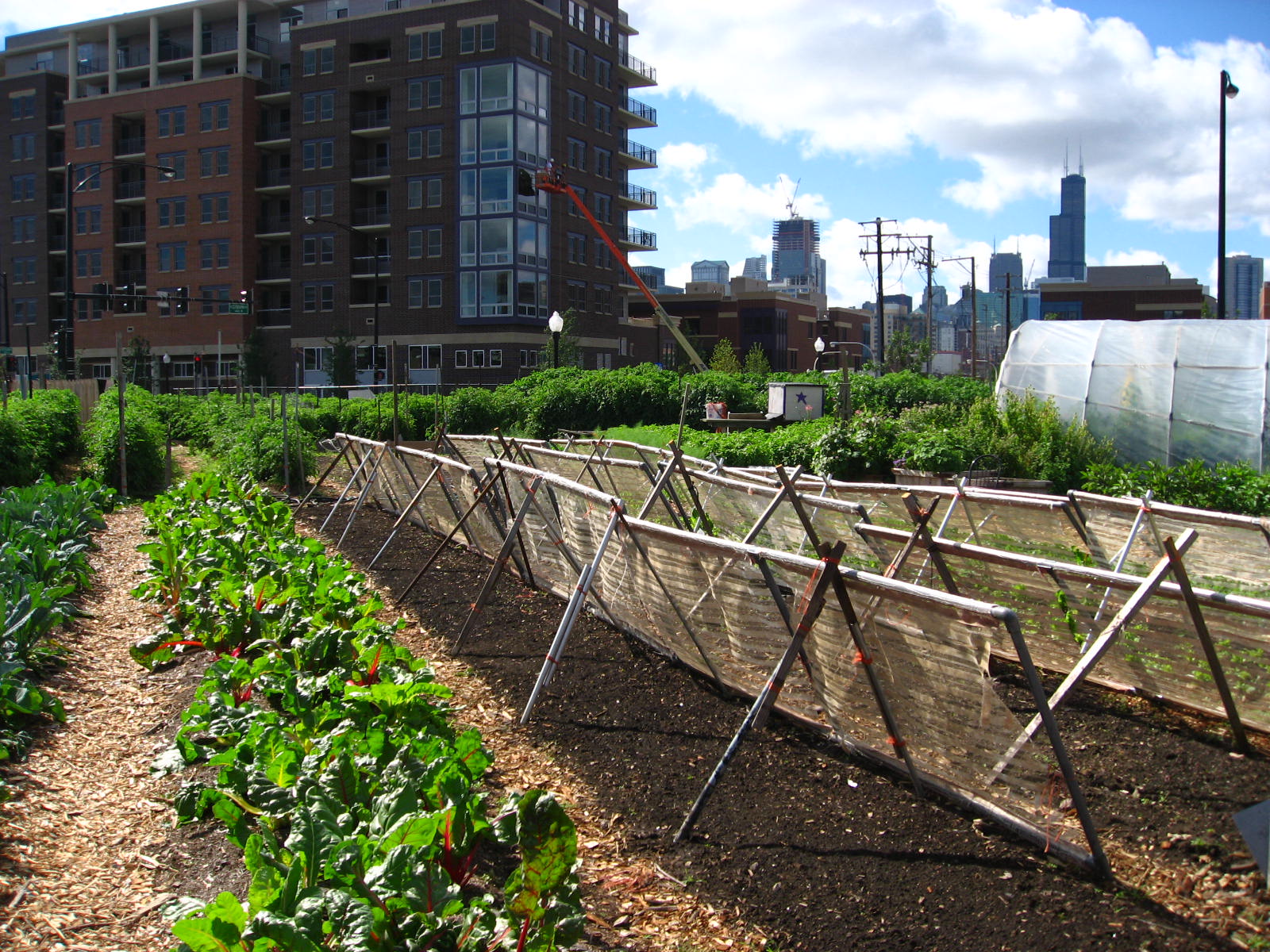
Urban agriculture (UA) refers to various practices of cultivating, processing, and distributing food in urban areas. The term also applies to the area activities of animal husbandry, aquaculture, beekeeping, and horticulture in an urban context. Urban agriculture is distinguished from peri-urban agriculture, which takes place in rural areas at the edge of suburbs. In many urban areas, efforts to expand agriculture also require addressing legacy soil contamination, particularly from lead and other heavy metals, which can pose risks to human health and food safety.
Urban agriculture can appear at varying levels of economic and social development. It can involve a movement of organic growers, "foodies" and "locavores", who seek to form social networks founded on a shared ethos of nature and community holism. These networks can develop by way of formal institutional support, becoming integrated into local town planning as a "transition town" movement for sustainable urban development. For others, food security, nutrition, and income generation are key motivations for the practice. In either case, the more direct access to fresh vegetable, fruit, and meat products that may be realised through urban agriculture can improve food security and food safety while decreasing food miles, leading to lower greenhouse gas emissions, thereby contributing to climate change mitigation.
Some of the first evidence of urban agriculture comes from early Mesopotamian cultures. Farmers would set aside small plots of land for farming within the city's walls. (3500BC) In Persia's semi-desert towns, oases were fed through aqueducts carrying mountain water to support intensive food production, nurtured by wastes from the communities. The Hanging Gardens of Babylon are another famous - if potentially legendary - regional example. In China, Xi'an has been continuously inhabited since at least 5000 BC, whose citizens have engaged in urban agriculture at varying degrees during different points of its history. At the Incans' Machu Picchu, water was conserved and reused as part of the stepped architecture of the city, and vegetable beds were designed to gather sun in order to prolong the growing season. Elsewhere in the Americas, well-documented examples of pre-Columbian Amerindian urban agriculture include the Aztecs' lake-based chinampas which were crucial to population growth in Mexico Valley's cities; Cahokia's maize-based economy in the Mississippi River near present-day St. Louis; and the thriving mesa agricultural plots of the cliff-based Pueblo cultures such as Mesa Verde of today's Four Corners region, among others.
The idea of supplemental food production beyond rural farming operations and distant imports is not new. It was used during war and depression times when food shortage issues arose, as well as during times of relative abundance. Allotment gardens emerged in Germany in the early 19th century as a response to poverty and food insecurity.
In the context of the US, urban agriculture as a widely recognized practice took root in response of the 1893–1897 economic depression in Detroit. In 1894, Mayor Hazen S. Pingree called on outlying citizens of a depression-struck Detroit to lend their properties to the city government ahead of the winter season. The Detroit government would in turn develop these lots as makeshift potato gardens - nicknamed Pingree's Potato Patches after the mayor - as potatoes were weather resistant and easy to grow. He intended for these gardens to produce income, food supply, and boost independence during times of hardship. The Detroit project was successful enough that other US cities adopted similar urban agriculture practices. By 1906, the United States Department of Agriculture estimated that over 75,000 schools alone managed urban agriculture programs to provide children and their families with fresh produce. However, it would not be until the First World War that US urban agriculture spread widely.
During World War One, food production became a major national security concern for several countries, including the US. President Woodrow Wilson called upon all American citizens to utilize any available open food growth, seeing this as a way to pull them out of a potentially damaging situation of food insecurity. The National War Garden Committee under the American Forestry Association organized campaigns with patriotic messages such as "Sow the Seeds of Victory", with the aim of reducing domestic pressure on food production. In so doing, primary agricultural industries could focus on shipping rations to troops in Europe. So called victory gardens sprouted during World War One (emulated later during World War Two) in the US, as well as Canada & the United Kingdom. By 1919, American victory gardens numbered 5 million plots country-wide, and over 500 million pounds of produce was harvested. So efficient were the American urban agriculture programs that surplus foodstuffs were shipped to war-ravaged European nations, in addition to American military forces.
A very similar practice came into use during the Great Depression that provided a purpose, job and food to those who would otherwise be without anything during such harsh times. These efforts helped raise spirits and boost economic growth. Over 2.8 million dollars' worth of food was produced from the subsistence gardens during the Depression. Public and government support for Victory Gardens waned during the Interwar Period, with most American sites becoming repurposed for various economic development initiatives.
By World War II, the War/Food Administration set up a National Victory Garden Program that set out to systematically establish functioning agriculture within cities. Indeed, these new victory gardens became the "first line of defense for the country". Once more, the government supported and encouraged Victory Gardens as a means of national security: domestic pressure on major agricultural industries would be relieved to further augment the war economy. With this new plan in action, as many as 5.5 million Americans took part in the victory garden movement and over nine million pounds of fruit and vegetables were grown a year, accounting for 44% of US-grown produce throughout that time. In the post-war period, the US government gradually stopped assisting urban agriculture programs, partially due to the lack of need of war supplies and partially due to the US fully embracing industrialized food systems.
Hub AI
Urban agriculture AI simulator
(@Urban agriculture_simulator)
Urban agriculture
Urban agriculture (UA) refers to various practices of cultivating, processing, and distributing food in urban areas. The term also applies to the area activities of animal husbandry, aquaculture, beekeeping, and horticulture in an urban context. Urban agriculture is distinguished from peri-urban agriculture, which takes place in rural areas at the edge of suburbs. In many urban areas, efforts to expand agriculture also require addressing legacy soil contamination, particularly from lead and other heavy metals, which can pose risks to human health and food safety.
Urban agriculture can appear at varying levels of economic and social development. It can involve a movement of organic growers, "foodies" and "locavores", who seek to form social networks founded on a shared ethos of nature and community holism. These networks can develop by way of formal institutional support, becoming integrated into local town planning as a "transition town" movement for sustainable urban development. For others, food security, nutrition, and income generation are key motivations for the practice. In either case, the more direct access to fresh vegetable, fruit, and meat products that may be realised through urban agriculture can improve food security and food safety while decreasing food miles, leading to lower greenhouse gas emissions, thereby contributing to climate change mitigation.
Some of the first evidence of urban agriculture comes from early Mesopotamian cultures. Farmers would set aside small plots of land for farming within the city's walls. (3500BC) In Persia's semi-desert towns, oases were fed through aqueducts carrying mountain water to support intensive food production, nurtured by wastes from the communities. The Hanging Gardens of Babylon are another famous - if potentially legendary - regional example. In China, Xi'an has been continuously inhabited since at least 5000 BC, whose citizens have engaged in urban agriculture at varying degrees during different points of its history. At the Incans' Machu Picchu, water was conserved and reused as part of the stepped architecture of the city, and vegetable beds were designed to gather sun in order to prolong the growing season. Elsewhere in the Americas, well-documented examples of pre-Columbian Amerindian urban agriculture include the Aztecs' lake-based chinampas which were crucial to population growth in Mexico Valley's cities; Cahokia's maize-based economy in the Mississippi River near present-day St. Louis; and the thriving mesa agricultural plots of the cliff-based Pueblo cultures such as Mesa Verde of today's Four Corners region, among others.
The idea of supplemental food production beyond rural farming operations and distant imports is not new. It was used during war and depression times when food shortage issues arose, as well as during times of relative abundance. Allotment gardens emerged in Germany in the early 19th century as a response to poverty and food insecurity.
In the context of the US, urban agriculture as a widely recognized practice took root in response of the 1893–1897 economic depression in Detroit. In 1894, Mayor Hazen S. Pingree called on outlying citizens of a depression-struck Detroit to lend their properties to the city government ahead of the winter season. The Detroit government would in turn develop these lots as makeshift potato gardens - nicknamed Pingree's Potato Patches after the mayor - as potatoes were weather resistant and easy to grow. He intended for these gardens to produce income, food supply, and boost independence during times of hardship. The Detroit project was successful enough that other US cities adopted similar urban agriculture practices. By 1906, the United States Department of Agriculture estimated that over 75,000 schools alone managed urban agriculture programs to provide children and their families with fresh produce. However, it would not be until the First World War that US urban agriculture spread widely.
During World War One, food production became a major national security concern for several countries, including the US. President Woodrow Wilson called upon all American citizens to utilize any available open food growth, seeing this as a way to pull them out of a potentially damaging situation of food insecurity. The National War Garden Committee under the American Forestry Association organized campaigns with patriotic messages such as "Sow the Seeds of Victory", with the aim of reducing domestic pressure on food production. In so doing, primary agricultural industries could focus on shipping rations to troops in Europe. So called victory gardens sprouted during World War One (emulated later during World War Two) in the US, as well as Canada & the United Kingdom. By 1919, American victory gardens numbered 5 million plots country-wide, and over 500 million pounds of produce was harvested. So efficient were the American urban agriculture programs that surplus foodstuffs were shipped to war-ravaged European nations, in addition to American military forces.
A very similar practice came into use during the Great Depression that provided a purpose, job and food to those who would otherwise be without anything during such harsh times. These efforts helped raise spirits and boost economic growth. Over 2.8 million dollars' worth of food was produced from the subsistence gardens during the Depression. Public and government support for Victory Gardens waned during the Interwar Period, with most American sites becoming repurposed for various economic development initiatives.
By World War II, the War/Food Administration set up a National Victory Garden Program that set out to systematically establish functioning agriculture within cities. Indeed, these new victory gardens became the "first line of defense for the country". Once more, the government supported and encouraged Victory Gardens as a means of national security: domestic pressure on major agricultural industries would be relieved to further augment the war economy. With this new plan in action, as many as 5.5 million Americans took part in the victory garden movement and over nine million pounds of fruit and vegetables were grown a year, accounting for 44% of US-grown produce throughout that time. In the post-war period, the US government gradually stopped assisting urban agriculture programs, partially due to the lack of need of war supplies and partially due to the US fully embracing industrialized food systems.
Recent media