Hubbry Logo
Four CornersFour CornersMain
Open search
Four Corners
Community hub
Four Corners
logo
8 pages, 0 posts
0 subscribers
Be the first to start a discussion here.
Four Corners
Four Corners
from Wikipedia

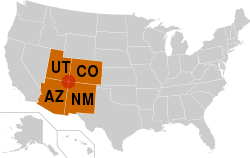
The Four Corners region is the red circle in this map. The Four Corners states are highlighted in orange.
A child touches four states, 1965

The Four Corners is a region of the Southwestern United States consisting of the southwestern corner of Colorado, southeastern corner of Utah, northeastern corner of Arizona, and northwestern corner of New Mexico. Most of the Four Corners region belongs to semi-autonomous Native American nations, the largest of which is the Navajo Nation, followed by Hopi, Ute, and Zuni tribal reserves and nations. The Four Corners region is part of a larger region known as the Colorado Plateau and is mostly rural, rugged, and arid. The largest state in the region is New Mexico, which is the fifth-largest state of the fifty states.

The Four Corners area is named after the quadripoint at the intersection of approximately 37° north latitude with 109° 03′ west longitude, where the boundaries of the four states meet, and is marked by the Four Corners Monument. It is the only location in the United States where four states meet. In addition to the monument, commonly visited areas within Four Corners include Monument Valley, Mesa Verde National Park, Chaco Canyon, Canyons of the Ancients National Monument and Canyon de Chelly National Monument. The most populous city in the Four Corners region is Farmington, New Mexico, followed by Durango, Colorado.

Prehistory and Indigenous history

[edit]
A map of Ancestral Puebloan sites in the Four Corners area
Major Ancestral Puebloan sites in the Four Corners area

Paulette F. C. Steeves, in The Indigenous Paleolithic of the Western Hemisphere, argues for a significantly earlier Indigenous presence in North America than is usually considered the case, supported by archaeological evidence and Indigenous oral histories.[1] Her work challenges long-held assumptions about the timing and nature of human migration into the Americas.

By the time of European contact, the region was home to complex societies such as the Ancestral Puebloans, known for their cliff dwellings, kivas, and extensive trade networks. Charles C. Mann, in 1491: New Revelations of the Americas Before Columbus, highlights the sophisticated agricultural, political, and spiritual systems present across the Americas before colonization.[2] Craig Childs, in House of Rain: Tracking a Vanished Civilization Across the American Southwest, retraces ancient migration routes and settlements in the Southwest, offering insights into how the environment and cultural memory shaped the lives of the people who lived in the Four Corners.[3] His work reveals that the land itself holds clues to long-standing Indigenous relationships with place, ceremony, and survival in an arid and challenging landscape.

History

[edit]

The United States acquired the Four Corners region from Mexico after the end of the Mexican–American War in 1848. In 1863 Congress created the Arizona Territory from the western part of New Mexico Territory. The boundary was legally defined as a line running due south from the southwest corner of Colorado Territory, which had been created in 1861. This was an unusual act of Congress, which almost always defined the boundaries of new territories as lines of latitude or longitude, or following rivers, but seldom as extensions of other boundaries.

By defining one boundary as starting at the corner of another, Congress ensured the eventual creation of four states meeting at a point, regardless of the inevitable errors of boundary surveying.[4] The area was first surveyed by the US Government in 1868 as part of an effort to make Colorado Territory into a state, the first of the Four Corners states formed. While the US Congress in 1863 intended the corners of Colorado to be placed at the intersections of lines of specific latitude and longitude, due to a "standard" survey error of the time, the originally surveyed location of the "Four Corners" point, along with the corresponding survey marker, was unintentionally placed by its initial surveyor 1,821 feet (555 m) east of the intended location.[5]

In 1925, some 57 years after Congress had first attempted to specify the spot, the problems surrounding the originally misplaced marker were brought up before the US Supreme Court. In order to amicably remedy this original surveying error, the US Supreme Court then redefined the point of the Four Corners, officially moving the Four Corners point roughly 1,800 feet (550 m) east, to where the original survey had first held it to be all along, and where it remains to this day, duly marked.[6] This initial survey error has resulted in some longstanding misunderstandings about the correct location of the Four Corners marker, some of which remain to this day.[when?][7]

The first Navajo tribal government was established in 1923 to regulate an increasing number of oil exploration activities on Navajo land in the Four Corners area.[8]

Geography

[edit]

The Four Corners Monument is located at 36°59′56.3″N 109°02′42.6″W / 36.998972°N 109.045167°W / 36.998972; -109.045167.[9]

The Four Corners is part of the high Colorado Plateau. This makes it a center for weather systems, which stabilize on the plateau then proceed eastward through Colorado and into the central states. This weather system creates snow- and rainfall over the central United States.[10]

Federally protected areas in the Four Corners area include Canyon de Chelly National Monument, Hovenweep National Monument, Mesa Verde National Park, and Canyons of the Ancients National Monument. Mountain Ranges in the Four Corners include Sleeping Ute Mountains, Abajo Mountains, and the Chuska Mountains.[11]

Politics

[edit]

Six governments have jurisdictional boundaries at the Four Corners Monument: the states of Arizona, Colorado, New Mexico, and Utah, as well as the tribal governments of the Navajo Nation and Ute Mountain Ute Tribe.[12] The Four Corners Monument itself is administered by the Navajo Nation Department of Parks and Recreation.[5] Other tribal nations within the Four Corners region include the Hopi and other Ute.[13] The Four Corners is home to the capital of the Navajo tribal government at Window Rock, Arizona.[8] The Ute Mountain Ute tribal headquarters are located at Towaoc, Colorado.[14] The US federal government also has a large presence in the area, particularly the Department of the Interior with the Bureau of Indian Affairs and the Department of Agriculture with the Forest Service.

Cities

[edit]

The Four Corners region is mostly rural. The economic hub, largest city, and only metropolitan area in the region is Farmington, New Mexico.[15] The populated settlement closest to the center of Four Corners is Teec Nos Pos, Arizona.[16] Other cities in the region include Cortez and Durango in Colorado; Monticello and Blanding in Utah; Kayenta and Chinle in Arizona; and Shiprock, Aztec, and Bloomfield in New Mexico.[15]

Counties

[edit]

Transportation

[edit]

Air service is available via the Durango-La Plata County Airport in Durango, Colorado, Four Corners Regional Airport in Farmington, New Mexico, and Cortez Municipal Airport in Cortez, Colorado. Interstate 40 passes along the southern edge of the Four Corners region. The primary U.S. Highways that directly serve the Four Corners include U.S. Route 64, U.S. Route 160 (which serves the Four Corners Monument itself), U.S. Route 163, U.S. Route 191, U.S. Route 491 (previously U.S. Route 666[17]), and U.S. Route 550.

The main line of the Atchison, Topeka and Santa Fe Railway, now operated by the BNSF Railway, passes along the southern edge of Four Corners. The area is home to remnants of through railroads that are now heritage railways. These include the Durango and Silverton Narrow Gauge Railroad and the Cumbres and Toltec Scenic Railroad. The Black Mesa and Lake Powell Railroad, which connects a power plant with a coal mine near Kayenta, comes near the Four Corners.[11]

Helium

[edit]

The Four Corners region was one of the first locations in the United States in which helium was extracted, and the area is increasingly important as a source of helium supply, with the region being noted for its abundance of high-grade 'green' helium.[18]

The most notable helium field in the region is Arizona's Holbrook Basin.

[edit]

See also

[edit]

References

[edit]
[edit]
Revisions and contributorsEdit on WikipediaRead on Wikipedia
from Grokipedia
The Four Corners designates the sole quadripoint in the United States where the corners of Arizona, Colorado, New Mexico, and Utah converge at one geographic location, positioned amid the high desert of the Colorado Plateau in the American Southwest. This intersection, resulting from 19th-century territorial surveys amid U.S. westward expansion into lands originally inhabited by Native American tribes, spans coordinates near 37° N latitude and 109° 03′ W longitude. The surrounding Four Corners region, characterized by rugged canyons, mesas, and sparse vegetation, encompasses vast semi-autonomous Native territories, foremost the Navajo Nation, alongside Ute and Hopi lands, and preserves archaeological legacies of the Ancestral Puebloans who constructed cliff dwellings and communal structures centuries prior. The Four Corners Monument, a concrete marker operated as a Navajo Tribal Park, draws visitors to pose astride state lines amid vendor stalls offering indigenous crafts, underscoring the area's blend of geographic novelty and enduring indigenous stewardship despite minor discrepancies in the marker's alignment with exact boundary lines from early mapping efforts.

Geography

Location and Boundaries

The Four Corners marks the sole in the United States, where the state boundaries of , , , and converge at precisely 36°59′56″N 109°02′43″W. This intersection defines a unique geographic feature, with each state's territory occupying one quadrant radiating from the point. The boundaries forming the Four Corners follow the 37th parallel north, which separates and from and , and the 109th meridian west, which divides and from and . These lines were legally established through federal surveys in the , with Deputy Surveyor Chandler Robbins contracted by the U.S. General Land Office in 1875 to monument the intersection while the Arizona-New Mexico territorial border. Robbins' work fixed the position based on astronomical observations, creating the enduring legal demarcation despite minor deviations from theoretical coordinates due to methodologies of the era. Administratively, the delineates four distinct state jurisdictions, impacting taxation—where rates vary significantly across the states—and , as each quadrant falls under its respective state's legal framework and agencies. Overlapping tribal lands, particularly the reservation extending into all four states, further influence governance at and near the point, with the monument itself situated on Navajo territory.

Physical Features

The Four Corners region lies within the , a vast elevated tableland dissected by narrow stream valleys and larger canyons formed through prolonged fluvial and aeolian erosion. Elevations across the area generally span 4,000 to 7,000 feet above , contributing to its high desert plateau character with prominent mesas and buttes capped by erosion-resistant layers. The terrain includes rugged landforms such as those near , where steep-sided canyons and isolated buttes rise amid expansive flat-topped elevations. Geologically, the region consists predominantly of sedimentary rocks, including sandstones, shales, and limestones deposited as fine sediments by ancient winds and waters between 248 and 65 million years ago, overlain in places by volcanic features. Subsequent uplift of the plateau as a relatively stable block, combined with ongoing erosion, has exposed these layered formations, creating the distinctive vertical cliffs and horizontal strata visible throughout the area. Hydrologically, the San Juan River serves as the primary drainage, flowing northwest from its headwaters in the through the region, joined by tributaries like the Mancos River near the Four Corners point. This river system, with a basin encompassing nearly 25,000 square miles, shapes the local topography through incision and , while sparse shrub vegetation on the plateaus—concentrated linearly along braided channels—facilitates differential erosion rates that preserve and reveal underlying geological structures.

Climate and Natural Resources

The Four Corners features a semi-arid to arid with annual precipitation averaging approximately 10 inches of rain and 11 inches of snow in areas like . Temperatures typically range from lows of around 20°F in winter to highs exceeding 95°F in summer, accompanied by low relative humidity often below 10%. The enjoys nearly 300 days of sunshine annually, contributing to its dry heat conditions. Seasonal weather patterns include winter snowfall and summer monsoons, which provide the majority of but remain highly variable. Snowmelt from higher elevations in surrounding mountain ranges feeds tributaries of the , such as the San Juan River, resulting in peak runoff from to that sustains water availability in this otherwise arid landscape. Local events are infrequent, with about 55 days per year experiencing some form of . The area's natural resources encompass significant mineral deposits, including in the Fruitland Formation, which has supported large-scale operations like the Navajo Mine adjacent to power facilities. occurs in sandstone-hosted deposits across the portion of the region, with historical centered in the Four Corners area. The Paradox Basin contains oil and fields, as well as helium-rich reservoirs in formations where concentrations exceed 0.3%, derived from radiogenic sources associated with and decay.

History

Prehistory

Archaeological evidence indicates Paleo-Indian presence in the Four Corners region during the , circa 11,000 BCE, marked by fluted projectile points hafted to spears for hunting such as mammoths. These bifacial stone tools, characterized by a short flute from the base, have been recovered alongside faunal remains in the Mesa Verde area, suggesting mobile bands exploiting post-glacial landscapes. The Archaic period, spanning approximately 8000 to 1000 BCE, reflects a transition to intensified foraging and smaller game pursuit amid warmer, drier conditions, with artifacts including atlatl components for spear-throwing efficiency. Rock art panels depicting atlatls and hunting motifs, found in sites across the broader Southwest including near Four Corners locales like the Palavayu region, provide evidence of cultural continuity in hunter-gatherer adaptations. From the Basketmaker period onward (ca. 350 BCE to 575 CE), semi-sedentary settlements emerged with pithouses—semi-subterranean dwellings of earth and timber—and the adoption of agriculture suited to the semiarid uplands, supplemented by beans and squash. In subsequent Pueblo periods (575–1300 CE), architecture advanced to above-ground room blocks, ceremonial kivas, and cliff alcove dwellings by the 1200s CE, enabling resource storage and defense against aridity-driven scarcities through proximity to water and defensible sites. These adaptations, inferred from tree-ring data and site middens, highlight empirical responses to variable precipitation and short growing seasons in the region.

Indigenous Settlement and Cultures

The abandonment of major Ancestral Puebloan settlements in the Four Corners region occurred around 1300 CE, primarily due to a severe from approximately 1276 to 1299 CE, compounded by soil depletion from intensive agriculture and social factors such as resource competition. Archaeological evidence, including tree-ring data from sites like Mesa Verde, indicates widespread depopulation as communities migrated southward toward wetter areas in present-day and , leaving behind cliff dwellings and mesa-top villages. Following this vacuum, Athabaskan-speaking groups ancestral to the Navajo (Diné) migrated into the region from the north, arriving in the Southwest by the mid-15th century and establishing proto-Navajo sites in the district of northwestern by the early 1500s. These migrants adapted by reusing abandoned Puebloan structures initially, then constructing dispersed fork-stick hogans—eight-sided dwellings symbolizing from underworlds in oral traditions—and organizing into matrilineal clans that traced descent through mothers, fostering exogamous marriage and clan-based land stewardship. Navajo expansion involved small-scale dry farming of and beans in arroyo bottoms, supplemented by deer and rabbits, and raiding for resources, which enabled population growth amid the arid landscape's constraints. Coexisting with the were Ute bands, Numic-speaking hunter-gatherers who maintained nomadic patterns in the region's higher elevations, relying on communal and hunts with bows and atlatls, and seasonal migrations tracking game across Colorado's into . Southern Paiute groups occupied fringes in southern , practicing seed gathering and pinyon nut harvesting, while Hopi ancestors, retaining Puebloan agricultural traditions, held mesa villages farther south but engaged in regional exchange. Pre-contact interactions included trade networks exchanging , shells, and among these groups and lingering outliers, but also conflicts, such as -Ute raids over territories, corroborated by oral histories of origins tied to defensive pueblitos and dendrochronological dates from sites showing accelerated construction around 1500-1600 CE amid insecurity. These dynamics reflected adaptive , with warfare driven by resource scarcity rather than , as evidenced by the absence of large-scale fortified settlements.

European Exploration and Territorial Changes

The first recorded European exploration of the Four Corners region occurred during Francisco Vázquez de Coronado's expedition of 1540–1542, which penetrated the American Southwest from Mexico in pursuit of the mythical Seven Cities of Cibola, rumored to hold vast gold and treasure. The expedition, comprising over 300 Spanish soldiers, indigenous allies, and friars, traversed areas now encompassing parts of and , including interactions with Pueblo peoples, but yielded no significant riches and withdrew after two years of hardship, with limited follow-up settlement in the remote Four Corners interior. Subsequent Spanish efforts in the 17th and 18th centuries focused on establishing missions and presidios primarily in central and northern , such as those among the Rio Grande Pueblos, while the Four Corners area remained a periphery under nominal control, with occasional prospecting forays like Juan Antonio María de Rivera's 1765 expedition into western seeking silver. Following Mexico's independence from in 1821, the region fell under Mexican jurisdiction as part of the territories of and , characterized by continued sparse governance and issuance of large land grants to encourage settlement, though the arid Four Corners vicinity saw few such concessions due to its isolation and hostility from indigenous groups like the . Mexican control ended with the Mexican-American War, culminating in the on February 2, 1848, which transferred approximately 500,000 square miles of northern Mexico—including the bulk of present-day , , , and portions of —to the for $15 million, reorganizing the Four Corners lands into the . The subsequent , ratified on December 30, 1853, acquired an additional 29,670 square miles of and from for $10 million, primarily to facilitate a southern route and resolve lingering border ambiguities, finalizing the southwestern boundaries relevant to the Four Corners. U.S. assertion of control involved boundary surveys in the 1850s, such as the U.S.-Mexico Boundary Commission under John Russell Bartlett, which demarcated the international frontier but left internal territorial lines provisional amid disputes over latitudes like 37°N. Effective territorial administration required military measures against resistance, including the establishment of forts like Fort Defiance (established 1851 in present-day ) and campaigns under Colonel , culminating in the forced relocation known as the Long Walk of 1864, where U.S. forces marched approximately 8,000–10,000 over 250–450 miles to Bosque Redondo internment near , to pacify the region and enable surveys and settlement. This pragmatic pacification, involving scorched-earth tactics, subdued raiding but resulted in high mortality, with estimates of up to 2,000 deaths en route or in captivity before the 1868 allowed partial return.

Modern Era and Monument Creation

![Flags surrounding the Four Corners Monument. In clockwise order starting from the frontmost flag, the state flag of Arizona, flag of the Navajo Nation, pre-2011 flag of Utah, Navajo nation secondinstancesecond instanceUte Mountain Ute Tribe Reservation, Colorado, New Mexico, Navajo Nation thirdinstancethird instance, and the flag of the United States.](./assets/Four_Corners_Monument_(1) The construction of narrow-gauge railroads in the late 19th century, such as the Durango and Silverton line completed in , facilitated access to mining districts in southwestern near the Four Corners region, enabling the transport of silver and other minerals. During World War II, uranium deposits in the encompassing the Four Corners area were mined to supply the , with carnotite ore from the region providing a key domestic source for atomic bomb development. In 1962, the (BLM) and upgraded the site with a larger pad and radial lines marking the state boundaries, establishing the modern following earlier surveys. A public dedication ceremony that year was sponsored by the BLM, the Four Corners Heritage Council, and the and Ute Tribal Councils, formalizing the as a visitor attraction. The assumed custody and operational management of the monument in the through federal-tribal agreements, developing it as the Tribal Park. The monument's establishment spurred in the region, with the site attracting approximately 250,000 visitors annually in recent years, though access was limited during the under regulations. Post-2000, maintenance challenges emerged, including inadequate parking, non-compliant restrooms, and structural deterioration, prompting calls for upgrades to handle visitor volume while addressing federal funding dependencies shared with the .

Demographics

Population Distribution

The Four Corners region features a highly sparse distribution, with overall densities typically below 10 persons per , reflecting its rugged terrain and arid climate across the intersecting counties of , , , and . , the most populous among these, recorded 121,661 residents in the 2020 Census, yielding a density of approximately 21 persons per over its 5,518 s. In contrast, , had 25,849 residents, for a density of about 12.8 persons per across 2,012 s. , reported 14,518 people, resulting in an extremely low density of roughly 1.9 persons per over 7,821 s. The portion, primarily within Apache County but focused near the , contributes smaller clusters, with the broader county's 66,021 residents spread thinly at around 5.8 persons per . Settlement patterns center on a few modest hubs amid vast rural expanses dominated by the , which encompasses much of the and sectors and features dispersed chapter communities rather than urban concentrations. , serves as the primary regional hub with 46,624 residents in 2020, supporting commerce and services for surrounding areas. Other key towns include (8,766 residents), (3,394 residents), and (4,670 residents), each functioning as local anchors for , , and reservation activities. Population trends indicate net out-migration from rural pockets, driven by scarce non-resource employment, with several counties showing declines since 2010. , lost 7.5% of its population by 2022, while , declined 3.2%, and , fell 7.7%; , experienced modest growth but remains below state averages due to similar rural constraints.

Ethnic and Cultural Composition

The ethnic composition of the Four Corners region is characterized by a substantial Native American presence, particularly the , who dominate in core areas across adjacent counties. In , American Indian and Alaska Native residents constitute 71.4% of the population, largely Navajo affiliated with the . San Juan County, New Mexico, reports 43.8% American Indian and Alaska Native, with Navajo forming the majority of this group. Similarly, , has 46.5% American Indian and Alaska Native, predominantly Navajo south of the San Juan River. In contrast, , has a lower 8.6% Native American share, with non-Hispanic whites at 71.3%. Hispanic or Latino populations range from 4.5% in Apache County to 19.9% in , reflecting historical settlement patterns in and portions. comprise the remainder, often exceeding 40% in and counties but forming minorities in and segments. Cultural markers underscore Native persistence despite assimilation pressures. The Navajo code talkers' use of Diné bizaad during exemplifies linguistic resilience, as their undecipherable transmissions confounded Japanese forces and contributed to Allied victories in the Pacific. Ute tribes maintain traditions through , such as the annual Four Corners Powwow hosted by the Southern Ute Indian Tribe, featuring dances and communal gatherings. Hopi practices involve ceremonial dances and doll carvings representing ancestral spirits, used to educate youth on natural forces and cultural harmony. Linguistic diversity persists with Navajo as the primary , spoken fluently by approximately 50% of Diné as of 2010, though surveys indicate declining proficiency among younger generations compared to 95% fluency rates among six-year-olds in the . This erosion reflects broader pressures but coexists with revitalization efforts amid the region's 40-50% Navajo demographic in reservation-adjacent zones.

Economy

Energy Production

The , a coal-fired power plant near , began operations in 1963 with its initial units and originally featured five generating units with a total capacity of 2,040 MW. Units 1–3, representing about 25% of the plant's output, were retired in 2014 following environmental agreements, reducing capacity to 1,540 MW from the remaining Units 4 and 5. The facility burns from adjacent Navajo Mine and has historically supplied roughly 7% of the Southwest's electricity demand, powering utilities across , , and beyond. In August 2025, Arizona Public Service, the primary operator, delayed the plant's retirement from 2031 to no later than 2038 to address grid reliability amid rising energy needs. The , spanning northwest and southwest within the Four Corners region, supports substantial extraction, particularly from formations. Annual gas output exceeds 700 billion cubic feet, with cumulative production historically driven by fields like the Fruitland Coal, making it one of the U.S.'s top areas. Oil production from reservoirs such as the Mancos Shale and Dakota Sandstone contributes to combined hydrocarbon yields equivalent to over 100,000 barrels of oil per day during peak operations in the basin's core Four Corners-adjacent zones. These resources underscore the area's role in regional energy supply, though output has declined from 1990s highs exceeding 4 billion cubic feet of gas daily. Helium production, derived from in the Four Corners vicinity, includes operations at the Doe Canyon field, which entered production in with estimated recoverable reserves of 3–5 billion cubic feet at concentrations around 0.5%. Four Corners Helium LLC has advanced exploration and partnerships for expansions, targeting helium-rich traps in nearby prospects like , leveraging existing infrastructure for extraction amid global supply constraints. This activity complements gas operations, as is a separated during processing.

Mining and Resource Extraction

The Navajo Mine, a surface coal operation on the in , has historically produced up to 8 million tons of thermal annually, primarily from the Fruitland Formation, with output supporting regional industrial uses. More recent production has averaged 4-5 million tons per year, reflecting operational adjustments amid market shifts. Coal extraction in the region, including sites like the Tony M Mine, has emphasized large-scale surface methods suited to the area's sedimentary basins. Uranium mining peaked during the 1950s and 1950s on the and surrounding , with operations in the Carrizo Mountains and Grants Uranium District yielding substantial ore volumes; over four decades from the 1940s, approximately 30 million tons of uranium-bearing ore were extracted from Navajo lands alone. Production declined sharply after the as demand waned, though the district accounted for a major share of U.S. defense-related output during the era. Other non-energy minerals extracted include from deposits near the region's periphery and salt from formations, though these have seen smaller-scale operations without dominant historical peaks. production occurs in Colorado's portion, bolstering the state's position as the second-largest U.S. producer in 2023 via active mines processing . Helium exploration has gained traction recently, with leases covering around 14,000 acres on Ute Mountain Ute lands in , targeting reservoirs with helium concentrations of 0.5-5%; companies like Mosman Oil and Gas hold interests in prospects such as Coyote Wash (4,320 acres) and adjacent (10,000 acres), with potential resources estimated at several billion cubic feet. Tribal lands dominate extraction sites, managed via leases that prioritize Native employment; for instance, operations like the nearby Kayenta Mine employed over 90% and workers, with federal oversight ensuring compliance through records on incident rates and inspections.

Tourism and Recreation

The Four Corners Monument serves as the region's premier tourist attraction, drawing approximately 250,000 visitors annually who come to stand at the precise point where Arizona, Colorado, New Mexico, and Utah converge. The site features a brass marker embedded in concrete, allowing visitors to straddle four states simultaneously, while surrounding vendor stalls operated by Navajo artisans offer handmade jewelry, crafts, and traditional foods such as frybread and mutton. Adjacent national parks and monuments amplify the area's appeal, with providing access to over 100,000 archaeological sites amid red rock canyons and Bears Ears buttes, and showcasing vast plateaus, mesas, and the confluence of the Green and Colorado Rivers. These sites attract hikers to trails like the Joint Trail in Bears Ears and off-road enthusiasts to designated vehicle routes, contributing to a regional visitor economy bolstered by adventure and . Recreational pursuits include guided cultural tours exploring traditional weaving, silversmithing, and storytelling; off-highway vehicle expeditions through scenic byways like the Trail of the Ancients; and in Ancestral Puebloan ruins near the monument. In June 2025, the installed a prefabricated modular restroom facility measuring 77 by 14 feet, equipped with solar-powered lighting and exhaust fans, to address needs for the high visitor volume. Federal funding authorized in prior years supports ongoing proposals for an interpretive center and permanent vendor infrastructure to enhance visitor education and experience.

Transportation and Infrastructure

Roadways and Highways

U.S. Route 160 functions as the main east-west corridor across the Four Corners region, linking Cortez, Colorado, to Kayenta, Arizona, and passing directly by the monument; it was commissioned in 1930 and underwent a significant rerouting in 1970 to its current alignment southwest from Cortez through the quadripoint area. U.S. Route 491 complements this as the primary north-south artery, extending approximately 194 miles from Utah through Colorado and New Mexico, intersecting US 160 near the monument and facilitating access to Shiprock and Gallup. Recent infrastructure enhancements include a 2011 Colorado project along US 160 near Four Corners, which widened lanes to 12 feet with 8-foot shoulders for safety compliance and added features amid the rugged . on these routes remains moderate, with annual average daily totals in the low thousands near the , driven largely by and local travel rather than industrial volumes, as documented in corridor studies. Numerous secondary roads on tribal lands, such as those within the , fall under maintenance, which prioritizes operation and repair of reservation facilities but contends with challenges like weather-induced seasonal closures from winter snow or monsoon flooding. Early rail development in the late included spurs from lines like the & reaching by 1881 for support, evolving into coal-hauling infrastructure by the mid-20th century to serve regional power plants; coal rail shipments to U.S. electric utilities dropped 22% from 2019 to 2020 levels, contributing to overall transport decline as sources diversify.

Energy Transmission and Pipelines

The Four Corners region's energy transmission infrastructure primarily consists of high-voltage (HVAC) lines that evacuate from coal-fired generating stations to interconnected grids serving the . The , with operational Units 4 and 5 providing a combined net capacity of approximately 1,540 megawatts (MW), connects to the grid via 500-kilovolt (kV) transmission lines, including the Four Corners-Moenkopi line, which facilitates power flow toward load centers in and beyond. These lines integrate into broader networks operated by the (WAPA), which maintains over 3,300 miles of transmission in its Rocky Mountain region, originating from federal and resources to support regional reliability. Natural gas pipelines from the , spanning and portions of the Four Corners area, form a dense network exceeding 3,700 miles, enabling export of production volumes surpassing 700 billion cubic feet annually. Key assets include gathering systems and processing facilities acquired by Harvest Midstream from , which handle raw gas from Fruitland Coal Formation wells and route it to major interstate lines for distribution to markets in the Midwest and West. Operators have pursued expansions, such as proposals by Four Corners Gas Transmission Company to repurpose legacy crude oil lines for natural gas service, enhancing takeaway capacity amid ongoing exploration. These systems exhibit vulnerabilities to , with (FERC) analyses of southwestern events, such as the 2011 cold weather outages, highlighting disruptions from icing, high winds, and temperature extremes that overload lines or impair substation equipment. Regional transmission has experienced curtailments during arctic storms, underscoring the need for measures like those recommended post-2011 to mitigate generator and line failures. Despite such risks, the infrastructure supports resource export without widespread chronic outages, as evidenced by FERC's broader findings that most U.S. blackouts since 2002 stem from rather than systemic flaws.

Government and Politics

Interstate and Tribal Jurisdictions

![Flags surrounding the Four Corners Monument. In clockwise order starting from the frontmost flag, the state flag of Arizona, flag of the Navajo Nation, pre-2011 flag of Utah, Navajo nation secondinstancesecond instanceUte Mountain Ute Tribe Reservation, Colorado, New Mexico, Navajo Nation thirdinstancethird instance, and the flag of the United States.](./assets/Four_Corners_Monument_(1) The at , where , , , and converge, introduces jurisdictional complexities for interstate matters, particularly law enforcement. The boundaries were surveyed between 1868 and 1879, establishing the legal intersection, though the official lies entirely within the in . In scenarios involving crimes spanning multiple states, especially on tribal lands, state criminal jurisdiction is limited; tribal authorities or federal agencies like the FBI typically assume primary responsibility under laws such as the for felonies on Indian reservations. For taxation and civil disputes crossing state lines, the four states adhere to the Multistate Tax Compact, which promotes uniformity and prevents duplicative taxation for multistate entities. Tribal sovereignty overlays state boundaries extensively in the region, with the exercising independent jurisdiction over its reservation lands encompassing approximately 27,000 square miles across , , and , including the administered by the Navajo Nation Parks and Recreation Department. The Navajo Nation operates its own district courts for civil and certain criminal matters, with appellate review by the Navajo Nation Supreme Court, reflecting semi-autonomous governance established through treaties and federal statutes like the of 1934. Adjoining the Navajo lands at the , the maintains sovereignty over its reservation, which includes portions of , , and , leading to coordinated boundary management between the tribes. Federal jurisdiction further complicates the framework, as a substantial portion of the Four Corners area comprises public lands managed by agencies such as the (BLM), which oversees millions of acres in the surrounding states for multiple uses including and . These federal enclaves, often intermingled with state and tribal territories, fall under exclusive U.S. authority, with enforcement by federal officers or coordinated interagency efforts; for instance, BLM rangers handle resource violations, while broader criminal investigations may involve the FBI. This layered system stems from historical grants, withdrawals, and the federal trust responsibility toward tribes.

Policy Debates on Land and Resources

The designation of in southeastern , part of the Four Corners region, under the of 1906 by President Obama on December 28, 2016, encompassed approximately 1.35 million acres, limiting certain resource extraction activities including energy leasing. President Trump's proclamation on December 4, 2017, reduced the monument by about 85% to 833,156 acres, facilitating increased access for oil, gas, and mineral leasing by removing protections over former areas, with subsequent auctions of 32 parcels for development in March 2018. President Biden restored the original boundaries on October 8, 2021, reinstating restrictions that require (NEPA) compliance for any proposed leasing, including environmental impact assessments that have delayed or conditioned energy projects in the vicinity. These unilateral presidential actions have sparked debates over federal authority versus local and state interests in , with proponents of reductions arguing they balance preservation with economic opportunities under existing multiple-use mandates of the Federal Land Policy and Management Act of 1976. Tribal-federal agreements in the Four Corners area address revenue distribution from energy resources on or near reservation lands, exemplified by the 's involvement in the Four Corners Power Plant through the Navajo Transitional Energy Company (NTEC), which holds a 7% ownership stake and generates royalties and taxes funneled back to the Nation. In 2024, NTEC's operations at the plant and associated Navajo Mine contributed over $128 million in economic impacts to the , including royalties structured via coal supply contracts and plant participation agreements that ensure tribal shares from federal and private leases. Such compacts, often negotiated under the Indian Mineral Development Act of 1982, prioritize tribal sovereignty in leasing while complying with federal oversight, though disputes arise over equitable allocation amid plant transitions to cleaner operations. In December 2024, the approved a lease for 4,320 acres in the Coyote Wash area of within the Four Corners region to Mosman Oil and Gas, pending confirmation, with initial payments of $30 per acre to the tribe upon approval. This agreement highlights ongoing negotiations for non-energy mineral resources on tribal trust lands, balancing development potential against federal regulatory requirements like NEPA reviews for permits. Debates center on the pace of approvals and revenue terms, with tribal councils asserting control over leasing to maximize economic returns from reserves amid global supply constraints.

Environmental and Economic Controversies

Air Pollution and Power Plant Operations

The Four Corners Power Plant, situated on land adjacent to the Four Corners region, relies on coal combustion to generate electricity for utilities across the , with operations governed by long-term leases from the that support local employment. Prior to regulatory retrofits and unit closures, the facility emitted approximately 40,000 tons of nitrogen oxides (NOx) annually, contributing significantly to regional haze and formation. (SO2) emissions were similarly elevated, necessitating controls under the Clean Air Act's Best Available Retrofit Technology (BART) provisions. EPA-mandated upgrades, including the installation of systems for and scrubbers for SO2 on Units 4 and 5 following a settlement, achieved reductions exceeding 90% in emissions compared to pre-closure levels from the original five units, which were shuttered in phases through 2014. These measures, part of a broader federal enforcement initiative, also cut SO2 by thousands of tons annually through enhanced efficiency targets, such as 30-day rolling averages exceeding 95% removal. Mercury emissions, a concentrated in ash and , totaled nearly 500 pounds per year in 2006 before activated injection and other controls reduced outputs to approximately 66 pounds annually by the early , with further monitoring required under EPA stack tests. Particulate matter, including fine PM2.5 linked to respiratory issues, is managed via filters on operating units, with continuous emissions monitors installed per 2015 settlement terms to ensure compliance and verify reductions of up to 43% from baseline levels. These controls have enabled continued coal-dependent operations under a 25-year extension approved by the Department of the Interior in 2015, sustaining roughly 500 direct jobs at the plant—90% held by workers—and supporting hundreds more in associated via tribal agreements, amid verifiable air quality improvements documented in EPA regional assessments.

Energy Transition and Tribal Impacts

The closure of the (NGS) in November 2019 resulted in the loss of approximately 700 direct jobs at the plant and associated Kayenta Mine, alongside an annual revenue reduction of $30–50 million for the from operations and royalties. Similarly, the San Juan Generating Station's shutdown in June eliminated hundreds of jobs in the region, including Navajo workers, and contributed to tens of millions in lost tribal and local revenues, exacerbating rates already exceeding 40% on the reservation. These phase-outs, driven by utility decisions prioritizing cheaper over amid regulatory pressures, directly caused over 1,000 job losses across the two facilities and a combined revenue shortfall exceeding $100 million annually for Navajo entities, with ripple effects on tribal services funded by energy royalties. The Four Corners Power Plant, the largest coal-fired facility in the U.S. and a key employer in the region, faces potential closure by 2031 under current leases, posing comparable risks of 300–500 job losses and over $59 million in annual revenue from leases, taxes, and mine operations. Tribal leaders, including those from the Navajo Transitional Energy Company (NTEC), have warned that such a shutdown would strain reservation budgets, where activities historically accounted for a substantial portion of economic output—estimated at up to 20–30% of GDP through direct royalties, wages, and indirect spending—without viable replacements scaling to match. Promises of a "" to renewables, including federal and utility-funded retraining programs, have largely failed to deliver, with reports indicating underutilized training initiatives and insufficient job creation in solar or wind sectors to offset losses. For instance, post-NGS closure efforts yielded minimal employment gains in green jobs, as programs overlooked the localized nature of reservation economies and the mismatch between intermittent renewable outputs and baseload power needs. Fossil fuels remain critical, contributing over $128 million in 2024 economic impacts to the via NTEC operations alone, underscoring the causal link between phase-outs and fiscal shortfalls absent proven alternatives. Renewable energy sources like solar and , while intermittent by nature, require or other dispatchable backups to maintain grid reliability in the Four Corners region's variable profile, inflating system costs beyond unsubstantiated claims of cheap "green" power. This —where generation halts without sun or —necessitates overbuilding capacity and storage, often rendering total levelized costs higher than or when fully accounted, as evidenced by broader grid analyses. In contrast, stable tribal resources like oil, gas, and production offer subsidy-free revenue streams; the Nation's operations, for example, provide consistent royalties without the reliability pitfalls of renewables. Recent surges in have even prompted discussions to extend Four Corners operations beyond 2031, highlighting the practical limits of rushed transitions.

Water Rights and Resource Management

The San Juan River, traversing the Four Corners region through Colorado, , , and , serves as a critical to the , with its regulated flows managed via the Navajo Dam, constructed between 1957 and 1963 as part of the federal Colorado River Storage Project. The dam enables irrigation diversions, flood control, and storage for municipal and industrial uses, supporting agricultural expansion in arid upstream basins, but it has trapped substantial —accounting for up to 57% of the 's total load at certain points—leading to reservoir that reduces effective storage capacity over time. This sedimentation, documented in basin hydrology studies, stems from high erosive inputs during seasonal storms, compounded by reduced downstream post-dam, which alters channel dynamics and exacerbates low-flow vulnerabilities. Strains under the 1922 , which apportions 7.5 million acre-feet annually from the Upper Basin (including Four Corners states) to meet deliveries at Lee Ferry, , arise from historical overallocation exceeding natural flows, with San Juan contributions historically averaging around 2 million acre-feet undepleted but now pressured by diversions for power and agriculture. pumping for irrigation and industrial needs invokes Winters Doctrine reserved rights from 1908, granting tribes implied federal water reservations with priority dates predating many state claims, as affirmed in settlements quantifying Navajo entitlements at roughly 600,000 acre-feet yearly on the San Juan alongside broader basin holdings. These tribal rights, comprising about 22% of total Colorado Basin allocations across 22 nations, often conflict with urban and agricultural priors in states like and , where federal courts have upheld tribal seniority but limited U.S. affirmative duties to secure delivery, as ruled in Arizona v. (2023). The 2000–2025 has diminished San Juan flows in line with basin-wide reductions of nearly 20% in volumes, driven by elevated and diminished rather than deficits alone, revealing systemic overuse where consumptive demands surpass recharge. Upper monitoring indicates persistent dryness categories, with elevations fluctuating amid competing tribal claims—holding 22% basin-wide priority—and downstream urban entitlements, prompting federal adjustments like reduced releases to prioritize Compact obligations over equitable redistribution. Causal analysis underscores that dam-enabled expansions ignored hydrological limits, as silt buildup and flow variability now constrain without curtailments exceeding historical norms.

References

Add your contribution
Related Hubs
User Avatar
No comments yet.