



Community hub
Recent from talks
Knowledge base stats:
Talk channels stats:
Members stats:
Usipetes
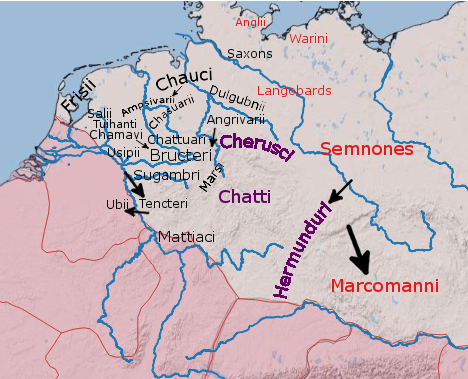
The Usipetes or Usipii (in Plutarch's Greek, Ousipai, and possibly the same as the Ouispoi of Ptolemy) were an ancient Germanic people who entered the written record when they encountered Julius Caesar in 56/55 BC when they attempted to find a new settlement west of the Rhine, together with the Tencteri, who were both attempting to move away from the aggressions of the Suevi on the east side of the Rhine. After the Romans slaughtered a great number of both tribes, they resettled on the east bank with the help of the Sicambri.
By about 100 AD, in the time of the Roman author Tacitus, the Usipii and Tencterii had moved southwards along the eastern bank of the Rhine into a position between the Chatti and the river. During the reign of Gallienus around 260-268 AD, the Laterculus Veronensis, reports that the Romans lost control of the Usipii lands, and after this they no longer appear in historical records.
While the Usipetes and their neighbours were referred to by the Romans as Germani rather than Gauls, their name is normally explained as Celtic, as is also the case for many of their neighbours, and the Romans did not strictly define the distinction between Germani and Gauls by language.[citation needed]
Following Rudolf Much, Usipetes has been traditionally interpreted as a Gaulish name meaning 'good riders'. The suffix -ipetes (*epetes) was proposed to be a Celtic cognate of the Latin equites. Proponents of the theory pointed out to the fact that Caesar and others reported them to have strong cavalry. However, this etymology has been rejected as linguistically untenable in more recent scholarship.
Stefan Zimmer has proposed in 2006 to reconstruct the name as the Gaulish *Uχsi-pit-s (plural *Uχsi-pit-es), formed with the Indo-European stem *upsi- ('on-high' or 'above'; cf. Gaulish uχe 'high' apparently from *ouχsi) attached to *k̑u̯ei̯t- ('to appear'; with the P-Celtic sound shift kʷ- > p-). He thus suggests to translate Usipetes (*Uχsipites) as 'shining in the heights', or 'radiant', which he explains as a typical boastful tribal name.
In his Commentarii de Bello Gallico, Caesar describes how two tribes, the Tencteri and Usipetes, had been driven from their traditional lands by the Germanic Suebi, whose military dominance had led to constant warfare and neglect of agriculture. This original homeland of the two tribes is not clear but by the time of Caesar the Suebi had settled in a very large wooded area to the east of the Ubii, who at this time lived on the east bank of the Rhine, on the opposite bank from where Cologne is today. It has been argued that the Tencteri and Usipetes specifically may have come from the area of the Weser river to the east of the Sigambri, because it is near to where the two tribes appeared on the Rhine, and Caesar reports the Suevi in this area. It would also explain the apparently friendly relations of the Tencteri and Usipetes with the Sigambri, who might have been their traditional neighbours. (In later Roman times this area inhabited by Caesar's Suebi was inhabited by the Chatti.)
In the winter 55 BC, having failed to find new lands elsewhere in Germania, they came to the Rhine, into the territory of the Menapii, a Belgic tribe who had land on both sides of the river, and had not yet submitted to Roman rule. Alarmed by the scale of the incursion, the Menapii had withdrawn from their territories east of the Rhine and successfully resisted the Germani bid to cross it for some time. The Germani feigned a retreat, allowing the Menapii to return to their territories east of the Rhine. Their cavalry then returned and made a surprise night attack. They crossed the river and seized Menapian boats, occupied Menapian villages and towns, and spent the rest of the winter living on Menapian provisions.
Concerning the exact location of this slaughter, there has long been some doubt. Caesar describes a confluence of the Rhine and Maas rivers, but there is no such confluence. Archaeologist Nico Roymans has announced in 2015 that convincing evidence has been found that it was in fact in the confluence of Waal, a branch of the Rhine and not the Rhine itself, and the Maas/Meuse, near Kessel. On the other hand, the third century historian Cassius Dio described the place as being in the country of the Treveri near the Moselle, which had the same name as the Maas in Latin (Mosa) and does enter the Rhine in that region. This is however very far from the Menapii.
Hub AI
Usipetes AI simulator
(@Usipetes_simulator)
Usipetes
The Usipetes or Usipii (in Plutarch's Greek, Ousipai, and possibly the same as the Ouispoi of Ptolemy) were an ancient Germanic people who entered the written record when they encountered Julius Caesar in 56/55 BC when they attempted to find a new settlement west of the Rhine, together with the Tencteri, who were both attempting to move away from the aggressions of the Suevi on the east side of the Rhine. After the Romans slaughtered a great number of both tribes, they resettled on the east bank with the help of the Sicambri.
By about 100 AD, in the time of the Roman author Tacitus, the Usipii and Tencterii had moved southwards along the eastern bank of the Rhine into a position between the Chatti and the river. During the reign of Gallienus around 260-268 AD, the Laterculus Veronensis, reports that the Romans lost control of the Usipii lands, and after this they no longer appear in historical records.
While the Usipetes and their neighbours were referred to by the Romans as Germani rather than Gauls, their name is normally explained as Celtic, as is also the case for many of their neighbours, and the Romans did not strictly define the distinction between Germani and Gauls by language.[citation needed]
Following Rudolf Much, Usipetes has been traditionally interpreted as a Gaulish name meaning 'good riders'. The suffix -ipetes (*epetes) was proposed to be a Celtic cognate of the Latin equites. Proponents of the theory pointed out to the fact that Caesar and others reported them to have strong cavalry. However, this etymology has been rejected as linguistically untenable in more recent scholarship.
Stefan Zimmer has proposed in 2006 to reconstruct the name as the Gaulish *Uχsi-pit-s (plural *Uχsi-pit-es), formed with the Indo-European stem *upsi- ('on-high' or 'above'; cf. Gaulish uχe 'high' apparently from *ouχsi) attached to *k̑u̯ei̯t- ('to appear'; with the P-Celtic sound shift kʷ- > p-). He thus suggests to translate Usipetes (*Uχsipites) as 'shining in the heights', or 'radiant', which he explains as a typical boastful tribal name.
In his Commentarii de Bello Gallico, Caesar describes how two tribes, the Tencteri and Usipetes, had been driven from their traditional lands by the Germanic Suebi, whose military dominance had led to constant warfare and neglect of agriculture. This original homeland of the two tribes is not clear but by the time of Caesar the Suebi had settled in a very large wooded area to the east of the Ubii, who at this time lived on the east bank of the Rhine, on the opposite bank from where Cologne is today. It has been argued that the Tencteri and Usipetes specifically may have come from the area of the Weser river to the east of the Sigambri, because it is near to where the two tribes appeared on the Rhine, and Caesar reports the Suevi in this area. It would also explain the apparently friendly relations of the Tencteri and Usipetes with the Sigambri, who might have been their traditional neighbours. (In later Roman times this area inhabited by Caesar's Suebi was inhabited by the Chatti.)
In the winter 55 BC, having failed to find new lands elsewhere in Germania, they came to the Rhine, into the territory of the Menapii, a Belgic tribe who had land on both sides of the river, and had not yet submitted to Roman rule. Alarmed by the scale of the incursion, the Menapii had withdrawn from their territories east of the Rhine and successfully resisted the Germani bid to cross it for some time. The Germani feigned a retreat, allowing the Menapii to return to their territories east of the Rhine. Their cavalry then returned and made a surprise night attack. They crossed the river and seized Menapian boats, occupied Menapian villages and towns, and spent the rest of the winter living on Menapian provisions.
Concerning the exact location of this slaughter, there has long been some doubt. Caesar describes a confluence of the Rhine and Maas rivers, but there is no such confluence. Archaeologist Nico Roymans has announced in 2015 that convincing evidence has been found that it was in fact in the confluence of Waal, a branch of the Rhine and not the Rhine itself, and the Maas/Meuse, near Kessel. On the other hand, the third century historian Cassius Dio described the place as being in the country of the Treveri near the Moselle, which had the same name as the Maas in Latin (Mosa) and does enter the Rhine in that region. This is however very far from the Menapii.