


Community hub
Recent from talks
Contribute something
Nothing was collected or created yet.
V429 Geminorum
View on Wikipedia| Observation data Epoch J2000.0 Equinox J2000.0 | |
|---|---|
| Constellation | Gemini |
| Right ascension | 07h 23m 43.58935s[2] |
| Declination | +20° 24′ 58.6506″[2] |
| Apparent magnitude (V) | 9.86 - 10.080[3] |
| Characteristics | |
| Spectral type | K5Ve[4] |
| Variable type | BY Dra[3] |
| Astrometry | |
| Radial velocity (Rv) | 7.56±0.28[2] km/s |
| Proper motion (μ) | RA: −65.642 mas/yr[2] Dec.: −230.692 mas/yr[2] |
| Parallax (π) | 36.0856±0.0186 mas[2] |
| Distance | 90.38 ± 0.05 ly (27.71 ± 0.01 pc) |
| Details | |
| Mass | 0.63[5] M☉ |
| Radius | 0.71[5] R☉ |
| Luminosity | 0.17[5] L☉ |
| Surface gravity (log g) | 4.53[5] cgs |
| Temperature | 4410[5] K |
| Metallicity | 0.30[5] |
| Rotation | 2.76±0.04 d[6] |
| Rotational velocity (v sin i) | 10.03[5] km/s |
| Age | 35-80[5][7] Myr |
| Other designations | |
| V429 Gem, BD+20°1790, TYC 1355-214-1, USNO-B1.0 1104-00142035, 2MASS J07234358+2024588, 1SWASP J072343.59+202458.6 | |
| Database references | |
| SIMBAD | data |

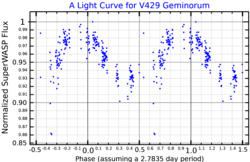
V429 Geminorum (BD+20°1790) is a young orange dwarf star in the constellation Gemini, located 90 light years away from the Sun. It is a BY Draconis variable, a cool dwarf which varies rapidly in brightness as it rotates.
Description
[edit]The star is young and very active and is a member of the AB Doradus Moving Group.[8] The star has also been studied and monitored by SuperWASP group and found to coincide with the ROSAT source 1RXS J072343.6+202500.[1] The planet candidate was announced in December 2009.[5]
Disproven planet
[edit]The Keplerian fit of the radial velocity data suggested an orbital solution for a close-in massive planet with an orbital period of 7.7834 days. Moreover, the presence of a close-in massive jovian planet could explain the high level of stellar activity detected.[5] However, further study suggests that this planet does not exist because the radial velocity variations are strongly correlated to stellar activity, suggesting this activity is the cause of the variations.[9][6] This echoes the similar case of the disproven planet detection around TW Hydrae, which was also found to be due to stellar activity rather than orbital motion.[10]
References
[edit]- ^ a b Norton; Wheatley, P. J.; West, R. G.; Haswell, C. A.; Street, R. A.; Collier Cameron, A.; Christian, D. J.; Clarkson, W. I.; et al. (2007). "New periodic variable stars coincident with ROSAT sources discovered using SuperWASP". Astronomy and Astrophysics. 467 (2): 785–905. arXiv:astro-ph/0702631. Bibcode:2007A&A...467..785N. doi:10.1051/0004-6361:20077084. S2CID 16358048.
- ^ a b c d e Vallenari, A.; et al. (Gaia collaboration) (2023). "Gaia Data Release 3. Summary of the content and survey properties". Astronomy and Astrophysics. 674: A1. arXiv:2208.00211. Bibcode:2023A&A...674A...1G. doi:10.1051/0004-6361/202243940. S2CID 244398875. Gaia DR3 record for this source at VizieR.
- ^ a b Samus, N. N.; Durlevich, O. V.; et al. (2009). "VizieR Online Data Catalog: General Catalogue of Variable Stars (Samus+ 2007-2013)". VizieR On-line Data Catalog: B/GCVS. Originally Published in: 2009yCat....102025S. 1. Bibcode:2009yCat....102025S.
- ^ Torres, C. A. O.; Quast, G. R.; Melo, C. H. F.; Sterzik, M. F. (2008). "Young Nearby Loose Associations". Handbook of Star Forming Regions, Volume II: The Southern Sky. ASP Monograph Publications. Vol. 5. pp. 1–757. arXiv:0808.3362. Bibcode:2008hsf2.book..757T.
- ^ a b c d e f g h i j Hernán-Obispo; Gálvez-Ortiz, M. C.; Anglada-Escudé, G.; Kane, S. R.; Barnes, J. R.; de Castro, E.; Cornide, M.; et al. (2009). "Evidence of a massive planet candidate orbiting the young active K5V star BD+20 1790". Astronomy and Astrophysics. 0912: A45. arXiv:0912.2773. Bibcode:2010A&A...512A..45H. doi:10.1051/0004-6361/200811000. S2CID 15243232.
- ^ a b Carleo, I.; Benatti, S.; et al. (May 2018). "Multi-band high resolution spectroscopy rules out the hot Jupiter BD+20 1790b. First data from the GIARPS Commissioning". Astronomy & Astrophysics. 613: A50. arXiv:1805.01281. Bibcode:2018A&A...613A..50C. doi:10.1051/0004-6361/201732350. S2CID 119261652.
- ^ Carpenter; Bouwman, Jeroen; Mamajek, Eric E.; Meyer, Michael R.; Hillenbrand, Lynne A.; Backman, Dana E.; Henning, Thomas; Hines, Dean C.; et al. (2009). "Formation and Evolution of Planetary Systems: Properties of Debris Dust Around Solar-Type Stars". The Astrophysical Journal Supplement. 181 (1): 197–226. arXiv:0810.1003. Bibcode:2009ApJS..181..197C. doi:10.1088/0067-0049/181/1/197. S2CID 31456106.
- ^ Lopez-Santiago; Montes, D.; Crespo-Chacón, I.; Fernández-Figueroa, M. J.; et al. (2006). "The Nearest Young Moving Groups". The Astrophysical Journal. 643 (2): 1160–1165. arXiv:astro-ph/0601573. Bibcode:2006ApJ...643.1160L. doi:10.1086/503183. S2CID 119520529.
- ^ Figueira; Marmier; Bonfils; di Folco; Udry; Santos; Lovis; Megevand; Melo; Pepe, F.; Queloz, D.; Segransan, D.; Triaud, A. H. M. J.; Viana Almeida, P.; et al. (2010). "Evidence against the young hot-Jupiter around BD +20 1790". Astronomy and Astrophysics. 513: L8. arXiv:1003.3678. Bibcode:2010A&A...513L...8F. doi:10.1051/0004-6361/201014323. S2CID 119199263.
- ^ Huelamo, N.; Figueira, P.; Bonfils, X.; Santos, N. C.; Pepe, F.; Gillon, M.; Azevedo, R.; Barman, T.; Fernández, M.; Di Folco, E.; Guenther, E. W.; Lovis, C.; Melo, C. H. F.; Queloz, D.; Udry, S.; et al. (2008). "TW Hydrae: evidence of stellar spots instead of a Hot Jupiter". Astronomy and Astrophysics. 489 (2): L9 – L13. arXiv:0808.2386. Bibcode:2008A&A...489L...9H. doi:10.1051/0004-6361:200810596. S2CID 18775872. Retrieved 2008-10-02.
