Hubbry Logo
VT-4VT-4Main
Open search
VT-4
Community hub
VT-4
logo
8 pages, 0 posts
0 subscribers
Be the first to start a discussion here.
VT-4
VT-4
from Wikipedia
Not found
Revisions and contributorsEdit on WikipediaRead on Wikipedia
from Grokipedia
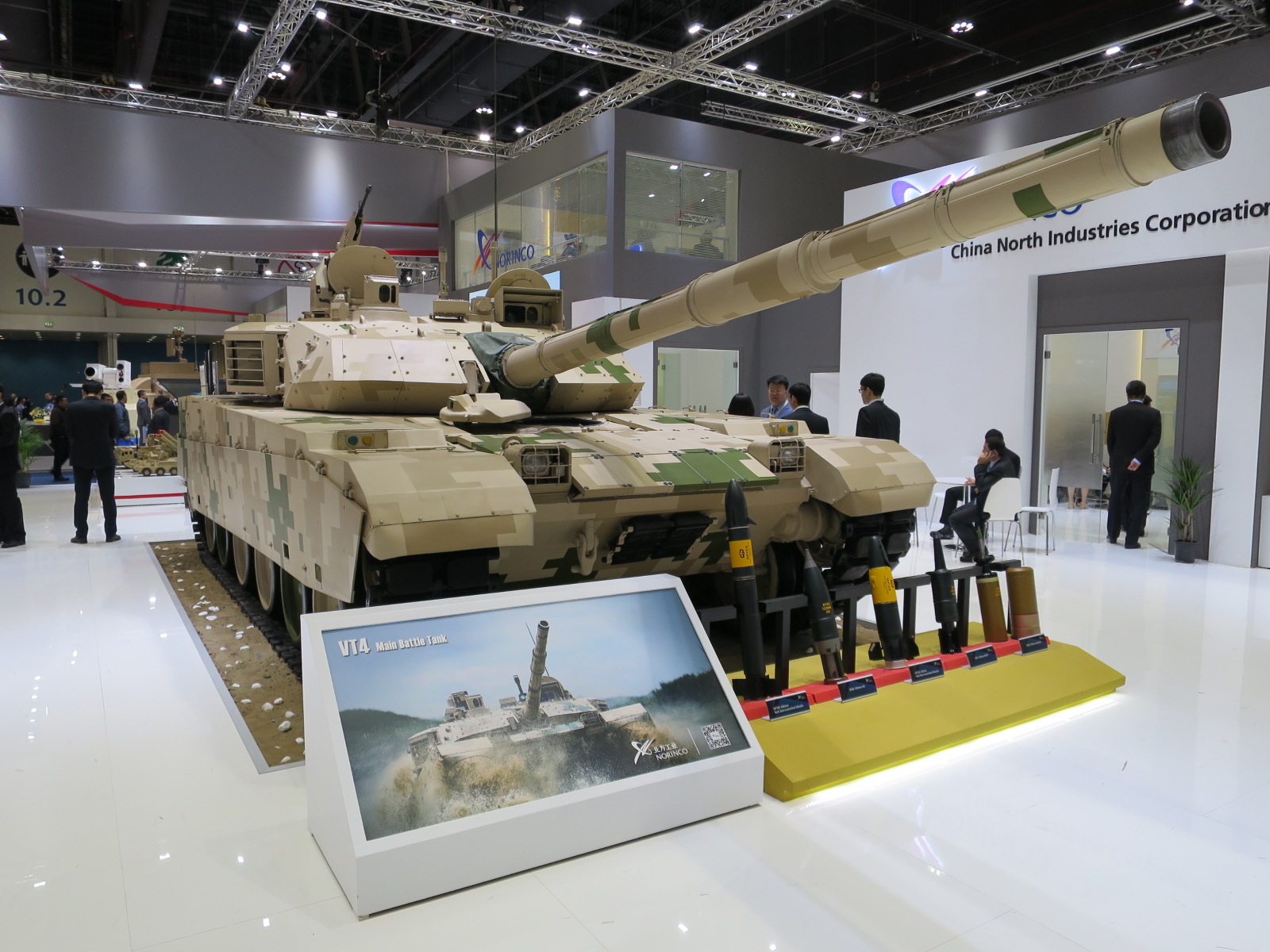
The VT-4, also designated MBT-3000, is a third-generation designed and manufactured by North Industries Corporation () exclusively for international export. Weighing approximately 52 tons, it features a 125mm capable of firing armor-piercing rounds, high-explosive projectiles, and anti-tank guided missiles such as the 9K119 Refleks with a range up to 5 kilometers. Development of the VT-4 began in the early , with the first prototype completed around 2012 and publicly unveiled at the defense exhibition that year. Drawing on technologies from China's domestic Type 99A , including advanced composite armor, digital fire-control systems, and a 1,300 horsepower enabling speeds up to 70 km/h, the VT-4 emphasizes mobility, firepower, and networked warfare capabilities suitable for modern battlefields. It incorporates an for 22 ready rounds, hunter-killer functionality for , and optional active protection systems in upgraded variants. The VT-4 has achieved notable export success, with confirmed operators including , which fields 62 units, , which ordered 680 for licensed production to bolster its armored forces, and with a smaller initial batch. Ongoing trials in countries like and interest from highlight its competitive positioning in non-Western markets, where it offers advanced features at a cost lower than many Western equivalents while demonstrating reliability in operational testing.

Development

Origins and Design Evolution

The VT-4, initially designated as the MBT-3000, emerged from Norinco's efforts to develop an export-oriented main battle tank incorporating select technologies from China's domestic Type 99 series, such as advanced fire control and modular armor elements, while prioritizing cost-effectiveness for international markets. The project built upon the earlier MBT-2000 export design, aiming to deliver third-generation capabilities including compatibility with 125mm smoothbore guns and autoloaders, without the full complexity of premium domestic models. Development likely began in the late 2000s, focusing on empirical engineering to balance firepower, protection, and mobility against production costs. A full-scale was completed by , with the first publicly unveiled at the defense exhibition in that June, marking its introduction as a competitive alternative to established Western and Russian tanks. Subsequent iterations refined the and turret for enhanced ergonomics and upgrade potential, incorporating feedback from prototype testing and demonstrations, such as the 2014 Norinco Armour Day event. By the mid-2010s, the MBT-3000 had evolved into the production-ready VT-4 configuration, entering serial manufacturing around 2016-2017 to fulfill initial export orders, with design choices validated through rigorous mobility and gunnery trials emphasizing real-world operational reliability over unproven innovations.

Production and Export Initiatives

The VT-4 main battle tank is manufactured exclusively by China North Industries Corporation (Norinco) for international export markets and has not been adopted for service with the People's Liberation Army (PLA), which relies on domestic designs such as the Type 99 series to mitigate risks of technology proliferation through foreign sales and reverse-engineering. This export-only orientation aligns with China's strategy to leverage its industrial base in armored vehicle production for geopolitical influence, targeting regions where Russian-supplied tanks like the T-72 and T-90 have historically dominated. Initial export initiatives focused on Southeast Asia, with Thailand placing the first order for 28 VT-4 tanks in 2016 at a unit price of approximately $5.3 million, followed by deliveries commencing in October 2017 after trials. The Royal Thai Army expanded its acquisition, approving an additional 10 units in 2018 and further batches to reach a total of 62 tanks, with Norinco completing all deliveries by November 2023. This marked a pivotal scale-up in production, demonstrating Norinco's capacity to fulfill mid-sized contracts while integrating customer-specific adaptations, such as enhanced interoperability with existing Thai armored formations. A significant production surge occurred in 2023 when Pakistan signed a contract for 680 VT-4 tanks (also designated Al-Haider locally), with initial deliveries exceeding 100 units from by early 2024 and the remainder slated for licensed assembly at to bolster indigenous manufacturing. This deal, valued in the billions, underscores 's export strategy to and the , capitalizing on Pakistan's need to modernize its fleet amid regional tensions and supply chain disruptions from traditional suppliers like . By late 2025, cumulative VT-4 production is estimated to surpass 200 units, driven by these large-scale orders and smaller acquisitions such as Nigeria's initial batch of at least six tanks, reflecting expanded outreach to .

Design Characteristics

Armament and Firepower

The VT-4 main battle tank is armed with a 125 mm smoothbore gun designated ZPT-98A, which serves as its primary weapon for engaging armored vehicles, fortifications, and personnel. The barrel of this gun has a rated life of approximately 500 rounds, though this can be shorter depending on the type of ammunition used. This gun supports a range of ammunition types, including armor-piercing fin-stabilized discarding-sabot (APFSDS) rounds for penetrating modern composite armor, high-explosive anti-tank (HEAT) projectiles, high-explosive (HE) shells for indirect fire and fragmentation effects, and gun-launched anti-tank guided missiles comparable to the 9M119 Refleks system for extended-range precision strikes against low-flying aircraft or heavily armored targets. The tank stores 38 rounds of 125 mm ammunition in total, with 22 held in an automatic loader carousel for rapid access, enabling a sustained firing rate of up to 8 rounds per minute under optimal conditions. This autoloader design reduces crew exposure during reloading and facilitates the tank's hunter-killer operational mode, where the commander can independently acquire targets via stabilized panoramic optics while the gunner engages. The integrated incorporates a , third-generation thermal imaging sights for both and gunner, and ballistic computation for stabilized firing on the move, supporting first-round hit probabilities against stationary targets at ranges exceeding 2 km in day or night conditions. Secondary armament includes a remotely operated 12.7 mm on the roof for anti-aircraft and light vehicle suppression, paired with a 7.62 mm for close-range engagements, enhancing the tank's versatility in scenarios.

Protection and Survivability

The VT-4 utilizes modular composite armor augmented by (ERA) blocks, such as the FY-4 type, applied to the hull and turret to counter shaped-charge warheads and enhance resistance to kinetic penetrators. This layered passive protection scheme is designed to defeat anti-tank guided missiles (ATGMs) and rocket-propelled grenades (RPGs) while providing baseline defense against armor-piercing fin-stabilized discarding sabot (APFSDS) rounds on the frontal arc. An optional GL-5 (APS) integrates four multi-mission fire control radars with a detection range suitable for intercepting incoming ATGMs and top-attack munitions, deploying countermeasures to neutralize threats before impact. The system comprises detection sensors, interception effectors, and launchers, enabling hard-kill engagement of projectiles in flight. The three-person crew operates from a compartmentalized layout, with the isolating ammunition storage to mitigate catastrophic secondary explosions, supplemented by liners and automatic fire-extinguishing systems for internal blast suppression. Nuclear, biological, and chemical () filtration and overpressure systems ensure crew survivability in contaminated environments. At approximately 52 tonnes in combat configuration, the VT-4 achieves a balance between enhanced armor mass and operational mobility, avoiding the vulnerabilities associated with heavier designs exceeding 60 tonnes. Smoke grenade launchers provide additional obscuration for evasion.

Mobility and Propulsion

The VT-4 employs a water-cooled, turbocharged, electronically controlled producing 1,300 horsepower. This is paired with a hydro-mechanical featuring six forward and two reverse gears, facilitating responsive gear shifts and enhanced maneuverability. The tank's , augmented by hydraulic dampers, supports independent wheel movement to maintain stability across uneven terrain. With a combat weight of approximately 52 tonnes, the VT-4 achieves a power-to-weight ratio of about 25 horsepower per tonne, enabling a maximum road speed of 70 km/h and cross-country speeds of 35-40 km/h. The fuel capacity of 1,960 liters supports an operational range exceeding 500 km on roads. These attributes, derived from the integrated powerpack design, contribute to the tank's agility in varied operational environments without compromising load-bearing capacity.

Command, Control, and Electronics

The VT-4 employs a computerized (FCS) with all-electric gun control equipment, enabling precise targeting through stabilized day and thermal sights fitted for both the commander and gunner, along with an integrated . This setup supports effective engagement at extended ranges, with thermal imaging providing night and adverse weather visibility for target identification and recognition. A roof-mounted panoramic sight for the facilitates independent and hunter-killer operations, where the can detect and designate targets for handover to the gunner without interrupting the engagement sequence. The system incorporates digital communications for functions, including data exchange that aids battlefield management by mapping friendly positions and enhancing overall . Additional electronics include an (INS) and (GPS) for accurate vehicle positioning and navigation, contributing to networked operations in export configurations. A laser warning device alerts the crew to incoming threats, integrating with the FCS to improve defensive responsiveness.

Variants and Modifications

Standard Configuration

The standard configuration of the VT-4 , also designated as the MBT-3000 by , establishes the baseline specifications for the platform prior to any export-specific adaptations. This variant has a combat weight of approximately 52 tonnes and is operated by a of three, consisting of a , gunner, and driver. The core armament includes a stabilized 125 mm gun fed by an , with 22 rounds stored ready for firing and a total capacity of 38 rounds of separate-loading . The propulsion system comprises a water-cooled, turbocharged, electronically controlled V-12 delivering 1,300 horsepower, paired with a hydro-mechanical transmission enabling a maximum road speed of 70 km/h. Deliveries of this standard model to commencing in 2017 provided the foundational template for subsequent VT-4 sales, without incorporating nation-specific enhancements such as altered electronics or armor packages.

Upgraded and Export-Specific Versions

The VT-4 features limited but documented export-specific upgrades, primarily through the VT-4A1 variant, which incorporates the GL-6 hard-kill (APS) for intercepting incoming threats, alongside enhanced side armor modules and an optical mast for improved . This configuration addresses buyer demands for advanced countermeasures against anti-tank guided missiles, with the APS integrating radar-guided interceptors effective against top-attack munitions. In the 2025 Bangladesh procurement, approximately 44 VT-4 tanks were delivered with integrated APS, likely the GL-5 or upgraded GL-6 variant, as part of a deal to modernize forces by replacing aging Type 59 vehicles; these include FY-2 explosive reactive armor (ERA) modules compatible with APS for layered defense. The modular chassis design facilitates such retrofits without major structural changes, though export standardization limits proliferation of highly customized sub-variants to maintain production efficiency and cost-effectiveness. Pakistan's Haider, a locally assembled derivative of the VT-4 produced by starting in 2026 under , incorporates Pakistani-specific enhancements such as improved optics and potential engine tuning for high-altitude operations, while retaining core VT-4 firepower and APS compatibility. Thailand's batch underwent modifications tested in 2024, including reinforced composite armor on the hull and turret front for better ballistic against kinetic penetrators. These adaptations reflect Norinco's approach to tailoring and electronics to regional threats, such as or drone swarms, while avoiding over-customization that could complicate .

Operators and Acquisitions

Confirmed Operators

The Royal Thai Army inducted the VT-4 in multiple batches starting in 2016, with the first 28 units delivered that year, followed by additional orders including 10 in 2017 and 14 in 2019, culminating in the completion of 60 tanks by November 2023. This acquisition supports the modernization of Thailand's armored brigades, replacing aging U.S.- and U.K.-origin tanks such as the and Mk 3 with a more cost-effective platform amenable to regional maintenance and logistics. The confirmed its VT-4 procurement in 2020, with initial deliveries of batches commencing that year and continuing into 2021, integrating the tanks under the Haider program as a supplement to the co-developed Al-Khalid series. At least 44 units were in service by mid-2024, aimed at bolstering frontline armored divisions amid border tensions with by providing upgraded firepower and electronics over legacy fleets. The received its first VT-4 units in April 2020 as part of a $152 million agreement signed in , with reports indicating an order for 35 tanks to equip counter-insurgency units. At least 17 were delivered in initial shipments including supporting vehicles, enhancing mobility and protection for operations in asymmetric conflict zones.

Procurement Processes and Potential Customers

The VT-4 has been marketed through competitive international tenders, often involving live-fire trials, mobility tests, and comparative evaluations against established competitors like the Russian . These processes emphasize the tank's export-oriented features, such as integrated fire control systems and cost-effectiveness, to appeal to nations diversifying away from traditional suppliers amid geopolitical shifts, including Russia's constrained export capacity due to ongoing conflicts. In , the VT-4 underwent extensive trials in 2024 organized by the Inner Mongolia First Machinery Group, achieving a 100% hit rate in long-range firing exercises and outperforming the in accuracy and reliability assessments. This success has advanced its candidacy for procurement as evaluates replacements for aging Soviet-era fleets, though no contract has been finalized as of late 2025. Bangladesh proceeded with an order for VT-4 variants equipped with advanced active protection systems in 2025, following evaluations that prioritized enhanced survivability features; pre-shipment preparations for VT-4A models were observed, indicating imminent delivery. The VT-4's , ranging from approximately $5 million to $6 million depending on configuration and batch size, positions it as an economical option for budget-limited militaries requiring third-generation capabilities without the premiums of Western alternatives. In broader competitions, it has frequently challenged the across Middle Eastern and Asian markets, though outcomes vary based on local political alignments and trial-specific requirements, with some bids unsuccessful due to preferences for proven Russian support.

Operational History

Initial Deployments and Exercises

The Royal Thai Army received its initial batch of 28 VT-4 tanks in October 2017, pursuant to a contract valued at around $150 million, marking the platform's first export integration into an active force. Training and familiarization exercises followed deliveries, with crews conducting field maneuvers to assess mobility, fire control, and crew coordination, culminating in full operational incorporation by 2020. Pakistan's Army inducted the first consignment of VT-4 tanks on July 1, 2021, with a formal ceremony held on October 13, 2021, at an armored formation base, emphasizing enhanced strike capabilities through Sino-Pakistani defense ties. The tanks appeared in the Pakistan Day military parade in Islamabad on March 25, 2022, representing their debut in ceremonial deployments and initial crew demonstrations. Subsequent joint exercises with China's People's Liberation Army, such as Warrior-VIII in late 2024, incorporated armor elements for tactical interoperability training, though specific VT-4 involvement focused on non-live-fire scenarios. Nigeria took delivery of its inaugural VT-4 tanks in April 2020 under a $152 million deal for 35 units, initiating crew training programs to build proficiency in operations and maintenance. By September 2020, officers and soldiers participated in hands-on sessions covering gunnery, maneuvers, and systems integration, followed by live-fire tests and patrol simulations in late 2020 for pre-operational familiarization. These early activities in the 2020s emphasized domestic security patrols and unit readiness without engaging in active hostilities.

Combat Engagements

The VT-4 main battle tank made its combat debut with the Nigerian Army on January 8, 2021, during Operation Tura Takaibango, a large-scale counter-terrorism offensive against Boko Haram militants in northeastern Nigeria. In these asymmetric engagements, the tanks provided armored support, leveraging their mobility and firepower to advance against insurgent positions in urban and rural terrains where Boko Haram relied on improvised explosives and small arms. Nigerian forces reported successful repulsion of militant attacks, though specific VT-4 kill counts or casualty inflictions remain unverified in open sources. Despite initial deployment successes in anti-terrorism operations, VT-4 units have sustained losses to and affiliated groups, including (ISWAP). In March and April 2025, insurgents captured and destroyed at least one VT-4 tank at a Nigerian using rocket-propelled grenades (RPGs), with footage showing the ablaze. These incidents highlight vulnerabilities to close-range anti-tank weapons in low-intensity conflicts, contributing to Nigerian dissatisfaction evidenced by reduced from an initial order of over 300 to approximately 258 units by mid-2025. No detailed casualty data from VT-4-specific engagements is publicly available. As of October 2025, VT-4 combat history remains confined to Nigeria's against insurgents, with no verified large-scale conventional battles. , a major operator with deliveries commencing in 2023, has not reported confirmed VT-4 use in border skirmishes with Afghan forces or , despite ongoing tensions. Thailand's VT-4 fleet has seen no battlefield deployments.

Performance Evaluation

Trial Results and Comparative Tests

In 2024, conducted trials of the VT-4 , during which it achieved a 100% hit rate in long-range firing exercises. The evaluations demonstrated superior mobility and firepower compared to the Russian T-90S, with the VT-4 completing runs covering 500 km with minimal mechanical failures. In , comparative tests in 2017 pitted the VT-4 against the Ukrainian T-80UD, resulting in the Chinese tank outperforming its competitor across key performance metrics, including and maneuverability. These trials contributed to Pakistan's subsequent procurement decisions, validating the VT-4's advantages in controlled environments. demonstrations have consistently highlighted the VT-4's advanced (FCS), enabling high first-shot accuracy through hunter-killer capabilities and stabilized optics, as evidenced in live-fire assessments for potential operators. This performance stems from integrated sensors and ballistic computers that enhance and engagement precision under varied conditions.

Reliability Issues and Criticisms

In Nigerian operations against and affiliated groups like ISWAP, VT-4 tanks have sustained multiple losses to basic rocket-propelled grenades (RPGs), highlighting vulnerabilities in side and rear armor protection despite claims of advanced composite and explosive reactive armor. Reports from early 2025 detail at least one VT-4 destroyed during a clash in , where insurgents overran a and ignited the vehicle, with imagery circulating on and confirmed by local outlets. Nigerian forces initially procured 17 VT-4s in 2019 for $152 million to bolster counter-insurgency efforts, but persistent mechanical breakdowns and delays for spares have hampered fleet readiness, contributing to a scaled-back order to 258 units by 2025 amid dissatisfaction with operational reliability. Pakistani evaluations of the VT-4, locally designated Al-Haider, have raised parallel concerns over engine durability and demands during field trials, with reports linking these to broader shortfalls in Chinese-supplied systems. While specific exercise breakdowns remain anecdotal, the tank's performance in Pakistani conditions has prompted scrutiny of its unproven powerpack compared to established Western or Russian alternatives, exacerbating doubts fueled by Nigeria's field failures and leading to hesitancy. Public demonstrations have underscored mechanical unreliability, as evidenced by a VT-4 stalling mid-performance at the Zhuhai Air Show on November 22, 2024, where it failed to ascend a slope and remained immobile, drawing widespread criticism of NORINCO's engineering quality control. Similar issues, including a main gun firing failure during a demo, have been documented, pointing to integration problems with domestic Chinese subsystems like the 1,200-1,500 hp diesel engine. As an export-only variant of the MBT-3000 not fielded by the , the VT-4 lacks extensive combat validation, limiting empirical data on long-term durability against peers like the or , and amplifying reliance on promotional tests over real-world stressors.

References

  1. https://handwiki.org/wiki/Engineering:VT-4
Add your contribution
Related Hubs
User Avatar
No comments yet.