



Community hub
Recent from talks
Contribute something
Nothing was collected or created yet.
Valis II
View on Wikipedia| Valis II | |
|---|---|
 PC Engine CD-ROM² cover art | |
| Developer | Laser Soft[a] |
| Publishers | List
|
| Director | Masami Hanari |
| Producer | Fumiyuki Moriyama |
| Designers | Hiroshi Akahori Yukito Ohayashi |
| Programmer | Masami Hanari |
| Artists | Osamu Nabeshima Tomokazu Tokoro |
| Writers | Bunzō Matsui Hiroshi Akahori |
| Composers | Kenichi Kamio Shinobu Ogawa |
| Series | Valis |
| Platforms | PC Engine CD-ROM²/TurboGrafx-CD, PC-8801, MSX2, PC-9801, X68000, Mega Drive/Genesis |
| Release | |
| Genres | Action, platform |
| Mode | Single-player |
Valis II[b] is a 1989 action-platform video game originally developed by Laser Soft, published by Telenet Japan and NEC for the PC Engine CD-ROM²/TurboGrafx-CD. A home computer version was released for PC-8801, MSX2, PC-9801 and X68000. A super deformed-style remake was also released in 1992 for the Sega Mega Drive/Genesis. It is the second entry in the eponymous series. It stars Yuko Asou, a Japanese schoolgirl teenager chosen to become the Valis warrior by wielding the titular mystical sword, after defeating the demon lord Rogles. The dream world Vecanti fell under the rule of emperor Megas, whose hatred towards his brother Rogles and bloodthirsty tendencies seeks to wipe out traces of the former tyrant, including his supporters. Gameplay varies between each version but all share similar elements, as the player explores and search for items and power-ups, while fighting enemies and defeat bosses.
Work on Valis II did not start for a period of two and a half years, as the team became understaffed when several members had left after Valis: The Fantasm Soldier. Telenet began shifting their focus in order to establish themselves in the LaserDisc market when the development moved toward. It was the first title created by Laser Soft, an internal gaming division of Telenet formed specifically to explore games for the CD-ROM format, and they also cooperated with Renovation Game (Reno), which handled the home computer version. The staff hired animators for the project, as people within the anime industry were becoming interested in the video game industry. Both the TurboGrafx-CD and computer versions were made simultaneously, but each under different development lines. The Genesis remake was slated for a European release by UbiSoft, as part of a multi-game licensing deal with Telenet's North American subsidiary Renovation Products, but it was never officially released in the region. Each version of the game have since been re-released through download services for other platforms and compilations.
Valis II on the TurboGrafx-CD garnered generally favorable reception from critics since its initial launch, some of which reviewed it as an import title; praise was given to the audiovisual presentation for showcasing the potential of the CD-ROM format, but others felt mixed regarding various aspects. The home computer version carried sentiments similar to the original release, with some reviewers noting the overall dark tone of its plot. The Mega Drive/Genesis remake, however, received negative response from the gaming press. It was followed by Valis III (1990).
Gameplay and premise
[edit]_Valis_II.png)
As with its predecessor, Valis II is an action-platform game starring Yuko Asou,[c] a Japanese schoolgirl teenager chosen to become the Valis warrior by wielding the titular mystical sword. It takes place after the defeat of demon lord Rogles[d] at the hand of Yuko. Time passes, however, the dream world Vecanti fell under the rule of emperor Megas,[e] whose hatred towards his brother Rogles seeks to wipe out any trace of the former tyrant, to the point of murdering any supporters Rogles might have had. Furthermore, his bloodthirsty tendencies recognize Yuko and the Valis sword as viable threats to his claim of the throne, and he orders his minions to eliminate her first before she has the chance to thwart him.[1] Despite details of the gameplay varying between each platform, all versions do share several similar features with Castlevania II: Simon's Quest, and Castlevania III: Dracula's Curse as well.[2]
The player controls Yuko through two-dimensional levels, battling enemies, jumping from ledge to ledge, and running until the player faces a boss at the end of each level. At certain points in the game, gameplay pauses, and cinematic cutscenes play regarding the game's storyline.[2] The home computer versions feature two shoot 'em up-like stages where Yuko flies over a constantly scrolling background.[2] This version also introduces a separate menu inventory where the player can choose power-ups found during levels, as well as costumes that alters Yuko's overall offensive and defensive attributes.[2] The Mega Drive/Genesis remake is an amalgamation of both the PC Engine CD-ROM²/TurboGrafx-CD original and the home computer versions, featuring the ability to select power-ups and costumes.[3] Yuko can also shoot projectiles upward against enemies.[3] However, the game's physics are different, while characters interact via in-game text boxes.[3]
Development
[edit]Valis II on the PC Engine CD-ROM²/TurboGrafx-CD was the first title developed by Laser Soft, an internal gaming division of Telenet formed specifically to explore games for the CD-ROM format.[2][4] It was directed by Masami Hanari, who acted as programmer, and produced by Fumiyuki Moriyama.[5] Hiroshi Akahori, who co-wrote the game's scenario alongside Bunzō Matsui, and Yukito Ohayashi served as co-designers.[5] Animator Osamu Nabeshima served as art director with Tomokazu Tokoro, best known for directing the anime series Haibane Renmei and Hellsing Ultimate, providing support as character designer.[4][5] The soundtrack was co-composed by Kenichi Kamio and Shinobu Ogawa.[5] Laser Soft also cooperated with Renovation Game (Reno), which handled the home computer version.[2][6] Tadashi Tadami, Hiroyuki Kai, Hiroshi Yoshida, as well as Masayasu Yamamoto collaborated as main programmers of the PC-8801, MSX2, PC-9801, and X68000 versions respectively.[6] Ogawa and Tenpei Sato co-arranged the mayority of music for the home computer version, with Sato focusing on tracks featured during animated cutscenes, while Masahiro Kajihara and an uncredited member under the pseudonym "Jizou Kurabo" each scored two pieces.[6][7][8]
Yamamoto recounted the creation process and history of Valis II in a 2007 interview, explaining that work on the sequel did not start immediately and several members had left after Valis: The Fantasm Soldier, leaving the team were understaffed for a period of two and a half years.[9] He stated that Telenet started shifting their focus to establish themselves in the LaserDisc market when development of the project went forward.[9] Yamamoto claimed that the team made both the PC Engine CD-ROM² and home computer versions simultaneously, but remarked that each were created under different development lines.[9] He also stated that the staff hired animators for the project, as people within the anime industry were becoming interested in the video game industry, and wanted them to employ similar production standards and methods they would use in anime series for the game.[9]
Release
[edit].png)
.png)
Bottom: SD Valis/Syd of Valis.
Valis II was first released for the PC Engine CD-ROM²/TurboGrafx-CD in Japan by Telenet on June 23, 1989, and later in North America by NEC on May 23, 1990.[10][citation needed] The home computer version was first released in Japan for the PC-8801 on July 8, 1989, then for the MSX2 and PC-9801 on August 5, and later for the X68000 on November 18 under the name Valis: The Fantasm Soldier II.[f][2][11][12][13] These versions contained more graphic cutscenes, while the X68000 version featured improved visuals.[2][14] The release of the computer versions were also supplemented with a soundtrack album, distributed in Japan by Toshiba EMI on August 27.[7]
A remake for the Sega Mega Drive/Genesis, developed by Imaginative System Create (I.S.C.), was first released in Japan by Laser Soft as SD Valis[g] on February 14, 1992.[15][16] Telenet also released the game through its subsidiary Renovation Products in North America as Syd of Valis in April 1992.[3][4][17] A European release was planned by UbiSoft, as part of a multi-game licensing deal with Renovation, but it was never officially released in the region for unknown reasons.[18][19] It features the same gameplay and plot as the TurboGrafx-CD original, but the character design was changed to a super deformed (SD) style, while the North American version incorrectly identifies Yuko as "Syd" and reuses artwork of another Telenet release called The Sugoroku '92: Nariagari Trendy[h] for its front cover.[3][citation needed]
A compilation titled Valis Visual Collection was released in 1993 by Telenet for the PC Engine CD-ROM², featuring the visual scenes from Valis II.[20] The original PC Engine version, as well as the home computer versions, were re-released in digital form for Microsoft Windows through D4 Enterprise's Project EGG service.[21][22][23][24][25] The game was included as part of the Valis: The Fantasm Soldier Complete compilation for Windows, published by Sunsoft in 2004 under a limited run of 2000 copies, which came bundled with a bonus CD and a figure.[26][27] In 2011, D4 Enterprise re-released the compilation with SD Valis and an additional title as Valis: The Fantasm Soldier Complete Plus, which came bundled with a CD soundtrack instead.[27] The PC Engine version was also made available by Sunsoft as part of the "PC Engine Archives" line on the PlayStation Network in 2011.[28]
In 2021, the media company Edia announced a reprint of the PC Engine version to commemorate the series' 35th anniversary.[29] The PC Engine version was re-released physically and digitally as part of Valis: The Fantasm Soldier Collection for the Nintendo Switch in Japan by Edia on December 9, 2021.[30] The physical edition of the collection is also planned for an English localization by Limited Run Games.[31] This version was later re-released separately through the Nintendo eShop by Edia first in Japan on February 10, 2022,[32] and later in Europe and North America in March 2022.[33][34] The Genesis remake was included as part of Valis: The Fantasm Soldier Collection II for Switch.[35] In 2023, the MSX2 version was included as part of Valis: The Fantasm Soldier Collection III for Switch.[36]
Reception
[edit]| Publication | Score |
|---|---|
| Electronic Gaming Monthly | 7/10, 8/10, 7/10, 7/10[37] |
| Famitsu | 5/10, 6/10, 7/10, 5/10[38] |
| Génération 4 | 70%[39] |
| Joystick | 92%[40] |
| The Games Machine (UK) | 74%[41] |
| Tilt | 15/20[42] |
| Computer+Videogiochi | 76%[43] |
| TurboPlay | 3/5[44] |
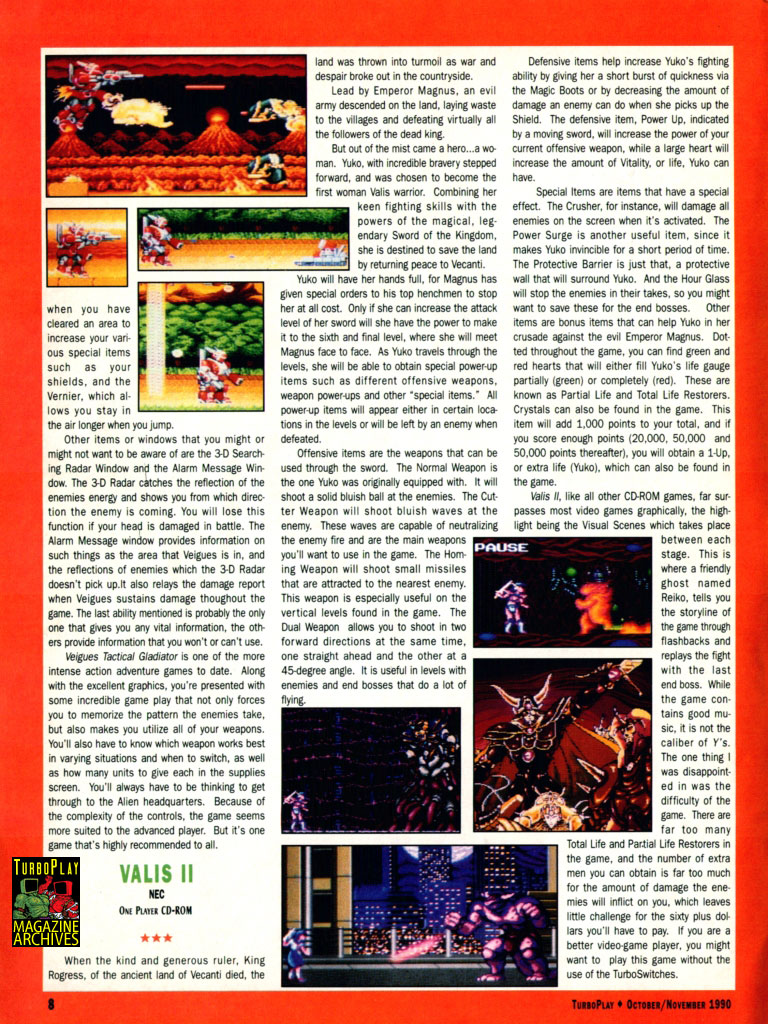
Valis II on the PC Engine CD-ROM²/TurboGrafx-CD garnered generally favorable reception from critics since its initial launch, some of which reviewed it as an import title.[38] The Games Machine's Warren Lapworth lauded the anime-style cutscenes for showing off the PC Engine CD-ROM's capabilities, while finding the game's action to be simple but enjoyable. However, Lapworth felt that the in-game graphics were uninteresting due to the drab and repetitive backgrounds, and expressed similar thoughts regarding the sprites.[41] Joystick's Jean-Marc Demoly commended the increasing difficulty of each level that contributed to its playability, as well as the game's visuals for the original and well-drawn enemy sprites, controls and sound, but noted that Yoko's animation lacked flexibility.[40] Génération 4's Philippe Querleux gave positive remarks to the soundtrack and save system, finding it to be a very addictive title, but noted its increasing difficulty starting from the third level.[39] An editor for TurboPlay was impressed by the game's visuals and music but disappointed by its perceived low difficulty.[44]
Tilt's Alain Huyghues-Lacour commended the game for its graphics, animation and audio for showcasing the potential of the CD-ROM format.[42] Electronic Gaming Monthly's four reviewers praised the intermission scenes, CD-quality soundtrack and visuals. They also found the story entertaining, but its short length and low difficulty were faulted.[37] Computer+Videogiochi, the Italian edition of British gaming publication Computer and Video Games, compared the game with Rastan but noted its variety and animated sequences.[43] In contrast, Hardcore Gaming 101's Kurt Kalata criticized its linear stages for being dull and boring, English dub and overall audiovisual presentation, regarding Valis II as "just a very mediocre and forgettable action game, only memorable for some nice creepy enemy sprites."[2]
Home computers
[edit]| Publication | Score |
|---|---|
| MSX Magazine | (MSX2) 7/6/7[45] |
| Software Gids | (MSX2) 5/5[46] |
| Technopolis | (PC-8801) 6/7[11] |
Valis: The Fantasm Soldier II on home computers carried sentiments similar to the original release. Micom Basic Magazine analyzed the PC-8801 version, praising the amount of visual scenes compared to the original Valis: The Fantasm Soldier, background music and audio but criticized the overall graphical quality due to the limited colors.[47] Technopolis' Gēzō also analyzed the PC-8801 version and commended the music, graphics, and variety of selectable suits. The writer also expressed that the game's story "makes me cry".[11] Japanese publication MSX Magazine reviewed the MSX2 version, giving positive ratings for its playability, visuals, scenario and overall value.[45] Software Gids' Dennis Lardenoye also reviewed the MSX2 version, giving positive remarks to the visuals, sound and overall game quality.[46] Oh!X's Hiroyuki Urakawa reviewed the X68000 version, noting the overall dark tone of its plot.[48] In the same retrospective outlook discussing the original TurboGrafx-CD release, Kurt Kalata of Hardcore Gaming 101 found it to be a better-designed title than the first entry but criticized the 8-bit computer version for the choppy action, finding the X68000 version to be more enjoyable.[2]
Mega Drive/Genesis
[edit]| Publication | Score |
|---|---|
| Beep! MegaDrive | 5.0/10[50] |
| Consoles + | 36%[49] |
| Famitsu | 18/40[51] |
| Games-X | 2/5[52] |
| Joypad | 63%[53] |
| Joystick | 56%[54] |
| Video Games (DE) | 46%[55] |
| Console XS | 65/100[56] |
| MegaTech | 47%[57] |
| Sega Pro | 65%[58] |
SD Valis/Syd of Valis received negative response from the gaming press.[50][51] It received scores of 19.5 out of 30 and 3.9718 out of 10 in public polls taken by Mega Drive Fan and the Japanese Sega Saturn Magazine respectively.[59][60] Games-X criticized its gameplay, short length and overall presentation.[52] Consoles +' Navarro and Laurent Defrance commended the audio and manga-style character sprites but faulted their small size. They also criticized the game's imprecise scrolling, playability and length.[49] Joypad's Olivier Prézeau gave positive remarks to its audiovisual presentation and controls,[53] however Joystick's Jean-Marc Demoly found it unpleasant to play, stating that "Syd Of Valis is a game that I strongly advise against, unless somewhere deep inside you, a small dose of masochism is present."[54] MegaTech's Mark Patterson and Paul Glancey lambasted its presentation for the lack of options, simplistic sprites and low sound quality. Both Patterson and Glancey summarized that it was a "pretty poor attempt at producing a cute beat 'em up."[57]
Sega Force's Paul Mellerick bashed its "very dull" gameplay despite "great" levels and enemies, writing that "even platform addicts will only play it for a while".[61] Sega Pro's James Scullion gave SD Valis a mediocre outlook, recommending saving money for some other game.[58] Console XS found it "mildly disturbing" due to the visual style.[56] Video Games' Michael Paul faulted the controls for being slippery and imprecise, while gearing his criticism towards the graphical design, low-detailed sprite animations, audio and repetitive enemy patterns.[55] In contrast to most reviewers, GamePro's Feline Groovy gave high marks to the visuals, sound, controls and fun factor.[62] In a retrospective article from Hardcore Gaming 101 dedicated to the SD remake, Kurt Kalata noted that the game's level design was improved over the original Valis II but equally dull.[3]
Notes
[edit]- ^ PC-8801, PC-9801, MSX2 and X68000 versions by Renovation Game, Sega Mega Drive/Genesis remake by Imaginative System Create (I.S.C. Co., Ltd.)
- ^ ヴァリスII, Varisu Tsū
- ^ 麻生 優子 (Asou Yūko)
- ^ ログレス (Roguresu)
- ^ めがす (Megasu)
- ^ 夢幻戦士 ヴァリスII (Mugen Senshi: Varisu Tsū)
- ^ SDヴァリス (Esu Dī Varisu)
- ^ ~ザスゴロク´92~ なりトレ (Suguroku '92: Naritore)
References
[edit]- ^ Venom, Dr. (August 2006). "Valis - Ascensão E Queda De Uma Serie". MSX Force (in Portuguese). No. 8. MSXRio. pp. 21–27.
- ^ a b c d e f g h i j Kalata, Kurt (July 5, 2012). "Valis II". Hardcore Gaming 101. Archived from the original on 2018-07-18. Retrieved 2022-04-28.
- ^ a b c d e f Kalata, Kurt (July 9, 2012). "Syd of Valis". Hardcore Gaming 101. Archived from the original on 2018-07-18. Retrieved 2022-04-28.
- ^ a b c Ciolek, Todd (December 17, 2007). "Column: 'Might Have Been' - Telenet Japan". GameSetWatch. UBM plc. Archived from the original on 2007-12-18. Retrieved 2020-07-07.
- ^ a b c d Laser Soft (May 23, 1990). Valis II (TurboGrafx-CD). NEC. Level/area: Staff roll.
- ^ a b c Renovation Game (July 8, 1989). Valis: The Fantasm Soldier II (PC-8801). Renovation Game. Level/area: Valis II Staff.
- ^ a b Kotowski, Don (August 1, 2012). "Valis II". Video Game Music Online. Archived from the original on 2020-08-14. Retrieved 2022-06-02.
- ^ Greening, Chris (March 13, 2013). "Tenpei Sato Profile". Video Game Music Online. Archived from the original on 2021-11-05. Retrieved 2022-06-02.
- ^ a b c d Shigehara, Moriyuki (October 30, 2007). ゲーム職人 第1集 だから日本のゲームは面白い 山本 雅康 (in Japanese). Micro Magazine. pp. 1–157. ISBN 978-4896372670. (Translation by Shmuplations. Archived 2022-02-19 at the Wayback Machine).
- ^ "New: ヴァリスII". PC Engine Fan (in Japanese). Vol. 2, no. 6. Tokuma Shoten. June 1, 1989. pp. 6–9.
- ^ a b c "Gaming World: 悪の世界ヴェカンテイが復活ガ — 夢幻戦士 ヴァリスII (画面は88版のちのです)". Technopolis (in Japanese). Vol. 8, no. 84. Tokuma Shoten. August 1989. pp. 24–25.
- ^ "夢幻戦士 ヴァリスII (画面は88版のちのです)". Technopolis (in Japanese). Vol. 8, no. 83. Tokuma Shoten. July 1989. pp. 12–13.
- ^ "New Soft: 夢幻戦士ヴァリスII". MSX Magazine (in Japanese). No. 71. ASCII Corporation. September 1989. p. 19.
- ^ "The Softouch - Software Information / 新作ソフト情報 - ★夢幻戦士ヴァリスII". Oh!X (in Japanese). No. 81. SoftBank Creative. November 1989. pp. 84–85.
- ^ ソフトウェア一覧(ソフトライセンシー発売)| メガドライブ. SEGA HARD Encyclopedia (in Japanese). Sega. 2022. Archived from the original on 2020-06-26. Retrieved 2022-05-04.
- ^ CRV (April 17, 2011). "I.S.C." Game Developer Research Institute. Archived from the original on 2016-10-09. Retrieved 2022-05-05.
- ^ "Around The Corner". Sega Visions. Vol. 1, no. 8. IDG. May–June 1992. p. 56.
- ^ "News – Ubisoft in exclusive Megadrive Game Import Deal Shocker!". MegaTech. No. 1. EMAP. December 1991. p. 6.
- ^ "Gutter Talk – Ubi-Renovation-Soft". Sega Force. No. 1. Europress Impact. January 1992. p. 10.
- ^ "NEW GAMES CROSS REVIEW: ヴァリス コレクション集 (PCエンジンCD-ROM)". Famitsu (in Japanese). No. 219. ASCII Corporation. February 26, 1993. p. 38.
- ^ Kitamura, Takakazu (August 28, 2002). "Project EGG、MSX「ヴァリス」など第9回ラインナップを公開 9月初旬にメガドライブ移植版「ワンダラーズ・フロム・イース」をリリース". GAME Watch (in Japanese). Impress Corporation. Archived from the original on 2020-09-22. Retrieved 2022-05-04.
- ^ "クリムゾン,ゼクサス…ツウだぜ,プロジェクトEGG!". SoftBank Games (in Japanese). ITmedia. November 3, 2002. Archived from the original on 2019-10-20. Retrieved 2022-05-04.
- ^ "【リリース】EGG,7月10日に「夢幻戦士ヴァリスII」を配信開始". 4Gamer.net (in Japanese). Aetas Inc. July 5, 2007. Archived from the original on 2009-05-05. Retrieved 2022-05-04.
- ^ "「プロジェクトEGG」PC-9801版「夢幻戦士ヴァリスII」を配信開始". 4Gamer.net (in Japanese). Aetas Inc. November 10, 2009. Archived from the original on 2019-07-13. Retrieved 2022-05-04.
- ^ "Project EGGでX68000版『夢幻戦士ヴァリスII』とPC-98版『Wind'sSeed ~風の種~』が配信". Dengeki Online (in Japanese). Kadokawa Game Linkage. January 24, 2012. Archived from the original on 2019-07-13. Retrieved 2022-05-04.
- ^ Venom, Dr. (August 2006). "Valis - Ascensão E Queda De Uma Serie". MSX Force (in Portuguese). No. 8. ASCII Corporation. pp. 21–27.
- ^ a b "プロジェクトEGG,「夢幻戦士ヴァリスCOMPLETE PLUS」を500本限定で発売". 4Gamer.net (in Japanese). Aetas Inc. November 24, 2011. Archived from the original on 2019-07-13. Retrieved 2022-05-04.
- ^ "ヴァリスII | ソフトウェアカタログ | プレイステーション オフィシャルサイト". PlayStation Official Site Software Catalog (in Japanese). Sony Interactive Entertainment. 2022. Archived from the original on 2016-06-05. Retrieved 2022-05-04.
- ^ Romano, Sal (June 15, 2021). "Valis: The Fantasm Soldier, Valis II, and Valis III coming to Switch – PC Engine reprints also planned". Gematsu. Archived from the original on 2021-08-14. Retrieved 2022-05-04.
- ^ Romano, Sal (August 19, 2021). "Valis: The Fantasm Soldier Collection for Switch launches December 9 in Japan". Gematsu. Archived from the original on 2021-08-23. Retrieved 2022-05-04.
- ^ Romano, Sal (November 11, 2011). "Valis: The Fantasm Soldier Collection coming west". Gematsu. Archived from the original on 2021-11-26. Retrieved 2022-05-04.
- ^ 「夢幻戦士ヴァリスCOLLECTION」海外での配信を記念したセールがスタート. 4Gamer.net (in Japanese). Aetas Inc. February 10, 2022. Archived from the original on 2022-02-10. Retrieved 2022-06-04.
- ^ Hagues, Alana (March 24, 2022). "Nintendo Download: 24th March (Europe)". Nintendo Life. Nlife Media. Archived from the original on 2022-05-14. Retrieved 2022-07-08.
- ^ Reynolds, Ollie (March 31, 2022). "Nintendo Download: 31st March (North America)". Nintendo Life. Nlife Media. Archived from the original on 2022-05-18. Retrieved 2022-07-08.
- ^ Romano, Sal (May 24, 2022). "Valis: The Fantasm Soldier Collection II launches September 22 in Japan". Gematsu. Archived from the original on 2022-05-25. Retrieved 2022-05-25.
- ^ Romano, Sal (August 24, 2023). "Valis: The Fantasm Soldier Collection III launches December 7 in Japan". Gematsu. Archived from the original on 2023-08-25. Retrieved 2023-12-17.
- ^ a b Harris, Steve; Semrad, Ed; Alessi, Martin; Williams, Ken (March 1991). "Review Crew: Valis II (Turbo Grafx 16 - NEC)". Electronic Gaming Monthly. No. 20. Sendai Publishing. p. 20.
- ^ a b "New Games Cross Review: ヴァリスII (PCエンジンCD-ROM)". Famitsu (in Japanese). No. 78. ASCII Corporation. July 7, 1989. p. 13.
- ^ a b Querleux, Philippe (May 1990). "Tests PC Engine: Valis 2". Génération 4 (in French). No. 22. Computec. p. 73.
- ^ a b Demoly, Jean-Marc (April 1990). "Consoles - CD-Rom sur PC Engine: Valis II". Joystick (in French). No. 4. Sipress. p. 46.
- ^ a b Lapworth, Warren (January 1990). "Reviews: Varis II — Fantasm Soldier (PC Engine)". The Games Machine. No. 26. Newsfield Publications. p. 82.
- ^ a b Huyghues-Lacour, Alain (February 1991). "Rolling Softs: Wallis II (CD Rom NEC, CD Laser Soft)". Tilt (in French). No. 87. Editions Mondiales S.A.. p. 78.
- ^ a b "Bytesize: Valis II - NEC (CD-ROM)". Computer+Videogiochi (in Italian). No. 7. Gruppo Editoriale Jackson. July–August 1991. p. 88.
- ^ a b "Closer Look: Valis II (NEC)". TurboPlay. No. 3. Larry Flynt Publications. October–November 1990. p. 8. Archived from the original on 2012-05-05.
- ^ a b "MSX Software Review: 夢幻戦士ヴァリスII". MSX Magazine (in Japanese). No. 74. ASCII Corporation. December 1989. pp. 26–27.
- ^ a b Lardenoye, Dennis (May–June 1990). "MSX Software: Fantasm Soldier 2 (Systeem: MSX-2)". MSX Gids (in Dutch). No. 1. Uitgeverij Herps. p. 37.
- ^ "Super Soft Corner - 新着ゲーム情報: 夢幻戦士 ヴァリスII (対応機種:PC-88SRシリーズ)". Micom BASIC Magazine (in Japanese). No. 85. The Dempa Shimbunsha Corporation. July 1989. p. 262.
- ^ Urakawa, Hiroyuki (February 1990). "The Softouch - Game Review: 夢幻戦士 ヴァリスII - あの感動のドラマがふたたび登場". Oh!X (in Japanese). No. 84. SoftBank Creative. pp. 34–35.
- ^ a b Navarro; Defrance, Laurent (April 1992). "Megadrive Review: Valis SD". Consoles + (in French). No. 8. M.E.R.7. pp. 80–81.
- ^ a b "BEメガドッグレース – SDヴァリス". Beep! Mega Drive (in Japanese). No. 30. SoftBank Creative. March 1992. p. 35.
- ^ a b "NEW GAMES CROSS REVIEW: SDヴァリス (メガドライブ)". Famitsu (in Japanese). No. 168. ASCII Corporation. March 6, 1992. p. 37.
- ^ a b "Software Review: Valis (Sega Mega Drive)". Games-X. No. 44. Europress. February–March 1992. pp. 26–27.
- ^ a b Demoly, Jean-Marc; Prézeau, Olivier (April 1992). "Megadrive: J'ai Dix Ans, Si Tu M'crois Pas, T'vas Voir Ta Gueule À La Récré! - Syd of Valis". Joypad (in French). No. 7. Challenge. pp. 78–79.
- ^ a b Demoly, Jean-Marc (April 1992). "Console News: Syd of Valis". Joystick (in French). No. 26. Sipress. p. 120.
- ^ a b Paul, Michael (June 1992). "Test: Schüleraufruhr - Syd of Valis". Video Games (in German). No. 7. Markt & Technik. p. 48.
- ^ a b "Software A-Z - Mega Drive: SD Valis". Console XS. No. 1. Paragon Publishing. May 1992. p. 133.
- ^ a b Patterson, Mark; Glancey, Paul (April 1992). "Valis SD Review". MegaTech. No. 4. EMAP. pp. 24–25.
- ^ a b Scullion, James (April 1992). "ProReview - SD Valis". Sega Pro. No. 6. Paragon Publishing. p. 38.
- ^ "Weekly Hit Chart". Mega Drive Fan (in Japanese). No. 28. Tokuma Shoten. May 1992. p. 115.
- ^ メガドラ読者レース. Sega Saturn Magazine (in Japanese). No. 9. SoftBank Creative. September 1995. p. 85. Archived from the original on 2021-03-14. Retrieved 2022-04-27.
- ^ Mellerick, Paul (April 1992). "Advance Play! - Varis SD". Sega Force. No. 4. Europress Impact. p. 55.
- ^ Groovy, Feline (August 1992). "Genesis ProReview: Syd of Valis". GamePro. No. 37. IDG. p. 40.
External links
[edit]



Valis II
View on GrokipediaPlot and Gameplay
Plot
Valis II continues the story of Yuko Asou, a Japanese high school student who, after defeating the demon lord Rogles in the first game, returns to the fantasy world of Vecanti to confront a new threat.[5] The narrative picks up with Vecanti under siege by the cyborg Emperor Megas, Rogles' older brother, who seeks to eradicate Rogles' followers and reclaim the throne as its rightful ruler.[2] Yuko, haunted by visions and initial attacks in the human world, is compelled to wield the mystical Valis sword once more, transforming from an ordinary schoolgirl into an armored warrior destined to protect the balance between dimensions. She learns she is the daughter of Queen Valia, ruler of Vecanti, and gains support from her twin sister Valna.[5][6] The central conflict revolves around Megas's forces, including his key generals Haizen and Gaias, who lead invasions aimed at weakening Vecanti and threatening the human world.[7][8] Yuko's quest spans the human world, where the story begins amid everyday life disrupted by supernatural incursions, and Vecanti, the primary fantasy realm under siege.[5] As she traverses these worlds, battling Megas's armies and uncovering ancient lore tied to the Valis sword's origins and her own heritage, Yuko grapples with the weight of her role, forging alliances that highlight themes of duty and the friendships that sustain her resolve.[5] Key plot developments include conflicts with Rogles' surviving loyalists, who attempt to steal the Valis sword, leading to confrontations that test her heroism.[3] The story builds to revelations about Megas's motivations rooted in betrayal and vengeance, forcing Yuko to confront the personal and cosmic burdens of her lineage as a chosen protector.[9] These elements deepen the series' exploration of a young protagonist's internal struggle, emphasizing the isolation and responsibility of wielding otherworldly power in defense of multiple worlds.[5]Gameplay
Valis II is a side-scrolling action-platformer where players control Yuko Asou, navigating two-dimensional levels by running, jumping, and engaging in combat against enemies and bosses. The game emphasizes precise platforming challenges, such as leaping across gaps and avoiding environmental hazards, while combating foes in a run-and-gun style despite the sword-based weaponry. Levels are structured across six stages blending environments from the human world and the fantasy realm of Vecanti, each concluding with a boss fight that tests pattern recognition and timing.[3][5] The core combat revolves around the Valis sword, which Yuko wields to perform melee swings and fire long-range energy projectiles with every attack. The sword can be upgraded to three power levels by collecting upgrade items dropped by enemies, increasing the projectiles' damage and reach; additionally, special items allow switching between four attack types, including normal blasts, homing missiles, wave shots that destroy enemy projectiles, and two-way spreads. Players can also acquire limited-use power-ups like protective barriers or invincibility spells, activated via a dedicated control input, and jewels that increase the score. In certain versions, such as the home computer ports, gameplay incorporates occasional shoot 'em up segments where Yuko flies over scrolling backgrounds, shifting to vertical shooting mechanics. In home computer ports, players can switch Yuko's costumes, each altering her abilities—such as enhanced speed or defense—adding strategic depth.[3][5][10] Player progression is managed through a health bar that depletes upon taking damage, replenished by collecting health pickups scattered throughout stages; Yuko starts with a set number of lives, with continues available upon depletion to maintain progress. The game includes minor puzzles, like timing-based platform sequences or item collection for hidden paths, though these are secondary to action elements. Controls are straightforward, using the d-pad for movement (including ducking), one button for jumping, and another for sword attacks, with responsive inputs that support the game's moderate difficulty, though later stages extend in length and intensity. The PC Engine CD version enhances immersion with animated cutscenes between stages, but core mechanics remain consistent across platforms, with port-specific tweaks like the shoot 'em up elements and costume switching in non-console releases.[11][12][10]Development
Original Development
Valis II was developed by Shin-Nihon Laser Soft, a subsidiary of Telenet Japan established in 1988 to focus on optical media games, marking it as the studio's inaugural CD-ROM title.[13] The project was directed by Masami Hanari, with Fumiyuki Moriyama serving as producer, under the oversight of Telenet Japan and publisher NEC.[14] Development emphasized building on the original Valis as a direct sequel, incorporating a darker tone through the introduction of the warlord Megas and expanded world-building that revealed deeper ties to protagonist Yuko Asou's family and the Dreamworld.[5] The production encountered technical challenges inherent to the emerging CD-ROM format, such as slow loading times and limited RAM capacity.[15] These hurdles necessitated small team sizes and intense workloads, with core development often handled by just a handful of programmers and designers amid broader resource constraints at Telenet.[15] Key innovations leveraged the CD-ROM's storage advantages to integrate anime-style cutscenes and voice acting, a departure from the floppy disk limitations of prior titles, enhancing narrative delivery and immersion.[5] This was achieved through collaborations with animators from the anime industry, who contributed to the high-quality visuals despite the limited budget that prompted outsourcing of art assets.[15] Published jointly by Telenet Japan and NEC, the game represented an ambitious step for Laser Soft in adapting the Valis series to console hardware while pushing multimedia boundaries.[3]Ports and Adaptations
The home computer ports of Valis II, developed in parallel to the PC Engine version by Renovation Game and released in 1989 for the NEC PC-8801, MSX2, NEC PC-9801, and Sharp X68000, adapted the content to floppy disk storage, necessitating reductions in visual and audio fidelity to fit hardware constraints.[5] These versions replaced the CD audio with chiptune soundtracks, which provided MIDI-like music but lacked the original's orchestral depth, and featured more compact cutscenes that emphasized violence and included semi-nudity, such as explicit depictions of the antagonist Megas murdering the character Valia—elements toned down or omitted in the PC Engine release. Gameplay was enhanced with more dynamic stage designs, including additional flying sections that consumed special item charges, and an improved power-up system allowing players to select weapons and costumes from a dedicated screen prior to levels, diverging from the original's simpler progression. However, the PC-8801, MSX2, and PC-9801 implementations suffered from choppy performance due to limited processing power and memory, resulting in less fluid platforming compared to the baseline PC Engine mechanics of side-scrolling action and sword-based combat.[5] The X68000 port addressed some of these issues by running at a smoother frame rate, shortening repetitive segments for better pacing, and removing certain unfair enemy placements or obstacles, though its audio remained somewhat muffled relative to the crisp chiptunes of the other computer versions. To accommodate floppy disk loading times and the absence of save functionality on these systems, the ports incorporated password systems for resuming progress, alongside minor level adjustments like streamlined enemy patterns to mitigate hardware-induced slowdowns during intense sequences. A distinct adaptation arrived in 1992 with the Sega Mega Drive/Genesis remake, developed by Imaginative System Create and published by Telenet Japan as SD Valis in Japan and localized as Syd of Valis in North America. This version adopted a super-deformed (chibi) art style with exaggerated proportions and brighter, cartoonish visuals to suit the console's sprite capabilities, while simplifying core gameplay from the PC Engine original by emphasizing platforming over complex mechanics and replacing elaborate cinema cutscenes with in-engine text dialogues featuring humorous, abbreviated interactions. It incorporated elements from the home computer ports, such as the weapon and armor selection screen, and allowed upward firing for better versatility, but removed shoot 'em up segments present in the original's flying stages to streamline the action-platformer focus. Technical adaptations for the cartridge format involved compressing graphical assets, leading to resized sprites that maintained the chibi aesthetic but reduced detail in backgrounds and animations, alongside audio downgrades to the Genesis's FM synthesis, which produced less nuanced tracks than the PC Engine's CD sound. The title was released exclusive to Japanese and North American markets.Release
Initial Releases
Valis II was initially released for the PC Engine CD-ROM² in Japan on June 23, 1989, published by Telenet Japan in collaboration with NEC.[6] This version leveraged the system's CD capabilities for enhanced audio and cutscenes, marking an early showcase of the platform's potential for anime-influenced storytelling.[3] The game later launched in North America as Valis II for the TurboGrafx-CD on May 23, 1990, distributed by NEC Home Electronics, with Hudson Soft handling aspects of the TurboGrafx ecosystem support.[6][16]| Platform | Region | Release Date | Publisher |
|---|---|---|---|
| PC-8801 | Japan | July 8, 1989 | Renovation Game |
| MSX2 | Japan | August 5, 1989 | Renovation Game |
| PC-9801 | Japan | August 5, 1989 | Renovation Game |
| X68000 | Japan | November 18, 1989 | Renovation Game |
Modern Re-releases
In 2007, Valis II became available digitally through Project EGG, a service by DMM Games that emulates classic Japanese PC titles on modern Windows PCs, offering the original 1989 PC-8801 version with faithful hardware simulation but without additional enhancements. Edia Games released Valis: The Fantasm Soldier Collection in 2022 for Nintendo Switch, bundling the PC Engine CD-ROM² version of Valis II alongside the first and third entries in the series, with modern features including save states, rewind functionality, and HD filter options to improve accessibility and visual clarity.[24] The collection launched in Japan on December 9, 2021, for physical copies, followed by a western digital release on February 10, 2022, and expanded to PC via Steam on October 29, 2024, introducing global availability with multilingual support including English subtitles and audio options where applicable.[24][25] Valis: The Fantasm Soldier Collection II, also published by Edia, arrived on Nintendo Switch in 2023 and includes additional titles from the series such as Valis: The Fantasm Soldier (MSX2 and Mega Drive versions), Syd of Valis, and Valis IV, building on the prior collection with quality-of-life updates such as customizable key remapping, alongside retained features like sound modes for accessing original tracks and visual modes for artwork galleries.[26] The package launched in Japan on September 22, 2022, with a surprise western digital release on February 23, 2023, maintaining a focus on emulated originals enhanced for contemporary play.[26] These re-releases have primarily targeted Japanese audiences initially through regional eShops and physical editions, though the Steam version has broadened access worldwide.[25] In June 2025, the X68000 version of Valis II was re-released as part of a double pack with Sol Feace for the X68000 Z emulation system by D4 Enterprise, available digitally and physically in Japan as of November 2025.[27]Reception
PC Engine Version
The PC Engine version of Valis II, released in Japan on June 23, 1989, and localized for the TurboGrafx-CD in North America on May 23, 1990, received generally positive reception from critics, who praised its innovative use of the CD-ROM format to deliver enhanced cutscenes, full voice acting, and high-quality music that contributed to an immersive atmosphere. Electronic Gaming Monthly awarded it a score of 30 out of 40 (75%), noting the game's strong audiovisual presentation as a highlight for the platform. Similarly, the Redbook audio enabled a dynamic soundtrack with synth elements that stood out, while animated cutscenes and voiced dialogue added a cinematic flair uncommon for action-platformers at the time.[28][5] Critics, however, pointed out several shortcomings, including low overall difficulty, a relatively short length of about six levels, and uneven pacing with long, repetitive segments that felt monotonous. Japanese magazine Famitsu scored it 23 out of 40 (approximately 58%), reflecting mixed feelings on gameplay depth and challenge compared to contemporaries. Other outlets like The Games Machine (74%) and Tilt (15/20 or 75%) echoed concerns about unremarkable level design and easy enemies, though they appreciated the anime-inspired visuals.[28] In terms of commercial performance, the game achieved modest success in Japan, benefiting from the PC Engine's strong market position, where the console and its CD-ROM² add-on together sold over 10 million units worldwide. In the United States, its impact was limited by the TurboGrafx-CD's niche install base, estimated at around 40,000 units sold. Player feedback often highlighted appreciation for the story's fantastical narrative and anime-style aesthetics, but many noted the reduced difficulty made it less engaging than the original Valis.[29][30][28]Home Computer Versions
The 1989 ports of Valis II to Japanese home computers, including the NEC PC-88 and MSX2 platforms, were developed by Renovation (a subsidiary of Telenet Japan) as adaptations of the original PC Engine CD-ROM² release, targeting hobbyist PC users familiar with detailed action-platformers on limited hardware. These versions retained the core side-scrolling gameplay, including sword-based combat and stage progression, but omitted CD-ROM-specific elements to fit cartridge and floppy disk constraints. Released simultaneously in Japan, they appealed to a niche audience of PC enthusiasts who valued deeper mechanical complexity over audiovisual spectacle. Ports to PC-98 and X68000 were also released, with the X68000 version offering smoother performance and shortened segments compared to the choppier PC-88 and MSX2 adaptations.[5] Strengths of these ports included solid visual adaptations with detailed sprites and backgrounds that captured the game's dark, violent tone, alongside effective chiptune soundtracks that enhanced the atmospheric platforming sequences. The PC-88 and MSX2 versions featured more intricate level designs with eventful enemy placements and unique mechanics, such as flying shoot-'em-up segments, providing a sense of progression and challenge. Reviewers praised the faithful recreation of the narrative's grim fantasy elements, noting how the simpler presentation still conveyed the story's intensity through static visuals and text. Additionally, the soundtrack's crisp 8-bit compositions were highlighted for their rock-influenced energy, contributing to memorable boss encounters.[5][31] However, the home computer ports suffered from the absence of the PC Engine's full-motion video cutscenes, voice acting, and animated sequences, resulting in a simpler, less immersive presentation that relied on static images and scrolling text for storytelling. Hardware limitations led to choppy scrolling, sluggish controls, and unfair collision detection, which frustrated players during intense platforming sections and made later stages particularly demanding. While the core action remained accessible for hobbyists, these technical shortcomings reduced overall polish compared to the original. The X68000 port mitigated some performance issues but still faced criticism for muffled audio.[5] Overall, reception for the PC-88 and MSX2 versions was positive among retro gaming analysts for their depth, with expanded weapon upgrades (up to four levels), jewel-based magic systems, and multiple protagonist outfits offering strategic variety not fully present in the PC Engine edition. Critics viewed them as faithful adaptations that prioritized gameplay substance for PC users, though less visually engaging without CD enhancements; these ports were seen as superior in mechanical intricacy but ultimately less captivating than the console original due to performance issues.[31][5]Mega Drive Version
The Mega Drive version of Valis II, released in Japan as SD Valis in February 1992 and in North America as Syd of Valis in April 1992, represented a significant divergence from the original PC Engine release through its adoption of a super-deformed (chibi) art style and simplified mechanics tailored for the console hardware. This remake aimed to bring the series to a broader audience but was largely criticized for its dated visuals, which appeared simplistic and less dynamic than those in comparable 16-bit platformers of the era. Reviewers frequently pointed to the chibi aesthetic as a stylistic misstep that diminished the game's epic fantasy tone, making stages feel cramped and less immersive.[19] Major criticisms centered on poor controls, with slippery character movement and imprecise collision detection leading to frustrating platforming sections, alongside unbalanced difficulty that swung between overly simplistic enemy encounters and punishing boss fights without adequate checkpoints or power-up balance. In the UK, MegaTech scored it 47%, criticizing its unpolished feel. Similarly, GamePro in the US rated it 4 out of 5, but noted clunky input responsiveness and lack of refinement as barriers to enjoyment despite some positives in action-platforming. Japanese publication Famitsu scored it 23 out of 40, noting the remake's failure to capture the original's atmosphere despite faithful level structures.[19] Few positives emerged in contemporary coverage, though some reviewers appreciated the version's accessibility on home consoles, allowing easier play sessions compared to the PC Engine CD's setup, and praised minor additions like selectable armors for slight strategic depth. Overall, the port received mixed to negative reception as an inferior take on the source material, with the chibi redesign alienating fans expecting the series' signature anime-inspired grandeur. Commercially, the title flopped in both Japan and the United States, with low sales figures underscoring its lack of appeal amid a crowded platformer market and contributing to the Valis series' diminished presence in Western territories. A planned European release by Ubisoft was ultimately canceled, further limiting its global footprint.[19] In retrospect, retro gaming enthusiasts regard the Mega Drive version as a quirky curiosity within the franchise, valued for its oddball chibi reinterpretation and console portability but dismissed as unrepresentative of the series' stronger entries on other platforms.[32]References
- https://strategywiki.org/wiki/Valis_II