Hubbry Logo
Rotary vane pumpRotary vane pumpMain
Open search
Rotary vane pump
Community hub
Rotary vane pump
logo
8 pages, 0 posts
0 subscribers
Be the first to start a discussion here.
Rotary vane pump
Rotary vane pump
from Wikipedia
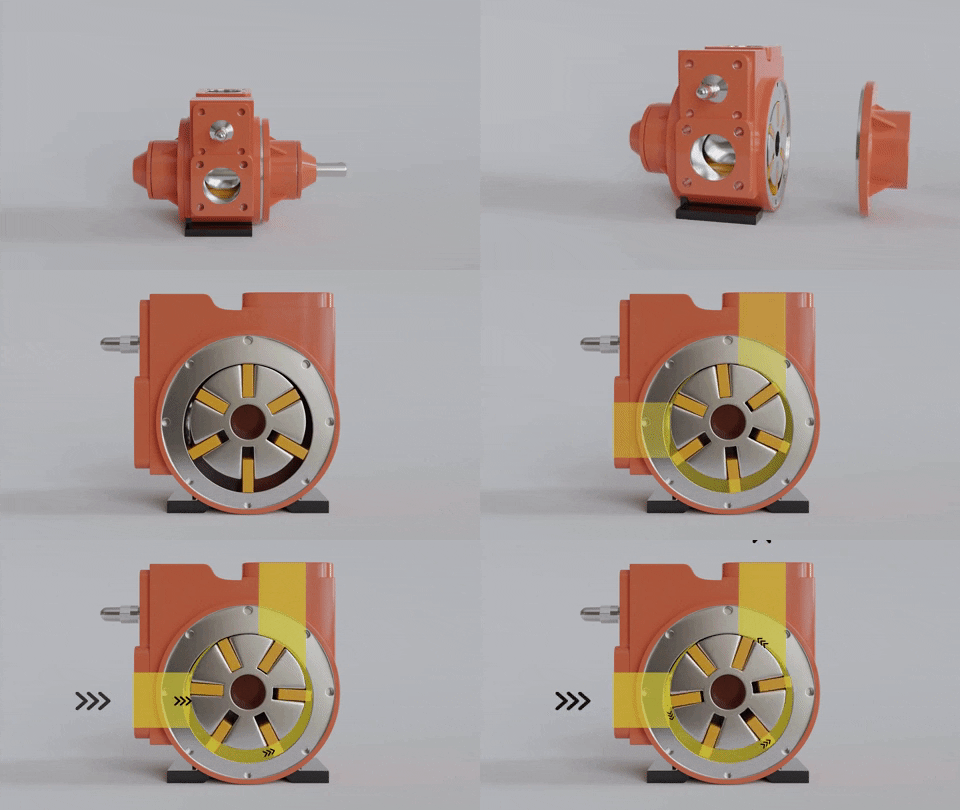
An eccentric rotary vane pump
Another eccentric rotary-vane pump design. Note that modern pumps have an area contact between rotor and stator (and not a line contact).
1. pump housing
2. rotor
3. vanes
4. spring

A rotary vane pump is a type of positive-displacement pump that consists of vanes mounted to a rotor that rotates inside a cavity. In some cases, these vanes can have variable length and/or be tensioned to maintain contact with the walls as the pump rotates.

This type of pump is considered less suitable than other vacuum pumps for high-viscosity and high-pressure fluids[citation needed], and is complex to operate[clarification needed][citation needed]. They can endure short periods of dry operation, and are considered good for low-viscosity fluids[citation needed].

Types

[edit]

The simplest vane pump has a circular rotor rotating inside a larger circular cavity. The centers of these two circles are offset, causing eccentricity. Vanes are mounted in slots cut into the rotor. The vanes are allowed a certain limited range of movement within these slots such that they can maintain contact with the wall of the cavity as the rotor rotates. The vanes may be encouraged to maintain such contact through means such as springs, gravity, or centrifugal force. A small amount of oil may be present within the mechanism to help create a better seal between the tips of the vanes and the cavity's wall. The contact between the vanes and the cavity wall divides up the cavity into "vane chambers" that do the pumping work. On the suction side of the pump, the vane chambers are increased in volume and are thus filled with fluid forced in by the inlet vacuum pressure, which is the pressure from the system being pumped, sometimes just the atmosphere. On the discharge side of the pump, the vane chambers decrease in volume, compressing the fluid and thus forcing it out of the outlet. The action of the vanes pulls through the same volume of fluid with each rotation.

Multi-stage rotary-vane vacuum pumps, which force the fluid through a series of two or more rotary-vane pump mechanisms to enhance the pressure, can attain vacuum pressures as low as 10−6 bar (0.1 Pa).

Uses

[edit]

Vane pumps are commonly used as high-pressure hydraulic pumps and in automobiles, including supercharging, power-steering, air conditioning, and automatic-transmission pumps[citation needed]. Pumps for mid-range pressures include applications such as carbonators for fountain soft-drink dispensers and espresso coffee machines[citation needed]. Furthermore, vane pumps can be used in low-pressure gas applications such as secondary air injection for auto exhaust emission control, or in low-pressure chemical vapor deposition systems[citation needed].

Rotary-vane pumps are also a common type of vacuum pump, with two-stage pumps able to reach pressures well below 10−6 bar. These are found in such applications as providing braking assistance in large trucks and diesel-powered passenger cars (whose engines do not generate intake vacuum) through a braking booster, in most light aircraft to drive gyroscopic flight instruments, in evacuating refrigerant lines during installation of air conditioners, in laboratory freeze dryers, and vacuum experiments in physics[citation needed]. In the vane pump, the pumped gas and the oil are mixed within the pump, and so they must be separated externally. Therefore, the inlet and the outlet have a large chamber, perhaps with swirl, where the oil drops fall out of the gas. Sometimes the inlet has louvers cooled by the room air (the pump is usually 40 K hotter) to condense cracked pumping oil and water, and let it drop back into the inlet. When these pumps are used in high-vacuum systems (where the inflow of gas into the pump becomes very low), a significant concern is contamination of the entire system by molecular oil back streaming.

History

[edit]

Like many simple mechanisms, it is unclear when the rotary vane pump was invented. Agostino Ramelli's 1588 book Le diverse et artificiose machine del capitano Agostino Ramelli ("The Various and Ingenious Machines of Captain Agostino Ramelli") contains a description and an engraving of a rotary vane pump[1] along with other types of rotary pumps, which suggests that the design was known at the time. In more recent times, vane pumps also show up in 19th-century patent records. In 1858, a US patent was granted to one W. Pierce for "a new and useful Improvement in Rotary Pumps", which acknowledged as prior art sliding blades "used in connection with an eccentric inner surface".[2] In 1874, a Canadian patent was granted to Charles C. Barnes of Sackville, New Brunswick.[3][4][5] There have been various improvements since, including a variable vane pump for gases (1909).[6]

Variable-displacement vane pump

[edit]

One of the major advantages of the vane pump is that the design readily lends itself to become a variable-displacement pump, rather than a fixed-displacement pump such as a spur-gear or a gerotor pump. The centerline distance from the rotor to the eccentric ring is used to determine the pump's displacement. By allowing the eccentric ring to pivot or translate relative to the rotor, the displacement can be varied. It is even possible for a vane pump to pump in reverse if the eccentric ring moves far enough. However, performance cannot be optimized to pump in both directions. This can make for a very interesting hydraulic-control oil pump.

A variable-displacement vane pump is used as an energy-saving device and has been used in many applications, including automotive transmissions, for over 30 years.[7][8][9]

Materials

[edit]
  • Externals (head, casing) – cast iron, ductile iron, steel, brass, plastic, and stainless steel
  • Vane, pushrods – carbon graphite, PEEK
  • End plates – carbon graphite
  • Shaft seal – component mechanical seals, industry-standard cartridge mechanical seals, and magnetically driven pumps
  • Packing – available from some vendors, but not usually recommended for thin liquid service

See also

[edit]

References

[edit]
[edit]
Revisions and contributorsEdit on WikipediaRead on Wikipedia
from Grokipedia
A rotary vane pump is a type of positive-displacement pump that employs a rotor with sliding vanes mounted within a cylindrical housing to trap and transport fluids or gases from an inlet to an outlet, creating either or through the eccentric of the rotor. The vanes, typically made from materials like carbon, , or self-lubricating composites, extend outward due to or springs, forming expanding and contracting chambers that draw in the medium during the intake phase and compress it during discharge. These pumps are versatile, operating in both oil-lubricated configurations for enhanced sealing and efficiency in applications—achieving ultimate pressures as low as 10⁻³ hPa in two-stage designs—and dry-running variants for cleaner, maintenance-free operation in gas compression or low-pressure fluid transfer. Key advantages include compact size, near-pulsation-free flow, and adaptability to various media, though they require careful to handle corrosive substances or vapors, often mitigated by features like gas ballast introduced in 1935 to prevent . Rotary vane pumps find widespread use across industries, from automotive systems like and braking to medical devices, , via , and industrial processes in semiconductors and . Pumping speeds range from miniature models at 25 m³/h to larger units exceeding 1,900 m³/h, with single-stage versions suited for rough (down to 0.3 hPa) and multi-stage for finer vacuums.

Introduction

Definition and Principles

A rotary vane is a type of positive displacement that utilizes sliding or pivoting vanes mounted to a rotor rotating within a cavity to create expanding and contracting chambers, thereby trapping and transporting fluids or gases. The rotor is positioned eccentrically within the pump housing, which ensures that the vanes maintain contact with the housing walls through mechanisms such as during rotation or auxiliary springs, forming sealed chambers that vary in volume as the rotor turns. This design enables distinct suction and discharge phases: during suction, the chamber volume expands to draw in the medium via the inlet port, while compression and expulsion occur as the volume contracts toward the outlet. The core physical principles of a rotary vane pump revolve around the volumetric displacement driven by the changing chamber sizes, where the eccentric rotor's motion causes the vanes to slide radially outward and inward, effectively pumping the medium without relying on generation like centrifugal pumps. , often supplemented by springs or fluid , ensures the vanes seal against the housing, minimizing leakage and maintaining efficiency across a range of viscosities. This volume variation directly propels the flow, making the pump suitable for low-to-medium applications, up to 300 bar or more in hydraulic uses depending on the design, where consistent displacement per is critical. In distinction from other rotary positive displacement pumps such as gear or lobe types, rotary vane pumps achieve superior sealing through the radial contact of vanes with the housing, which self-adjusts for wear and handles viscous fluids more effectively with reduced pulsation. Gear pumps, by contrast, rely on interlocking teeth that can suffer from higher leakage over time, while lobe pumps are better for shear-sensitive or highly viscous media but offer less adaptability to varying loads.

Key Components

The rotary vane pump consists of several essential components that form its core structure, enabling the assembly to function as a positive displacement device. At the heart is the rotor, a cylindrical component mounted eccentrically on the within the pump . It features radial slots designed to accommodate the vanes, allowing for their insertion and movement, and is typically constructed from durable metals to withstand rotational stresses. The vanes are flat or curved blade-like elements that slide within the rotor's slots, extending radially outward to maintain contact with the surrounding cavity. These are usually present in numbers ranging from 2 to 12 per pump, depending on the design and application, and are made from self-lubricating materials such as carbon-graphite, PEEK, or glass-fiber reinforced PTFE to ensure longevity and minimal friction. Enclosing the rotor and vanes is the , also known as the stator or pumping chamber, which forms an oval or circular cavity offset from the rotor's center. This structure includes strategically positioned inlet and outlet ports and is often constructed from robust materials like or to provide a sealed environment for the internal assembly. End plates seal the axial ends of the housing, forming a complete for the pumping chamber while often incorporating bearings to support the . These plates are integral to maintaining structural integrity and alignment of the rotor. Auxiliary elements include springs or pressurization systems in low-speed designs, which assist in extending the vanes radially, and shaft seals that prevent leakage along the interface. These components, such as mechanical or magnetic seals, enhance the pump's containment capabilities and are selected based on compatibility with the pumped medium.

Operating Principles

Mechanism of Operation

A rotary vane pump functions as a positive displacement device through a continuous cycle of , transfer, and discharge, enabled by the eccentric positioning of its rotor within the pump . The rotor, which is offset from the center of the cylindrical , contains radial slots holding multiple sliding vanes. As the rotor rotates, typically at speeds ranging from 1,500 to 1,800 RPM for standard models, causes the vanes to extend outward from their slots, maintaining continuous contact with the inner surface of the to form dynamic, sealed chambers. This eccentricity between the rotor and is essential, as it generates the volume variations necessary for fluid movement without requiring additional mechanical linkages. In the suction phase, as the rotor turns, the vanes on the expanding side of the eccentricity extend outward relative to the under or springs, maintaining contact with the housing, thereby increasing the volume of the chamber between consecutive vanes. This expansion creates a low-pressure region that draws fluid or gas into the through the port, filling the enlarging compartment until it is sealed by the trailing vane. The process ensures efficient intake, with the unidirectional rotation of the establishing a consistent flow direction from to outlet. During the transfer phase, the sealed chambers move with the rotating vanes along the eccentric path around the , carrying the entrapped fluid without significant pressure or volume change. This intermediate stage isolates the and discharge processes, preventing premature mixing of fluids. In the discharge phase, as the chambers reach the contracting side of the eccentricity, the vanes are forced inward by the , reducing the chamber volume and compressing the fluid. This forces the pressurized fluid out through the outlet port, completing the cycle and generating the pump's output flow. The vane tips' continuous contact with the provides the primary sealing mechanism, minimizing and leakage by creating airtight compartments along the eccentric path. Overall, the supports operation at rotation speeds up to 3,000 RPM in some configurations, maintaining unidirectional flow throughout.

Performance Characteristics

The flow rate in a rotary vane pump is directly proportional to the pump's displacement and rotational speed, as it is a positive displacement device that delivers a fixed per . The theoretical flow rate QQ can be calculated using the Q=VdN60,Q = \frac{V_d \cdot N}{60}, where QQ is the flow rate in liters per minute (L/min), VdV_d is the displacement in cubic centimeters per revolution (cm³/rev), and NN is the rotational speed in (RPM). This relationship holds under ideal conditions, with actual rates reduced by factors such as internal leakage. Rotary vane pumps exhibit robust pressure capabilities tailored to their application: for liquid handling, they typically operate up to 10-15 bar (145-217 psi), with some models reaching 18 bar (261 psi) continuously. In vacuum service, they achieve ultimate pressures down to 10310^{-3} mbar, suitable for low to medium ranges. Efficiency in rotary vane pumps is characterized by high due to minimal internal slippage, and mechanical efficiency influenced by in the vane slots and bearings. These metrics are affected by operating conditions, including fluid viscosity, pressure differential, and speed; higher viscosities reduce due to increased leakage, while excessive lowers . Rotary vane pumps effectively handle low- to medium-viscosity fluids, typically from 1 to several thousand cSt, maintaining performance across these ranges without significant power loss. They are self-priming up to a 7 m head, enabling reliable operation even with entrained air or partial dry running. and levels are moderate, typically 50-70 dB(A) for standard models, arising from vane impacts against the housing and dynamics. Compared to pumps, pulsations are minimal due to the continuous rotary motion, resulting in smoother flow and lower vibration transmission. Advanced designs incorporate liners to suppress by up to 15 dB(A).

Types

Fixed-Displacement Vane Pumps

Fixed-displacement vane pumps deliver a constant volume of per revolution, making them suitable for applications requiring steady flow rates without adjustment capabilities. The features a rotor mounted eccentrically within a cylindrical , creating a fixed eccentricity that determines the chamber volume. Vanes, typically made of materials like carbon or polymers, slide freely in radial slots within the rotor, extending outward via , springs, or hydraulic pressure to maintain contact with the wall, thereby trapping and displacing as the rotor turns. These pumps are categorized into unbalanced and balanced subtypes based on their configuration to manage radial loads. Unbalanced vane pumps employ a single cam ring and offset , resulting in a simpler but higher bearing wear due to unbalanced pressure forces on the discharge side. In contrast, balanced vane pumps use two cam rings or an elliptical with dual inlet and outlet ports, which distribute pressure evenly to minimize radial loads and extend component life, though at the cost of increased complexity. Displacement volumes in fixed-displacement vane pumps typically range from 1 to 300 cm³ per , allowing selection based on required flow for consistent hydraulic or transfer needs. These pumps operate efficiently at speeds from 500 to 3000 rpm, providing reliable performance in systems where variable output is unnecessary. involves periodic inspection and replacement of vanes, which wear over time due to sliding contact and can shorten by up to 75% before needing substitution to restore sealing . is often essential, with oil forming a to reduce between vanes and housing, though dry-running variants exist for specific clean applications; regular oil changes every 500-1000 hours are recommended to prevent contamination. Common implementations include transfer systems, such as diesel pumping in marine or automotive contexts, where their self-priming ability and tolerance for low-viscosity fluids ensure efficient, pulsation-free delivery.

Variable-Displacement Vane Pumps

Variable-displacement vane pumps differ from fixed-displacement models by incorporating mechanisms that allow the output flow to be adjusted dynamically based on . The primary adjustment method involves varying the eccentricity between the rotor and the through a sliding control ring or bushing, which alters the effective displacement per . This eccentricity is typically controlled by a compensator or an electrohydraulic , enabling precise modulation of the pump's output. Pressure compensation in these pumps functions by automatically reducing displacement when the outlet pressure reaches a predetermined setpoint, thereby maintaining system stability without excess flow. This mechanism senses the pressure differential and adjusts the control ring position to minimize energy input while meeting demand, where the pressure change (ΔP) relates functionally to the displacement adjustment (V_d). In practice, the compensator responds to rising pressure by shifting the bushing to decrease eccentricity, effectively throttling flow from maximum to near zero. These pumps are particularly suited for closed-loop hydraulic systems, where they maintain constant pressure while varying flow rates from 0% to 100% of capacity to match fluctuating demands, such as in automotive transmissions or . Typical displacement ranges for such pumps span 5 to 200 cm³/rev, allowing flexibility across low- to medium-flow applications. Compared to fixed-displacement vane pumps, variable-displacement variants offer superior energy efficiency in systems with intermittent or variable demand, as they avoid continuous full-output operation and reduce parasitic losses. This efficiency stems from lower power consumption and heat generation, making them ideal for applications requiring sustained performance without oversized fixed pumps. Variable-displacement vane pumps gained prominence in 20th-century , particularly from the mid-century onward, as balanced designs enabled reliable operation in industrial and automotive sectors.

Specialized Variants

Flexible vane pumps represent a modification where the vanes are constructed from elastomeric materials that flex or bend during operation rather than rigidly sliding against the stator walls. This design maintains sealing contact through deformation of the lobe-shaped vane tips, enabling the pump to handle low-pressure applications effectively without the need for precise machining tolerances typical in sliding vane configurations. Such pumps are particularly suited for dry-run scenarios, as the flexible vanes reduce and , allowing intermittent operation without in environments where contamination must be minimized. Swinging vane pumps incorporate vanes that pivot on hinges rather than extending radially from slots in the , which minimizes sliding contact and associated wear on the vane tips and housing. In this mechanism, the vanes fold inward during the compression phase and swing outward to seal against the , providing a smoother operation with lower mechanical stress. This pivoting action enhances durability and precision, making swinging vane pumps ideal for metering applications where accurate, low-volume fluid delivery is required without frequent maintenance. Two-stage rotary vane pumps feature a series configuration of two vane pumping mechanisms within a single unit, where the outlet of the first feeds into the of the second, allowing for progressive compression and evacuation of the medium. This tandem arrangement achieves deeper levels, typically down to 10^{-3} mbar, by reducing the workload on each and minimizing back-diffusion of gases. Such pumps are employed in scenarios demanding higher performance than single-stage designs, with the dual compression enhancing overall in rough to medium regimes. Reversible flow variants utilize a bidirectional rotor design that permits the direction of to be reversed, thereby switching the and outlet ports to alter the flow direction without disassembling the pump. This capability is achieved through symmetrical vane and housing geometry, ensuring consistent sealing and performance in either orientation. These pumps facilitate applications requiring periodic flow reversal, such as in transfer systems, where efficient discharging and reclaiming operations are essential. Dry-running rotary vane pumps operate without oil or other lubricants by employing self-lubricating materials, such as graphite composites, for the vanes, which generate a minimal amount of solid lubricant through controlled wear during operation. The vanes, often made from robust graphite-based compounds, maintain contact with the stator while minimizing friction and heat buildup, enabling continuous dry compression without fluid media. This design is advantageous in clean environments, like food processing or electronics manufacturing, where oil contamination could compromise product purity or equipment integrity.

Applications

Vacuum and Gas Pumping

Rotary vane pumps are widely utilized in applications due to their ability to achieve moderate to high levels through gas evacuation and compression. In single-stage configurations, these pumps typically reach ultimate pressures around 0.1 mbar, making them suitable for rough tasks, while oil-sealing enhances performance by providing effective lubrication and sealing to minimize back-leakage. Multi-stage designs, often two-stage, extend capabilities to ultimate pressures as low as 10^{-4} mbar, enabling finer conditions in more demanding setups. A key feature in many rotary vane pumps for vacuum service is the gas ballast mechanism, which introduces a controlled amount of ambient air or into the compression stage. This prevents the of vapors during compression, maintaining them in a gaseous state and thereby avoiding oil contamination that could degrade sealing efficiency. By reducing the of condensable vapors below their saturation point, the gas ballast extends the pump's operational life in environments with moist or vapor-laden gases. In laboratory vacuum systems, rotary vane pumps support processes such as , , and by providing reliable roughing and backing vacuum. They are essential for evacuating systems, removing non-condensable gases to ensure efficient and prevent system inefficiencies. In semiconductor processing, these pumps facilitate critical steps like thin-film deposition and by maintaining controlled low-pressure environments. Pumping speeds for rotary vane vacuum pumps typically range from 1 to 300 m³/h, with larger industrial models extending up to 1000 m³/h depending on the . The achievable ultimate pressure is influenced by factors such as system leaks, which allow back-diffusion, and oil , which sets a practical limit in oil-sealed s. Despite their versatility, rotary vane pumps have limitations in handling corrosive gases, as standard models are not designed for such media without modifications like specialized coatings or corrosion-resistant materials on internal components. For corrosive applications, variants with protective linings or alternative fluids are required to prevent material degradation and maintain performance. serves as the primary sealing medium in these pumps, contributing to their vacuum efficiency but necessitating periodic maintenance to manage risks.

Liquid and Hydraulic Uses

Rotary vane pumps are widely employed in hydraulic systems to power actuators, such as those in presses and lifts, where they deliver consistent fluid flow and pressure for precise control of mechanical operations. In and agricultural equipment, these pumps drive hydraulic cylinders to facilitate movement, enabling efficient lifting and pressing actions. Variable-displacement variants are particularly valued for load-sensing applications, as they adjust output to match varying demands, optimizing energy use in machinery like systems and injection molding . In fuel and oil transfer, rotary vane pumps serve critical roles in automotive and aviation sectors, providing metering and boosting capabilities for precise fluid delivery. Automotive applications include and transmission systems, where the pumps ensure smooth hydraulic operation under moderate pressures. In aviation, heavy-duty vane pumps handle transfer for fueling, supporting safe and reliable distribution in . These pumps excel with low- to medium-viscosity fluids like , diesel, and light oils, typically operating at pressures of 1-10 bar to avoid vane wear. For chemical processing, rotary vane pumps are suited to handling viscous or shear-sensitive fluids, such as solvents, paints, inks, and alcohols, due to their gentle, pulseless flow that minimizes degradation. They manage non-lubricating and high-temperature liquids effectively, with designs incorporating corrosion-resistant materials for acids and fine chemicals. Operating at differential pressures up to 10 bar, these pumps support transfer in processing plants without excessive shear. Their self-priming capability, with lifts exceeding 25 feet, proves advantageous for emptying sumps or tanks, allowing operation without separate priming mechanisms. In closed hydraulic circuits, rotary vane pumps are frequently integrated with filters and coolers to maintain fluid cleanliness and , enhancing system longevity in industrial and mobile applications. Such configurations, often provided as skidded packages including and baseplates, ensure reliable performance in and setups. Rotary vane pumps are also utilized in espresso machines, particularly in prosumer and commercial models, where they handle the pressurization of water for brewing. These pumps offer advantages such as quiet operation, stable pressure that reaches up to 9 bar quickly, high durability and long lifespan, support for continuous extraction, and the ability to connect directly to water lines.

Design and Materials

Construction Materials

Rotary vane pumps employ specific materials for their key components to ensure , low , and compatibility with operating fluids. The vanes, which slide within the rotor slots, are commonly constructed from carbon-graphite or composites such as PEEK or resin-bonded materials. These selections provide inherent self-lubrication, minimizing wear and during high-speed operation. The pump , which encloses the rotor and vanes, is typically made from or aluminum alloys to offer structural strength and thermal conductivity for heat dissipation. For applications involving corrosive fluids, housings are preferred to enhance chemical resistance and prevent degradation. End plates, which seal the ends of the rotor chamber, often match the housing material to maintain uniform expansion and sealing under varying temperatures. The rotor itself is generally fabricated from or for robustness against rotational stresses, though composite materials like carbon-graphite are used in specialized dry-running variants to reduce weight and inertia. Seals and O-rings throughout the pump, including those at shaft interfaces and chamber boundaries, utilize elastomers such as Viton () or Buna-N () to ensure compatibility with lubricating oils and prevent leaks under pressure. In oil-sealed (wet) rotary vane pumps, mineral-based oils serve as lubricants to facilitate internal sealing between vanes and housing, while also cooling components and reducing wear. Dry-running variants, which operate without oil to avoid , incorporate low-friction coatings such as PTFE on vanes and rotor surfaces to maintain and despite the absence of liquid .

Design Considerations

In rotary vane pump design, the eccentricity between the rotor centerline and the pump chamber centerline is a critical parameter that determines the chamber volume variation during operation. This offset enables the vanes to extend and retract, creating expanding and contracting chambers for fluid intake and discharge. Clearances between the vane tips and the chamber wall, as well as between the rotor and housing, must be tightly controlled—typically around 0.025 mm for vane tips—to minimize internal leakage and maintain sealing integrity under varying pressures and temperatures. Material selection influences these tolerances, as thermal expansion can affect clearance stability during operation. Vane slot design plays a key role in reducing operational hysteresis, which refers to the lag in vane response due to or , ensuring smooth radial movement and consistent contact with the chamber wall. Slots are machined with precise dimensions to allow free sliding while incorporating balancing grooves or ports on the vane undersides to equalize forces and minimize radial and axial loads on the rotor bearings. This balancing approach, common in both unbalanced and balanced vane configurations, extends component life by distributing evenly across multiple vanes, typically 8 to 12 in number. Port timing is optimized to synchronize with the rotor's for maximal flow , with the arc sized to allow sufficient filling time during the expansion phase, and the outlet arc designed to facilitate rapid discharge while minimizing . These angular extents are determined by the number of vanes and eccentricity, ensuring overlap between adjacent vanes to prevent fluid re-expansion in the discharge zone. Sizing rotary vane pumps involves scaling based on required flow rate and pressure demands, with displacement volume calculated from rotor dimensions, eccentricity, and vane count to match application needs such as 1 to 100 L/min at pressures up to 10 bar. Modular designs, featuring interchangeable cartridge kits or scalable housing sizes, enable customization for varying capacities while maintaining compatibility with standard mounting interfaces. Safety features are integral to prevent system failures, particularly relief valves integrated into the pump housing or discharge line to automatically bypass excess pressure above a set threshold, thus protecting seals, vanes, and downstream components from overpressurization. These valves, often spring-loaded and adjustable, ensure compliance with operational limits without requiring external controls.

Advantages and Limitations

Operational Benefits

Rotary vane pumps are prized for their compact size and low weight, which make them particularly suitable for integration into mobile equipment and space-constrained installations. These attributes stem from their simple rotary design, allowing for a smaller footprint compared to reciprocating pumps while delivering comparable performance. A key operational benefit is their ability to handle a wide viscosity range, from thin gases and low-viscosity fluids like water (around 1 cSt) to thicker oils up to 22,000 cSt depending on the model, without requiring priming in most applications. This versatility arises from the self-adjusting vanes that maintain sealing efficiency across varying fluid thicknesses, enabling reliable operation in diverse environments such as fuel transfer or lubrication systems, though efficiency decreases at higher viscosities and not all models handle above 10,000 cSt effectively. Their self-priming capability further enhances usability, as they can evacuate air from the suction line to initiate flow automatically. Rotary vane pumps operate quietly, typically producing noise levels below 70 dB, which is smoother and less disruptive than reciprocating alternatives. This low vibration and sound profile results from the continuous rotary motion, minimizing pulsations and making them ideal for noise-sensitive settings like laboratories or indoor industrial processes. In espresso machines, this quiet operation is particularly beneficial, providing a smoother experience compared to vibratory pumps. Their cost-effectiveness is supported by straightforward with fewer , leading to extended intervals such as oil changes every 3,000 hours and vane inspections or replacements every 2,000–3,000 hours in clean environments. This simplicity reduces overall ownership costs, as routine servicing involves basic tasks like oil replacement rather than complex overhauls. The pumps' versatility is enhanced by options for reversibility—achieved by reversing motor direction to alter flow direction—and multi-stage configurations that stack units for higher pressure or vacuum levels in a single assembly. These features allow adaptation to varied needs, from bidirectional fluid transfer in tankers to enhanced in analytical , without requiring entirely new systems. Overall, their high efficiency, often above 80% in optimal conditions, underscores their practical value across applications. In the context of espresso machines, rotary vane pumps offer stable pressure that reaches up to 9 bar quickly and maintains consistency during extraction, high durability with a long lifespan, and support for continuous extraction in high-volume settings, often allowing direct connection to water lines.

Common Drawbacks

Rotary vane pumps exhibit significant susceptibility to , particularly affecting the vanes and surfaces, which erode over time due to constant sliding contact. This is exacerbated in dry running or fluid conditions, where the absence of accelerates material degradation and can lead to premature failure. As wear progresses, internal leakage paths form between the vanes, rotor, and chamber walls, resulting in increased volumetric slip that diminishes pumping . This slippage allows or gas to bypass the discharge, reducing overall and requiring more frequent to restore sealing . The imposes limitations on high-pressure applications, with maximum differential pressures typically capped at around 15 bar to avoid excessive stress on the vanes, which could cause deformation or under higher loads. Additionally, while some models handle viscosities up to 22,000 cSt, higher viscosities generally increase internal friction and reduce flow , with many pumps less effective above 10,000 cSt. Oil-sealed variants depend heavily on clean, low-vapor-pressure lubricants to maintain sealing and , but contamination from particulates or incompatible fluids can degrade performance and lead to rapid component failure. between moving parts generates substantial during operation, particularly in continuous duty cycles, necessitating external cooling systems to prevent thermal degradation of seals, oil, and other components. In espresso machines, rotary vane pumps are more expensive and bulkier than alternatives like vibratory pumps, and their higher flow rates may limit fine control in certain extraction scenarios.

History and Development

Early Invention

The concept of rotary pumps dates back to ancient times, with the from the 3rd century BC serving as an early predecessor that utilized rotational motion to displace fluids, though it lacked the sliding vane mechanism central to later designs. Vane-specific rotary pumps emerged in the , building on these foundational rotary principles to enable more efficient positive displacement. The modern rotary vane pump was invented by Charles C. Barnes of , , who received Canadian No. 3559 on June 16, 1874, for a basic sliding vane design featuring vanes extending from a rotor to create expanding and contracting chambers within a cavity. This innovation marked a significant step in pump technology, allowing for continuous fluid movement through radial vanes that maintained contact with the housing walls. Initial rotary vane pumps employed metal vanes, typically made from materials like or iron, which restricted operations to low speeds to prevent excessive wear and friction. By the early , following the rise of the after 1910, these pumps saw adoption in oil extraction processes and automotive fuel systems, where their ability to handle viscous fluids at moderate pressures proved valuable for emerging industrial needs. A significant advancement in vacuum applications came in 1907 when Wolfgang Gaede developed the rotary vane pump design for creating , enabling moderate vacuum levels for scientific and industrial use. In 1935, Gaede introduced the gas ballast mechanism to oil-sealed rotary vane pumps, preventing vapor and expanding their utility in handling gases with vapors. During this period, rotary vane pumps also began emerging in laboratory settings for basic vacuum applications, supporting early scientific experiments requiring moderate vacuum levels.

Modern Advancements

In the , advancements in hydraulic applications led to the introduction of variable-displacement rotary vane pumps by companies such as , enabling adjustable flow rates to match varying load demands and improving system efficiency in mobile equipment like construction machinery. These pumps featured pressure-compensated designs that maintained constant output pressure, reducing energy waste compared to fixed-displacement models. During the 1980s and 2000s, the adoption of synthetic materials, such as carbon-graphite composites and high-grade polymers for vanes, enhanced durability and reduced friction in rotary vane pumps, allowing operation at higher speeds and temperatures without excessive wear. Precision manufacturing techniques, including computer numerical control (CNC) machining, enabled tighter tolerances in and components, minimizing leakage and improving overall reliability. Concurrently, dry-running rotary vane pumps emerged as a key innovation, utilizing oil-free designs with self-lubricating vanes to eliminate contamination risks, making them essential for environments in fabrication and pharmaceutical production. From the 2010s to 2025, rotary vane pumps have integrated monitoring technologies for real-time oversight of parameters like temperature, vibration, and pressure, supporting to anticipate failures. Efficiency improvements through variable speed drives (VSDs) have become standard, adjusting motor speed to demand and achieving energy savings in applications with fluctuating loads, such as industrial vacuum systems. Environmental adaptations have addressed regulatory pressures for , with low-volatility synthetic oils formulated to minimize emissions during operation. Market growth has expanded rotary vane pumps into electric vehicles (EVs), where compact models provide for boosters and assist in systems by circulating coolants in battery packs, enhancing range and safety. Recent developments in hybrid systems, using rotary vane pumps as backing stages for high- technologies like turbomolecular pumps, have enabled ultimate vacuums below 10^{-6} for applications such as advanced .

References

Add your contribution
Related Hubs
User Avatar
No comments yet.