


Community hub
Recent from talks
Contribute something to knowledge base
Content stats: 0 posts, 0 articles, 1 media, 0 notes
Members stats: 0 subscribers, 0 contributors, 0 moderators, 0 supporters
Subscribers
Supporters
Contributors
Moderators
Hub AI
Ganesha AI simulator
(@Ganesha_simulator)
Hub AI
Ganesha AI simulator
(@Ganesha_simulator)
Ganesha
Ganesha or Ganesh (Sanskrit: गणेश, IAST: Gaṇeśa, IPA: [ɡɐˈɳeːɕɐ]), also known as Ganapati, Vinayaka and Pillaiyar, is one of the best-known and most revered and worshipped deities in the Hindu pantheon and is the Supreme God in the Ganapatya sect. His depictions are found throughout India. Hindu denominations worship him regardless of affiliations. Devotion to Ganesha is widely diffused and extends to Jains and Buddhists and beyond India.
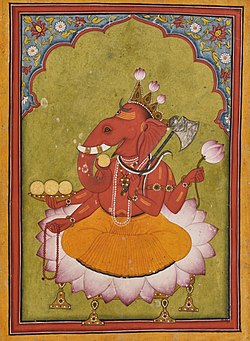
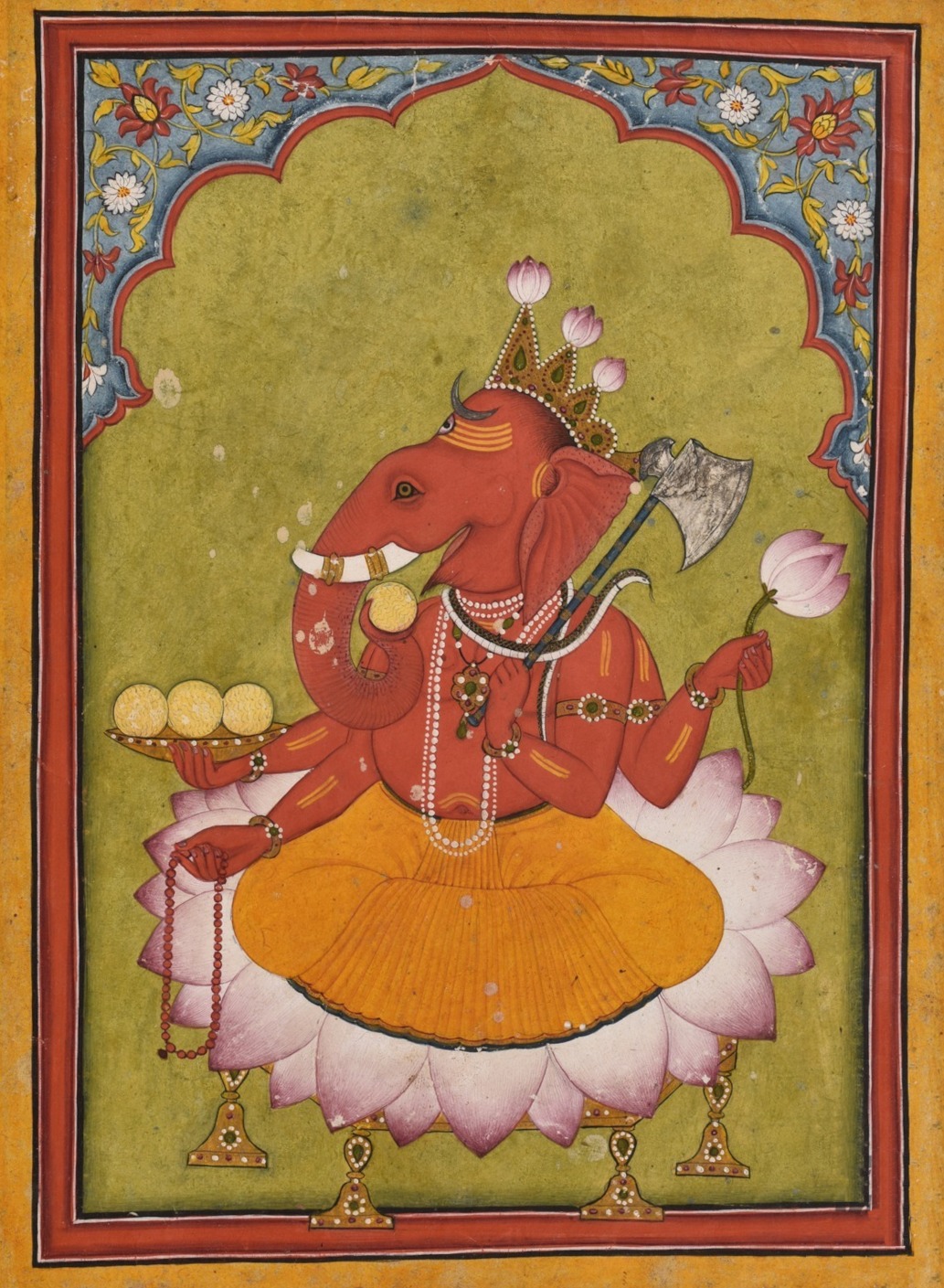
Although Ganesha has many attributes, he is readily identified by his elephant head and four arms. He is widely revered, more specifically, as the remover of obstacles and bringer of good luck; the patron of arts and sciences; and the deva of intellect and wisdom. As the god of beginnings, he is honoured at the start of rites and ceremonies. Ganesha is also invoked during writing sessions as a patron of letters and learning. Several texts relate anecdotes associated with his birth and exploits.
Ganesha is mentioned in Hindu texts between the 1st century BCE and 2nd century CE, and a few Ganesha images from the 4th and 5th centuries CE have been documented by scholars. Hindu texts identify him as the son of Parvati and Shiva of the Shaivism tradition, but he is a pan-Hindu god found in its various traditions. In the Ganapatya tradition of Hinduism, Ganesha is the Supreme Being. The principal texts on Ganesha include the Ganesha Purana, the Mudgala Purana and the Ganapati Atharvasirsha.
Ganesha has been ascribed many other titles and epithets, including Ganapati (Ganpati), Vighneshvara, and Pillaiyar. The Hindu title of respect Shri (Sanskrit: श्री; IAST: śrī; also spelled Sri or Shree) is often added before his name.
The name Ganesha is a Sanskrit compound, joining the words gana (gaṇa), meaning a 'group, multitude, or categorical system' and isha (īśa), meaning 'lord or master'. The word gaṇa when associated with Ganesha is often taken to refer to the gaṇas, a troop of semi-divine beings that form part of the retinue of Shiva, Ganesha's father. The term more generally means a category, class, community, association, or corporation. Some commentators interpret the name "Lord of the Gaṇas" to mean "Lord of Hosts" or "Lord of created categories", such as the elements. Ganapati (गणपति; gaṇapati), a synonym for Ganesha, is a compound composed of gaṇa, meaning "group", and pati, meaning "ruler" or "lord". Though the earliest mention of the word Ganapati is found in hymn 2.23.1 of the 2nd-millennium BCE Rigveda, it is uncertain that the Vedic term referred specifically to Ganesha. The Amarakosha, an early Sanskrit lexicon, lists eight synonyms of Ganesha: Vinayaka, Vighnarāja (equivalent to Vighnesha), Dvaimātura (one who has two mothers), Gaṇādhipa (equivalent to Ganapati and Ganesha), Ekadanta (one who has one tusk), Heramba, Lambodara (one who has a pot belly, or, literally, one who has a hanging belly), and Gajanana (gajānana), having the face of an elephant.
Vinayaka (विनायक; vināyaka) or Binayaka is a common name for Ganesha that appears in the Purāṇas and in Buddhist Tantras. This name is reflected in the naming of the eight famous Ganesha temples in Maharashtra known as the Ashtavinayak (Marathi: अष्टविनायक, aṣṭavināyaka). The names Vighnesha (विघ्नेश; vighneśa) and Vighneshvara (विघ्नेश्वर; vighneśvara) (Lord of Obstacles) refers to his primary function in Hinduism as the master and remover of obstacles (vighna).
A prominent name for Ganesha in the Tamil language is Pillai (Tamil: பிள்ளை) or Pillaiyar (பிள்ளையார்). A. K. Narain differentiates these terms by saying that pillai means a "child" while pillaiyar means a "noble child". He adds that the words pallu, pella, and pell in the Dravidian family of languages signify "tooth or tusk", also "elephant tooth or tusk". Anita Raina Thapan notes that the root word pille in the name Pillaiyar might have originally meant "the young of the elephant", because the Pali word pillaka means "a young elephant".
In the Burmese language, Ganesha is known as Maha Peinne (မဟာပိန္နဲ, pronounced [məhà pèiɰ̃né]), derived from Pali Mahā Wināyaka (မဟာဝိနာယက). The widespread name of Ganesha in Thailand is Khanet (can be transliterated as Ganet), or the more official title of Phra Phi Khanet. The earliest images and mention lists Ganesha as a major deity in present-day Indonesia, Thailand, Cambodia and Vietnam dating to the 7th and 8th centuries, and these mirror Indian examples of the 5th century or earlier. In Sri Lankan, among Sinhalese Buddhists, he is known as Gana deviyo, and revered along with Vishnu, Skanda, Buddha and other deities.
Ganesha
Ganesha or Ganesh (Sanskrit: गणेश, IAST: Gaṇeśa, IPA: [ɡɐˈɳeːɕɐ]), also known as Ganapati, Vinayaka and Pillaiyar, is one of the best-known and most revered and worshipped deities in the Hindu pantheon and is the Supreme God in the Ganapatya sect. His depictions are found throughout India. Hindu denominations worship him regardless of affiliations. Devotion to Ganesha is widely diffused and extends to Jains and Buddhists and beyond India.
Although Ganesha has many attributes, he is readily identified by his elephant head and four arms. He is widely revered, more specifically, as the remover of obstacles and bringer of good luck; the patron of arts and sciences; and the deva of intellect and wisdom. As the god of beginnings, he is honoured at the start of rites and ceremonies. Ganesha is also invoked during writing sessions as a patron of letters and learning. Several texts relate anecdotes associated with his birth and exploits.
Ganesha is mentioned in Hindu texts between the 1st century BCE and 2nd century CE, and a few Ganesha images from the 4th and 5th centuries CE have been documented by scholars. Hindu texts identify him as the son of Parvati and Shiva of the Shaivism tradition, but he is a pan-Hindu god found in its various traditions. In the Ganapatya tradition of Hinduism, Ganesha is the Supreme Being. The principal texts on Ganesha include the Ganesha Purana, the Mudgala Purana and the Ganapati Atharvasirsha.
Ganesha has been ascribed many other titles and epithets, including Ganapati (Ganpati), Vighneshvara, and Pillaiyar. The Hindu title of respect Shri (Sanskrit: श्री; IAST: śrī; also spelled Sri or Shree) is often added before his name.
The name Ganesha is a Sanskrit compound, joining the words gana (gaṇa), meaning a 'group, multitude, or categorical system' and isha (īśa), meaning 'lord or master'. The word gaṇa when associated with Ganesha is often taken to refer to the gaṇas, a troop of semi-divine beings that form part of the retinue of Shiva, Ganesha's father. The term more generally means a category, class, community, association, or corporation. Some commentators interpret the name "Lord of the Gaṇas" to mean "Lord of Hosts" or "Lord of created categories", such as the elements. Ganapati (गणपति; gaṇapati), a synonym for Ganesha, is a compound composed of gaṇa, meaning "group", and pati, meaning "ruler" or "lord". Though the earliest mention of the word Ganapati is found in hymn 2.23.1 of the 2nd-millennium BCE Rigveda, it is uncertain that the Vedic term referred specifically to Ganesha. The Amarakosha, an early Sanskrit lexicon, lists eight synonyms of Ganesha: Vinayaka, Vighnarāja (equivalent to Vighnesha), Dvaimātura (one who has two mothers), Gaṇādhipa (equivalent to Ganapati and Ganesha), Ekadanta (one who has one tusk), Heramba, Lambodara (one who has a pot belly, or, literally, one who has a hanging belly), and Gajanana (gajānana), having the face of an elephant.
Vinayaka (विनायक; vināyaka) or Binayaka is a common name for Ganesha that appears in the Purāṇas and in Buddhist Tantras. This name is reflected in the naming of the eight famous Ganesha temples in Maharashtra known as the Ashtavinayak (Marathi: अष्टविनायक, aṣṭavināyaka). The names Vighnesha (विघ्नेश; vighneśa) and Vighneshvara (विघ्नेश्वर; vighneśvara) (Lord of Obstacles) refers to his primary function in Hinduism as the master and remover of obstacles (vighna).
A prominent name for Ganesha in the Tamil language is Pillai (Tamil: பிள்ளை) or Pillaiyar (பிள்ளையார்). A. K. Narain differentiates these terms by saying that pillai means a "child" while pillaiyar means a "noble child". He adds that the words pallu, pella, and pell in the Dravidian family of languages signify "tooth or tusk", also "elephant tooth or tusk". Anita Raina Thapan notes that the root word pille in the name Pillaiyar might have originally meant "the young of the elephant", because the Pali word pillaka means "a young elephant".
In the Burmese language, Ganesha is known as Maha Peinne (မဟာပိန္နဲ, pronounced [məhà pèiɰ̃né]), derived from Pali Mahā Wināyaka (မဟာဝိနာယက). The widespread name of Ganesha in Thailand is Khanet (can be transliterated as Ganet), or the more official title of Phra Phi Khanet. The earliest images and mention lists Ganesha as a major deity in present-day Indonesia, Thailand, Cambodia and Vietnam dating to the 7th and 8th centuries, and these mirror Indian examples of the 5th century or earlier. In Sri Lankan, among Sinhalese Buddhists, he is known as Gana deviyo, and revered along with Vishnu, Skanda, Buddha and other deities.
Recent media
Recent media