
Recent from talks
Volcanism on the Moon
Knowledge base stats:
Talk channels stats:
Members stats:
Volcanism on the Moon
Volcanism on the Moon is represented by the presence of volcanoes, pyroclastic deposits and vast lava plains on the lunar surface. The volcanoes are typically in the form of small domes and cones that form large volcanic complexes and isolated edifices. Calderas, large-scale collapse features generally formed late in a volcanic eruptive episode, are exceptionally rare on the Moon. Lunar pyroclastic deposits are the result of lava fountain eruptions from volatile-laden basaltic magmas rapidly ascending from deep mantle sources and erupting as a spray of magma, forming tiny glass beads. However, pyroclastic deposits formed by less common non-basaltic explosive eruptions are also thought to exist on the Moon. Lunar lava plains cover large swaths of the Moon's surface and consist mainly of voluminous basaltic flows. They contain a number of volcanic features related to the cooling of lava, including lava tubes, rilles and wrinkle ridges.
The Moon has been volcanically active throughout much of its history, with the first volcanic eruptions having occurred about 4.2 billion years ago, during the Aitkenian period. Volcanism was most intense from the Upper Imbrian epoch to the Eratosthenian period, between 3.8 and 3 billion years ago. In this period, much of the lunar lava plains were created. This activity was originally thought to have diminished about 1 billion years ago during the Copernician period, but more recent evidence suggests that smaller-scale volcanism may have occurred in the last 50 million years. Today, the Moon has no active volcanoes, even though a significant amount of magma may persist under the lunar surface.
In 1604, German astronomer Johannes Kepler studied the moon and mistakenly thought that the lunar spots were seas. In Dioptrice, he called them maria, the Latin word for "seas". Italian astronomer Galileo Galilei saw the spots through an early telescope and confirmed the earth-like composition of the Moon in his Sidereus Nuncius (1610). Kepler changed his mind on the composition of the Moon after reading Galileo's account. In 1665, British chemist Robert Hooke was the first to suggest that the bowl-shaped depressions on the Moon were volcanoes. This idea was supported by their resemblance to the craters in the Phlegraean Fields of Italy, though the lunar ones are much larger. French astronomer Pierre Puiseux later proposed that the Moon’s craters were collapsed volcanic domes that had released all their gases. In the 18th century, another French astronomer, Pierre-Simon Laplace, suggested that meteorites were volcanic projectiles thrown out during major lunar eruptions.
The origin of lunar craters remained controversial throughout the first half of the 20th century, with volcano supporters arguing that bright rays fanning out of some craters were streaks of volcanic ash similar to those found at Mount Aso in Japan. Astronomers also reported flashes of light and red clouds over the Alphonsus and Aristarchus craters. Evidence collected during the Apollo program (1961–1972) and from uncrewed spacecraft of the same period proved conclusively that meteoric impact, or impact by asteroids for larger craters, was the origin of almost all lunar craters, and by implication, most craters on other bodies as well. It was initially believed that meteorite impacts could not be responsible for circular craters and that they must have all been due to volcanic activity, as meteorites would create elliptic craters when impacting at an angle. However, research has shown that meteorites would have sufficient energy to cause a circular explosion upon impact, causing circular craters, unless they were to hit at an extraordinarily small angle to the horizontal.
After impact cratering, volcanism is the most dominant process that has modified the lunar crust. Much of this modification has been preserved due to the lack of plate tectonics on the Moon, such that the lunar surface has changed insignificantly throughout the Moon's geological history. Lunar volcanism has mostly been confined to the near side of the Moon where basaltic lava plains are the dominant volcanic feature. In contrast, positive topographic features such as domes, cones and shields represent only a tiny fraction of the lunar volcanic record. Volcanoes and lava plains have been found on both sides of the Moon.
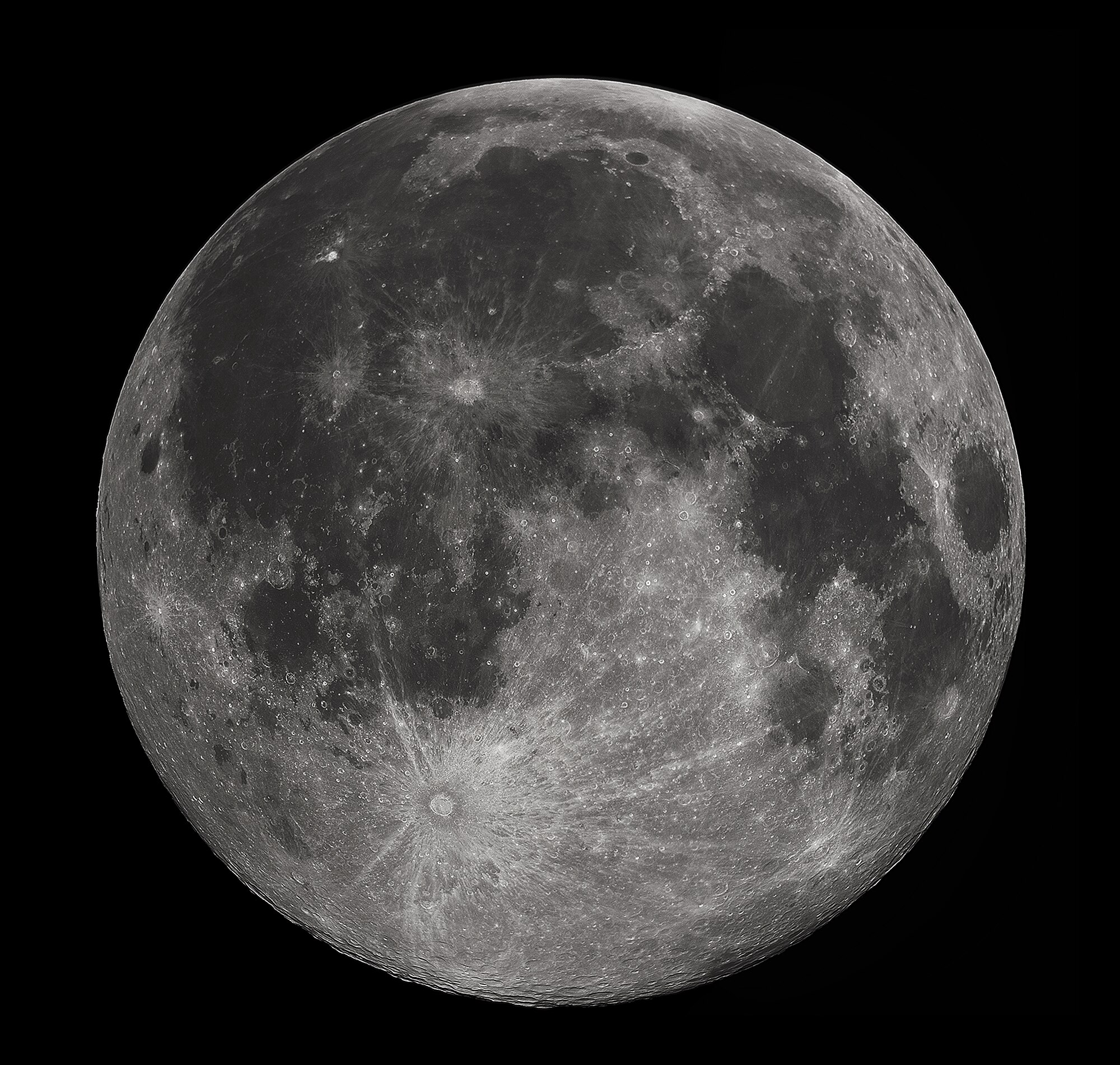
The lunar maria are large basaltic plains that cover more than 15% of the Moon's surface. They are the most obvious volcanic features on the Moon, appearing as dark topographic features when seen with the naked eye. Many tend to cover the floors of large impact basins and are therefore typically circular in outline, with some smaller maria filling the bottoms of impact craters. The major lunar maria range in size from more than 200 km (120 mi) to about 1,400 km (870 mi) and are outclassed only by the larger Oceanus Procellarum, which has a diameter of roughly 2,590 km (1,610 mi). They typically range in thickness from about 500 to 1,500 m (1,600 to 4,900 ft), with individual lava flows ranging from 10 to 20 m (33 to 66 ft) thick. This suggests that each mare is the product of several overlapping eruptive events.
The ages of the mare basalts have been determined both by direct radiometric dating and by the technique of crater counting. The radiometric ages range from about 3.16 to 4.2 billion years, whereas the youngest ages determined from crater counting are about 1.2 billion years, in the latter part of the Eratosthenian period. Nevertheless, the majority of mare basalts appear to have erupted between about 3 and 3.5 billion years ago. The few basaltic eruptions that occurred on the far side of the Moon are old, whereas the youngest flows are found within Oceanus Procellarum on the near side. While many of the basalts either erupted within, or flowed into, low-lying impact basins, the largest expanse of volcanic units, Oceanus Procellarum, does not correspond to any known impact basin.
The reason that the mare basalts are predominantly located on the near-side hemisphere of the Moon is still being debated by the scientific community. Based on data obtained from the Lunar Prospector mission, it appears that a large proportion of the Moon's inventory of heat producing elements (in the form of KREEP) is located within the regions of Oceanus Procellarum and the Imbrium basin, a unique geochemical province now referred to as the Procellarum KREEP Terrane. While the enhancement in heat production within the Procellarum KREEP Terrane is most certainly related to the longevity and intensity of volcanism found there, the mechanism by which KREEP became concentrated within this region is not agreed upon.
Hub AI
Volcanism on the Moon AI simulator
(@Volcanism on the Moon_simulator)
Volcanism on the Moon
Volcanism on the Moon is represented by the presence of volcanoes, pyroclastic deposits and vast lava plains on the lunar surface. The volcanoes are typically in the form of small domes and cones that form large volcanic complexes and isolated edifices. Calderas, large-scale collapse features generally formed late in a volcanic eruptive episode, are exceptionally rare on the Moon. Lunar pyroclastic deposits are the result of lava fountain eruptions from volatile-laden basaltic magmas rapidly ascending from deep mantle sources and erupting as a spray of magma, forming tiny glass beads. However, pyroclastic deposits formed by less common non-basaltic explosive eruptions are also thought to exist on the Moon. Lunar lava plains cover large swaths of the Moon's surface and consist mainly of voluminous basaltic flows. They contain a number of volcanic features related to the cooling of lava, including lava tubes, rilles and wrinkle ridges.
The Moon has been volcanically active throughout much of its history, with the first volcanic eruptions having occurred about 4.2 billion years ago, during the Aitkenian period. Volcanism was most intense from the Upper Imbrian epoch to the Eratosthenian period, between 3.8 and 3 billion years ago. In this period, much of the lunar lava plains were created. This activity was originally thought to have diminished about 1 billion years ago during the Copernician period, but more recent evidence suggests that smaller-scale volcanism may have occurred in the last 50 million years. Today, the Moon has no active volcanoes, even though a significant amount of magma may persist under the lunar surface.
In 1604, German astronomer Johannes Kepler studied the moon and mistakenly thought that the lunar spots were seas. In Dioptrice, he called them maria, the Latin word for "seas". Italian astronomer Galileo Galilei saw the spots through an early telescope and confirmed the earth-like composition of the Moon in his Sidereus Nuncius (1610). Kepler changed his mind on the composition of the Moon after reading Galileo's account. In 1665, British chemist Robert Hooke was the first to suggest that the bowl-shaped depressions on the Moon were volcanoes. This idea was supported by their resemblance to the craters in the Phlegraean Fields of Italy, though the lunar ones are much larger. French astronomer Pierre Puiseux later proposed that the Moon’s craters were collapsed volcanic domes that had released all their gases. In the 18th century, another French astronomer, Pierre-Simon Laplace, suggested that meteorites were volcanic projectiles thrown out during major lunar eruptions.
The origin of lunar craters remained controversial throughout the first half of the 20th century, with volcano supporters arguing that bright rays fanning out of some craters were streaks of volcanic ash similar to those found at Mount Aso in Japan. Astronomers also reported flashes of light and red clouds over the Alphonsus and Aristarchus craters. Evidence collected during the Apollo program (1961–1972) and from uncrewed spacecraft of the same period proved conclusively that meteoric impact, or impact by asteroids for larger craters, was the origin of almost all lunar craters, and by implication, most craters on other bodies as well. It was initially believed that meteorite impacts could not be responsible for circular craters and that they must have all been due to volcanic activity, as meteorites would create elliptic craters when impacting at an angle. However, research has shown that meteorites would have sufficient energy to cause a circular explosion upon impact, causing circular craters, unless they were to hit at an extraordinarily small angle to the horizontal.
After impact cratering, volcanism is the most dominant process that has modified the lunar crust. Much of this modification has been preserved due to the lack of plate tectonics on the Moon, such that the lunar surface has changed insignificantly throughout the Moon's geological history. Lunar volcanism has mostly been confined to the near side of the Moon where basaltic lava plains are the dominant volcanic feature. In contrast, positive topographic features such as domes, cones and shields represent only a tiny fraction of the lunar volcanic record. Volcanoes and lava plains have been found on both sides of the Moon.
The lunar maria are large basaltic plains that cover more than 15% of the Moon's surface. They are the most obvious volcanic features on the Moon, appearing as dark topographic features when seen with the naked eye. Many tend to cover the floors of large impact basins and are therefore typically circular in outline, with some smaller maria filling the bottoms of impact craters. The major lunar maria range in size from more than 200 km (120 mi) to about 1,400 km (870 mi) and are outclassed only by the larger Oceanus Procellarum, which has a diameter of roughly 2,590 km (1,610 mi). They typically range in thickness from about 500 to 1,500 m (1,600 to 4,900 ft), with individual lava flows ranging from 10 to 20 m (33 to 66 ft) thick. This suggests that each mare is the product of several overlapping eruptive events.
The ages of the mare basalts have been determined both by direct radiometric dating and by the technique of crater counting. The radiometric ages range from about 3.16 to 4.2 billion years, whereas the youngest ages determined from crater counting are about 1.2 billion years, in the latter part of the Eratosthenian period. Nevertheless, the majority of mare basalts appear to have erupted between about 3 and 3.5 billion years ago. The few basaltic eruptions that occurred on the far side of the Moon are old, whereas the youngest flows are found within Oceanus Procellarum on the near side. While many of the basalts either erupted within, or flowed into, low-lying impact basins, the largest expanse of volcanic units, Oceanus Procellarum, does not correspond to any known impact basin.
The reason that the mare basalts are predominantly located on the near-side hemisphere of the Moon is still being debated by the scientific community. Based on data obtained from the Lunar Prospector mission, it appears that a large proportion of the Moon's inventory of heat producing elements (in the form of KREEP) is located within the regions of Oceanus Procellarum and the Imbrium basin, a unique geochemical province now referred to as the Procellarum KREEP Terrane. While the enhancement in heat production within the Procellarum KREEP Terrane is most certainly related to the longevity and intensity of volcanism found there, the mechanism by which KREEP became concentrated within this region is not agreed upon.
Recent media