
Recent from talks
Volga Bulgaria
Knowledge base stats:
Talk channels stats:
Members stats:
Volga Bulgaria
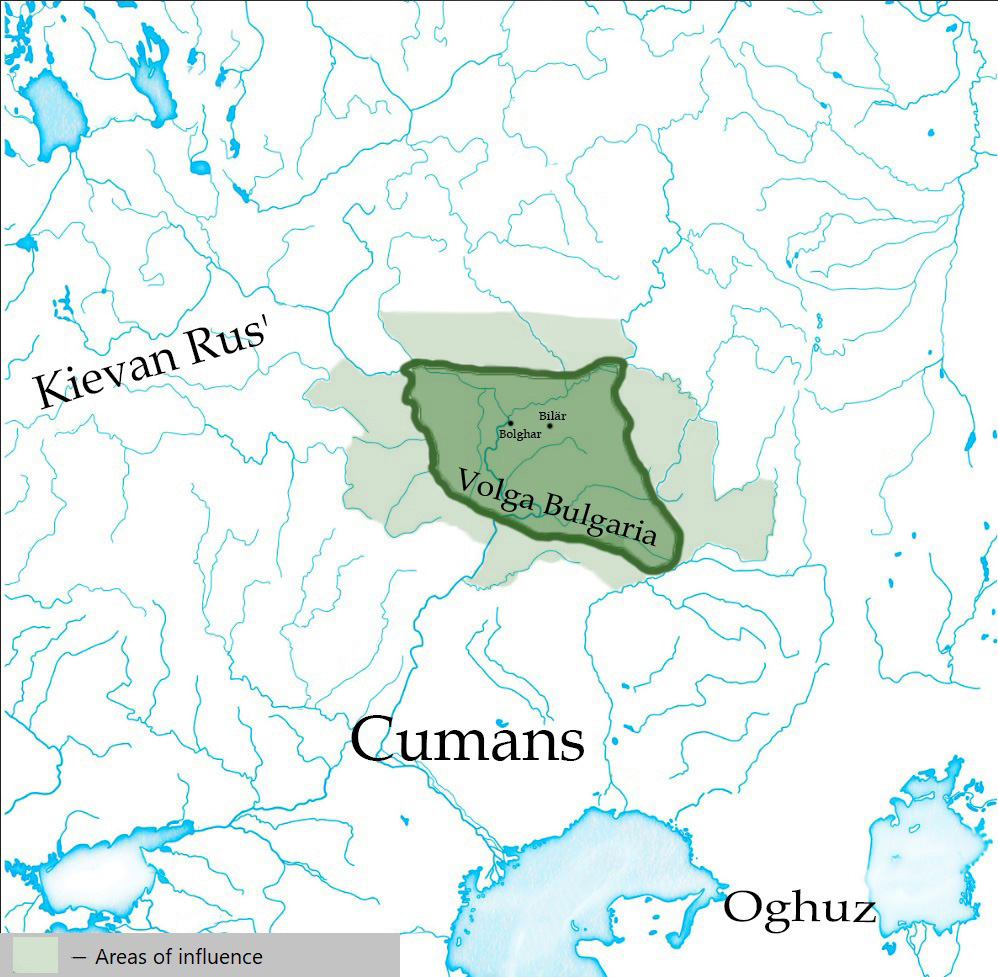
Volga Bulgaria or Volga–Kama Bulgaria (sometimes referred to as the Volga Bulgar Emirate) was a historical Bulgar state that existed between the 9th and 13th centuries around the confluence of the Volga and Kama River, in what is now European Russia. Volga Bulgaria was a multi-ethnic state with large numbers of Bulgars, Finno-Ugrians, Varangians, and East Slavs. Its strategic position allowed it to create a local trade monopoly with Norse, Cumans, and Pannonian Avars.
The origin of the early Bulgars remains a topic of scholarly debate, as their precise beginnings are still unclear, but most researchers believe their homeland was likely situated somewhere in the vast region stretching between modern-day Kazakhstan and the North Caucasian steppes. Interaction with the Hunnic tribes, causing the migration, may have occurred there, and the Pontic–Caspian steppe seems the most likely location.
Some scholars propose that the Bulgars may have been a branch or offshoot of the Huns or perhaps Huns seem to have been absorbed by the Bulgars after Dengizich's death. Others however, argue that the Huns continued under Ernak, becoming the Kutrigur and Utigur Hunno-Bulgars. These conclusions remain a topic of ongoing debate and controversy among scholars.
The Bulgars were an Oghuric people who settled north of the Black Sea. During their westward migration across the Eurasian steppe, they came under the overlordship of Khazars, leading other ethnic groups, including Finno-Ugric and Iranic as well as other Turkic peoples. In about 630 they founded Old Great Bulgaria, which was destroyed by the Khazars in 668. Kotrag, following the death of his father, began to extend the influence of his Bulgars to the Volga River. He is remembered as the founder of Volga Bulgaria. They reached the Volga region in the eighth century, where they became the dominant population at the end of the 9th century. They assimilated tribes of different origin who lived in the area, notably the Imenkovo culture that used to dominate the region.
However, some Bulgar tribes under the leader Asparukh moved west from the Pontic-Caspian steppes and eventually settled along the Danube River, in what is now known as Bulgaria proper, where they created a confederation with the Slavs, adopting a South Slavic language and the Eastern Orthodox faith. However, Bulgars in the Volga region eventually gave birth to Chuvash people. Unlike Danube Bulgars, Volga Bulgars did not adopt any language. The Chuvash language today is the only Oghuric language that survived and is often considered to be an offshoot of the Volga Bulgar language.
Most scholars generally agree that the Volga Bulgars, during their early historical period, were initially under the political and military dominance of the Khazar Khaganate. This fragmented Volga Bulgaria grew in size and power and gradually freed itself from the influence of the Khazars. Sometime in the late 9th century, unification processes started and the capital was established at Bolghar (also spelled Bulgar) city, 160 km south of modern Kazan. However, complete independence was reached after Khazaria's destruction and conquest by Sviatoslav in the late 10th century; thus, Bulgars no longer paid tribute to it. Abu al-Ghazi Bahadur named the Volga Bulgar people as Ulak.
Volga Bulgaria adopted Islam as a state religion in 922 – 66 years before the Christianization of Kievan Rus'. In 921 Almış sent an ambassador to the Caliph requesting religious instruction. The next year an embassy returned with Ibn Fadlan as secretary. A significant number of Muslims already lived in the country. The Volga Bulgars attempted to convert Vladimir I of Kiev to Islam; however Vladimir rejected the notion of Rus' giving up wine, which he declared was the "very joy of their lives".
Commanding the Volga River in its middle course, the state controlled much of trade between Europe and Asia prior to the Crusades (which made other trade routes practicable). Bolghar, was a thriving city, rivalling in size and wealth the greatest centres of the Islamic world. Trade partners of Bolghar included from Vikings, Bjarmland, Yugra and Nenets in the north to Baghdad and Constantinople in the south, from Western Europe to China in the East. Other major cities included Bilär, Suar (Suwar), Qaşan (Kashan) and Cükätaw (Juketau). Modern cities Kazan and Yelabuga were founded as Volga Bulgaria's border fortresses. Some of the Volga Bulgarian cities have still not been found, but they are mentioned in old East Slavic sources. They were: Ashli (Oshel), Tuxçin (Tukhchin), İbrahim (Bryakhimov), Taw İle. Some of them were ruined during and after the Golden Horde invasion.[citation needed]
Hub AI
Volga Bulgaria AI simulator
(@Volga Bulgaria_simulator)
Volga Bulgaria
Volga Bulgaria or Volga–Kama Bulgaria (sometimes referred to as the Volga Bulgar Emirate) was a historical Bulgar state that existed between the 9th and 13th centuries around the confluence of the Volga and Kama River, in what is now European Russia. Volga Bulgaria was a multi-ethnic state with large numbers of Bulgars, Finno-Ugrians, Varangians, and East Slavs. Its strategic position allowed it to create a local trade monopoly with Norse, Cumans, and Pannonian Avars.
The origin of the early Bulgars remains a topic of scholarly debate, as their precise beginnings are still unclear, but most researchers believe their homeland was likely situated somewhere in the vast region stretching between modern-day Kazakhstan and the North Caucasian steppes. Interaction with the Hunnic tribes, causing the migration, may have occurred there, and the Pontic–Caspian steppe seems the most likely location.
Some scholars propose that the Bulgars may have been a branch or offshoot of the Huns or perhaps Huns seem to have been absorbed by the Bulgars after Dengizich's death. Others however, argue that the Huns continued under Ernak, becoming the Kutrigur and Utigur Hunno-Bulgars. These conclusions remain a topic of ongoing debate and controversy among scholars.
The Bulgars were an Oghuric people who settled north of the Black Sea. During their westward migration across the Eurasian steppe, they came under the overlordship of Khazars, leading other ethnic groups, including Finno-Ugric and Iranic as well as other Turkic peoples. In about 630 they founded Old Great Bulgaria, which was destroyed by the Khazars in 668. Kotrag, following the death of his father, began to extend the influence of his Bulgars to the Volga River. He is remembered as the founder of Volga Bulgaria. They reached the Volga region in the eighth century, where they became the dominant population at the end of the 9th century. They assimilated tribes of different origin who lived in the area, notably the Imenkovo culture that used to dominate the region.
However, some Bulgar tribes under the leader Asparukh moved west from the Pontic-Caspian steppes and eventually settled along the Danube River, in what is now known as Bulgaria proper, where they created a confederation with the Slavs, adopting a South Slavic language and the Eastern Orthodox faith. However, Bulgars in the Volga region eventually gave birth to Chuvash people. Unlike Danube Bulgars, Volga Bulgars did not adopt any language. The Chuvash language today is the only Oghuric language that survived and is often considered to be an offshoot of the Volga Bulgar language.
Most scholars generally agree that the Volga Bulgars, during their early historical period, were initially under the political and military dominance of the Khazar Khaganate. This fragmented Volga Bulgaria grew in size and power and gradually freed itself from the influence of the Khazars. Sometime in the late 9th century, unification processes started and the capital was established at Bolghar (also spelled Bulgar) city, 160 km south of modern Kazan. However, complete independence was reached after Khazaria's destruction and conquest by Sviatoslav in the late 10th century; thus, Bulgars no longer paid tribute to it. Abu al-Ghazi Bahadur named the Volga Bulgar people as Ulak.
Volga Bulgaria adopted Islam as a state religion in 922 – 66 years before the Christianization of Kievan Rus'. In 921 Almış sent an ambassador to the Caliph requesting religious instruction. The next year an embassy returned with Ibn Fadlan as secretary. A significant number of Muslims already lived in the country. The Volga Bulgars attempted to convert Vladimir I of Kiev to Islam; however Vladimir rejected the notion of Rus' giving up wine, which he declared was the "very joy of their lives".
Commanding the Volga River in its middle course, the state controlled much of trade between Europe and Asia prior to the Crusades (which made other trade routes practicable). Bolghar, was a thriving city, rivalling in size and wealth the greatest centres of the Islamic world. Trade partners of Bolghar included from Vikings, Bjarmland, Yugra and Nenets in the north to Baghdad and Constantinople in the south, from Western Europe to China in the East. Other major cities included Bilär, Suar (Suwar), Qaşan (Kashan) and Cükätaw (Juketau). Modern cities Kazan and Yelabuga were founded as Volga Bulgaria's border fortresses. Some of the Volga Bulgarian cities have still not been found, but they are mentioned in old East Slavic sources. They were: Ashli (Oshel), Tuxçin (Tukhchin), İbrahim (Bryakhimov), Taw İle. Some of them were ruined during and after the Golden Horde invasion.[citation needed]
Recent media