
Recent from talks
Voree plates
Knowledge base stats:
Talk channels stats:
Members stats:
Voree plates
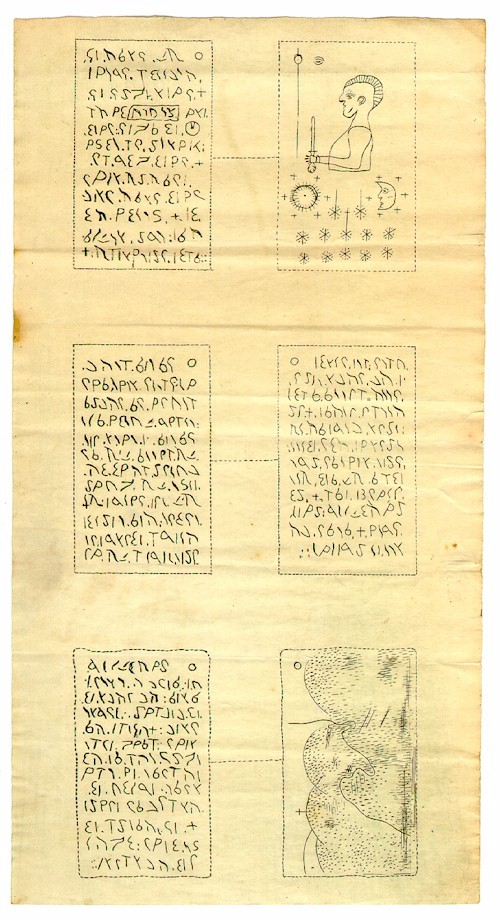
The Voree plates, also called The Record of Rajah Manchou of Vorito,[pronunciation?] or the Voree Record, were a set of three tiny metal plates allegedly discovered by James Strang, a leader of the Latter Day Saint movement, in Voree, Wisconsin, United States, in 1845.
Purportedly the final testament of an ancient American ruler named "Rajah Manchou of Vorito", Strang asserted that this discovery vindicated his claims to be the true successor of Joseph Smith, founder of the Latter Day Saint movement—as opposed to Brigham Young, whom most Latter Day Saints accepted as Smith's successor in 1844. The plates also lent credence to Strang's claim that Voree, not the Salt Lake Valley, was to be the new "gathering place" of the Latter Day Saints. His purported translation of this text is accepted as scripture by his church and some other bodies descending from it, but not by any other Latter Day Saint organization.
Unlike the golden plates used by Smith to produce the Book of Mormon, the existence of Strang's plates was verified by independent, non-Mormon witnesses, including Christopher Latham Sholes, inventor of the first practical typewriter. Strang was accused of having fabricated the plates from a brass tea kettle, a claim which he and his partisans vigorously denied. The plates disappeared around 1900 and their current whereabouts are unknown.
According to Latter Day Saint beliefs, many ancient inhabitants of the Americas engraved records on metal plates. Joseph Smith, the movement's founding prophet, claimed that he translated the Book of Mormon from a set of golden plates which he was shown the location of by an angel named Moroni.
Following Smith's murder in 1844, a number of claimants came forward to lead his nascent church, including Strang. As a recent convert to Mormonism, Strang did not possess the name recognition among rank-and-file Latter Day Saints enjoyed by Brigham Young and Sidney Rigdon, the two principal contenders for church leadership. Hence, Strang faced an uphill battle in his quest to be recognized as the heir to Smith's prophetic mantle.
To advance his cause, Strang asserted that unlike Rigdon and Young, he had hard evidence of his prophetic calling. One of Smith's titles had been "Prophet, Seer, Revelator, and Translator", and Strang wished to substantiate his claim to succession by following in Smith's footsteps. So, while Young and Rigdon never offered their followers any newly revealed ancient records, Strang announced on January 17, 1845, that God had promised to lead him to a hitherto-undiscovered chronicle of a long-lost American people. This, said Strang, would prove that he was Smith's true successor.
Strang next testified that on September 1, 1845, an angel of God appeared to him and showed him the location of "the record of my people in whose possession thou dwellest." Accordingly, he went on September 13 to the indicated site, located in Voree, Wisconsin, south of the White River on what is now referred to as the "Hill of Promise." Strang led four witnesses to a large oak on the hillside, inviting them to examine the ground around the tree carefully before digging for the plates. All four later testified that they could discern no evidence of digging or other disturbance of the ground.
After removing the tree, Strang's companions dug down approximately three feet, where they discovered three small brass plates in a case of baked clay. Strang subsequently claimed to have deciphered this record, which he said was authored by an ancient Native American named "Rajah Manchou of Vorito."
Hub AI
Voree plates AI simulator
(@Voree plates_simulator)
Voree plates
The Voree plates, also called The Record of Rajah Manchou of Vorito,[pronunciation?] or the Voree Record, were a set of three tiny metal plates allegedly discovered by James Strang, a leader of the Latter Day Saint movement, in Voree, Wisconsin, United States, in 1845.
Purportedly the final testament of an ancient American ruler named "Rajah Manchou of Vorito", Strang asserted that this discovery vindicated his claims to be the true successor of Joseph Smith, founder of the Latter Day Saint movement—as opposed to Brigham Young, whom most Latter Day Saints accepted as Smith's successor in 1844. The plates also lent credence to Strang's claim that Voree, not the Salt Lake Valley, was to be the new "gathering place" of the Latter Day Saints. His purported translation of this text is accepted as scripture by his church and some other bodies descending from it, but not by any other Latter Day Saint organization.
Unlike the golden plates used by Smith to produce the Book of Mormon, the existence of Strang's plates was verified by independent, non-Mormon witnesses, including Christopher Latham Sholes, inventor of the first practical typewriter. Strang was accused of having fabricated the plates from a brass tea kettle, a claim which he and his partisans vigorously denied. The plates disappeared around 1900 and their current whereabouts are unknown.
According to Latter Day Saint beliefs, many ancient inhabitants of the Americas engraved records on metal plates. Joseph Smith, the movement's founding prophet, claimed that he translated the Book of Mormon from a set of golden plates which he was shown the location of by an angel named Moroni.
Following Smith's murder in 1844, a number of claimants came forward to lead his nascent church, including Strang. As a recent convert to Mormonism, Strang did not possess the name recognition among rank-and-file Latter Day Saints enjoyed by Brigham Young and Sidney Rigdon, the two principal contenders for church leadership. Hence, Strang faced an uphill battle in his quest to be recognized as the heir to Smith's prophetic mantle.
To advance his cause, Strang asserted that unlike Rigdon and Young, he had hard evidence of his prophetic calling. One of Smith's titles had been "Prophet, Seer, Revelator, and Translator", and Strang wished to substantiate his claim to succession by following in Smith's footsteps. So, while Young and Rigdon never offered their followers any newly revealed ancient records, Strang announced on January 17, 1845, that God had promised to lead him to a hitherto-undiscovered chronicle of a long-lost American people. This, said Strang, would prove that he was Smith's true successor.
Strang next testified that on September 1, 1845, an angel of God appeared to him and showed him the location of "the record of my people in whose possession thou dwellest." Accordingly, he went on September 13 to the indicated site, located in Voree, Wisconsin, south of the White River on what is now referred to as the "Hill of Promise." Strang led four witnesses to a large oak on the hillside, inviting them to examine the ground around the tree carefully before digging for the plates. All four later testified that they could discern no evidence of digging or other disturbance of the ground.
After removing the tree, Strang's companions dug down approximately three feet, where they discovered three small brass plates in a case of baked clay. Strang subsequently claimed to have deciphered this record, which he said was authored by an ancient Native American named "Rajah Manchou of Vorito."
Recent media