


Community hub
Recent from talks
Contribute something
Nothing was collected or created yet.
Angel Moroni
View on Wikipedia
 | This article may contain original research. Significant proportion of citations, especially in first few sections, are to sources from the early nineteenth century written by people closely involved in the events (experiences the participants believed constituted encounters with an angel). These are primary sources, and the section extrapolates from those primary sources to posit original research about the sources and their meaning, e. g. the textual comparison of different versions of accounts cited to nothing but the accounts themselves rather than to textual scholarship of the accounts, etc. Summarizing secondary scholarship—summarizing the Moroni story, about the reception history of the Moroni figure, about analyzing depictions like statues, etc.—would improve the article. (March 2024) |

| Part of a series on the |
| Book of Mormon |
|---|
 |
The angel Moroni (/moʊˈroʊnaɪ/)[1] is an angel who Joseph Smith, founder of the Latter Day Saint movement, reported as having visited him on numerous occasions, beginning on September 21, 1823. According to Smith, the angel Moroni was the guardian of the golden plates buried near his home in western New York, which Latter Day Saints believe were the source of the Book of Mormon. An important figure in the theology of the Latter Day Saint movement, Moroni is featured prominently in its architecture and art. Besides Smith, the Three Witnesses and several other witnesses also reported that they saw Moroni in visions in 1829.
Moroni is thought by Latter Day Saints to be the same person as a Book of Mormon prophet-warrior named Moroni, who was the last to write in the golden plates. According to the Book of Mormon, the angel Moroni was a pre-Columbian warrior who buried the golden plates. After he died, he became an angel who was tasked with directing Smith to their location in the 1820s. According to Smith, he then returned the golden plates to Moroni after they were translated and, as of 1838, Moroni still had the plates in his possession.[2]
Angel's name and identity
[edit]Initially, when talking about his receipt of the golden plates, Smith referred only to "an angel" without identifying its name. Thus, in an 1831 letter from Lucy Mack Smith to her brother, she discusses Moroni as the person who buried the plates, but does not identify him as the unnamed "holy angel" that gave Smith the means to translate the golden plates.[3] In Smith's 1832 (second hand, but officially authorized) history, he said he was visited by "an angel of the Lord", who mentioned the Book of Mormon prophet "Moroni" as the last engraver of the golden plates; however, that account did not mention whether or not the angel was referring to himself as Moroni.[4]
Smith identified the angel as Moroni in 1835, while preparing the first edition of the Doctrine and Covenants, in which he indicated a number of angels who would come to the earth after the Second Coming and drink sacramental wine with himself and Oliver Cowdery.[5][failed verification] Among those angels, the revelation listed "Moroni, whom I have sent unto you to reveal the book of Mormon, containing the fulness of my everlasting gospel; to whom I have committed the keys of the record of the stick of Ephraim".[5] Around this time, Cowdery was writing a history of Smith in which he identified the angel as the prophet Moroni from the Book of Mormon.[6] In July 1838, Smith wrote an article for the church periodical Elders' Journal, in the form of questions and answers, that stated the following:
Question 4th. How, and where did you obtain the book of Mormon?
Answer. Moroni, the person who deposited the plates, from whence the book of Mormon was translated, in a hill in Manchester, Ontario County, New York, as a resurrected being, appeared unto me, and told me where they were; and gave me directions how to obtain them.[7]
However, on May 2, 1838, a few months before Smith's statement in Elders' Journal, Smith began dictating a church history that included a more detailed account of his visits from the angel.[8] In this text, Smith's scribe erroneously identified the angel as "Nephi", which is the name of the Book of Mormon's first narrator.[9] Smith's 1838 identification as "Nephi" was left unchanged when the 1838 history was published in 1842 in Times and Seasons, which Smith edited himself,[10] and in Millennial Star.[11] In the latter, an editorial referred to the 1823 vision and praised "the glorious ministry and message of the angel Nephi".[12] In 1851, after Smith's death (1844), the identification as "Nephi" was repeated when the Church of Jesus Christ of Latter-day Saints (LDS Church) published its first edition of the Pearl of Great Price.[13] It was also repeated in 1853 when Smith's mother Lucy Mack Smith published a history of her son.[14]
As a further complication, Mary Whitmer, mother to one of the Three Witnesses and four of the Eight Witnesses, said she had a vision of the golden plates, shown to her by an angel whom she always called "Brother Nephi",[15] but never clarified or indicated whether she believed this was the same angel that Smith and others later reported as Moroni.
Nevertheless, based on Smith's other statements that the angel was "Moroni", and based on both prior and later publications, most Latter Day Saints view Smith's 1838 identification of the angel as Nephi as a mistake on the part of the transcriber.[16] In the version of Smith's 1838 history published by the LDS Church, as well as the portion canonized by that denomination as the Pearl of Great Price, the name "Nephi" has been changed by editors to read "Moroni".[17] The Community of Christ publishes the original story, including the identification of "Nephi", but indicates "Moroni" in a footnote.[18]
Theorized origin of the name
[edit]Commenting on the name of the angel Moroni, Grant H. Palmer speculates that Smith had read of the city Moroni on the island Comoros from either a map or tales of Captain William Kidd, popular at the time.[19] According to Latter-day Saint scholar Hugh Nibley, the use of "mor" in the Book of Mormon is an Egyptian word, and means "beloved, good, everything nice and desirable."[20]
Description
[edit]In one of Smith's histories, he described him as an "angel of light" who "had on a loose robe of most exquisite whiteness. It was a whiteness beyond anything earthly I had ever seen .… His hands were naked and his arms also a little above the wrists .… Not only was his robe exceedingly white but his whole person was glorious beyond description".[21] According to Smith's sister Katharine, the angel "was dressed in white raiment, of whiteness beyond anything Joseph had ever seen in his life, and had a girdle about his waist. He saw his hands and wrists, and they were pure and white".[22]
Appearances to Joseph Smith and others
[edit]
Smith said that on the night of September 21, 1823, Moroni appeared to him and told him about the golden plates that were buried in a stone box a few miles from Smith's home. Smith said that the same angel visited him various times over the course of the next six years; Smith also said that the angel visited him to retrieve the golden plates after Smith had finished translating a portion of the writing on the plates[23] into the Book of Mormon.[2]
In addition to Smith, several other early Mormons said they had visions where they saw the angel Moroni. Three Witnesses said they saw the angel in 1829: Oliver Cowdery, David Whitmer, and Martin Harris. Other early Mormons who may have said they saw Moroni include:
- Hyrum Smith[24]
- Luke S. Johnson[25][26]
- Zera Pulsipher,[27][28] later disputed.[29]
- W. W. Phelps;[30][31]
- John P. Greene and his wife Rhoda[32]
- John Taylor[33]
- Oliver Granger[34]
- Heber C. Kimball[35]
- Lucy Harris[36]
- Harrison Burgess[37]
Mary Whitmer may also have seen Moroni, although she referred to the angel she saw as "Brother Nephi".[38][24]
Mortal life of Moroni the prophet
[edit]According to the Book of Mormon, Moroni was the son of Mormon,[39] the prophet for whom the Book of Mormon is named. Moroni may have been named after Captain Moroni, an earlier Book of Mormon figure.[40] Before Mormon's death in battle, he passed the golden plates to Moroni. Moroni then finished writing on the plates and concluded the record, presumably burying them in the hill Cumorah in western New York.[41] He is the namesake of the Book of Moroni in the Book of Mormon.
Theological significance
[edit]
Because of his instrumentality in the restoration of the gospel, Moroni is commonly identified by Latter Day Saints as the angel mentioned in Revelation 14:6, "having the everlasting gospel to preach unto them that dwell on the earth, and to every nation, and kindred, and tongue, and people."
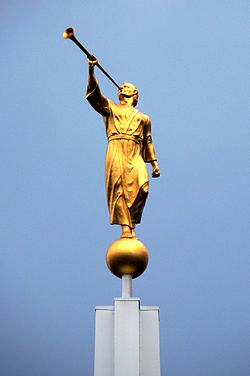
The image of the angel Moroni blowing a trumpet is commonly used as an unofficial symbol of the LDS Church. Moroni appears on the cover of some editions of the Book of Mormon. Statues of the angel stand atop many LDS temples, with most statues facing east.
In 2007, the LDS Church stated that an image of the angel Moroni in an advertisement violated one of the church's registered trademarks.[42]
Sculptors
[edit]The Nauvoo Temple was the first Latter Day Saint temple to be crowned with a figure of an angel. This angel, not officially identified as Moroni, was a metal weathervane with gold leaf on the trumpet. It was designed by William Weeks (architect of the Nauvoo temple) and installed in January 1846.[43] This figure was positioned in a flying horizontal position holding an open book in one hand and a trumpet in the other.
Cyrus Dallin sculpted the first angel which was identified as Moroni. This angel was placed on the Salt Lake Temple during the capstone ceremony on April 6, 1892, one year to the day before the temple was dedicated. Dallin's design is a neoclassical angel in robe and cap, standing upright with a trumpet in hand. It stands 3.8 meters high, was molded in hammered copper from the plaster original, and was covered with 22-karat gold leaf. On March 18, 2020, the trumpet held by the statue of Angel Moroni on the Salt Lake Temple fell to the ground as a result of a 5.7 magnitude earthquake.[44]
Torleif S. Knaphus fashioned a replica of the Dallin angel in the 1930s, but the casting of his angel wasn't placed on a temple until many years later. In 1983, castings of this angel were placed on the Idaho Falls Temple and the Atlanta Temple.[45]
Millard F. Malin's angel, which was placed on the Los Angeles Temple in 1953, is known as the second Angel Moroni statue. His angel was cast in aluminum, stands 4.7 meters high, and weighs 953 kilograms. Malin depicted Moroni with Native American features, wearing a Mayan style cloak, and holding the golden plates in its left hand.[46]
Avard Fairbanks sculpted the third Angel Moroni statue, which was placed on the Washington D.C. Temple, dedicated in 1974. This angel was created as a one-meter model which was sent to Italy where it was enlarged, cast in bronze, and gilded. The finished statue is 5.5 meters high and weighs over 4,000 pounds (1,800 kg). The Seattle Washington, Jordan River Utah, and Mexico City Mexico temples each have a 4.6-meter casting of this statue.[46]
Karl Quilter sculpted his first Angel Moroni in 1978. Two sizes were made, one three meters high, the other just over two meters. These statues were designed to reduce the cost and weight of the previous Angel Moroni statues, in order to become a standard part of the temple architecture. The Quilter angels are made of fiberglass and covered with gold leaf. In 1998, with the construction of many new smaller temples, Quilter was commissioned to create a new angel. This angel was similar in design to his previous angels, but he gave Moroni a slightly larger build, with his left hand opened and his body turned slightly to show more action. Quilter's Angel Moroni is now on over 100 temples around the world.[47]
See also
[edit]Notes
[edit]- ^ "Pronunciation Guide". Book of Mormon. Retrieved April 1, 2013.
- ^ a b Joseph Smith–History, 1:60, Pearl of Great Price.
- ^ (Morgan 1986, p. 349).
- ^ (Smith 1832, p. 4).
- ^ a b (Smith et al. 1835, p. 180).
- ^ (Cowdery 1835, p. 112).
- ^ (Smith 1838–1842, pp. 42–43).
- ^ (Smith 1838a, p. 7).
- ^ (Smith 1838a, p. 5).
- ^ (Smith 1842d, p. 753)
- ^ (Pratt & Ward 1842, p. 53).
- ^ (Pratt & Ward 1842, p. 71).
- ^ (Richards 1851, p. 41).
- ^ (Smith 1853, p. 79).
- ^ (Whitmer 1888, p. 621).
- ^ See FAIR Wiki, "Nephi or Moroni" Archived August 7, 2008, at the Wayback Machine.
- ^ Joseph Smith–History 1:27 .
- ^ Harper, Steven C. (August 22, 2019), "The Joseph (F.) Smith Story", First Vision, Oxford University Press, pp. 127–140, doi:10.1093/oso/9780199329472.003.0019, ISBN 978-0-19-932947-2, retrieved November 1, 2023
{{citation}}: CS1 maint: work parameter with ISBN (link) - ^ Palmer, Grant H. (2014). "Joseph Smith, Captain Kidd, Cumorah, and Moroni" (PDF). John Whitmer Historical Association Journal. 34 (1): 50–57. Archived from the original (PDF) on July 16, 2016. Retrieved May 24, 2017.
- ^ See Hugh W. Nibley, Teachings of The Book of Mormon, Semester 3, Lecture 71 Archived March 11, 2016, at the Wayback Machine
- ^ (Smith 1838).
- ^ (Salisbury 1895, p. 11).
- ^ "Uncle Dale's Old Mormon Articles: Palmyra Area 1829-31". www.sidneyrigdon.com. Archived from the original on November 7, 2013.
- ^ a b Pettit, Tom. "Moroni Appeared to 17 Different People!". Living Heritage Tours. Retrieved April 24, 2016.
- ^ "The Angel Moroni". BYU Idaho. March 11, 2003. Retrieved March 18, 2023.
- ^ Peterson, H. Donl (2000). Moroni: Ancient Prophet, Modern Messenger. Salt Lake City, Utah: Deseret Book. pp. 165–166. ISBN 1-57008-709-1.
- ^ "The Angel Moroni". BYU Idaho. March 11, 2003. Retrieved March 18, 2023.
- ^ Peterson, H. Donl (2000). Moroni: Ancient Prophet, Modern Messenger. Salt Lake City, Utah: Deseret Book. pp. 167–168. ISBN 1-57008-709-1.
- ^ Nielsen, Chad (March 12, 2023). "Zerah Pulsipher and the Angel". Times and Seasons. Retrieved March 18, 2023.
- ^ "The Angel Moroni". BYU Idaho. March 11, 2003. Retrieved March 18, 2023.
- ^ Peterson, H. Donl (2000). Moroni: Ancient Prophet, Modern Messenger. Salt Lake City, Utah: Deseret Book. pp. 168–169. ISBN 1-57008-709-1.
- ^ Russell, William D.; Walker, Ronald W. (1999). "Wayward Saints: The Godbeites and Brigham Young". The Western Historical Quarterly. 30 (4): 524. doi:10.2307/971442. ISSN 0043-3810. JSTOR 971442.
- ^ Peterson, H. Donl (2000). Moroni: Ancient Prophet, Modern Messenger. Salt Lake City, Utah: Deseret Book. p. 170. ISBN 1-57008-709-1.
- ^ Peterson, H. Donl (2000). Moroni: Ancient Prophet, Modern Messenger. Salt Lake City, Utah: Deseret Book. p. 171. ISBN 1-57008-709-1.
- ^ Peterson, H. Donl (2000). Moroni: Ancient Prophet, Modern Messenger. Salt Lake City, Utah: Deseret Book. pp. 170–171. ISBN 1-57008-709-1.
- ^ Peterson, H. Donl (2000). Moroni: Ancient Prophet, Modern Messenger. Salt Lake City, Utah: Deseret Book. pp. 166–167. ISBN 1-57008-709-1.
- ^ Peterson, H. Donl (2000). Moroni: Ancient Prophet, Modern Messenger. Salt Lake City, Utah: Deseret Book. p. 170. ISBN 1-57008-709-1.
- ^ Skousen, Royal (2014). "Another Account of Mary Whitmer's Viewing of the Golden Plates". www.interpreterfoundation.org. The Interpreter Foundation. Retrieved September 16, 2018.
- ^ "Mormon 6". churchofjesuschrist.org. Retrieved September 19, 2018.
- ^ "Alma 48". churchofjesuschrist.org. Retrieved September 19, 2018.
- ^ Smith, Joseph Jr. (July 1838), "Editor's note", Elders' Journal of the Church of Jesus Christ of Latter Day Saints, 1 (3): 42–43, archived from the original on May 20, 2007, retrieved May 28, 2007.
- ^ Andrew Adams, "Angel Moroni at the Center of Controversial Ad Campaign" Archived September 25, 2010, at the Wayback Machine, KSL Radio, March 23, 2007.
- ^ Leonard, Glen M. (2002), Nauvoo: A Place of Peace, A People of Promise, Salt Lake City: Deseret Book, p. 253
- ^ Toone, Trent (March 18, 2020). "Utah earthquake causes Angel Moroni on Salt Lake Temple to lose his trumpet". Deseret News. Retrieved September 18, 2020.
- ^ Hunter, J. Michael (January 2000). "I Saw Another Angel Fly". Ensign: 32–33. Archived from the original on January 6, 2015. Retrieved January 6, 2015.
- ^ a b Hunter, J. Michael (January 2000). "I Saw Another Angel Fly". Ensign: 34. Archived from the original on January 6, 2015. Retrieved January 6, 2015.
- ^ Hunter, J. Michael (January 2000). "I Saw Another Angel Fly". Ensign: 36. Archived from the original on January 6, 2015. Retrieved January 6, 2015.
References
[edit]- Cowdery, Oliver (1835), "Letter VI to W.W. Phelps, Esq.", Latter Day Saints' Messenger and Advocate, 1 (7): 108–112
- Huggins, Ronald V. (2003), "From Captain Kidd's Treasure Ghost to Angel Moroni: Changing Dramatis Personae in Early Mormonism" (PDF), Dialogue: A Journal of Mormon Thought, 36 (4): 17–42, doi:10.2307/45227184, JSTOR 45227184, S2CID 254337561.
- Morgan, Dale (1986), Walker, John Phillip (ed.), Dale Morgan on Early Mormonism: Correspondence and a New History, Salt Lake City, Utah: Signature Books, archived from the original on June 24, 2010.
- Peterson, H. Donl (January 1992), "Moroni—Joseph Smith's Tutor", Ensign, p. 22.
- Pratt, P. P.; Ward, Thomas (August 1842), "History of Joseph Smith; Editorial Remarks", Latter Day Saints' Millennial Star, vol. 3, no. 4, pp. 53–54, 70–72.
- Richards, Franklin D., ed. (1851), The Pearl of Great Price: Being a Choice Selection from the Revelations, Translations, and Narrations of Joseph Smith, First Prophet, Seer, and Revelator to The Church of Jesus Christ of Latter-day Saints, Liverpool: Richards.
- Salisbury, Katharine Smith (April 10, 1895), Walker, Kyle R. (ed.), "Katharine Smith Salisbury's Recollections of Joseph's Meetings with Moroni", BYU Studies, 41 (3) (published 2002): 4–17.
- Smith, Joseph (1832), "History of the Life of Joseph Smith", in Jessee, Dean C (ed.), Personal Writings of Joseph Smith, Salt Lake City: Deseret Book (published 2002), ISBN 1-57345-787-6, archived from the original on November 20, 2008
{{citation}}: ISBN / Date incompatibility (help). - Smith, Joseph; Cowdery, Oliver; Rigdon, Sidney; Williams, Frederick G. (1835), Doctrine and Covenants of the Church of the Latter Day Saints: Carefully Selected from the Revelations of God, Kirtland, Ohio: F. G. Williams & Co, archived from the original on May 20, 2012, retrieved May 29, 2007.
- Smith, Joseph (July 1838a), "Editor's note", Elders' Journal of the Church of Jesus Christ of Latter Day Saints, 1 (3).
- Smith, Joseph (1838–1842), "History of the Church, Ms. A–1 (LDS Church Archives, Salt Lake City)", in Jessee, Dean C (ed.), Personal Writings of Joseph Smith, Salt Lake City: Deseret Book (published 2002), ISBN 1-57345-787-6
{{citation}}: ISBN / Date incompatibility (help). - Smith, Joseph (March 20, 1842d), "History of Joseph Smith", Times and Seasons, 3 (12): 753–54.
- Smith, Lucy Mack (1853), Biographical Sketches of Joseph Smith the Prophet, and His Progenitors for Many Generations, Liverpool: S.W. Richards
{{citation}}:|archive-url=is malformed: timestamp (help)CS1 maint: url-status (link) . - Whitmer, John C. (October 1888), "The Eight Witnesses", The Historical Record, Salt Lake City: Andrew Jenson, p. 621.
Further reading
[edit]- Romney, Joseph B. (1992), "Moroni, Angel", in Ludlow, Daniel H (ed.), Encyclopedia of Mormonism, New York: Macmillan Publishing, p. 953, ISBN 0-02-879602-0, OCLC 24502140
- References to Moroni2, Index, Book of Mormon (LDS edition)
External links
[edit] Media related to Angel Moroni at Wikimedia Commons
- The text of Moroni at Wikisource.

Angel Moroni
View on GrokipediaIdentity and Name
Etymology and Theorized Origins
The name "Moroni," associated with both the ancient prophet in the Book of Mormon and the angel who revealed the record to Joseph Smith, has prompted scholarly exploration of its linguistic roots, primarily within Latter-day Saint academic circles. One leading theory posits a Hebrew origin, drawing on ancient inscriptions where forms like mrwny appear, potentially deriving from Semitic roots such as mry ("beloved" or "I was beloved") or constructions meaning "belonging to Moron" (a place name) or "my lord." Paul Y. Hoskisson and other onomastic scholars have highlighted these attestations in pre-exilic Hebrew texts, suggesting compatibility with the Book of Mormon's claimed Israelite provenance, though exact meanings remain interpretive.[7][8] Complementing this, Hugh Nibley advanced an Egyptian etymology, proposing that "Moroni" incorporates elements like mr ("beloved" or "loved one") or ḥm ("warrior"), reflecting the figure's martial and prophetic roles in the text. This interpretation aligns with broader Semitic-Egyptian linguistic influences observed in Joseph Smith's translations, such as the Book of Abraham, where names blend Egyptian phonetics with Semitic semantics, as seen in terms like Pharaoh (from Egyptian pr-ꜥꜣ, adapted in Semitic contexts). Nibley's analysis, grounded in comparative philology, underscores potential cultural exchanges in the ancient Near East that could inform Nephite naming practices.[9][10] Critics of the Book of Mormon have proposed alternative origins for the name, suggesting it may have been derived from contemporary sources available to Joseph Smith. One such theory posits that "Moroni" came from the name of the capital city of the Comoros Islands (Moroni), an archipelago off the east coast of Africa, which appeared on 19th-century maps and in accounts of American whaling voyages and explorations. Proponents argue this could explain the name's appearance without ancient precedents, though defenders note the geographical distance and lack of direct evidence linking Smith to such specific sources.[11] In the context of 19th-century America, the name "Moroni" lacked precedents in common English or Protestant biblical nomenclature, with no recorded uses in colonial records or popular literature prior to 1830. This rarity fuels ongoing scholarly debates about its introduction: whether it represented a direct divine revelation during Joseph Smith's translation process, as early manuscripts from the 1820s—such as the original Book of Mormon printer's manuscript—consistently render it without alteration, or if it drew from obscure biblical echoes like "Moriah" (Genesis 22:2) or tribal names such as "Manasseh" (Numbers 1:34), adapted through phonetic innovation. Proponents of revelation emphasize the name's seamless integration into the dictated text, absent any evident contemporary borrowing.[12]Identity as Angel and Ancient Prophet
In Latter-day Saint theology, the angel Moroni is understood as the resurrected form of the prophet Moroni, a figure from the Book of Mormon who served as the final custodian of ancient American sacred records. This dual identity links the heavenly messenger who appeared to Joseph Smith with the mortal prophet who preserved and hid those records for future revelation. The connection underscores the belief that Moroni, after his death, continued his prophetic role in the spirit world by delivering the golden plates containing the Book of Mormon to initiate the Restoration.[1] The Book of Mormon provides internal evidence of the prophet Moroni's role as the last Nephite record-keeper. As the son of Mormon, he completed the abridgment of the sacred history following the near-total destruction of his people in a final war against the Lamanites. In Mormon 8:1–4, Moroni declares, "Behold I, Moroni, do finish the record of my father, Mormon," noting that he alone survived to continue the work amid widespread devastation. He then sealed and hid the plates around A.D. 421 to preserve them until God deemed the time right for their emergence, as explained in the official preface to the text.[13][14] Joseph Smith's canonical account in the Pearl of Great Price further establishes this identity through the angel's 1823 appearance. In Joseph Smith—History 1:30–33, the messenger appears in a burst of light, calls Joseph by name, assures him of forgiveness, and reveals knowledge of the buried plates, quoting scriptures to emphasize the imminent Restoration. Although the angel does not verbally state his name in this narrative, Joseph identifies him as Moroni, the same ancient prophet, based on the content of the message and subsequent revelations confirming the link to the Book of Mormon's records.[1] This identification distinguishes Moroni from other angels in Latter-day Saint angelology, such as John the Baptist, who appeared in 1829 to restore the Aaronic Priesthood keys for baptism and ministerial ordinances, or the initial 1830 manuscript reference to "Nephi," which church leaders corrected to Moroni after reviewing Joseph's fuller accounts, as it better aligned with the prophet's role as plate guardian. Unlike these figures, who focused on priesthood restoration or preparatory messages, Moroni's unique commission centered on delivering the scriptural record to testify of Christ's ministry among ancient Americas' inhabitants.[1]Description and Depictions
Scriptural and Visionary Descriptions
In Joseph Smith's canonical 1838 account, recorded in Joseph Smith—History, the Angel Moroni is described as appearing in a room filled with light brighter than the noonday sun, his whole person glorious beyond description, and his countenance truly like lightning. He wore a loose robe of exquisite whiteness, surpassing any earthly fabric, with his hands, arms, feet, and legs partially exposed above the wrists and ankles, emphasizing a form of radiant purity and divine authority.[15] Earlier personal histories by Smith show variations in these details, reflecting evolving recollections or emphases. The 1832 history portrays the angel emerging from a pillar of flame, clothed in a white robe "whiter than any albes," with a face like lightning, highlighting the supernatural fire and exceptional brightness of the attire.[16] Within the Book of Mormon, depictions of Moroni in his mortal life as a prophet and military leader contrast starkly with his later angelic glory, underscoring a transformation from earthly toil to celestial splendor. In Ether 15, Moroni abridges the account of the Jaredite wars' devastation, describing the people's weariness after relentless conflict, as the combatants retire to camps exhausted, howling in grief over their dead without rest. This contrasts with Moroni's own exhausted, solitary state—wandering alone to finish the record after his nation's annihilation around AD 421—standing in opposition to the visionary accounts of his resurrected form, enveloped in heavenly light and unblemished whiteness.[17] The Three Witnesses—Oliver Cowdery, David Whitmer, and Martin Harris—provided corroborating visionary testimony in 1829, describing an angel descending in brilliant light, holding the gold plates and displaying their engravings while declaring the record's divine truth with a heavenly voice. Their printed statement affirms seeing the holy angel in heaven, who showed the plates and artifacts, enveloped in a light that affirmed the translation's authenticity, aligning with Smith's descriptions of luminous glory.Iconic Artistic Representations
Early artistic representations of the Angel Moroni emerged in the mid-to-late 19th century through illustrations and paintings created by contemporaries and early followers of Joseph Smith, often depicting the angel presenting the golden plates to the prophet. One of the earliest known works is C. C. A. Christensen's Mormon Panorama, a series of paintings from the 1870s and 1880s that includes a scene of Moroni handing the plates to a young Joseph Smith at the Hill Cumorah, rendered in a folk-art style with Moroni in flowing white robes and a halo-like glow.[18] An 1893 engraving by Edward Stevenson further illustrates this moment, showing Moroni extending the plates while Joseph kneels, emphasizing the supernatural encounter in a detailed, narrative format typical of 19th-century religious woodcuts.[19] The iconic image of Moroni holding a trumpet developed in late 19th- and early 20th-century Latter-day Saint art, symbolizing the proclamation of the gospel, though this element was not part of original visionary accounts. This motif originated with Cyrus E. Dallin's statue for the Salt Lake Temple, completed in 1893, where Moroni stands in a dynamic pose with a trumpet raised to his lips, clad in classical robes and positioned atop the temple's spire to evoke angelic heralding.[20] By the early 20th century, this trumpet-bearing figure became standardized in LDS illustrations, influencing works like Arnold Friberg's 1950s paintings that portrayed Moroni in heroic, muscular form with the instrument, blending biblical angel imagery with Restoration themes.[21] In non-Latter-day Saint art, depictions of Moroni appear in American folklore and popular illustrations, often in neutral historical contexts or satirical political cartoons critiquing Mormonism. 19th-century cartoons, such as those in Harper's Weekly, portrayed Moroni alongside Joseph Smith in exaggerated, humorous scenes involving buried treasures and golden plates, using caricature to mock the origins of the faith. Neutral representations occasionally surfaced in broader American religious art or folklore compilations, showing Moroni as a generic heavenly messenger without doctrinal emphasis, as seen in some 20th-century history textbooks illustrating frontier religious movements.[22] Official church-approved images of Moroni draw directly from Joseph Smith's visionary descriptions, which briefly reference scriptural foundations, to standardize elements like attire, posture, and color for consistency across media. These accounts describe Moroni in a loose, flowing robe of exquisite whiteness, with bare hands, neck, and a girdle at the waist, influencing artists to depict him in ethereal white garments that convey purity and divinity.[1] Posture in such art typically shows Moroni in upright, majestic stances—either descending, standing, or presenting artifacts—to reflect the reverent, instructional nature of the visions, while avoiding wings or other non-canonical features to align with doctrinal portrayals.[23] This evolution from primitive 19th-century sketches to refined 20th-century icons ensures Moroni's visual identity emphasizes solemnity and historical fidelity in LDS contexts.[23]Mortal Life as Prophet Moroni
Role in the Book of Mormon Narrative
In the Book of Mormon narrative, Moroni emerges as a pivotal figure in the final chapters of the Nephite civilization, serving as both a military leader and a sacred record-keeper. Following the devastating final battles against the Lamanites around 385 AD, where his father Mormon was mortally wounded, Moroni assumed leadership of the remaining Nephite forces. He detailed the catastrophic defeat at Cumorah, where hundreds of thousands perished, marking the near-total annihilation of his people, and lamented the widespread apostasy and bloodshed that preceded it.[24] After his father's death, Moroni completed the abridgment of the sacred records, a task that included compiling the Book of Moroni, which spans chapters 1 through 10. This section contains his personal teachings and exhortations, emphasizing doctrines such as faith as a principle of power, the sacrament of baptism, proper church organization including the roles of elders, priests, teachers, and deacons, and the importance of charity as the pure love of Christ. Moroni also incorporated excerpts from his father's writings and added prophetic counsel on judging righteous judgment and the gifts of the Spirit, framing these as essential guides for future readers. Moroni further contributed by abridging the records of the Jaredites, an ancient civilization that preceded the Nephites, into the Book of Ether. This abridgment recounts the Jaredites' migration from the Tower of Babel, their prosperity in the Americas, and ultimate downfall due to cycles of pride, secret combinations, and moral decay, serving as a cautionary tale of societal collapse. He highlighted key events like the rise and fall of kings such as Coriantumr and the prophet Ether's warnings, underscoring themes of divine judgment on unrighteousness. Throughout his writings, particularly in Mormon chapter 8, Moroni issued prophetic warnings to future "Gentile" readers, foretelling that the record would come forth in a day when the power of God would be denied and churches built up to get gain. He affirmed the book's divine origin, declaring that its words were written by commandment of the Lord and would stand as a witness against unbelievers, urging readers to seek truth through faith and the Holy Ghost.Final Days, Death, and Burial
Following the catastrophic defeat of the Nephites at the Hill Cumorah in A.D. 385, Moroni, son of the prophet and military leader Mormon, became one of the few survivors of his people.[24] After his father was slain in the conflict, Moroni escaped and wandered alone for many years, concealing himself from the victorious Lamanites who continued to hunt down any remaining Nephites to eradicate their faith in Christ.[13] In his writings, preserved in the Book of Mormon, he describes this period of isolation, noting that he had "wandered many times in the wilderness, and [had] hid [himself] in secret places" without companions, sustained only by divine purpose.[13] During these solitary decades, estimated at over 35 years, Moroni completed the sacred record entrusted to him by his father, adding abridgments, exhortations, and personal testimonies.[25] He reflected deeply on his loneliness and the fulfillment of ancient prophecies regarding the Nephites' downfall, yet affirmed his trust in God's preservation of the record for a future generation.[13] These final entries convey a sense of resolute faith amid profound solitude, as Moroni wrote, "Behold, I make an end of speaking concerning this people. I am the son of Mormon, and my father was a descendant of Nephi," before sealing his additions to the plates.[13] Moroni's death is inferred to have occurred around A.D. 421, based on the internal chronology of the Book of Mormon, where he completes his final writings 36 years after receiving the plates from his father following the battle at Cumorah.[26][25] Prior to his passing, he buried the golden plates containing the sacred records in a stone box near the Hill Cumorah to protect them from destruction, as he explained that he hid them up "by the power of God" lest they fall into the hands of those who would alter or misuse them.[27][13]Supernatural Appearances
Revelations to Joseph Smith
On the evening of September 21, 1823, 17-year-old Joseph Smith, seeking forgiveness and guidance through prayer in his family's home near Palmyra, New York, experienced a vision in which a brilliant light filled the room, revealing the angel Moroni as a glorious personage dressed in a pure white robe.[15] Moroni informed Smith that his sins were forgiven and that he had been chosen for a divine work, then directed him to a buried record of ancient American prophets engraved on golden plates, hidden in a nearby hill later called Cumorah, which contained the fulness of the everlasting gospel as prophesied in the Bible.[2] Moroni warned Smith against yielding to temptations for worldly gain, emphasizing that the plates must be used solely to glorify God and not for personal riches, and quoted passages from the books of Malachi, Isaiah, Joel, and Acts to underscore the record's role in the latter-day restoration.[15] This appearance repeated twice more that night and once the following morning, with Moroni repeating the same message and scriptures each time.[28] The next day, Moroni led Smith to the hill, revealing the exact location of the plates in a stone box but instructing him not to remove them yet, as he was not spiritually prepared; when Smith attempted to take them, Moroni appeared again, explaining that improper thoughts of using the record for wealth had disqualified him, and reiterated warnings about Satan's economic temptations.[29] From 1824 to 1827, Moroni met Smith annually at the hill on September 22, providing further instruction on the ancient prophets who had written the record, its purpose in restoring pure gospel truths to the world, and additional prophetic insights from Isaiah and other scriptures foretelling the latter days.[30] These visits emphasized spiritual preparation, with Moroni quoting relevant biblical prophecies such as those in Isaiah about gathering Israel and the coming forth of sacred records.[2] After four years of such annual teachings and personal trials that tested Smith's humility, on the morning of September 22, 1827, Moroni finally delivered the golden plates to Smith at the hill, along with a breastplate and interpreters (spectacles with seer stones) to aid in translation, entrusting him with the sacred responsibility to bring the record to light.[31][32] This culmination followed Moroni's ongoing messages, including renewals of warnings against seeking riches through the plates, as detailed in Smith's account (Joseph Smith—History 1:45–53).[15]Sightings by Other Individuals
In June 1829, Oliver Cowdery, David Whitmer, and Martin Harris experienced a shared vision in which an angel descended from heaven and presented the gold plates containing the Book of Mormon record. Their published testimony describes the angel laying the plates before them, revealing the engravings upon them, and a divine voice affirming the truth of the translation by the gift and power of God.[33] This event, guided by revelation to Joseph Smith, provided independent validation of the plates' existence beyond Smith's personal encounters.[34] Later that same month, eight additional individuals—Christian Whitmer, Jacob Whitmer, Peter Whitmer Jr., John Whitmer, Hiram Page, Joseph Smith Sr., Hyrum Smith, and Samuel H. Smith—examined the uncovered gold plates in a physical setting arranged by Joseph Smith. Their affidavit attests to handling the plates, observing their golden appearance and ancient engravings, and declares the record's authenticity, though they did not witness the angel directly; the testimony underscores Moroni's implied involvement as the divine custodian who delivered the plates to Smith. David Whitmer, one of the original three witnesses, reiterated the visionary details in his 1887 pamphlet An Address to All Believers in Christ, emphasizing the angel's descent in a bright light and the supernatural display of the plates to him, Cowdery, and Harris as a pivotal confirmation of the Book of Mormon's divine origin.[35] In a separate 1880 interview published in the Richmond Democrat, Whitmer further described the angel's appearance during the vision, portraying him as a resplendent figure who turned the leaves of the plates before their eyes.[36] Emma Smith, Joseph's wife, provided indirect corroboration through her 1879 interview with her son Joseph Smith III, where she recounted seeing and feeling the weight of the covered plates multiple times during the translation process and affirmed their tangible reality based on Joseph's descriptions of Moroni's visitations, though she did not claim a personal angelic sighting.Theological and Symbolic Role
Significance in Latter-day Saint Doctrine
In Latter-day Saint doctrine, the Angel Moroni holds a pivotal role through his recorded teachings in the Book of Mormon, particularly the exhortation in Moroni 10:32 to "come unto Christ, and be perfected in him, and deny yourselves of all ungodliness." This invitation emphasizes repentance, faith, and reliance on divine grace as essential to spiritual conversion and sanctification, forming a foundational principle in teachings on personal transformation and discipleship.[37] Church leaders frequently reference this verse to underscore that true conversion involves denying ungodliness and loving God fully, enabling individuals to access Christ's atoning power for perfection.[38] Moroni's contributions extend to key ordinances and organizational principles outlined in Latter-day Saint practice, including the sacrament prayers preserved in Moroni 4–5 of the Book of Mormon, which align directly with the wording in Doctrine and Covenants 20:77, 79. These prayers, revealed anciently and incorporated into modern worship, guide members in renewing baptismal covenants weekly, promising the Holy Ghost as a constant companion.[39] Additionally, Doctrine and Covenants 20:37–59, detailing duties such as preaching the gospel, baptizing converts, and administering ordinances, draws upon the doctrinal foundation provided by Moroni's record, which equips missionaries with scripture to fulfill these responsibilities effectively.[40] As the angelic messenger who appeared to Joseph Smith, Moroni serves as the herald initiating the Restoration, delivering the golden plates that inaugurated the dispensation of the fulness of times.[1][2] This dispensation encompasses the gathering of all gospel keys and covenants, fulfilling ancient prophecies and preparing the world for the Savior's return. Moroni's writings also contain prophecies realized in modern revelations, notably in Mormon 8:21–23, where he foretells the book's emergence among the Gentiles to aid the remnant of Israel in receiving the fulness of the gospel. This vision aligns with the ongoing gathering of Israel through missionary efforts and temple work, as the Book of Mormon acts as a divine instrument in this prophetic fulfillment.[41]Interpretations and Symbolism
The trumpet borne by the Angel Moroni symbolizes a divine call to repentance and impending judgment, evoking the apocalyptic imagery of the seven trumpets in Revelation 8–11, where angels herald catastrophic events as warnings for humanity to turn to God before the final reckoning.[42] In Latter-day Saint theology, this instrument further represents the proclamation of the restored gospel worldwide, akin to the gathering of the elect described in Matthew 24:31 and Revelation 14:6, urging spiritual awakening in the last days.[20][4] Moroni himself embodies the archetype of a resurrected saint, bridging ancient Israelite and Nephite covenants with their modern renewal through the Restoration, as his post-mortal ministry demonstrates the enduring authority of priesthood keys across dispensations.[3] This portrayal underscores themes of resurrection and covenant continuity, with Moroni's glorified appearance to Joseph Smith illustrating how ancient prophets actively participate in God's plan for latter-day Israel.[43] From a critical scholarly perspective, 19th-century skeptics frequently dismissed Moroni as a folkloric treasure guardian drawn from regional American folklore about buried riches and spectral protectors, rather than a literal angelic visitant.[44] Figures like Eber D. Howe in Mormonism Unvailed (1834) portrayed such visions as products of superstitious treasure-seeking culture prevalent in early 19th-century New York, while later analyses have explored them as potential psychological projections amid Joseph's youthful religious fervor and family milieu.[45][46] Among fundamentalist Mormon groups, interpretations often emphasize Moroni's role as a perpetual guardian of hidden records, including sealed portions of ancient scriptures and additional prophetic writings preserved for future revelation, extending beyond the Book of Mormon to underscore exclusive access to sacred knowledge.[47] This view aligns with early accounts of Moroni depositing other plates in a repository, reinforcing themes of divine secrecy and eschatological disclosure.[48]Cultural and Historical Legacy
Statues, Monuments, and Sculptors
The first prominent statue of the Angel Moroni was sculpted by Cyrus E. Dallin between 1891 and 1892, featuring the figure in a neoclassical style with flowing robes, a trumpet held to the lips in the right hand, and a book in the left, and it was placed atop the east central spire of the Salt Lake Temple on April 6, 1892.[49] This 12-foot-5-inch copper statue, later gilded with gold leaf, became the model for subsequent representations and marked the inaugural use of such a figure on a temple spire. In the 1930s, Norwegian-American sculptor Torleif S. Knaphus created an early gold-leafed replica of Dallin's design for the Washington D.C. Chapel, completed in 1933 and standing 11 feet 6 inches tall in cast aluminum, which served as one of the first such figures on an East Coast church building before being relocated and is currently on display at the Church History Museum in Salt Lake City.[50][51] Knaphus's version, with slightly more robust arms, was commissioned as the church expanded its architectural presence and anticipated future temple constructions.[51] From the 1980s onward, Angel Moroni statues became a standardized feature on many temples of The Church of Jesus Christ of Latter-day Saints worldwide, with 168 operating temples featuring them as of November 2025, a practice established by church architects to symbolize continuity in sacred architecture as temple building accelerated globally; however, newer temple designs since around 2018 increasingly omit the statue for varied architectural styles.[21][52] These placements, often using variations of Dallin's original mold or new casts, adorn spires from the Nauvoo Illinois Temple to international sites like the Manila Philippines Temple, with the church producing fiberglass and bronze versions for durability and cost efficiency. Notable later sculptors include Karl A. Quilter, who designed a compact 6-foot-10-inch fiberglass Moroni statue in 1997 specifically for the reconstructed Nauvoo Illinois Temple, dedicated in 2002, featuring a more modest pose adapted for smaller temple scales.[53] These modern works, along with contributions from sculptors like Avard T. Fairbanks for the Washington D.C. Temple in 1973, draw design influences from 19th-century accounts of the angel's appearances, emphasizing elements such as the trumpet and robes to evoke historical visions while adhering to architectural standardization.[50][54]Influence in Media and Popular Culture
The Angel Moroni has appeared in various literary works, often portrayed satirically or reimagined in fictional narratives. In Mark Twain's 1872 travelogue Roughing It, Moroni is referenced as part of a humorous critique of the Book of Mormon's origins, with Twain describing the text delivered by the angel as "chloroform in print" to underscore its perceived dullness and implausibility.[55] Similarly, Latter-day Saint author Orson Scott Card incorporates Moroni into his alternate-history fantasy series The Tales of Alvin Maker, where the angel figure is re-visioned through the Native American character Lolla-Wossiky in a scene echoing the 1823 visitation, blending Mormon lore with indigenous themes to explore American mythology.[56] In film and television, Moroni features in depictions of Joseph Smith's visions, extending his image beyond religious audiences. The 2003 production The Book of Mormon Movie, Volume 1: The Journey portrays Moroni as a central figure who reveals the golden plates to Smith, emphasizing the angel's role in the narrative's early scenes through dramatic reenactments.[57] A satirical take appears in the 2003 South Park episode "All About Mormons," which musically dramatizes Moroni's visits to Smith, using humor to highlight the story's fantastical elements for a broad comedic audience.[58] Moroni's iconography has permeated broader pop culture, including science fiction and live performances that attract diverse viewers. In James S.A. Corey's The Expanse series, adapted for television, a Mormon generation ship named the Nauvoo is adorned with a statue of Moroni, symbolizing the faith's pioneering spirit in a futuristic setting and drawing on the angel's traditional trumpet-bearing image.[59] The Hill Cumorah Pageant, an annual outdoor theatrical production in New York from 1937 to 2019, reenacted Book of Mormon scenes including Moroni's appearances and consistently drew significant non-Latter-day Saint crowds—such as 35,000 non-members in 1997 alone—to experience the spectacle; the event was discontinued after 2019.[60][61] These portrayals often reference the familiar statue of Moroni as a visual archetype for the angel's heraldic form.References
- https://commons.wikimedia.org/wiki/File:Joseph_Smith_receiving_golden_plates.jpg