Hubbry Logo
Air vortex cannonAir vortex cannonMain
Open search
Air vortex cannon
Community hub
Air vortex cannon
logo
8 pages, 0 posts
0 subscribers
Be the first to start a discussion here.
Air vortex cannon
Air vortex cannon
from Wikipedia
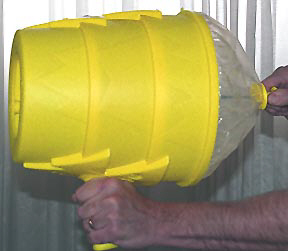
The Brian Jordan plastic "airzooka"
A demonstration of a smoke ring produced by a home-made vortex ring toy.
Smoke ring produced by a home-made vortex ring toy

An air vortex cannon is a toy that releases doughnut-shaped air vortices — similar to smoke rings but larger, stronger and invisible. The vortices can ruffle hair, disturb papers or blow out candles after travelling several metres.

An air vortex cannon can be made easily at home,[1][2] from just a cardboard box.[3]

Air cannons are used in some amusement parks such as Universal Studios to spook or surprise visitors.[citation needed]

Visualization of the air vortex fired from an air vortex cannon

The Wham-O Air Blaster toy introduced in 1965 could blow out a candle at 25 feet (7.6 m).[4][5] The commercial Airzooka was developed by Brian S. Jordan who claims to have conceived it when still a boy. A feature of the Airzooka is a loose non-elastic polythene membrane, tensioned by a bungee cord, rather than elastic membranes. This allows a much greater volume of air to be displaced.[citation needed]

A large air vortex cannon, with a 9 feet (2.7 m) wide barrel and a displacement volume of 2,873 US gallons (10.88 m3) was built in March 2008 at the University of Minnesota, and could blow out candles at 180 feet (55 m).[6][7]

In 2012, a large air vortex cannon was built for Czech Television program Zázraky přírody (lit.'Wonders of Nature'). It was capable of bringing down a wall of cardboard boxes from 100 metres (330 ft) in what was claimed to be a world record.[8]

See also

[edit]

References

[edit]
[edit]
Revisions and contributorsEdit on WikipediaRead on Wikipedia
from Grokipedia
An air vortex cannon is a simple mechanical device that generates and launches stable, doughnut-shaped rings of spinning air known as toroidal vortices, which can travel several meters through the air and interact with objects by delivering a burst of force without rapidly dispersing. These vortices form when a flexible diaphragm, such as a stretched over the end of a cylindrical chamber, is rapidly pulled back and released, compressing and expelling air through a small circular at the opposite end. The sudden burst creates a high-speed jet of air that curls inward due to with the aperture edges and surrounding air, resulting in a self-sustaining ring where internal balances gradients to maintain coherence. This phenomenon demonstrates key principles of and , including momentum transfer and vortex stability, and can be visualized by adding or fog to the chamber. Air vortex cannons have historical roots in early 20th-century demonstrations and military experiments, with modern commercial versions, such as the handheld Airzooka—a device capable of propelling air blasts up to 20 feet (6 m)—developed by inventor Brian S. Jordan around 2002. Jordan, a U.S. aviator, drew inspiration from basic physics experiments, and the quickly gained popularity for its safe, non-projectile way to explore force and motion. Larger iterations, such as those built from trash cans or buckets for classroom or programs, can knock over lightweight targets like cups from distances of 10 feet (3 m) or more, while specialized versions produce visible smoke or even fire rings for dramatic effect when safely fueled with . Air vortex cannons are widely used in STEM education to teach concepts in physical science, including waves, aeronautics, and sound propagation, as seen in hands-on activities developed by organizations like for middle school students. Beyond education, the underlying vortex ring technology appears in natural phenomena, such as those produced by dolphins or for propulsion and hunting, and has inspired engineering applications like studying helicopter rotor wakes or potential non-lethal crowd control devices. Advancements as of 2024 include experimental electromagnetic variants that generate similar vortex-like waves in non-air media, expanding the concept to fields like .

History

Early concepts and military development

The study of vortex rings originated in the 19th century as part of broader investigations into fluid dynamics. In 1858, Hermann von Helmholtz published foundational work on vortex motion, describing vortex rings mathematically and noting their stability in inviscid fluids, which laid the groundwork for later experimental demonstrations. Early observations of vortex rings often involved smoke rings produced by tobacco, with popular tradition attributing initial notice to figures like Sir Walter Raleigh, though systematic study began with Helmholtz's theoretical framework. By the late 1860s, scientists like and Peter Guthrie Tait advanced experimental understanding through demonstrations of smoke rings generated via simple devices, such as a box fitted with a rubber diaphragm to expel smoke-filled air. Kelvin's observations, shared in correspondence with Helmholtz, highlighted the rings' coherent propagation and interactions, including collisions that mimicked atomic behaviors, inspiring his vortex atom theory. These 19th- and early 20th-century experiments emphasized vortex rings' potential as analogs for stable fluid structures, influencing research without initial military intent. During , German engineers adapted principles for anti-aircraft weaponry amid intensifying Allied bombing campaigns. Austrian physicist Mario Zippermayr developed the Windkanone (Whirlwind Cannon) or Turbulenzkanone () starting in 1942, under the oversight of , aiming to launch vortices via explosive mixtures of hydrogen, oxygen, and coal dust to generate shock waves disrupting low-flying bombers. The device featured a large barrel angled upward, with ignition creating a high-velocity air plug or mortar-fired projectile that formed a vortex up to 200 meters away, intended to shear wings or destabilize aircraft through turbulence. Initial prototypes were tested at sites like Zwölfaxing near in summer , where a 60 kg charge produced a pressure wave breaking windows 1,500 meters distant, and later at Hillersleben artillery range, demonstrating board-breaking force at 200 meters but limited real-world efficacy. Further trials in 1944, including at Lofer in , confirmed the cannon's ability to produce "considerable vortex effects" in controlled conditions, but deployment near —such as at the Doeberitz for related prototypes—revealed critical flaws. The vortices proved inconsistent against fast-moving targets due to rapid dissipation in variable winds and , failing to reliably generate sufficient shock waves for use despite claims of potential against bomber formations. Zippermayr's design, one of several "wonder weapons," was ultimately abandoned as ineffective, with no widespread production or battlefield application before the war's end in 1945. In the post-war period, engineer Thomas M. Shelton patented a smoke ring projector in 1953 (filed 1949) that used compressed air to form and propel stable rings.

Commercial and recreational development

An early commercial air vortex cannon was the Air Blaster, introduced in 1965, which could blow out a at 25 feet (7.6 m). The Airzooka, a handheld recreational air vortex cannon, was invented by Brian S. Jordan in the 1980s as a designed to launch invisible vortex rings of air using a frame and elastic mechanism. Jordan, a U.S. naval aviator, conceived the idea during his youth while experimenting with smoke ring generators made from cardboard boxes. The device propels air rings up to approximately 12 meters (40 feet), providing a harmless, battery-free way to disrupt lightweight objects or playfully target individuals from a distance. Commercialization of the Airzooka gained momentum in the early , with Jordan's company, through partnerships like Creative Group Marketing and Can You Imagine, Inc., introducing it to retail markets including Wal-Mart, , and online catalogs. Priced under $15 initially, it quickly became popular as an demonstrating air dynamics, with later models retailing for $20–30 and available through science outlets such as the store. A key related , U.S. Patent 6,983,742 for a collapsible , was granted to Jordan in 2006, facilitating easier manufacturing and shipping of the design. In the 2000s, interest expanded to larger recreational versions suitable for group play or demonstrations, often constructed by hobbyists using everyday materials like plastic buckets and trash bags to create more powerful vortex launchers. Online communities, including , began sharing DIY builds around 2005, promoting accessible projects that amplified the cannon's range and impact for backyard experiments or events without requiring specialized tools. Similar commercial variants, such as the Smash Blast Pro, emerged in the 2020s, offering rapid-fire capabilities and stackable designs while maintaining the core vortex principle.

Physics

Vortex ring formation

In an air vortex cannon, the formation of a begins with the sudden displacement of air within a cylindrical chamber, typically achieved through the rapid motion of a diaphragm or . This impulsive action generates a high-velocity slug of air that exits through a , creating a radial outflow of at the edge. Due to viscous between the fast-moving air and the surrounding stationary , the outflow curls inward and backward, rolling up into a coherent toroidal structure known as a . The circulation Γ\Gamma of the resulting , which quantifies the rotational strength around the toroidal core, is given by Γ=12vd\Gamma = \frac{1}{2} v d, where vv is the initial velocity of the diaphragm or and dd is the of the . This relation arises from the application of Helmholtz's vortex theorems, which ensure the conservation of circulation in inviscid, barotropic flows, adapted here to the initial impulse imparted to the fluid. Immediately after release, the 's toroidal shape is stabilized by the separation of the at the edge, which initiates the roll-up , preventing premature . Key factors influencing efficient formation include the ratio of the chamber length (or piston stroke) to the orifice diameter, with an optimal range of 3:1 to 5:1 maximizing energy transfer from the chamber to the ring while minimizing excess trailing that could disrupt coherence. Visualization of these otherwise invisible air rings is often achieved using , which reveals density gradients in the flow through variations.

Propagation and stability

Once formed, vortex rings propagate forward through self-induced motion resulting from mutual induction between the azimuthal vorticity elements comprising the ring structure. This process drives the ring at initial speeds of up to 20–30 m/s, governed approximately by the relation UΓ4πR(ln8Ra14)U \approx \frac{\Gamma}{4\pi R} \left( \ln \frac{8R}{a} - \frac{1}{4} \right), where Γ\Gamma denotes the circulation, RR the ring radius, and aa the core radius, as derived from Thomson's foundational analysis of vortex motion. The stability of propagating vortex rings depends critically on flow conditions, particularly the Reynolds number (ReRe). In low-ReRe regimes (Re<104Re < 10^4), rings remain laminar and coherent, traveling distances of 10–50 meters before significant dissipation; higher ReRe introduces turbulence, leading to breakup through Kelvin-Helmholtz instability at shear layers within the ring core. Vortex rings gradually lose coherence due to viscous drag, which diffuses the vorticity concentration over time. The characteristic decay timescale is given by τR2ν\tau \approx \frac{R^2}{\nu}, where ν\nu is the kinematic viscosity of air (1.5×10⁵\approx 1.5 \times 10^{-5} m²/s), such that larger rings (e.g., 1 m diameter) propagate farther than smaller ones owing to their slower relative diffusion rates.

Design and construction

Basic components

The chamber of an air vortex cannon serves as a cylindrical to store and compress air before release, typically constructed from PVC pipe with a of 10–30 cm and of 30–60 cm to achieve an optimal volume for generating a pulse. This allows the volume Vπr2LV \approx \pi r^2 L, where rr is the and LL the , to facilitate efficient air displacement upon actuation. In educational and recreational builds, materials like clear Perspex or are also used for during operation, such as a 60 cm long chamber with a 30 cm square cross-section to minimize external air interference. The diaphragm or creates the necessary differential by rapidly displacing air, often using an elastic such as or plastic sheeting stretched over the chamber's open end, secured with bungee cords or tape, or a mechanical pulled back 10–30 to build 0.1–0.5 atm of . For instance, a is pulled and released to impulsively push air forward, while piston-style actuators, like an inner PVC pipe connected via bungee cables, provide adjustable displacement for controlled vortex formation. Speaker-driven actuators, enclosed in a wooden , offer precise control in scientific setups by vibrating to eject air. The , typically a flanged open end with a 5–10 diameter and smooth edges, shapes the outflow into a coherent ring vortex by promoting and minimizing during expulsion. Constructed from PVC or plastic with a sharp at the exit, it ensures the air pulse forms a stable toroidal structure, as seen in designs with 2–5 internal diameters for targeted ring generation. A lightweight frame, often made from , , or wooden planks, supports and aligns the components to enable efficient energy transfer from the to . In simple assemblies, the chamber itself provides primary structure, supplemented by tape or brackets to maintain airtight seals and alignment, through minimal frictional losses in basic designs.

Variations and DIY builds

Handheld variations of air vortex cannons adapt the basic design for portability, often resembling the commercial Airzooka toy, which measures approximately 27 cm in length and uses an accordion-style mechanism instead of a rigid diaphragm to compress and release air. These compact builds reduce the overall size to around 30 cm, allowing easy one-handed operation and transport for recreational use. Large-scale builds employ everyday containers like 5-gallon plastic reinforced with trash can lids, paired with trash bag diaphragms to generate more powerful vortices capable of ranges up to 10–15 m. A simple DIY version using a can be constructed in about 30 minutes with materials costing under $10, including a plastic , trash bag, staples, and . The steps are: (1) Cut a 5–8 cm (2–3 inch) hole in the bottom of a 5-gallon to serve as the ; (2) Stretch a trash bag over the open top and secure it tightly with staples around the rim to form an elastic ; (3) Pull back on the center of the membrane to compress air inside, then release sharply to fire a . Advanced modifications include aerosol-fueled versions that achieve higher velocities through ignited bursts within the chamber, as demonstrated in experimental setups using propane-air mixtures for rapid expansion and vortex formation. These designs require strict safety precautions due to flammability risks, such as conducting tests in controlled environments to mitigate hazards equivalent to small TNT charges.

Applications

Recreational and educational

Air vortex cannons have gained popularity as recreational toys, particularly through commercial products like the Airzooka, which allows users to launch invisible air rings that can ruffle hair or knock over lightweight objects such as paper cups or candles from distances of up to 6–12 meters. These devices, often used in and casual play, emphasize harmless fun without projectiles, making them suitable for indoor and outdoor settings. The Airzooka, developed by inventor Brian S. Jordan and released in the early , builds on earlier concepts like the 1965 Wham-O Air Blaster but popularized the vortex mechanism for entertainment. In educational contexts, air vortex cannons serve as engaging demonstrations to illustrate basic principles of , such as the formation and propagation of air rings. For instance, NASA's 2020 activity guide provides instructions for constructing a simple using household materials to create visible air blasts, helping students qualitatively explore concepts like differences and without delving into complex equations. Similar hands-on projects appear in STEM curricula from organizations like Science Buddies, where participants build DIY versions to observe vortex stability and encourage interest in physics through interactive experimentation. These activities are accessible for children aged 8 and older, promoting safe exploration of air while fostering curiosity in science. Large-scale versions of air vortex cannons have featured in public events and science fairs to captivate audiences with visual spectacles, such as propelling lightweight targets across rooms or extinguishing distant flames. A notable example is the for the tallest artificial air vortex, achieved at 34.43 meters in , , in 2007, which demonstrated the device's potential for dramatic, educational displays. Such demonstrations, often at museums or festivals, highlight the cannon's ability to make abstract concepts tangible and exciting for learners of all ages.

Scientific and practical uses

Air vortex cannons have been investigated for fire suppression applications, where vortex rings can deliver suppressant agents with high precision to penetrate flames more effectively than traditional sprays. Researchers at developed a portable device in 2025 that uses electrically assisted wind to generate ionic s, successfully extinguishing small fires at distances up to 2 meters without chemical residues, offering a safer alternative for firefighters in confined spaces. A 2024 MDPI study highlighted technology's potential in management, demonstrating improved suppressant distribution through stable ring propagation that maintains coherence over short ranges. In medical and biological applications, stable vortex rings enable targeted aerosol delivery of pharmaceuticals, minimizing dispersion and enhancing deposition in specific anatomical sites. A 2022 study examined the role of vortical flows, including vortex rings, in particle transport within respiratory models, showing reduced dispersion and improved lung deposition efficiency for inhaled therapeutics compared to conventional nebulization. Similarly, research on ocular drug delivery demonstrated that aerosol-loaded toroidal vortices from specialized devices achieve precise surface application with low velocity, overcoming barriers like tear film dilution and achieving up to 80% retention rates in ex vivo models. These approaches leverage the rings' inherent stability for controlled release in sensitive environments. Military and defense research has explored air vortex cannons for non-lethal applications, such as and counter-drone operations, by generating high-energy gas rings to disorient targets without permanent harm. Concepts for guns, which propel rings of air or irritants like , have been prototyped since the early 2000s for standoff incapacitation, with rings traveling up to 50 meters to deliver kinetic or chemical effects. Recent demonstrations, including tests against small drones, illustrate their potential in disrupting unmanned aerial systems through air pulses, building on historical pneumatic designs for modern tactical use. As research tools, air vortex cannons facilitate studies of and in controlled environments like wind tunnels, where generated rings simulate natural vortical structures for analyzing wake interactions and energy cascades. Experimental setups using vortex rings have quantified turbulence generation through ring collisions, revealing mechanisms like that contribute to energy dissipation in high-Reynolds-number flows. Electromagnetic variants, developed in 2024, extend this capability by producing toroidal electromagnetic pulses with orbital , enabling investigations into twisted electromagnetic fields for high-capacity communication and target detection without physical projectiles. The propagation stability of these rings supports long-range delivery in such experiments, maintaining structural integrity over distances relevant to atmospheric studies.

References

Add your contribution
Related Hubs
User Avatar
No comments yet.