


Community hub
Recent from talks
Contribute something
Nothing was collected or created yet.
WR 86
View on Wikipedia| Observation data Epoch J2000.0 Equinox J2000.0 | |
|---|---|
| Constellation | Scorpius[2] |
| Right ascension | 17h 18m 23.06137s[3] |
| Declination | −34° 24′ 30.6308″[3] |
| Apparent magnitude (V) | 9.27[4] |
| Characteristics | |
| Evolutionary stage | Wolf-Rayet star[5] |
| Spectral type | WC7 + B0III[5] |
| Apparent magnitude (J) | 7.436[6] |
| Apparent magnitude (K) | 6.666[7] |
| U−B color index | −0.07[8] |
| B−V color index | +0.63[8] |
| Variable type | β Cep[4] |
| Astrometry | |
| Proper motion (μ) | RA: −0.92[3] mas/yr Dec.: −4.80[3] mas/yr |
| Parallax (π) | 1.84±1.62 mas[3] |
| Distance | 2,100±800[5] pc |
| Absolute magnitude (MV) | −4.3 + −4.3[5] |
| Details | |
| WR | |
| Radius | 10[9] R☉ |
| Luminosity | 200,000[5][9] L☉ |
| Temperature | 56,000[9] K |
| B | |
| Mass | 19 M☉ |
| Radius | ~8.5 (SBL) R☉ |
| Luminosity | 63,000[5] L☉ |
| Temperature | 31,405[5] K |
| Age | 4.0[5] Myr |
| Other designations | |
| V1035 Scorpii, CD−34°11622, HD 156327, HIP 84655, 2MASS J17182306-3424306, WDS J17184-3425 | |
| Database references | |
| SIMBAD | data |

WR 86 is a visual binary in the constellation Scorpius consisting of a Wolf-Rayet star and a β Cephei variable. It lies 2° west of NGC 6357 on the edge of the Great Rift in the Milky Way in the tail of the Scorpion.
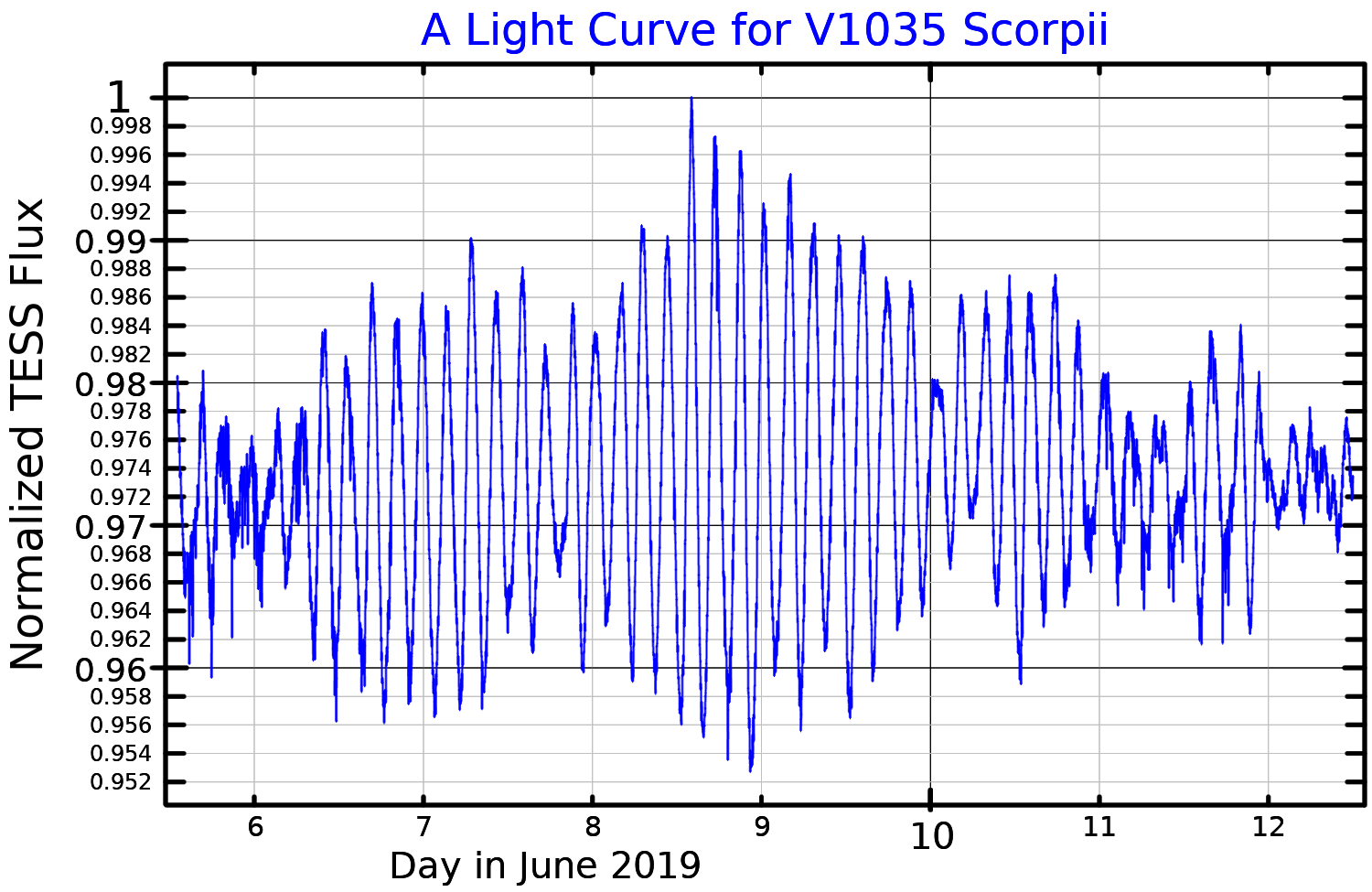
WR 86 is a binary with two components of equal visual brightness 0.3" apart.[10] One has the emission-line spectrum of a WC7 Wolf-Rayet star, while the other is a B0 giant. Peter Monderen et al. discovered that the star is a variable star, in April 1986.[11] It was given its variable star designation, V1035 Scorpii, in 1997.[12] The blue giant varies slightly in brightness every 3.5 hours. The WR star may also be slightly variable.[5]
The pulsations of the B-type giant are characteristic of a β Cephei variable. Analysis of its pulsations and comparison to the expected properties of a WC7 star suggest that both stars could have evolved without mass exchange. The WR and B stars would have had initial masses of 40 M☉ and 20 M☉ respectively four million years ago.[5]
References
[edit]- ^ "MAST: Barbara A. Mikulski Archive for Space Telescopes". Space Telescope Science Institute. Retrieved 8 December 2021.
- ^ Anderson, E.; Francis, Ch. (2012). "XHIP: An extended hipparcos compilation". Astronomy Letters. 38 (5): 331. arXiv:1108.4971. Bibcode:2012AstL...38..331A. doi:10.1134/S1063773712050015.
- ^ a b c d e Van Leeuwen, F. (2007). "Validation of the new Hipparcos reduction". Astronomy and Astrophysics. 474 (2): 653–664. arXiv:0708.1752. Bibcode:2007A&A...474..653V. doi:10.1051/0004-6361:20078357. S2CID 18759600.
- ^ a b Samus, N. N.; Durlevich, O. V.; et al. (2009). "VizieR Online Data Catalog: General Catalogue of Variable Stars (Samus+ 2007-2013)". VizieR On-line Data Catalog: B/GCVS. Originally Published in: 2009yCat....102025S. 1. Bibcode:2009yCat....102025S.
- ^ a b c d e f g h i j Paardekooper, S. J.; Veen, P. M.; Van Genderen, A. M.; Van Der Hucht, K. A. (2002). "On the variability of the visual binary WR86. WC7 with a β-Cephei companion". Astronomy and Astrophysics. 384 (3): 1012. Bibcode:2002A&A...384.1012P. doi:10.1051/0004-6361:20020085.
- ^ Cutri, Roc M.; Skrutskie, Michael F.; Van Dyk, Schuyler D.; Beichman, Charles A.; Carpenter, John M.; Chester, Thomas; Cambresy, Laurent; Evans, Tracey E.; Fowler, John W.; Gizis, John E.; Howard, Elizabeth V.; Huchra, John P.; Jarrett, Thomas H.; Kopan, Eugene L.; Kirkpatrick, J. Davy; Light, Robert M.; Marsh, Kenneth A.; McCallon, Howard L.; Schneider, Stephen E.; Stiening, Rae; Sykes, Matthew J.; Weinberg, Martin D.; Wheaton, William A.; Wheelock, Sherry L.; Zacarias, N. (2003). "VizieR Online Data Catalog: 2MASS All-Sky Catalog of Point Sources (Cutri+ 2003)". CDS/ADC Collection of Electronic Catalogues. 2246: II/246. Bibcode:2003yCat.2246....0C.
- ^ Van Der Hucht, K. A. (2006). "New Galactic Wolf-Rayet stars, and candidates. An annex to the VIIth Catalogue of Galactic Wolf-Rayet Stars". Astronomy and Astrophysics. 458 (2): 453–459. arXiv:astro-ph/0609008. Bibcode:2006A&A...458..453V. doi:10.1051/0004-6361:20065819. S2CID 119104786.
- ^ a b Ducati, J. R. (2002). "VizieR Online Data Catalog: Catalogue of Stellar Photometry in Johnson's 11-color system". CDS/ADC Collection of Electronic Catalogues. 2237. Bibcode:2002yCat.2237....0D.
- ^ a b c Sander, A.; Hamann, W.-R.; Todt, H. (2012). "The Galactic WC stars. Stellar parameters from spectral analyses indicate a new evolutionary sequence". Astronomy & Astrophysics. 540: A144. arXiv:1201.6354. Bibcode:2012A&A...540A.144S. doi:10.1051/0004-6361/201117830. S2CID 119182468.
- ^ Mason, Brian D.; Wycoff, Gary L.; Hartkopf, William I.; Douglass, Geoffrey G.; Worley, Charles E. (2001). "The 2001 US Naval Observatory Double Star CD-ROM. I. The Washington Double Star Catalog". The Astronomical Journal. 122 (6): 3466. Bibcode:2001AJ....122.3466M. doi:10.1086/323920.
- ^ Monderen, P.; De Loore, C. W. H.; van der Hucht, K. A.; van Genderen, A. M. (April 1988). "Short-timescale light variations of the Wolf-Rayet stars WR 46 and WR86". Astronomy and Astrophysics. 195: 179–182. Bibcode:1988A&A...195..179M. Retrieved 16 September 2025.
- ^ Kazarovets, E. V.; Samus, N. N. (April 1997). "The 73rd Name-List of Variable Stars" (PDF). Information Bulletin on Variable Stars. 4471. Bibcode:1997IBVS.4471....1K. Retrieved 16 September 2025.
