


Community hub
Recent from talks
Contribute something
Nothing was collected or created yet.
Messier 4
View on Wikipedia| Messier 4 | |
|---|---|
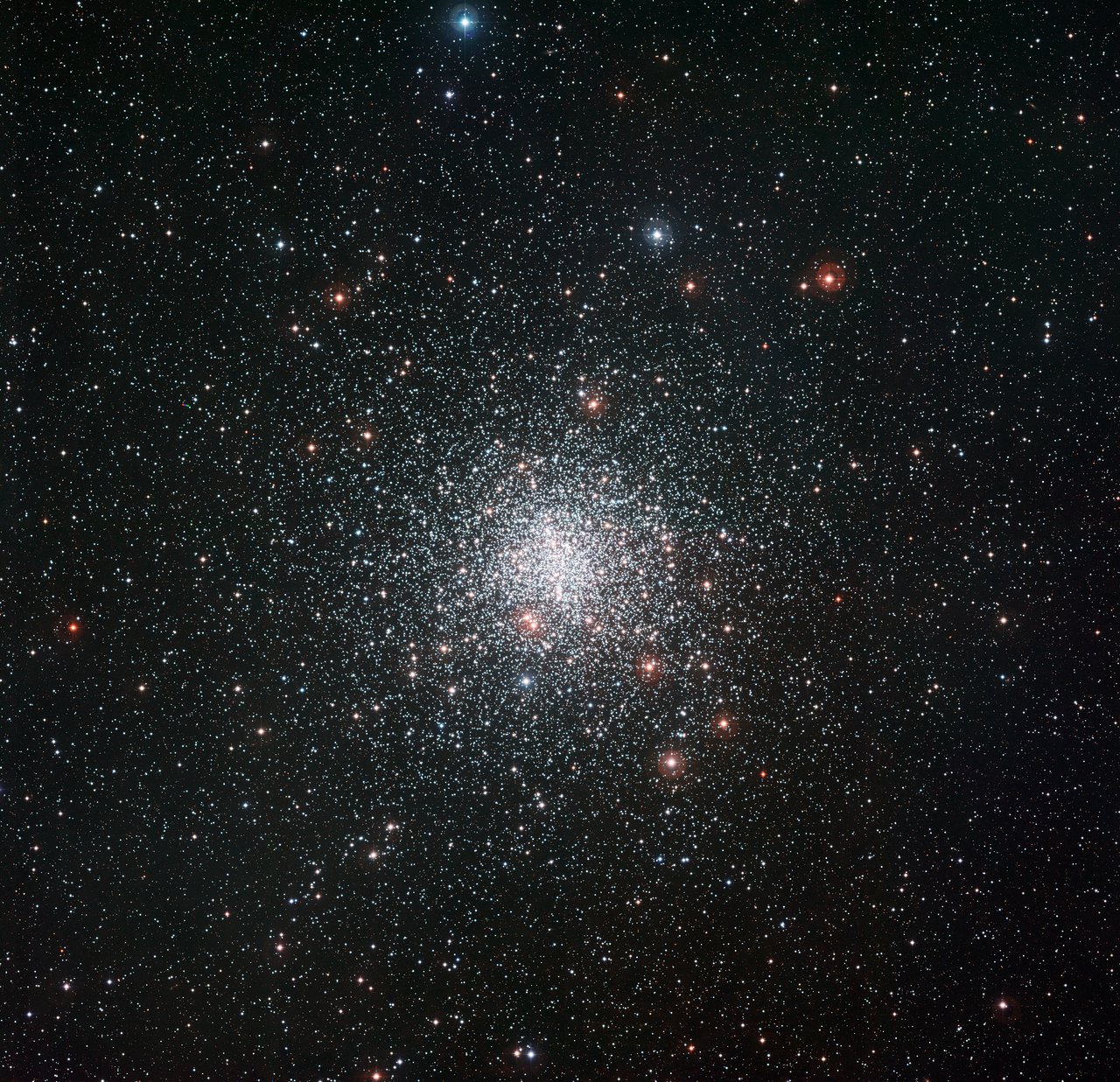
 Globular star cluster Messier 4 | |
| Observation data (J2000 epoch) | |
| Class | IX[1] |
| Constellation | Scorpius |
| Right ascension | 16h 23m 35.22s[2] |
| Declination | −26° 31′ 32.7″[2] |
| Distance | 6.033 kly (1.850 kpc)[3] |
| Apparent magnitude (V) | 5.6[4] |
| Apparent dimensions (V) | 26′.0 |
| Physical characteristics | |
| Mass | 8.4×10⁴[5] M☉ |
| Radius | 35 light-years [citation needed] |
| Metallicity | [Fe/H] = −1.07[6] dex |
| Estimated age | (12.2 ± 0.2) Gyr[7] |
| Notable features | Closest globular cluster |
| Other designations | NGC 6121[8] |
Messier 4 or M4 (also known as NGC 6121 or the Spider Globular Cluster) is a globular cluster in the constellation of Scorpius. It was discovered by Philippe Loys de Chéseaux in 1745 and catalogued by Charles Messier in 1764.[9] It was the first globular cluster in which individual stars were resolved.[9]
Visibility
[edit]M4 is conspicuous in even the smallest of telescopes as a fuzzy ball of light. It appears about the same size as the Moon in the sky. It is one of the easiest globular clusters to find, being located only 1.3 degrees west of the bright star Antares, with both objects being visible in a wide-field telescope. Modestly sized telescopes will begin to resolve individual stars, of which the brightest in M4 are of apparent magnitude 10.8.[9]
Characteristics
[edit]M4 is a rather loosely concentrated cluster of class IX and measures 75 light-years across. It features a characteristic "bar" structure across its core, visible to moderate sized telescopes. The structure consists of 11th-magnitude stars and is approximately 2.5′ long and was first noted by William Herschel in 1783. At least 43 variable stars have been observed within M4.[9]
M4 is approximately 6,000 light-years away,[10] making it the closest globular cluster to the Solar System. It has an estimated age of 12.2 billion years.[7]
In astronomy, the abundance of elements other than hydrogen and helium is called the metallicity, and it is usually denoted by the abundance ratio of iron to hydrogen as compared to the Sun. For this cluster, the measured abundance of iron is equal to [Fe/H] = −1.07±0.1. This value is the logarithm of the ratio of iron to hydrogen relative to the same ratio in the Sun. Thus the cluster has an abundance of iron equal to 8.5% of the iron abundance in the Sun. This strongly suggests this cluster hosts two distinct stellar populations, differing by age. Thus the cluster probably saw two main cycles or phases of star formation.[6]
The space velocity components are (U, V, W) = (−57±3, −193±22, −8±5) km/s. This confirms an orbit around the Milky Way of a period of (116±3) million years with eccentricity 0.80±0.03: during periapsis it comes within (0.6 ± 0.1) kpc from the galactic core, while at apoapsis it travels out to (5.9±0.3) kpc. The inclination is at (an angle of) 23°±6° from the galactic plane, thus it reaches as much as (1.5±0.4) kpc above the disk.[11] When passing through the disk, this cluster does so at less than 5 kpc from the galactic nucleus. The cluster undergoes tidal shock during each passage, which can cause the repeated shedding of stars. Thus the cluster may have been much more massive.[6]
Notable stars
[edit]Photographs by the Hubble Space Telescope in 1995 found white dwarf stars in M4 that are among the oldest known stars in our galaxy; aged 13 billion years. One has been found to be a binary star with a pulsar companion, PSR B1620−26 and a planet orbiting it with a mass of 2.5 times that of Jupiter (MJ).[12] One star in Messier 4 was also found to have much more of the rare light element lithium than expected.[13]
CX-1 Is located in M4. It is known as a possible millisecond pulsar/neutron star binary. It orbits in 6.31 hours.[14]
Spinthariscope analogy
[edit]The view of Messier 4 through a good telescope was likened by Robert Burnham Jr. to that of hyperkinetic luminous alpha particles seen in a spinthariscope.[15]
Central black hole
[edit]
In 2023, an analysis of Hubble Space Telescope and European Space Agency's Gaia spacecraft data from Messier 4 revealed an excess mass of roughly 800 solar masses in the center of this cluster, which appears to not be extended. This could thus be considered as kinematic evidence for an intermediate-mass black hole[5][16] (even if an unusually compact cluster of compact objects like white dwarfs, neutron stars or stellar-mass black holes cannot be completely discounted).
References
[edit]- ^ Shapley, Harlow; Sawyer, Helen B. (August 1927). "A Classification of Globular Clusters". Harvard College Observatory Bulletin. 849 (849): 11–14. Bibcode:1927BHarO.849...11S.
- ^ a b Goldsbury, Ryan; et al. (December 2010). "The ACS Survey of Galactic Globular Clusters. X. New Determinations of Centers for 65 Clusters". The Astronomical Journal. 140 (6): 1830–1837. arXiv:1008.2755. Bibcode:2010AJ....140.1830G. doi:10.1088/0004-6256/140/6/1830. S2CID 119183070.
- ^ Baumgardt, H.; et al. (2021). "Accurate distances to Galactic globular clusters through a combination of Gaia EDR3, HST, and literature data". Monthly Notices of the Royal Astronomical Society. 505 (4): 5957–5977. arXiv:2105.09526. Bibcode:2021MNRAS.505.5957B. doi:10.1093/mnras/stab1474.
- ^ "Messier 4". SEDS Messier Catalog. Retrieved 21 July 2024.
- ^ a b c Vitral, E.; et al. (2023). "An elusive dark central mass in the globular cluster M4". Monthly Notices of the Royal Astronomical Society. 522 (4): 5740–5757. arXiv:2305.12702. Bibcode:2023MNRAS.522.5740V. doi:10.1093/mnras/stad1068.
- ^ a b c Marino, A. F.; et al. (November 2008). "Spectroscopic and photometric evidence of two stellar populations in the Galactic globular cluster NGC 6121 (M 4)". Astronomy and Astrophysics. 490 (2): 625–640. arXiv:0808.1414. Bibcode:2008A&A...490..625M. doi:10.1051/0004-6361:200810389. S2CID 15786238.
- ^ a b Caputo, F.; Castellani, V.; Quarta, M. L. (February 1985). "Reddening, distance modulus and age of the globular cluster NGC 6121 (M4) from the properties of RR Lyrae variables". Astronomy and Astrophysics. 143 (1): 8–12. Bibcode:1985A&A...143....8C.
- ^ "M 4". SIMBAD. Centre de données astronomiques de Strasbourg. Retrieved 2010-03-25.
- ^ a b c d "Messier Object 4". www.messier.seds.org. Retrieved 2023-11-13.
- ^ Baumgardt, H.; et al. (2021). "Accurate distances to Galactic globular clusters through a combination of Gaia EDR3, HST, and literature data". Monthly Notices of the Royal Astronomical Society. 505 (4): 5957–5977. arXiv:2105.09526. Bibcode:2021MNRAS.505.5957B. doi:10.1093/mnras/stab1474.
- ^ Dinescu, Dana I.; Girard, Terrence M.; van Altena, William F. (April 1999). "Space Velocities of Globular Clusters. III. Cluster Orbits and Halo Substructure". The Astronomical Journal. 117 (4): 1792–1815. Bibcode:1999AJ....117.1792D. doi:10.1086/300807.
- ^ "Ancient orbs". ESA/Hubble Picture of the Week. Retrieved 3 September 2012.
- ^ "A Cluster with a Secret". ESO Press Release. Retrieved 5 September 2012.
- ^ Kaluzny, J.; Rozanska, A.; Rozyczka, M.; Krzeminski, W.; Thompson, Ian B. (May 2012). "A second neutron star in M4?". The Astrophysical Journal Letters. 750 (1): L3. arXiv:1203.5971. Bibcode:2012ApJ...750L...3K. doi:10.1088/2041-8205/750/1/L3. S2CID 118323035. Retrieved 1 March 2021.
- ^ Celestial Handbook, Volume three: Pavo through Vulpecula Robert Burnham Jr. page 1703.
- ^ a b "NASA's Hubble Hunts for Intermediate-Sized Black Hole Close to Home". NASA. 23 May 2023. Retrieved 23 May 2023.
See also
[edit]External links
[edit]
- M4, SEDS Messier pages
- M4, Galactic Globular Clusters Database page
- "Hubble Space Telescope Finds Stellar Graveyard". Hubble News Desk. 1995-08-28. Retrieved 2006-05-24.
- Gray, Meghan. "M4 – Globular Cluster". Deep Sky Videos. Brady Haran.
- Messier 4 on WikiSky: DSS2, SDSS, GALEX, IRAS, Hydrogen α, X-Ray, Astrophoto, Sky Map, Articles and images


| List |
|  |
|---|---|---|
| See also | ||


Messier 4
View on GrokipediaDiscovery and Observation
Discovery and Cataloging
Messier 4 was first discovered by the Swiss astronomer Philippe Loys de Chéseaux in 1745–1746 during his observations of southern sky objects, where he cataloged it as the 19th entry in his list of nebulae and noted its appearance as a hazy patch without resolved stellar components.[3] This discovery was later incorporated into Nicolas-Louis de Lacaille's 1755 catalog of southern objects as Lacaille I.9, further documenting its position near the bright star Antares in Scorpius.[3] Independently rediscovered by French astronomer Charles Messier on May 8, 1764, the object was added as the fourth entry in his renowned catalog of nebulae and star clusters, earning the designation M4.[3] Messier described it as "A cluster of very small stars; with a small telescope it can be seen in the form of a nebula," marking it as the only globular cluster he could partially resolve into individual stars using his 3.5-inch refractor telescope at the time.[7] This cataloging effort was part of Messier's broader project to compile a list of deep-sky objects to aid comet hunters in distinguishing them from cometary apparitions.[8] The object's nature as a globular cluster became more apparent through subsequent observations in the late 18th century, with British astronomer William Herschel independently observing it on May 22, 1783, and classifying it as a "very compressed and rich star cluster" (Class VI.10 in his system), noting a central bar of 11th-magnitude stars approximately 2.5 arcminutes long.[7] Herschel's larger reflecting telescopes allowed for greater resolution, confirming its stellar composition and contributing to the early understanding of globular clusters as distinct from true nebulae.[3] By the 19th century, astronomers such as John Herschel had further sketched and described M4's dense, spherical arrangement of stars, solidifying its status as one of the earliest globular clusters to be systematically studied and recognized as a resolved stellar aggregate rather than a nebulous entity.Visibility and Appearance
Messier 4 is situated 1.3° west of the prominent red supergiant Antares (Alpha Scorpii) in the constellation Scorpius, making it relatively easy to locate with basic star charts. Its equatorial coordinates for the J2000 epoch are right ascension 16h 23m 35.22s and declination −26° 31′ 32.7″. As the nearest globular cluster to Earth, it offers a favorable position for observation from mid-southern latitudes.[9][3] With an apparent visual magnitude of 5.6, Messier 4 is invisible to the naked eye under typical light-polluted conditions but may appear as a faint, fuzzy patch comparable in angular size to the full Moon (about 36 arcminutes across) from pristine dark skies. In binoculars, it resembles a compact, unresolved glow, often tinged slightly orange due to interstellar dust absorption along the line of sight. Small telescopes (under 4 inches) reveal it as a brighter, more defined ball of light, though still unresolved into distinct stars.[3] Resolving individual stars requires telescopes of 4–6 inches in aperture, where the brightest members at magnitude 10.8–11 begin to emerge against the dense backdrop. In larger instruments, a striking linear "bar" of 11th-magnitude stars, stretching about 2.5 arcminutes in length at a position angle of 12°, becomes prominent across the cluster's central region, adding to its distinctive elongated appearance. The overall view through a good telescope evokes a scintillating swarm, likened by astronomer Robert Burnham Jr. to the hyperkinetic flashes of alpha particles in a spinthariscope.[3][12][13] Messier 4 is optimally visible during June evenings from the Southern Hemisphere, when Scorpius culminates high overhead, though it remains observable from northern latitudes during summer months before midnight. Seasonal windows extend from late May through August in the south, with the cluster rising earlier in the evening as the season progresses.[14][6]Physical Characteristics
Distance, Size, and Age
Messier 4 lies at a distance of 6,033 light-years (1.850 ± 0.02 kpc) from the Solar System, rendering it the nearest globular cluster to Earth. This measurement, derived from a combination of Gaia Early Data Release 3 astrometry, Hubble Space Telescope photometry, and literature data, positions the cluster approximately 6.45 ± 0.01 kpc from the Galactic center and near the interface between the galactic disk and halo.[15][16] The cluster spans an apparent diameter of 36 arcminutes on the sky, equivalent to a physical diameter of about 63 light-years given its proximity. Messier 4 has a total mass of 8.4 × 10⁴ solar masses and is classified as concentration class IX on the Shapley-Sawyer scale, reflecting its loosely concentrated core with a core radius of roughly 0.45 pc and a half-mass radius of 3.95 pc.[17][18][16][19][3] Estimates place the age of Messier 4 at 12.2 ± 0.2 billion years, obtained through main-sequence fitting to color-magnitude diagrams and analysis of white dwarf cooling sequences, which provide independent constraints on the cluster's formation timeline. These methods highlight the cluster's status as one of the oldest stellar systems in the Milky Way, predating the Solar System by nearly three times.[20][21]Metallicity and Orbital Parameters
Messier 4 exhibits a metallicity of [Fe/H] = −1.07, indicating an iron abundance approximately 8.5% that of the Sun, a value characteristic of ancient halo globular clusters formed in the early Milky Way.[22] This low metal content reflects the cluster's origin from primordial gas with limited enrichment from previous stellar generations, aligning with its estimated age of around 12 billion years.[23] The cluster follows a highly eccentric orbit around the Galactic center, with an orbital period of 116 ± 3 million years. Its eccentricity measures 0.80 ± 0.03, leading to a perigalacticon distance of roughly 0.62 kpc and an apogalacticon of about 6.52 kpc from the center. Additionally, the orbital plane is inclined at 23° ± 6° relative to the Galactic plane, positioning Messier 4 as a member of the inner halo population.[24] This eccentric trajectory brings the cluster into close proximity with the Galactic disk during perigalacticon passages, subjecting it to strong tidal forces from the interstellar medium and the Galaxy's gravitational potential. Such interactions promote ongoing mass loss through stellar stripping and evaporation, contributing to the cluster's observed low present-day mass of approximately 8.4 × 10^4 solar masses despite its ancient formation.[23] These dynamics highlight Messier 4's role in tracing the Milky Way's halo assembly and evolution.Stellar Population
Composition and Variables
Messier 4 contains an estimated 100,000 stars, the majority of which are low-mass main-sequence stars with masses between approximately 0.09 and 0.65 solar masses, alongside a population of evolved red giants.[2][25] The stellar population is dominated by K- and M-type dwarfs on the lower main sequence and features two distinct populations with slightly varying metallicities, reflecting the cluster's ancient, metal-poor nature with an overall metallicity of [Fe/H] = -1.16.[23][12] The horizontal branch exhibits a predominantly blue morphology, consistent with the helium core flash that occurs in low-mass stars during the red giant branch phase, leading to a well-defined sequence of hot helium-burning stars.[26] Approximately 95 variable stars have been confirmed within Messier 4 (from 116 suspects), including a significant number of RR Lyrae variables that serve as standard candles for distance calibration due to their well-known periods and luminosities.[3] Of these, 47 are RR Lyrae stars—approximately 36 of the fundamental mode (RRab) and 11 of the first overtone (RRc)—with pulsation periods ranging from 0.23 to 0.63 days; their light curves display characteristic asymmetric shapes with rapid rises and slower declines typical of radial pulsations in horizontal branch stars.[3][27] The cluster has a projected half-light radius of 4.33 arcminutes and a core radius of 1.16 arcminutes, corresponding to a relatively low central density and sparse core typical of concentration class IX globular clusters.[23] Resolved observations indicate a binary fraction of about 15% among the stellar population, higher than in many other globular clusters, as determined from photometric and astrometric monitoring of brightness variations and proper motions.[28]Notable Objects
One of the most remarkable objects in Messier 4 is the triple system PSR B1620−26, comprising a millisecond pulsar and a low-mass white dwarf in a close orbit with a period of approximately 191 days, orbited by a circumbinary gas giant exoplanet designated PSR B1620−26 b.[29] The planet, nicknamed Methuselah, has a mass of about 2.5 Jupiter masses and completes its highly eccentric orbit around the binary pair every roughly 100 years at a semi-major axis of 23 AU, surviving in the dense cluster environment through dynamical capture rather than in situ formation.[30] This system, located just outside the cluster core, provides key insights into planetary survival in globular clusters and dates to over 12 billion years old, comparable to the cluster's age.[29] A standout stellar anomaly in Messier 4 is a lithium-rich dwarf star on the cluster's turn-off region, exhibiting an unusually high lithium abundance of log ε(Li) ≈ 2.8, far exceeding the typical depletion expected from standard stellar evolution models for such ancient, metal-poor stars.[31] This detection challenges theories of lithium preservation or production, suggesting possible external pollution from prior stellar generations or internal mixing processes not accounted for in canonical models.[31] Among the cluster's X-ray emitting sources, CX-1 stands out as a variable Chandra-detected object with a luminosity of about 8 × 10^{31} erg s^{-1} in the 0.5–2.5 keV band, likely a cataclysmic variable or low-mass X-ray binary involving a neutron star accretor. Its hard power-law spectrum (photon index ≈ 1.0) and optical counterpart showing Hα excess indicate ongoing mass transfer, consistent with a compact binary nature, though no precise orbital period has been confirmed. The brightest resolved stars in Messier 4 are red giants along the cluster's red giant branch, reaching apparent visual magnitudes of 11.0 to 12.0, with several exhibiting variability as part of the cluster's approximately 95 confirmed variables, including early-designated examples like V1 from classical surveys. Post-2020 astrometric and photometric analyses have revealed an elevated fraction of binary systems among these giants, highlighting unusual dynamical interactions in the cluster's core, though no additional confirmed exoplanets beyond PSR B1620−26 b have been identified.[28]Scientific Studies
Stellar Evolution and White Dwarfs
Messier 4 hosts a substantial population of white dwarfs, the end products of low- to intermediate-mass stellar evolution, which have been identified primarily through deep Hubble Space Telescope (HST) imaging campaigns initiated in 1995. Early HST observations resolved the first extensive cooling sequence of white dwarfs in a globular cluster, revealing dozens of these faint objects in a small field, with subsequent deeper exposures identifying over 270 white dwarfs down to visual magnitudes of approximately V = 30.[32] These white dwarfs, remnants of stars with initial masses up to about 8 solar masses, provide a snapshot of the cluster's ancient stellar population, as their progenitors have long since evolved off the main sequence.[33] The cooling sequences of these white dwarfs, traced through their luminosity function, exhibit a sharp rise in number counts at faint magnitudes (I > 25.5), characteristic of a single-burst stellar population with minimal ongoing star formation. HST's high resolution has been crucial for isolating these objects at apparent magnitudes fainter than 28, enabling detailed modeling of their cooling tracks and confirming the cluster's age at 12.2 ± 0.5 billion years through comparisons with standard white dwarf evolutionary models.[34] This age aligns with isochrone fits to the main-sequence turnoff and underscores the uniformity of stellar evolution in this ancient environment. Due to Messier 4's advanced age, observations of its surviving low-mass main-sequence stars and white dwarf progenitors offer unique insights into the low-mass end of the initial mass function (IMF), where higher-mass stars have evolved away. HST photometry of the lower main sequence reveals a shallow IMF slope of α ≈ 0.75 (where dN/dM ∝ M^{-α}) down to masses of ~0.09 solar masses, indicating a slow rise in the number of low-mass stars without a clear turnover in this range. Theoretical models suggest a potential IMF turnover around 0.1–0.2 solar masses, influenced by the cluster's dynamics and binary interactions, which preferentially probe this regime in old systems like Messier 4.[35] A 2025 JWST study of the white dwarf cooling sequence in Messier 4, using infrared imaging, confirmed the presence of collision-induced absorption effects and observed a broader color dispersion at faint magnitudes, possibly due to infrared excess. This analysis refined the age estimate and provides deeper insights into white dwarf atmospheres in dense environments.[34] Overall, the white dwarf population in Messier 4 implies globular cluster formation occurred within the first billion years after the Big Bang, providing constraints on early universe star formation efficiency and chemical enrichment.Central Black Hole
A 2023 study utilizing proper motion data from the Hubble Space Telescope and Gaia mission revealed anomalies in the velocity dispersion of stars near the core of Messier 4, indicating the presence of an excess dark mass concentrated at the cluster's center.[36] This analysis employed Bayesian Jeans modeling to derive the mass profile, assuming isotropic motions in the core and tangential anisotropy (β ≈ -0.4 ± 0.1) in the outskirts, which robustly pointed to a mass excess beyond what is expected from visible stars alone.[36] The inferred dark mass is approximately 800 ± 300 solar masses (), distributed within a compact radius of about 0.016–0.034 pc (roughly 3,300–7,000 AU), suggesting either an intermediate-mass black hole (IMBH) or a dense cluster of unresolved stellar remnants.[36] This scale implies a point-like or highly concentrated object, as Hubble's high-precision astrometry over 12 years rules out a more extended distribution of ordinary stars or a stable cluster of neutron stars and smaller black holes due to dynamical instabilities.[37] No direct electromagnetic signatures, such as X-ray emission from accretion, have been detected for this object, consistent with a quiescent IMBH or a non-accreting remnant population.[38] Alternative interpretations include an extended population of stellar remnants, such as white dwarfs, neutron stars, or stellar-mass black holes, though these face challenges in explaining the observed compactness without rapid segregation or disruption.[36] The debate remains open, as the data do not conclusively distinguish between an IMBH and a remnant cluster, highlighting the need for higher-resolution dynamical probes.[36] The study's authors propose additional observations to refine the mass profile and nature of this central feature.[36]References
- https://science.[nasa](/page/NASA).gov/mission/hubble/science/explore-the-night-sky/hubble-messier-catalog/messier-4/
- https://simbad.u-strasbg.fr/simbad/sim-id?Ident=Messier+4