
Recent from talks
Ranch
Knowledge base stats:
Talk channels stats:
Members stats:
Ranch
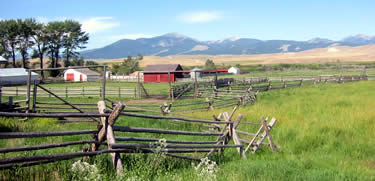
A ranch (from Spanish: rancho/Mexican Spanish) is an area of land, including various structures, given primarily to ranching, the practice of raising grazing livestock such as cattle and sheep. It is a subtype of farm. These terms are most often applied to livestock-raising operations in Mexico, the Western United States and Western Canada, though there are ranches in other areas. People who own or operate a ranch are called ranchers, cattlemen, or stockgrowers. Ranching is also a method used to raise less common livestock such as horses, elk, American bison, ostrich, emu, and alpaca.
Ranches generally consist of large areas, but may be of nearly any size. In the western United States, many ranches are a combination of privately owned land supplemented by grazing leases on land under the control of the federal Bureau of Land Management or the United States Forest Service. If the ranch includes arable or irrigated land, the ranch may also engage in a limited amount of farming, raising crops for feeding the animals, such as hay and feed grains.
Ranches that cater exclusively to tourists are called guest ranches or, colloquially, "dude ranches". Most working ranches do not cater to guests, though they may allow private hunters or outfitters onto their property to hunt native wildlife. However, in recent years,[when?] a few struggling smaller operations have added some dude ranch features such as horseback rides, cattle drives, and guided hunting to bring in additional income. Ranching is part of the iconography of the "Wild West" as seen in Western movies and rodeos.
The term ranch comes from the Spanish term rancho, itself from the term rancharse, which means “to get ready, to settle in a place, to pitch camp”, itself from the military French term se ranger (to arrange oneself, to tidy up), from the Frankish hring, which means ring or circle. It was, originally, vulgarly applied in the 16th century to the provisional houses of the indigenous peoples of the Americas.
The term evolved differently throughout the Spanish speaking world:
In Mexico, it evolved to mean a cattle farm, station or estate, a pasturing land or agricultural settlement where cattle are raised. Originally used to refer to a hamlet or village where cattle is raised and where the land is sowed; and to a small independent cattle farm, or to a cattle station, an area of land for cattle raising, that is dependent of a hacienda, a large cattle estate.
In Spain it retained its military origin, being defined as: the group of people, typically soldiers, who eat together in a circle; a mess hall. “Rancho” in Spain is also the: “food prepared for several people who eat in a circle and from the same pot.” It was also defined as a family reunion to talk any particular business. While “ranchero” is defined as the: “steward of a mess”, the steward in charge of preparing the food for the “rancho” or mess-hall.
In South America, specifically in Argentina, Uruguay, Chile, Brasil, Bolivia and Paraguay, the term is applied to a modest humble rural home or dwelling, a cottage; while in Venezuela it’s an improvised, illegal dwelling, generally poorly built or not meeting basic habitability requirements; a shanty or slum house.
Hub AI
Ranch AI simulator
(@Ranch_simulator)
Ranch
A ranch (from Spanish: rancho/Mexican Spanish) is an area of land, including various structures, given primarily to ranching, the practice of raising grazing livestock such as cattle and sheep. It is a subtype of farm. These terms are most often applied to livestock-raising operations in Mexico, the Western United States and Western Canada, though there are ranches in other areas. People who own or operate a ranch are called ranchers, cattlemen, or stockgrowers. Ranching is also a method used to raise less common livestock such as horses, elk, American bison, ostrich, emu, and alpaca.
Ranches generally consist of large areas, but may be of nearly any size. In the western United States, many ranches are a combination of privately owned land supplemented by grazing leases on land under the control of the federal Bureau of Land Management or the United States Forest Service. If the ranch includes arable or irrigated land, the ranch may also engage in a limited amount of farming, raising crops for feeding the animals, such as hay and feed grains.
Ranches that cater exclusively to tourists are called guest ranches or, colloquially, "dude ranches". Most working ranches do not cater to guests, though they may allow private hunters or outfitters onto their property to hunt native wildlife. However, in recent years,[when?] a few struggling smaller operations have added some dude ranch features such as horseback rides, cattle drives, and guided hunting to bring in additional income. Ranching is part of the iconography of the "Wild West" as seen in Western movies and rodeos.
The term ranch comes from the Spanish term rancho, itself from the term rancharse, which means “to get ready, to settle in a place, to pitch camp”, itself from the military French term se ranger (to arrange oneself, to tidy up), from the Frankish hring, which means ring or circle. It was, originally, vulgarly applied in the 16th century to the provisional houses of the indigenous peoples of the Americas.
The term evolved differently throughout the Spanish speaking world:
In Mexico, it evolved to mean a cattle farm, station or estate, a pasturing land or agricultural settlement where cattle are raised. Originally used to refer to a hamlet or village where cattle is raised and where the land is sowed; and to a small independent cattle farm, or to a cattle station, an area of land for cattle raising, that is dependent of a hacienda, a large cattle estate.
In Spain it retained its military origin, being defined as: the group of people, typically soldiers, who eat together in a circle; a mess hall. “Rancho” in Spain is also the: “food prepared for several people who eat in a circle and from the same pot.” It was also defined as a family reunion to talk any particular business. While “ranchero” is defined as the: “steward of a mess”, the steward in charge of preparing the food for the “rancho” or mess-hall.
In South America, specifically in Argentina, Uruguay, Chile, Brasil, Bolivia and Paraguay, the term is applied to a modest humble rural home or dwelling, a cottage; while in Venezuela it’s an improvised, illegal dwelling, generally poorly built or not meeting basic habitability requirements; a shanty or slum house.
Recent media