Hubbry Logo
Washington AgreementWashington AgreementMain
Open search
Washington Agreement
Community hub
Washington Agreement
logo
8 pages, 0 posts
0 subscribers
Be the first to start a discussion here.
Washington Agreement
from Wikipedia
Washington Agreement
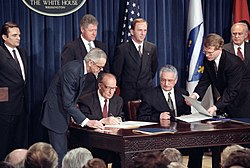
Bosnian President Alija Izetbegović and Croatian President Franjo Tuđman sign the Washington Agreement
TypeCeasefire agreement
Signed18 March 1994
LocationWashington, D.C., United States
Vienna, Austria
Sealed24 March 1994
Effective30 March 1994
Signatories
Parties
RatifiersParliament of the Federation of Bosnia and Herzegovina
LanguagesBosnian
Croatian

The Washington Agreement (Croatian: washingtonski sporazum; Bosnian: vašingtonski sporazum) was a ceasefire agreement between the Republic of Bosnia and Herzegovina and the Croatian Republic of Herzeg-Bosnia, signed on 18 March 1994 in Washington, D.C.[1] It was signed by Bosnian Prime Minister Haris Silajdžić, Croatian Foreign Minister Mate Granić and President of Herzeg-Bosnia Krešimir Zubak.

Under the agreement, the combined territory held by the Croat and Bosnian (in that time Bosniak) government forces was divided into ten autonomous cantons, establishing the Federation of Bosnia and Herzegovina and ending the Croat-Bosniak War. The cantonal system was selected to prevent dominance by one ethnic group over another.[2]

The subsequently signed Washington Framework Agreement had the creation of a loose federation (or confederation) between Croatia and Federation of Bosnia and Herzegovina as one of its goals.[3]

Background

[edit]

War broke out between Herzeg-Bosnia, supported by Croatia, and the Republic of Bosnia and Herzegovina and the Croatian Defence Forces. It lasted from 18 October 1992 to 23 February 1994,[4] and is considered often as a "war within a war" as it was a part of the much larger Bosnian War. Fighting soon spread to Central Bosnia and soon Herzegovina, where most of the fighting would take place in those regions.

Between 1992 and 1994, many massacres and killings would take place, such as the Lašva Valley ethnic cleansing,[5] Trusina massacre, Ahmići massacre, Sovići and Doljani killings, Vitez massacre, Mokronoge massacre,[6][7] Grabovica massacre, Uzdol massacre,[8] Stupni Do massacre, Križančevo selo killings,[9] Zenica massacre, Gornji Vakuf shelling, Busovača massacre, and the Stari Vitez terrorist attack. Battles, operations, and sieges were also common during that time period, as the battle of Žepče, Bugojno, Siege of Mostar, Operation Neretva '93, and Operation Tvigi 94.


See also

[edit]

References

[edit]

Further reading

[edit]
[edit]
Revisions and contributorsEdit on WikipediaRead on Wikipedia
from Grokipedia
![Bosnian President Alija Izetbegović and Croatian President Franjo Tuđman sign the Croat-Muslim Federation Peace Agreement][float-right]
The Washington Agreement was a U.S.-brokered ceasefire and political accord signed on March 18, 1994, by representatives of the Republic of Bosnia and Herzegovina and the Croatian Republic of Herzeg-Bosnia, formally ending the Croat–Bosniak War—a conflict within the broader Bosnian War—and establishing the Federation of Bosnia and Herzegovina as a unified entity comprising Bosniak and Croat majority areas.
Prior to the agreement, intense fighting between the Bosnian Army (ARBiH) and the Croatian Defence Council (HVO) had erupted in 1993, marked by ethnic cleansing campaigns, notably around Mostar and other central Bosnian regions, exacerbating the fragmentation of anti-Serb forces and hindering international intervention. The accord, building on a preliminary framework from March 1, 1994, divided the federation's territory into ten semi-autonomous cantons designed to prevent dominance by either group, while mandating the dissolution of the self-proclaimed Herzeg-Bosnia and joint military command against Bosnian Serb forces.
This federation structure laid the groundwork for the 1995 Dayton Accords, enabling a coordinated military push that reclaimed significant territory from Serb control, though persistent ethnic divisions and governance inefficiencies—evident in ongoing Mostar segregations—highlighted implementation challenges and the accord's limitations in fostering true integration.

Historical Context

Origins of the Bosnian War

The Bosnian War originated amid the dissolution of socialist in the early 1990s, a federation formed after comprising six republics with deep ethnic divisions exacerbated by historical grievances, including Ottoman-era conquests, Habsburg rule, and World War II massacres such as those by Croatia's regime against Serbs. By 1991, following Slovenia's and Croatia's secessions amid armed conflicts with Yugoslav federal forces dominated by , —internally diverse—faced similar pressures for , though lacking a clear ethnic majority to unify consensus. The 1991 census recorded a population of approximately 4.4 million, with (ethnic Muslims) at 43.5%, Serbs at 31.2%, Croats at 17.4%, and the remainder identifying as or other groups, distributed unevenly across regions like Serb-majority eastern areas and Croat concentrations in . Political fragmentation intensified as ethnic-based parties emerged: the (SDA) led by appealing to , the (HDZ) to Croats, and the Serb Democratic Party (SDS) under advocating Bosnian Serb interests tied to remaining in a Serb-led . Serbian President , pursuing a ideology, supported Bosnian Serb separatism through arms, propaganda, and the (JNA), which by late 1991 shifted toward aiding Serb territorial claims. Bosnian Serbs, fearing subjugation in an independent state potentially dominated by the Bosniak plurality, rejected multi-ethnic power-sharing proposals like the 1991 and instead held their own plebiscites in November 1991 affirming ties to . The immediate trigger was a on independence held February 29 to March 1, 1992, organized by Bosniak and parties at the urging of the European Community's arbitration committee, which had recognized and . Bosnian Serbs largely boycotted, achieving a 63.6% turnout with 99.7% of participants voting yes, though this excluded the Serb third of the population and ignored their counter-referenda favoring union with . Bosnia's assembly declared independence on March 3, 1992, prompting Karadžić's SDS to proclaim a separate Serb entity in January and escalate barricades in . International recognition by the and European Community on April 6-7, 1992, catalyzed JNA withdrawal but its handover of heavy weapons to Bosnian Serb forces, leading to attacks on and other sites by mid-April, marking the war's onset. This cascade reflected not merely aggression but the causal failure of Yugoslavia's asymmetric breakup to secure minority safeguards in Bosnia's zero-sum ethnic arithmetic.

Escalation of Croat-Bosniak Conflict

The initial alliance between and Croats against Bosnian Serb forces frayed as Croatian ambitions for a separate entity in intensified, with the asserting administrative control over territories claimed as historically Croatian. Sporadic clashes began in October 1992 in areas like Prozor and Novi Travnik, where (HVO) units sought to consolidate gains amid fears of Bosniak dominance in a unified Bosnia. By late 1992, HVO forces had detained Bosniak leaders and civilians in detention camps, signaling a shift from cooperation to confrontation driven by territorial partition goals aligned with Zagreb's interests. Tensions escalated dramatically in early 1993 following the rejection of international peace plans like the Vance-Owen proposal, which allocated cantons but failed to satisfy Croat demands for control over western . On 11 January 1993, heavy fighting erupted in Gornji Vakuf, a mixed town, as HVO forces launched offensives to seize strategic positions, displacing thousands of and marking the first major battle of the internecine war. This pattern intensified in April with HVO operations in central Bosnia's Lašva Valley, including the 16 April in Ahmići near , where HVO troops deliberately targeted civilians, killing at least 116, including women and children, to expel the population and secure ethnically homogeneous areas; the International Criminal Tribunal for the former (ICTY) later ruled this as part of a for . On the same day, Army of the (ARBiH) forces retaliated by killing at least 30 Croats in Trusina village, underscoring mutual atrocities amid the chaos. The siege of epitomized the escalation, with HVO forces capturing the eastern, Bosniak-held part of the city in May after intense urban combat, followed by systematic shelling that destroyed the historic Old Bridge and displaced over 50,000 ; Croat snipers and artillery targeted civilians, exacerbating humanitarian crises. HVO operations like "Neretva '93" in June aimed to link Croat-held territories, involving forced expulsions and village burnings across . By autumn, HVO assaults continued, including the 23 attack on Stupni Do village near , where troops killed at least 37 Bosniak civilians—many burned alive—and razed homes, as documented by UN investigators who found evidence of deliberate targeting to clear the area. These actions, supported by units crossing into Bosnia, resulted in an estimated 10,000-15,000 deaths and over 200,000 displaced in the Croat-Bosniak theater by late , weakening the anti-Serb front and prompting U.S.-led mediation to avert total fragmentation. Bosniak counteroffensives, such as in the area, inflicted Croat casualties but were often reactive to HVO initiatives, with ARBiH also perpetrating detentions and killings that ICTY prosecuted as war crimes. The mutual , fueled by irredentist claims rather than defensive necessity, eroded prior alliances and heightened international alarm over Bosnia's viability.

Negotiation and Mediation

Pre-Washington Diplomatic Efforts

The escalation of hostilities between Bosnian Croat forces of the Croatian Defence Council (HVO) and the Bosnian Army (ARBiH) in mid-1993, following the collapse of broader peace initiatives like the Owen-Stoltenberg plan, prompted initial bilateral diplomatic contacts aimed at de-escalation. On October 8, 1993, Croatian President Franjo Tuđman and Bosnian President Alija Izetbegović met in Zagreb, where they agreed to support potential NATO involvement in enforcing ceasefires and jointly opposed Serb territorial gains, though no immediate truce was achieved amid ongoing clashes in central Bosnia. These talks reflected Croatia's strategic interest in stabilizing its ally against Serb advances while preserving HVO control over Herzeg-Bosnia territories, but mutual distrust over ethnic cantons and Mostar persisted. By early , intensified diplomatic pressure complemented bilateral efforts, leveraging threats of sanctions against for continued HVO aggression. On January 10–11, 1994, Tuđman and Izetbegović convened again, discussing military coordination and territorial concessions in , which laid groundwork for subsequent despite unresolved disputes over Croat . UN Protection Force (UNPROFOR) then facilitated military-level talks in , culminating in a agreement on February 23, 1994, signed by HVO commander General Ante Roso and ARBiH representatives after five hours of negotiations; this halted major combat operations but required political follow-up for durability. US engagement accelerated in 1994, with the suspension of peace talks under the International Conference on the Former Yugoslavia to prioritize American mediation focused on a Croat-Bosniak federation. Special envoy Charles Redman initiated between , , and Washington, pressing for joint institutions and territorial power-sharing to counter Serb dominance, building directly on the truce amid reports of fragile compliance. These efforts contrasted with prior European-led initiatives, which had stalled over entity divisions, and emphasized pragmatic alliance-building against Bosnian Serb forces rather than comprehensive partition.

Role of U.S. and International Mediators

![Bosnian President Alija Izetbegović and Croatian President Franjo Tuđman signing the Washington Agreement][float-right] The United States assumed a leading mediatory role in the Washington Agreement, initiating direct diplomatic intervention to halt the escalating Croat-Bosniak conflict amid the broader Bosnian War. Following the failure of prior European-led efforts, U.S. officials, motivated by strategic interests to unify Bosniak and Croat forces against Bosnian Serb advances, organized proximity talks in late February 1994 at the U.S. State Department. Key U.S. diplomats Charles Redman, serving as special envoy, and , U.S. Ambassador to , facilitated these four-day negotiations between representatives of the and the . Redman, representing the administration, applied pressure through ultimatums and incentives, persuading the parties to cease hostilities and commit to a federation framework, which culminated in the agreement's signing on March 18, 1994, in . International mediators, including the and , had attempted reconciliation earlier but achieved limited success due to insufficient leverage and internal divisions among the parties. The U.S. effort effectively supplanted these initiatives by leveraging its diplomatic authority and military signaling, such as implicit threats of intervention, to enforce compliance and establish the Croat-Bosniak Federation as a precursor to broader peace negotiations.

Key Events Leading to the Talks

The Croat-Bosniak conflict, initially marked by sporadic clashes in 1992, escalated sharply in early 1993 as (HVO) forces, backed by , pursued territorial control in central Bosnia amid the broader war against Bosnian Serbs. Tensions boiled over in regions like , where HVO offensives in January 1993 aimed to secure strategic passes such as Makljen, resulting in heavy fighting and civilian displacements despite Bosniak Army of the Republic of Bosnia and Herzegovina (ARBiH) resistance. By spring 1993, HVO actions included systematic expulsions and attacks on Bosniak villages in the Lašva Valley, fragmenting allied fronts and enabling Bosnian Serb advances elsewhere. A pivotal atrocity occurred on April 16, 1993, when HVO units massacred approximately 116 Bosniak civilians in Ahmići, part of broader operations that killed hundreds across central Bosnia that month, drawing international condemnation and solidifying mutual distrust. Fighting intensified around , with HVO forces besieging the city and destroying the Old Bridge, while ARBiH counteroffensives in September-October 1993 captured Croat-held areas, leading to reprisal killings and a affecting over 200,000 displaced persons by late 1993. This intra-Bosnian warfare, which claimed around 10,000 lives by some estimates, undermined anti-Serb efforts and stalled UN peace initiatives like the Owen-Stoltenberg plan. U.S. policy shifted in late toward coercing Croat-Bosniak to counter Serb gains, with diplomats warning of selective arms lifts favoring if cooperation failed; this pressure, combined with military exhaustion on both sides, facilitated indirect talks. A UN-brokered took effect on February 23, 1994, in , halting major hostilities after months of skirmishes and setting the stage for federation framework discussions agreed on March 1. These developments reflected recognition that continued infighting only strengthened Bosnian Serb positions, prompting leaders and to negotiate under U.S. auspices.

Provisions of the Agreement

Ceasefire and Military Disengagement

The Washington Agreement, signed on March 18, 1994, required an immediate and unconditional ceasefire between the Army of the Republic of Bosnia and Herzegovina (ARBiH) and the (HVO), halting active hostilities that had intensified since 1993. This provision aimed to end the Croat-Bosniak conflict, which had resulted in over 100,000 casualties and widespread in central Bosnia, including the destruction of . Under Section VI of the framework document, both parties committed to immediate military disengagement, with forces withdrawing to a "safe distance" to prevent renewed clashes, though exact distances were deferred to a detailed military annex to be negotiated subsequently. The agreement also mandated the expulsion of all foreign armed forces from territory, excluding those authorized by the Bosnian government or the UN Security Council, targeting irregular units like fighters aligned with Bosniak forces and Croatian paramilitaries. Transitional command structures were preserved pending integration into a unified military, with Section VIII specifying that the military agreement would outline comprehensive disengagement protocols, including buffer zones and verification mechanisms. These measures facilitated a alliance against Bosnian Serb forces, enabling joint ARBiH-HVO operations by mid-1994, though initial disengagement faced delays due to contested territories and command rivalries. UNPROFOR monitored compliance in select areas, but enforcement relied primarily on U.S. diplomatic pressure and the threat of Croatian isolation from aspirations.

Establishment of the Bosnian Federation

![Bosnian President Alija Izetbegović and Croatian President Franjo Tuđman sign the Croat-Muslim Federation Peace Agreement][float-right] The Washington Agreement, initialed on March 1, 1994, and formally signed on March 18, 1994, at the , created the as a union of Bosniak and Croat majority areas, comprising approximately 51% of Bosnia's pre-war territory. This entity was designed to integrate territories controlled by the Army of the (ARBiH) and the (HVO), ending the 10-month Croat-Bosniak conflict that had caused significant casualties and displacement. The agreement's framework outlined a federal structure with a bicameral , a rotating presidency shared between and Croats, and a , ensuring power-sharing to prevent dominance by either group. Territories were divided into 10 autonomous cantons—five with Bosniak majorities, three with Croat majorities, and two mixed—to devolve authority and manage ethnic diversity, while federal powers covered defense, , and currency. provisions mandated integration of ARBiH and HVO forces under a unified command, with a joint headquarters and equal representation in officer corps, alongside demobilization and like open borders and joint patrols. On March 18, Bosnian Prime Minister Haris Silajdžić and Croat leader Krešimir Zubak signed the Federation's constitution, formalizing these structures and committing to human rights protections, including the right of displaced persons to return and compensation for war damages. The pact also required Croatia to end support for the self-proclaimed Croatian Republic of Herzeg-Bosnia, dissolving parallel institutions to consolidate federal authority. This establishment narrowed the Bosnian War's fronts by aligning Bosniak and Croat forces against Bosnian Serb advances, though implementation faced delays due to lingering mistrust and command disputes.

Economic and Humanitarian Measures

The Washington Agreement vested the central government of the with exclusive authority over economic policy, encompassing planning and reconstruction efforts to address war damage. This included oversight of commerce, such as customs administration, , , and internal , while cantons retained responsibilities for regulating and facilitating local business activities and charitable organizations. A preliminary confederation agreement with outlined immediate cooperation in key economic sectors, including , , , free-market development, , , and economic reconstruction, alongside , , , product , , and migration policies. Over a specified transition period, the parties committed to phased integration: establishing a for domestic goods, a , a common market allowing free movement of goods, services, capital, and labor, and ultimately a monetary union. These measures aimed to stabilize the war-torn through cross-border coordination, though implementation faced delays amid ongoing conflict. On humanitarian fronts, the agreement affirmed internationally recognized and freedoms for all persons within the . It explicitly guaranteed refugees and displaced persons the right to return freely to their pre-war homes of origin. Additionally, individuals deprived of property through were entitled to restoration of such assets or fair compensation if restoration proved impossible, with any coerced property transfers deemed legally void; these rights were to be enforced via and cantonal legislation.

Implementation and Short-Term Outcomes

Formation of Joint Institutions

The Washington Agreement, signed on March 18, 1994, outlined a framework for joint institutions in the newly established , emphasizing power-sharing between Bosniacs and Croats to prevent dominance by either group. A High-Level Transitional Committee, convened starting March 4, 1994, in , was tasked with finalizing the Federation's by mid-March, though adoption occurred later; this body facilitated consensus between Bosniac and Croat delegations from the parliamentary elections, forming the basis for a to promulgate the document. The Constitution of the , adopted by the on June 24, 1994, defined the permanent joint institutions, including a bicameral and a co-presidency. The consists of 140 members elected proportionally across the Federation for four-year terms, while the House of Peoples comprises 30 Bosniac delegates, 30 Croat delegates, and a proportional number of "Others" selected by cantonal , ensuring equal representation to safeguard vital national interests through mechanisms requiring majorities from both constituent peoples. Executive authority resides in a of two members—one Bosniac President and one Croat —elected by the on nominations from respective caucuses, serving alternating one-year terms over a four-year mandate, with removal possible only by a two-thirds majority in both houses and approval. The federal , headed by a nominated by the President with concurrence and confirmed by the , includes ministers paired with deputies from the other constituent people, mandating at least one-third Croat occupancy in ministerial roles to enforce parity. Transitional provisions enabled rapid institution-building: upon the Constitution's entry into force, the elected interim President, Vice President, and government officials to operate until the first direct elections, scheduled per subsequent frameworks like the Dayton Accords; this interim phase prioritized consensus to operationalize shared governance amid ongoing conflict.

Military Integration Challenges

Despite the Washington Agreement's provisions for a unified military command and immediate disengagement of forces, integrating the (HVO) and the Army of the (ARBiH) proved fraught with obstacles rooted in recent . The agreement mandated a transitional committee to finalize military arrangements by March 15, 1994, including withdrawal to safe distances and establishment of joint command structures under authority, but deep mutual distrust persisted due to atrocities committed during the 1993 Croat-Bosniak fighting, such as in and Ahmići, which undermined confidence in shared operations. HVO units, often viewed as extensions of the with loyalties to , resisted subordination to Bosniak-dominated ARBiH leadership, while feared Croat would dilute their control over defense resources. Political interference exacerbated these issues; Bosnian Croat leaders prioritized ethnic , leading to stalled negotiations, including a reported incident in early 1996 where a Croat general drew a during talks on unification. By mid-1995, the Federation's integration existed largely on paper, with parallel command chains and sporadic violations of disengagement zones hindering coordinated action against Bosnian Serb forces. Logistical disparities further complicated efforts: ARBiH suffered from inadequate equipment and training compared to better-supplied HVO units backed by , fostering resentment and operational inefficiencies. External factors, including Croatian funding of up to $700 million annually to HVO until 1999, delayed full unification by preserving separate capabilities. The U.S.-led Train and Equip Program, initiated in 1995, eventually reduced combined forces from over 200,000 to under 45,000 by 1997 through joint training and ethnicity-neutral standards, but progress remained slow, with the Federation Defense Law only passing on July 9, 1996, after months of acrimony. Ethnic tensions among officers, including bigotry and reluctance to serve under opposite-ethnic commanders, limited , though showed more than politicians in fostering cooperation.

Immediate Ceasefire Enforcement

The Washington Agreement stipulated an immediate and unconditional ceasefire between the Army of the Republic of Bosnia and Herzegovina (ARBiH) and the Croatian Defence Council (HVO), effective upon signing on March 18, 1994, following a preliminary truce on February 23, 1994. Provisions required the disengagement of forces within specified timelines, including the withdrawal of troops from forward positions and the establishment of a joint military command structure to oversee compliance and integrate units under a unified federation army. This framework aimed to halt inter-ethnic combat, which had resulted in over 30,000 casualties since mid-1993, by redirecting resources toward common threats from Bosnian Serb forces. Enforcement mechanisms emphasized bilateral verification through liaison officers and international oversight, with the U.S. State Department facilitating proximity talks to resolve disputes and monitor adherence via on-site diplomats. No robust third-party military presence, such as expanded UNPROFOR roles, was immediately deployed for this specific , relying instead on U.S. diplomatic leverage—including threats to lift the on or authorize airstrikes against non-compliant parties—to deter violations. The agreement's constitution-drafting committee, convened in starting March 4, 1994, incorporated safeguards to build trust, though implementation hinged on political will amid ongoing Serb offensives. In the short term, compliance was high due to mutual strategic imperatives: faced Serb advances, such as the siege of , prompting rapid joint operations by late March 1994, including coordinated ARBiH-HVO counterattacks in central Bosnia. Sporadic clashes persisted in flashpoints like , where HVO units delayed withdrawals from occupied ARBiH territories until U.S.-brokered adjustments in April, but these did not escalate to widespread fighting. By May 1994, the federation's military integration advanced with the formalization of a unified command, reducing intra-alliance friction and enabling the transfer of heavy weapons to joint depots, though full disengagement lagged in ethnically mixed cantons due to local command resistance. Overall, the ceasefire's enforcement succeeded in curtailing Croat-Bosniak hostilities—responsible for approximately 60% of non-Serb casualties in —facilitating a alliance that held through the war's remainder, sustained by U.S. pressure rather than autonomous institutional mechanisms. Initial outcomes included reduced civilian displacements in Herzeg-Bosnia territories and the opening of humanitarian corridors, though enforcement challenges foreshadowed persistent ethnic tensions in governance.

Long-Term Impact

Contribution to the Dayton Accords

The Washington Agreement, signed on March 18, 1994, established the as a unified entity comprising Bosniak and Croat majority areas, thereby halting hostilities between those groups and creating a single negotiating partner for peace talks. This federation structure directly informed the Dayton Accords' territorial framework, where the Federation was designated as one of two entities alongside the , occupying approximately 51% of Bosnia's territory. By forging a Bosniak-Croat alliance, the agreement shifted the military balance in the , enabling joint operations against Bosnian Serb forces and strengthening the position of the unified side entering Dayton negotiations in November 1995. U.S. mediation, which brokered the Washington deal under figures like Ambassador Charles Redman, built diplomatic momentum and institutional templates—such as federal power-sharing mechanisms—that were adapted into constitution, including provisions for a bicameral and rotating presidency. The agreement's emphasis on confederation-like autonomy for Croat-majority cantons within the addressed ethnic tensions preemptively, reducing fragmentation risks that could have derailed broader goal of a single with internal divisions. This pragmatic consolidation proved essential, as separate Bosniak and Croat delegations at Dayton would likely have empowered Serb negotiators under , potentially prolonging the war; instead, the pre-existing facilitated concessions like territorial swaps and demilitarization zones. Overall, Washington served as a foundational step, transforming bilateral into a multilateral framework that underpinned Dayton's cessation of hostilities on December 14, 1995.

Effects on Bosnian Governance Structure

The Washington Agreement of March 18, 1994, established the as a federal entity comprising roughly 51% of Bosnia's pre-war territory, introducing a multi-layered structure with a central federal government and ten ethnically mixed or homogeneous cantons. This framework delineated powers between the federal level—responsible for , defense, , and —and cantons, which retained authority over , policing, , and local administration, while municipalities handled further devolved functions. The cantonal system aimed to reflect demographic realities, granting to areas with Croat majorities (e.g., three western cantons) and mixed populations elsewhere, thereby decentralizing authority to mitigate but fostering administrative fragmentation with overlapping jurisdictions. At the federal level, the agreement mandated consociational power-sharing between and Croats, including a co-presidency with one Bosniak and one Croat elected by the and alternating annual terms, a with deputies ensuring ethnic balance, and a cabinet requiring at least one-third Croat ministers. The bicameral consisted of a House of Representatives elected proportionally across the and a House of Peoples with equal Bosniak and Croat delegates from each canton, where decisions on "vital interests"—defined to protect constituent peoples' —necessitated consensus or majorities from both groups, effectively granting group powers. Judicial institutions, including a with equal ethnic representation plus international appointees, were designed to arbitrate disputes and safeguard , with similar ethnic quotas in cantonal courts. These mechanisms institutionalized ethnic parity, reducing the risk of domination by the Bosniak majority (which constituted about 70% of the Federation's population) but introducing procedural hurdles that slowed governance. This structure's effects persisted beyond the agreement's immediate cessation of Bosniak-Croat hostilities, influencing the 1995 Dayton Accords by preserving the as one of two entities alongside , thus embedding asymmetry in Bosnia's overall state architecture: the Federation's 10 cantons contrasted with the more centralized Republika Srpska. The result was a highly decentralized system with 13 governments in the alone (federal plus cantonal), contributing to inefficiencies such as duplicated bureaucracies, fiscal disparities, and coordination failures in areas like . Veto provisions, replicated in Dayton's state-level institutions, have repeatedly stalled reforms, as ethnic leaders invoke vital interests to block , perpetuating and undermining central authority—evident in persistent disputes over electoral laws and state property allocation.

Demographic and Territorial Changes

The Washington Agreement, signed on March 18, 1994, established the Federation of Bosnia and Herzegovina as a union of Bosniak- and Croat-majority territories, encompassing approximately 51% of Bosnia and Herzegovina's total land area, while deferring resolution of Serb-majority regions for future negotiations. This territorial framework divided the Federation into 10 cantons designed to align with ethnic concentrations and geographic features like river basins, aiming to mitigate fears of domination by either group; for instance, cantons 3 (Central Bosnia), 7 (Livno), 8 (West Herzegovina), and 9 (Herzegovina-Neretva) were structured with Croat pluralities to secure their influence. The agreement's ceasefire provisions facilitated military disengagement in contested zones such as Mostar and central Bosnia, where prior Croat-Bosniak clashes had shifted control, effectively freezing de facto lines and preventing further territorial fragmentation between the signatories. Demographically, the agreement halted ongoing mutual displacements between and Croats that had intensified since mid-1993, including expulsions from mixed areas like and , where thousands of civilians from both groups had been forced to flee amid campaigns. By formalizing ethnically aligned cantons, it entrenched distributions reflecting wartime gains— dominant in eastern and central cantons, Croats in southwestern ones—rather than promoting returns or integration, thereby preserving ethnic majorities in sub-units amid an estimated 2 million total war displacements across Bosnia. This structure, while stabilizing the Federation's internal lines, contributed to long-term segregation by institutionalizing divisions that mirrored pre-agreement ethnic engineering, with Croats comprising about 17% of the Federation's post-war compared to their pre-1992 20% share in Bosnia overall. In practice, territorial adjustments under the agreement, such as ceding certain Bosniak-held pockets in to Croat control in exchange for concessions elsewhere, reinforced demographic homogeneity within cantons but exacerbated internal tensions, as seen in Mostar's persistent east-west ethnic split despite the . These changes laid groundwork for the Dayton Accords' 51/49 entity split but prioritized pragmatic ethnic power-sharing over reversing war-induced migrations, resulting in a where inter-cantonal movement remained limited and ethnic returns were minimal in the short term.

Criticisms and Debates

Bosniak Perspectives on Ethnic Compromise

Bosniak leaders, including President and Prime Minister , regarded the Washington Agreement of March 18, 1994, as a strategic imperative to terminate the Croat-Bosniak , which had erupted in 1993 and diverted resources from the primary conflict with Bosnian Serb forces. Silajdžić, who co-signed the framework as Bosnia and Herzegovina's representative, emphasized its role in fostering a unified front to pressure international actors for lifting the and enabling military reinforcement against Serb advances. This view aligned with first-hand negotiations where prioritized alliance restoration over maximalist territorial demands, accepting the federation's 51% allocation of Bosnia's territory to counter Serb control of approximately 49%. However, significant Bosniak reservations centered on the agreement's ethnic compromise, particularly the delineation of 10 cantons with provisions for Croat-majority areas and parity mechanisms that entrenched structures. Silajdžić critiqued subsequent Croat insistence on ethnically defined cantons as deviating from federal principles, arguing that negotiations should proceed as a "united team" rather than segregating Bosniak and Croat sides. Izetbegović advocated for a stronger to mitigate presidential ethnic vetoes, compromising only on a co-presidency model under U.S. to expedite the pact. Bosniak intellectual Komšić opposed the granular territorial haggling—such as disputes over villages in municipality—as futile, proposing instead two non-ethnic cantons (Central ) with governance parity to avoid legitimizing divisions. These perspectives reflected a tension between short-term survival and long-term unitary statehood: while the agreement averted collapse amid Croat offensives like in , it institutionalized ethnic quotas and veto rights that later viewed as enabling Croat obstructionism in joint institutions. By May 1994, Silajdžić highlighted implementation friction over cantonal borders, underscoring how the compromise preserved Bosniak gains in central Bosnia but diluted central authority in favor of segmental autonomy. Empirical outcomes, such as the federation's role in subsequent offensives reclaiming 10-15% of territory from Serbs by late 1995, validated the pragmatic calculus for many, though critics like Komšić argued it perpetuated fragmentation incompatible with a civic Bosnian identity.

Croat and International Critiques

Bosnian Croat leaders associated with the expressed strong reservations about the Washington Agreement, viewing it as a concession that undermined their autonomy and exposed Croats to potential domination by the numerically superior Bosniak population in a unified federation. , the president of Herzeg-Bosnia, formally suspended its institutions following the agreement's signing on March 18, 1994, but only under intense pressure from U.S. officials and Croatian President , who prioritized halting the Croat-Bosniak conflict to enable joint action against Bosnian Serbs. Internal opposition within Croat ranks persisted, with hardliners arguing that dissolving Herzeg-Bosnia forfeited territorial and political leverage gained during the war, including control over key areas like and western , without ironclad guarantees for Croat parity. During negotiations, key Croat delegates such as Ivo Zubak and Stjepan Buntić voted against the final version of the agreement, citing inadequate protections against ethnic-based power imbalances, particularly in where they sought a revival of Herzeg-Bosnia through ethnically defined cantons rather than the compromise of mixed or parity-based administrative units. The faction of the (HDZ) in Bosnia actively resisted implementation, framing the deal as a to Croat and a diversion from partitioning Bosnia along ethnic lines in coordination with . Diaspora communities, including in Cleveland, , echoed these sentiments in public forums shortly after the signing, with HDZ branches decrying the agreement as capitulation and favoring continued hostilities with to preserve Croat gains. Over time, Bosnian Croats critiqued the agreement's federal structure as inherently flawed, arguing it failed to deliver on implied promises of a linking the federation to , instead entrenching a system where could marginalize Croats through demographic weight and electoral mechanisms. Subsequent amendments, such as reductions in Croat representation in federal institutions, amplified these concerns, with critics like those in HDZ BiH asserting that the cantonal envisioned in eroded into Bosniak centralization, exemplified by cases where non-Croats influenced Croat delegate selections. International observers offered mixed evaluations, with some analysts highlighting the agreement's precarious nature from inception, as it imposed a fragile Croat-Bosniak alliance without resolving underlying territorial disputes or ensuring equitable power-sharing amid mutual distrust. , reporting in 1994, noted early implementation difficulties stemming from stipulations on joint presidency and military integration that clashed with entrenched ethnic divisions. Libertarian-leaning critiques, such as from the , described the U.S.-pressured federation as inherently unstable, prone to infighting that prolonged Bosnia's fragmentation rather than fostering viable unity against Serb forces. These views contrasted with broader diplomatic praise for ceasing Croat-Bosniak fighting on March 18, 1994, but underscored risks of the deal serving as a tactical expedient rather than a sustainable framework.

Evaluations of Pragmatism vs. Principle

The Washington Agreement of March 18, 1994, which established the Federation of Bosnia and Herzegovina by uniting Bosniak and Croat-held territories into a single entity comprising approximately 51% of Bosnia's pre-war territory, elicited debates over whether its concessions prioritized pragmatic wartime necessities or eroded foundational principles of state sovereignty and ethnic unity. Proponents of its pragmatism argue that it immediately ceased hostilities between Bosniak Army (ARBiH) and Croatian Defence Council (HVO) forces, which had resulted in over 10,000 deaths and displaced hundreds of thousands since mid-1993, thereby preserving combat resources for the joint front against Bosnian Serb forces. This alliance enabled coordinated offensives, such as the 1995 advances that reclaimed significant territory from Serb control, demonstrating causal efficacy in altering the war's military balance without requiring unattainable ideals of immediate full integration. Critics from a principled standpoint, particularly among Bosniak leaders like who initially advocated a unitary civic state, contend that the agreement's cantonization—dividing the federation into ten semi-autonomous ethnic-based units—legitimized Croat separatism and rewarded prior HVO aggression, including in areas like , thus undermining Bosnia's constitutional integrity as affirmed in its 1992 independence declaration. This structure, while halting the "war within a war," entrenched ethnic powers and decentralized authority, fostering paralysis that persisted post-Dayton and contradicted first-order principles of sovereign central control over territory held by allied forces. U.S. , driven by strategic imperatives to counter Serb advances amid debates, exemplified over normative commitments to undivided multi-ethnic statehood, as evidenced by the agreement's rapid negotiation under threat of Croatian aid cutoff. Empirical outcomes tilt toward pragmatic vindication in the short term: Croat-Bosniak fighting ended within days, facilitating U.S. Train and Equip programs that bolstered forces to 174,000 troops by 1996, pivotal to territorial outcomes. Yet principled evaluations highlight enduring costs, including stalled returns of displaced persons—only 20-30% by 2000 in mixed cantons—and reinforced ethnic , as cantonal budgets ballooned to 80% of federation spending by the early 2000s, perpetuating inefficiency over unified administration. Analysts like those in congressional reports attribute this to the agreement's causal : tactical unity at the expense of structural cohesion, a compromise deemed necessary given Croat leverage via but critiqued for preempting stronger central institutions.

References

Add your contribution
Related Hubs
User Avatar
No comments yet.