Hubbry Logo
search
logo
1175211

Watts Cemetery Chapel

logo
Community Hub0 Subscribers
Read side by side
from Wikipedia

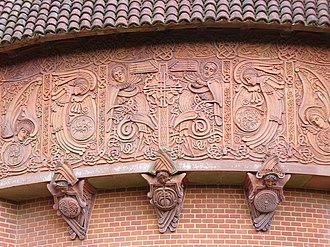
The Watts Cemetery Chapel or Watts Mortuary Chapel is a chapel in a Modern Style (British Art Nouveau style) version of Celtic Revival in the village cemetery of Compton in Surrey. The designer was Mary Fraser Tytler, an artist resident in the village, who married the painter and sculptor George Frederic Watts. While the overall architectural structure is loosely Romanesque Revival, the lavish decoration in terracotta relief carving and paintings is Celtic Revival, on an unusually large scale. According to the local council, it is "a unique concoction of art nouveau, Celtic, Romanesque and Egyptian influence with Mary's own original style".[1]

Key Information

Other responses have been less positive. Ian Nairn, in the 1971 Surrey volume of the Buildings of England series, described the interior as "one of the most soporific rooms in England" and regretted "the intolerable torpor and weariness of the motifs".[2] It is a Grade I listed building.[3]

History

[edit]

When Compton Parish Council created a new cemetery, local resident artist Mary Fraser Tytler, the wife of Victorian era painter and sculptor George Frederic Watts, offered to design and build a new mortuary chapel. The Wattses had recently built a house, "Limnerslease", a few hundred yards away, now part of the Watts Gallery. Tytler was a follower of the Home Arts and Industries Association, set up by Earl Brownlow in 1885 to encourage handicrafts among the lower classes, and the chapel was the Wattses' contribution to this characteristically Victorian preoccupation with social improvement through creative enlightenment.[1]

A group of local amateurs and enthusiasts, many of whom later went on with Mary Fraser Tytler to found the Compton Potters' Arts Guild, constructed the chapel from 1896 to 1898; virtually every village resident was involved. The ground plan is essentially circular; from the outside the building has the look of a Roman Italianate chapel. Local villagers were invited to decorate the chapel under Mary's guidance, resulting in an interior that fuses art nouveau and Celtic influences, combined with Mary's own original style.[4] Each member of Fraser Tytler's evening class, led by Louis Deuchars, had a separate job, with 74 Compton villagers taking part. G. F. Watts paid for the project and also painted a version of The All-Pervading for the altar only three months before he died.

The graves display sayings influenced by the Arts and Crafts movement, including "The Morning Stars Sang Together" and, inside the chapel, "Their hope is full of immortality but the souls of the righteous are in the hands of God."[5]

Both Wattses have memorials in the "cloister" a few yards from the chapel, and a number of the memorials throughout the small cemetery use unglazed terracotta, even from dates after the Compton Pottery closed in the 1950s. Members of the Huxley family, including Julia Huxley[6] and her sons Aldous Huxley and Julian Huxley are buried within the cemetery.

The chapel is open Monday to Friday: 8am – 5pm, Saturday to Sunday and bank holidays: 10am – 5:30pm and is managed by the nearby Watts Gallery, celebrating the architect and her husband. There is no charge.[7]

[edit]

References

[edit]

Sources

[edit]
[edit]
Revisions and contributorsEdit on WikipediaRead on Wikipedia
from Grokipedia
The Watts Cemetery Chapel, also known as the Watts Mortuary Chapel, is a Grade I listed mortuary chapel situated in the cemetery of the village of Compton, Surrey, England. Designed and constructed between 1896 and 1898 by Mary Seton Watts—the wife of the Victorian artist George Frederic Watts—in collaboration with over 70 local villagers, it serves as a memorial to the deceased and a working parish chapel. The building exemplifies the Arts and Crafts movement through its innovative use of terracotta clay sourced locally, blending influences from Celtic Revival, Romanesque, and Art Nouveau styles in a Greek cross plan enclosed within a circular footprint.[1][2] The chapel's creation was inspired by the need for a new burial ground after the local churchyard closed in 1895, with the cemetery itself laid out between 1895 and 1898 under the auspices of the Compton Parish Council. Funded initially by George Frederic Watts as a gift to the village, Mary Watts led the project to foster community involvement, teaching villagers terracotta modeling techniques during evening classes; the exterior features intricate symbolic motifs of hope, liberty, and spirituality, while the interior, completed in 1901, includes experimental gesso wall paintings, a Tree of Life emblem, and vaulted ribs adorned with angelic figures. The chapel was formally opened in 1898 and dedicated to those interred in the surrounding cemetery, which is itself Grade II* listed.[1][2][3] Of particular historical significance, the chapel is the final resting place of George Frederic Watts (died 1904) and Mary Watts (died 1938), whose graves lie within the cemetery; it also contains the burial site of the writer Aldous Huxley (died 1963) and members of his family, including his mother Julia and brother Julian. Recognized for its exceptional craftsmanship and cultural importance, the chapel was first listed as Grade I on 14 June 1967 by Historic England due to its unique architectural innovation and embodiment of community-driven artistic endeavor during the late Victorian era. Today, it remains open to visitors as part of the Watts Gallery – Artists' Village, offering insights into early 20th-century design and spiritual symbolism, with its acoustics noted for enhancing choral performances.[1][3][4]

History

Origins and Construction

In 1895, following the closure of the old churchyard in Compton, Surrey, the Parish Council acquired land for a new cemetery, prompting Mary Watts (née Fraser-Tytler) to conceive a mortuary chapel as both a practical response to the community's burial needs and an initiative to foster social improvement among villagers through hands-on artistic training and skill-building.[1] Influenced by the ethos of the Arts and Crafts movement, which emphasized communal craftsmanship to counter industrial alienation, Mary envisioned the project as a collaborative endeavor to empower local residents across social classes.[5] Funding for the chapel came primarily from Mary's husband, the renowned artist George Frederic Watts, who provided financial support drawn from his portrait commissions, supplemented by community contributions and resources from the Home Arts and Industries Association, through which Mary had organized local craft classes.[1][6] Construction commenced in 1896 without professional contractors, involving approximately 74 amateur villagers of varying ages and genders who learned terracotta modeling and building techniques under Mary's guidance, transforming the site into a symbol of collective labor.[2][6] The retired architect George Tunstal Redmayne offered structural advice on the initial cardboard model and design in 1895, ensuring stability while Mary retained full artistic direction.[6] The chapel's exterior was completed and consecrated on 1 July 1898 by the Bishop of Winchester, serving immediately as the mortuary facility for the new cemetery, though interior decorations continued until 1901.[1][2][7]

Post-Construction Developments

The Watts Cemetery Chapel was consecrated on 1 July 1898 following the completion of its exterior, marking its inaugural use as a functional mortuary chapel for the adjacent cemetery.[6][7] It has continued to serve as a working chapel for parish services and burials since that time.[2] George Frederic Watts was buried in the cemetery in July 1904.[1] His wife, Mary Seton Watts, joined him there upon her death in 1938.[7] The chapel received Grade I listed status from Historic England on 14 June 1967, acknowledging its exceptional architectural and artistic qualities as a product of the Arts and Crafts movement.[1] The surrounding cemetery underwent significant expansion between 1950 and 1952 under the direction of Compton Parish Council, including the addition of an acre of land along the southern boundary, which was consecrated by the Bishop of Guildford on 28 January 1950, and the preparation of new layout plans by council architect F. J. Hodgson in 1952.[7] A garden of remembrance for cremation burials was introduced in 1959, further adapting the site to evolving funerary practices.[7] Throughout the 20th century, the chapel benefited from periodic maintenance to preserve its terracotta elements and interior features, with more intensive conservation efforts in the early 21st century addressing weathering on the exterior brickwork and terracotta friezes.[8] These works have focused on stabilizing the structure while retaining its original symbolic motifs.[8] Today, the Watts Cemetery Chapel is managed by the Watts Gallery Trust, which oversees its operations alongside the nearby gallery and artists' village; the site remains under the ownership of Compton Parish Council for the cemetery portion.[2] It operates as a public venue open daily from 10 a.m. to 4 p.m., closed on Christmas Eve, Christmas Day, and Boxing Day, and may occasionally close for private services.[2] Community volunteers continue to support its upkeep through guided tours and visitor engagement.[9]

Design and Architecture

Exterior Features

The Watts Cemetery Chapel presents a Romanesque Revival structure with a simple, squat form, comprising a Greek cross plan inscribed within a circular footprint that integrates harmoniously with the surrounding cemetery landscape. This design emphasizes modesty and adaptation to the site, constructed of local red brick with walls and decorative elements extensively clad and adorned in local terracotta tiles. The overall aesthetic draws from Celtic Revival and Art Nouveau influences, creating a compact, grounded appearance suited to its role as a mortuary chapel in the Arts and Crafts-inspired Compton Cemetery.[1][2] These terracotta tiles, featuring numerous unique hand-made elements that cover the walls and roof, were crafted by villagers under the guidance of Mary Seton Watts, who led the design process. They incorporate intricate, flowing patterns that evoke organic forms and symbolic depth, blending seamlessly with the cemetery's Arts and Crafts ethos. Decorative motifs abound, including Celtic knots, Egyptian-inspired symbols such as the Tree of Life, and Art Nouveau flourishes like intertwining vines and mythical beasts—such as lions, dragons, herons, peacocks, and owls—adorned on arches, spandrels, corbels, and quadrant sections.[2][1][10][11][12] The entrance, located on the southwest arm, highlights these elements with a round-headed, one-step door surround framing double carved and panelled doors, flanked by jambs bearing Art Nouveau intertwining vines, contemplative faces, and medallions of natural motifs. Symbolic terracotta panels nearby represent hope, liberty, and spirituality through ancient Celtic and other motifs, while variegated marble-like effects in the clay add textural depth. The pantiled roof rises modestly, with open gables over windows and a square bell turret featuring arched openings and terracotta decorations in Celtic Revival patterns, including winged figures, further unifying the chapel with the verdant, crafted cemetery setting.[1][2][11]

Interior Decoration

The interior of Watts Cemetery Chapel is adorned with experimental gesso reliefs and paintings, crafted primarily by Mary Watts and around 70 local villagers between 1896 and 1904. These decorations cover the walls, arches, and ceilings, utilizing a gluey chalk mixture of gesso applied over low-relief bases formed from everyday materials like twine, wire, and sacking, which were then hardened, painted, and sometimes gilded or silvered to create a textured, three-dimensional effect. This technique, influenced by Byzantine and Celtic Revival styles, allowed for an intricate, immersive mural that blends sculpture and painting, emphasizing communal artistry and spiritual depth.[13][14][6] Central to the interior are four large gesso panels depicting a heavenly scene centered on the Tree of Life, intertwined with grape vines symbolizing abundance and resurrection, flanked by angels clutching medallions that represent human duality and spiritual balance. These panels, executed in vibrant colors such as crimson, orange-red, green, and blue, feature seraphim and cherubic figures stretching into the dome, with blooming vines and floral motifs rising from earthly roots to celestial heights. A gilded altar recess features the painting "The All-Pervading" by G. F. Watts, enhancing the symbolic themes.[13][15][6][1] The ceilings and arches incorporate Celtic interlace patterns, including knotted cords and triskele designs drawn from ancient manuscripts like the Book of Durrow, evoking an otherworldly, harmonious atmosphere akin to an illuminated manuscript brought to life.[13][15][6] Symbolic motifs throughout the decorations draw from Christian, Celtic, and universal traditions, including alpha and omega emblems signifying eternity, doves representing peace and the Holy Spirit, and eternal life themes embodied in the Tree of Life's cyclical forms with fruits, birds, and ascending ladders. These elements, often framed in golden ribbons or sun discs, promote themes of renewal and unity. Small windows allow diffused natural light to filter in, enhancing the jewel-like glow of the gold leaf and vibrant hues, which creates a dramatic, sacred ambiance.[14][13][6]

The Cemetery

Layout and Design

The Watts Cemetery, also known as Compton Cemetery, was established between 1895 and 1898 on land provided by the Compton Parish Council, with the layout designed collaboratively by Mary Watts and local community members in an Arts and Crafts style that emphasized natural integration and gentle symmetry through curving forms.[7][2] The cemetery occupies terraced strip fields on Budburrow Hill and is a Grade II* registered park and garden. It features winding Bargate stone paths—including a main north-south route that curves toward the centrally positioned Watts Memorial Chapel, an east-west circulatory path, and later additions—that guide visitors through the site while preserving open green spaces.[7] These paths, combined with plantings of Irish yew trees, cedars, beeches, and hollies selected by Mary Watts, create a peaceful, contemplative environment that harmonizes with the surrounding rural landscape, evoking a sense of enclosure and renewal.[7][6] A defining feature of the cemetery's design is the use of uniform terracotta grave markers and kerbstones, hand-crafted by villagers through the Compton Potters' Arts Guild, which Mary Watts founded in 1898 to promote local craftsmanship using Surrey clay.[16][7] These markers, numbering around sixty, incorporate press-moulded or wheel-thrown forms adorned with Celtic and symbolic engravings, such as crosses and natural motifs, reflecting the guild's decorative aesthetic and the broader Celtic Revival influences in Watts's work.[16] The materials—local terracotta, Bargate stone, and red brick—underscore the Arts and Crafts commitment to handiwork and regional resources, avoiding industrial uniformity in favor of organic, community-driven artistry.[7] In 1950-1952, the cemetery was extended to add more burial plots, with a new gravel path marking the boundary while adhering to the original design principles of natural flow and simplicity, ensuring the expansion integrated seamlessly with the existing layout.[7] Overall, the cemetery embodies the "garden cemetery" tradition, blending 19th-century English landscape garden ideals—such as picturesque paths and evergreen plantings—with Arts and Crafts simplicity to foster a serene, egalitarian space for reflection amid nature's cycles.[2][6]

Memorials and Burials

The Watts Cemetery Chapel cloister serves as the final resting place for George Frederic Watts, who was buried there in 1904 following his death at the age of 87.[7] A terracotta Celtic cross memorial, designed by his wife Mary Watts and produced at her Compton Pottery workshops, stands nearby to honor him; it features intricate Celtic symbolism drawn from her Scottish heritage and research into ancient manuscripts like the Book of Durrow, emphasizing themes of eternity and spirituality.[17] Mary Seton Watts joined her husband in the cloister upon her death in 1938 at age 88, their joint burial underscoring the chapel's role as a personal family memorial within the Arts and Crafts-inspired cemetery.[7][2] The cemetery also contains graves of the Huxley family, including simple terracotta markers for relatives of writer Aldous Huxley; his ashes were interred in his parents' plot after his death in 1963, reflecting the site's ongoing use for notable local and literary connections.[7] Numerous community-crafted memorials, produced by the Potters' Arts Guild founded by Mary Watts, adorn the cemetery, with many featuring personalized Celtic symbols and inscriptions dating from the late 19th century to the mid-20th century.[7][2] These terracotta headstones, crosses, and kerbstones—such as the Grade II-listed examples for Margery Gillett and Julian Sturgis—highlight the project's social legacy through graves of villagers, including builders and guild artisans who contributed to the chapel's construction.[7]

Cultural and Historical Significance

Artistic Legacy

The Watts Cemetery Chapel stands as a pinnacle of the British Arts and Crafts movement, embodying its ideals of craftsmanship, community involvement, and a return to medieval-inspired techniques while incorporating distinctive Modern Style (British Art Nouveau) elements that reflect the singular vision of its designer, Mary Watts.[2][1] This community-led project, which enabled the artistic expression through local labor, fused terracotta modeling with organic, flowing forms characteristic of Art Nouveau, creating a structure that prioritizes symbolic depth over industrial uniformity.[13] The chapel's syncretic style draws from diverse historical influences, including Celtic Revival motifs such as intricate knots and crosses symbolizing eternity, Romanesque Revival arches evoking solidity and faith, and Egyptian elements like hieroglyphic-inspired symbols representing eternal life and spiritual rebirth.[2][13] These are blended with Mary's original iconography, including a Tree of Life frieze and gesso decorations in vibrant blues and reds, to produce a harmonious yet eclectic aesthetic that merges ancient spiritual traditions with contemporary artistic innovation.[1] This unique fusion has earned recognition as one of Britain's most original buildings, celebrated for its masterful integration of historical and modern spiritual symbolism in a compact, experimental form.[2][13] Affirming its architectural and artistic preeminence, the chapel received Grade I listing in 1967 from Historic England, which highlights its exceptional interest as a rare example of community-crafted terracotta work combining Romanesque exteriors with Art Nouveau interiors in a "unique design" of profound symbolic resonance.[1] Its influence extends to subsequent Arts and Crafts endeavors, inspiring contemporary interpretations such as the 2023 "From the Earth" exhibition at Watts Gallery, where sculptor Halima Cassell's terracotta works drew directly from the chapel's cross-cultural motifs and earthy materials to explore themes of unity and heritage.[13] This ongoing legacy underscores the chapel's role in perpetuating the movement's emphasis on enduring, handmade artistry.[2]

Community and Social Impact

The Watts Cemetery Chapel project, initiated by Mary Watts in the late 19th century, was designed to foster community cohesion in the village of Compton by involving local residents in its creation, thereby teaching craft skills and bridging class divides prevalent in Victorian England.[16] Inspired by social reformers such as William Morris and John Ruskin, Watts viewed artistic collaboration as a means to promote self-improvement and social harmony among villagers.[16] Over 70 locals participated in the molding and decoration of the chapel's terracotta elements between 1895 and 1904, with Watts conducting evening classes at her home, Limnerslease, to instruct them in these techniques.[2] This hands-on involvement particularly empowered women and unskilled workers, who gained practical expertise in pottery and design, challenging traditional gender and class roles through the establishment of the Compton Potters' Arts Guild in 1898.[16] In the long term, the chapel has endured as a symbol of collective self-improvement, functioning as a active mortuary chapel for remembrance services and community events that reinforce local bonds.[2] Its construction process exemplified Victorian ideals of moral and artistic elevation, leaving a tangible legacy of communal achievement in Compton.[18] Today, the Watts Gallery - Artists' Village oversees the chapel's modern impact through educational programs, including volunteer-led tours that highlight its social history and hands-on conservation projects to preserve its terracotta structure.[19][20] As of 2025, these initiatives feature guided experiences during events like Heritage Open Days and immersive soundscape installations, engaging visitors in the chapel's ongoing role as a community hub.[21][22] The chapel's broader legacy lies in promoting accessible art and spirituality, influencing community arts initiatives across Surrey by reviving traditional crafts through the enduring model of the Compton Potters' Arts Guild, which produced items sold at venues like Liberty of London and inspired local pottery traditions.[16]
User Avatar
No comments yet.