


Community hub
Recent from talks
Contribute something
Nothing was collected or created yet.
Shere
View on Wikipedia
Shere is a village in the Guildford district of Surrey, England 4.8 miles (7.7 km) east south-east of Guildford and 5.4 miles (8.7 km) west of Dorking, centrally bypassed by the A25. Located on the River Tillingbourne it is a small still partly agricultural village chiefly set in the wooded Vale of Holmesdale between the North Downs and Greensand Ridge. As of 2011 the village had a population of 1,032.
Key Information


The village gives its name to the larger civil parish of Shere, extending to the east and south into hamlets founded in the early Middle Ages which officially, in the 19th century, were consolidated into three villages; Gomshall, Holmbury St. Mary and Peaslake. This larger entity has a total population of 3,359 and area of 24.5 square kilometres (9.5 sq mi) (as at the 2011 census).[2]
History
[edit]Domesday book and manors
[edit]Shere appears in Domesday Book of 1086 as Essira and Essire in the ancient hundred of Blackheath.[3] It was held by William the Conqueror. Its Domesday assets were: 1 church, 2 mills worth 10s per year, 14 ploughs, 3 acres (1.2 ha) of meadow, woodland worth 50 hogs. It rendered £15 per year to its overlords.[3][4][5]
In 1086, when Gomshall was royal demesne, the villeins (villagers) there were exempt from the sheriff's jurisdiction; Gomshall Netley and Gomshall Towerhill manors had court baron. Eleanor, Countess of Ormond owning the Vachery manor, had view of frankpledge in Gomshall Towerhill. In 1281 William Braose was granted free warren there
In the 13th century Roger de Clare settled for a life-rent on the church and sold the manor of Shere to a grandson of Geoffrey Fitz Peter, 1st Earl of Essex. In turn his grandson divided the manor, according with the law of moiety title to his daughter Joan Butler who thus received the new manor of Shiere Vachery; while Richard Óg de Burgh, 2nd Earl of Ulster ('the red Earl') received Shiere Ebor(acum). Two other manors evolved.
Highlights of the often influential tapestry of powerful owners include (but are not limited to):
Medieval to 19th century
[edit]The Victoria County History (Surrey: 1911) cites numerous mentions in the Assize Rolls, Patent Rolls, Feet of Fines and the ecclesiastical records of Westminster and Lambeth Palaces. Traditionally the parish included the areas of the current civil parish and measured about 4+1⁄2 miles from north to south, and from 2 to 2+1⁄2 miles from east to west and contained 6,400 acres of land and 12 of water.[6]
The neighbourhood was for a time one of the wildest in Surrey: sheep-stealers, smugglers, and poachers found a refuge in these remote hills. Some of the cottages have, still existing, very large cellars (excavated easily in the sandy hill), stated by H.E. Malden to have been "far too large for any honest purpose, and were no doubt made for storing smuggled goods till they could be conveniently taken on to London".[6]
In 1671, a Shere man called Edward Bound was charged by church authorities with "playing cricket on the Sabbath" and was exonerated, one of the sport's earliest references.[7]
Iron was worked from the stone and into implements in centuries before the 18th century in Shere.[6] In 1911 great quantities of watercress were grown which is no longer the case;[6] the principal area in southern England for this being near New Alresford in Hampshire.
19th century
[edit]Holmbury St. Mary up in the Greensand Ridge was a modern village term devised in 1878 for the two hamlets of Felday in Shere and Pitland Street in Shere and Abinger, when the place became a civil parish and ecclesiastical parish. The Church of England schools were built in 1860 and enlarged in 1900.[6]
School
[edit]Shere Infant and Nursery School has been serving the local community since 1852, celebrating its 175th birthday in 2017. The school received a 'Good' status from the Ofsted inspection in December 2015.[8]
Landmarks
[edit]St James' Church
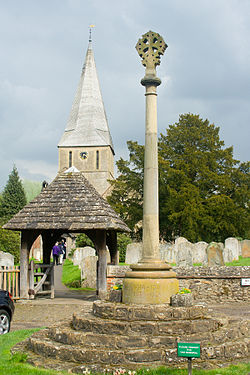
[edit]The church of St James is in the Early English style, most being 12th, 13th and 14th century. It replaced an earlier Anglo-Saxon church mentioned in the Domesday Book.[9] Constructed of ironstone rubble with sandstone buttresses, it was restored in 1895 by S. Weatherley. By the north chancel wall there is a 14th-century quatrefoil window and squint – belonging to an Anchorite cell used by Christina Carpenter in the 14th-century. There is 14th-century glass in the east window and the chancel fittings were renewed in 1956 by Louis Osman. It is a Grade I listed building.[10]
Other Listed Buildings
[edit]Within the village centre conservation area there are 34 listed buildings.
These are all older than 1830, in some cases by several centuries.[11]
Transport
[edit]The village can be accessed for long-distance travel from the north and west from the A3 at West Clandon – from the east the M25 at Leatherhead and the A24 at Dorking followed by the A25 road provides a shorter alternative route than taking the first route; there are minor routes south however the nearest major route directly south is the A24 at Dorking.
Gomshall railway station is less than 1 mile (1.6 km) away on the Reading to Gatwick line. While 1614 people (65% of the parish) in 2001 for instance were economically active, only 178 routinely used public transport and 1037 used motor vehicles. The average Shere commuter travels 20.3 kilometres (12.6 mi) to work.[12]
Economy, demography and housing
[edit]
The economy is a mixture of local and regional with the many shops and some farming within it. A significant minority of the working population are London commuters, particularly in the civil parish at large. The 2001 census shows the self-employed (including with employees) form 36% of the population, retirees form 16% of the population and employees form 48% of the population. 77% of the ward's population is Christian, of the remainder 22% are of no religion or not stated.[2]


Within the civil parish are shops, four village halls, and three post offices. Many walks radiate from the village, including a streamside walk, parts of the North Downs Way and the Pilgrims' Way. In the village are Millstream Press, a book publisher named after the Tillingbourne, a textiles-cum-boutique[13] and Surrey Hills Brewery.[14]
The United Kingdom Census 2011 considered the village as four relevant output layers, approximately a third of the ward Shere, the latter being used for elections to Guildford Borough Council. All parts featured their single largest proportion of housing as either semi-detached or single-family homes and most of these with gardens.
In all 439 households (in slightly fewer homes) make up the village including its scattered farms and cottages. The census boundaries drawn exclude central and eastern Burrows Cross due to is proximity to slightly larger hamlet Gomshall, being contiguous and due south Burrows Cross had census overlap of its output areas (E00155528 and E00155529) and was included within Gomshall.
The proportion of households in three divisions of Shere who owned their home outright was at least 5% above the national average, in the fourth division this was 3% below, a central area including one of the two conservation area thoroughfares. The proportion of residents who owned their home with a loan was between 2.8% and 11.3% lower than the national average. The census shows that overall, Shere has a lower proportion than average of rented residential property and of social housing relative to the Surrey and national averages.[1]
| Output area | Population | Households | % Owned outright | % Owned with a loan | hectares[1] |
|---|---|---|---|---|---|
| E00155527 | 220 | 100 | 39.0 | 30.0 | 165 |
| E00155526 | 329 | 144 | 35.4 | 23.6 | 87 |
| E00155525 | 142 | 51 | 51.0 | 23.5 | 677 |
| E00155524 | 341 | 144 | 27.1 | 21.5 | 59 |
Across the whole parish the 2011 distribution of housing was:
| Output area | Detached | Semi-detached | Terraced | Flats and apartments | Caravans/temporary/mobile homes | shared between households[1] |
|---|---|---|---|---|---|---|
| (Civil Parish) | 745 | 477 | 146 | 103 | 4 | 0 |
The average level of accommodation in the region composed of detached houses was 28%, the average that was apartments was 22.6%.
Local government
[edit]At Surrey County Council, one of the 81 representatives represents the area within the Shere division which includes Albury and (East and West) Clandon.[15]
At Guildford Borough Council most wards of the borough are deemed appropriate to be represented under the current constitution of councillors by two to three councillors, which is the case for the Tillingbourne ward which has two.
| Election | Member | Ward | |
|---|---|---|---|
| 2015 | Richard Billington (Conservative) | Tillingbourne[16] | |
| 2019 | Diana Jones (Green Party) | ||
| Election | Member[17] |
Electoral Division | |
|---|---|---|---|
| 2017 | Keith Taylor (Conservative) | Shere | |
Notable residents
[edit]
- Christine Carpenter (of unknown year of birth and death) submitted a petition in 1329[18] and consequently was granted permission to become the Anchoress of Shere Church[19] (aka. The Church of St. James). She received her food and drink from friends and family through a metal grating on the outside wall. In the interior of the church a quatrefoil shape was cut out of the wall through which she could receive the Eucharist and a squint (or hagioscope) for her use for prayer and reflection. She left her cell and in 1332 she applied again and was granted permission to be re-enclosed.[9]
- Benjamin Williams Leader (1831–1923), landscape artist. Lived in the parish from 1889 to 1923 at Burrows Cross, a large mansion which dominated its hamlet directly south-east of the village, designed by Norman Shaw.
- Lewis Pinhorn Wood (1848–1918), landscapist and watercolourist, best known for his rural scenes of Sussex and Surrey. In the tradition of the Victorian era, his work depicted idyllic scenes of rural life across the home counties. He lived with his family in the parish in the 1870s and 1880s at 'Burnside'.
- Harry Edwards (1893–1976), spiritual healer, founded his "Spiritual Healing sanctuary" at Burrows Lea, a house in the east of the parish, in 1946; he went on to found the "National Federation of Spiritual Healers" (NFSH) in 1959.[20]
- John "Hoppy" Hopgood (1921–1943), a pilot with 617 Squadron, the Dambusters. Flying as Guy Gibson's second in command, he was killed in the attack on the Möhne dam. "Hoppy" lived in Hurstcote House on Hook Lane which is now the site of Shere Court.
In popular culture
[edit]Film location
[edit]Since at least the early 20th century, the location and Tudor architecture has been a draw for artists and film-makers. The Victoria County History, which was written for the county of Surrey in 1911, lavished more praise than on any other village:
Shere has often been called one of the most beautiful villages in England; certainly few can surpass it in Surrey for a combination of those qualities that go to make up the ideal village... Shere is, therefore, the haunt of painters, many of them residents in and around, and samples of their handiwork may be inspected in the ancient Black Horse Inn.[6]
Films made in the area include:

- 1918, D. W. Griffith's silent film Hearts of the World.[21]
- 1946, as Dr. Reeves’ village in Michael Powell and Emeric Pressburger's A Matter of Life and Death.[22]
- 1964, The Earth Dies Screaming, a science fiction film directed by Terence Fisher.[22]
- 1965, Die, Monster, Die!, loosely based on H. P. Lovecraft's The Colour Out of Space, starring Boris Karloff.[23]
- 1972, The Ruling Class, starring Peter O'Toole.[22]
- 2004, Bridget Jones: The Edge of Reason, in which St James's church features briefly in the final wedding scene.[24]
- 2005, The Wedding Date starring Debra Messing and Dermot Mulroney.[24]
- 2006, The Holiday starring Cameron Diaz, Kate Winslet and Jude Law.[24][25]
- 2021, The music video for Zombie! by Orla Gartland.[26]
In literature
[edit]Anchoress of Shere by Paul L. Moorcraft.[27]
The Passionate Friends, a social commentary novel by H. G. Wells, places the protagonist's marriage here.[28]


References
[edit]- ^ a b c d Key Statistics; Quick Statistics: Population Density United Kingdom Census 2011 Office for National Statistics Retrieved 21 November 2013
- ^ a b Census data
- ^ a b Open Domesday Online: Shere, accessed Dec 2017.
- ^ Domesday Book – Surrey Archived 15 July 2007 at the Wayback Machine
- ^ Domesdaymap.co.uk complete transcriptions (free) with original excerpts
- ^ a b c d e f g H.E. Malden, ed. (1911). "Parishes: Shere". A History of the County of Surrey: Volume 3. Institute of Historical Research. Retrieved 7 November 2013.
- ^ Major J (2007) More Than a Game, p.31. HarperCollins.
- ^ (School Website).
- ^ a b Austin, Tim (2005). History of St James' Church Shere. Shere parish.
- ^ Historic England. "Details from listed building database (1377794)". National Heritage List for England. Retrieved 6 May 2012.
- ^ Map created by Ordnance Survey, courtesy of English Heritage
- ^ "2001 Census". ONS. Retrieved 7 May 2012.
- ^ "Mad Jak textiles, food and fashion". Retrieved 6 May 2012.
- ^ "Surrey Hills Brewery address". Retrieved 6 May 2012.
- ^ Electoral Divisions Archived 2 December 2013 at the Wayback Machine Surrey County Council. Retrieved 6 November 2013
- ^ "Your Councillors". Guildford Borough Council. Retrieved 29 December 2020.
- ^ Your Councillor Surrey County Council. Retrieved 6 November 2013
- ^ [1] University of Saint Thomas–Saint Paul, MN "Petition to Become an Anchoress", http://courseweb.stthomas.edu, 2003, 22 April 2012
- ^ [2] "History of Shere", sheredelight.com, 2011, 22 April 2012
- ^ The Harry Edwards Spiritual healing Sanctuary (Royal College of Psychiatrists).
- ^ Schnickel, Richard (1984). D. W. Griffith and the Birth of Film. London: Pavilion. p. 348. ISBN 978-0-9075-1647-7.
- ^ a b c "Surrey Film Locations". Great British Life. 9 May 2016. Retrieved 22 August 2023.
- ^ "Filming Locations for Die, Monster, Die (Monster Of Terror) (1965), in Berkshire and Surrey". The Worldwide Guide to Movie Locations. Retrieved 19 August 2023.
- ^ a b c Hughes, Seren; Rowlands, Robert (26 January 2021) [12 December 2020]. "The fairytale Surrey village in The Holiday, Wedding Date and Bridget Jones: Edge of Reason". Surrey Live. Retrieved 22 August 2023.
- ^ "Stars arrive as village becomes a Hollywood backdrop". Discover Kate.
- ^ Behind the scenes of zombie! the music video, archived from the original on 21 December 2021, retrieved 26 May 2021
- ^ Moorcraft, Paul L. (2002). The Anchoress of Shere. Scottsdale, Arizona: Poisoned Pen Press. ISBN 159058028-1.
- ^ Wells, H G. The Passionate Friends. London: Macmillan. ISBN 9781275155701.
External links
[edit]

- Shere Parish Council
- 1933 Video of Shere
- Shere Village website
- Young Kuwaiti Man visits English Village of Shere, 1960s - Archive Film 1062116
Nearest Settlements | |
|---|---|


| International | |
|---|---|
| National | |
| Other | |

Shere
View on GrokipediaGeography
Location and boundaries
Shere is a civil parish and village in the Guildford borough of Surrey, England, situated in the Tillingbourne Valley approximately 4.8 miles (7.7 km) east-southeast of Guildford and 5.4 miles (8.7 km) west of Dorking.[6] The parish lies at the foot of the North Downs, a range of chalk hills, along the River Tillingbourne, which flows through the central village.[7] The civil parish encompasses the villages of Shere, Gomshall, Holmbury St. Mary, Peaslake, and most of Abinger Hammer (excluding the village centre itself).[8] It covers a total area of 24.52 km² (9.46 sq mi), making it the largest parish by area in the Guildford borough, and includes extensive rural landscapes designated as part of the Surrey Hills National Landscape, the Metropolitan Green Belt, and an Area of Great Landscape Value.[5][8] Historically, the parish boundaries have included the hamlets of Felday and Pislake (now corresponding to parts of Peaslake), with an area recorded as 6,396 acres (25.9 km²) in the mid-19th century, reflecting minor adjustments over time but maintaining a focus on the valley and surrounding hills.[7] The parish is centrally bypassed by the A25 road, preserving its rural character while connecting it to nearby towns.[6]Physical features
Shere lies within the Tillingbourne Valley in the Surrey Hills National Landscape, a designated area of outstanding natural beauty encompassing the parish of Shere, which includes the villages of Shere, Gomshall, Holmbury St. Mary, Peaslake, and most of Abinger Hammer. The terrain features gently undulating hills and a narrow valley floor at approximately 35 meters above ordnance datum (AOD), with steeply sloping sides rising to surrounding greensand hills that reach elevations of up to 243 m AOD south of Peaslake. This landscape is bordered to the north by the chalk downs of the North Downs, creating a transition from rolling claylands to wooded escarpments.[9][10] The Tillingbourne River is a defining hydrological feature, flowing eastward through the valley before joining the River Wey south of Guildford; it supports a network of tributaries, ponds, weirs, and historic mill sites that have shaped the area's settlement patterns and ecology. Elevations vary from low-lying valley floors to prominent hills such as nearby St Martha's Hill (in the adjacent St Martha parish), which exceeds 165 m AOD and forms part of the Wooded Greensand Hills. These hills, including Shere Heath, offer panoramic views and remnant open heathland amid pastoral farmland.[10] Geologically, the region is dominated by Lower Greensand Group formations, including the Hythe Formation (well-sorted sands and sandstones up to 85 m thick, with chert nodules), Bargate Formation (gritty, ferruginous sandstones up to 10 m thick, with outliers around Shere), Sandgate Formation (argillaceous, glauconitic sands 0–45 m thick, often absent near Shere), and Folkestone Formation (loose, ferruginous quartz sands 32–60 m thick). These overlie Gault Clay and are capped in places by Upper Greensand siltstones and the Chalk Group, which forms the nearby Hog's Back ridge at around 152 m AOD. Ironstone within these strata contributes to the formation of steep-sided hills.[11][10] Soils reflect this geology, with nutrient-poor, acidic sandy types derived from greensand supporting heathlands, woodlands, and acid-loving vegetation, while fertile loamy soils over underlying clays sustain pastures and historic parklands. Notable natural features include ancient woodlands like those at assarted woods at Burrows Cross, and biodiversity-rich areas designated as Sites of Nature Conservation Importance, enhanced by spring lines and seasonal streams. Nearby Colyers Hanger (a Site of Special Scientific Interest in the adjacent St Martha parish) exemplifies the broader woodland character.[10]History
Early history and Domesday Book
The settlement of Shere in Surrey likely originated during the Saxon period, as evidenced by its pre-Conquest landholding and inclusion in the Domesday survey, which typically recorded established communities. Prior to 1066, the manor was held by Queen Edith, wife of Edward the Confessor, indicating a significant royal estate in the area.[12] The name Shere appears in the Domesday Book as Essira or Essire, derived from Old English elements suggesting a 'bright' or 'clear' place, possibly referring to the clear waters of the nearby Tillingbourne stream.[13] Archaeological evidence is limited, but the presence of a church by 1086 points to an organized community with religious institutions predating the Norman Conquest.[12] In the Domesday Book of 1086, Shere is described as a substantial settlement in Blackheath hundred, held directly by King William I as part of the royal demesne. It supported 31 households, comprising 19 villagers, 6 smallholders, and 6 slaves, suggesting a population of around 150–200 people when accounting for families and dependents. The land included 14 ploughlands (with 2 teams on the lord's demesne and 12 for the men), 3 acres of meadow, woodland rendering 50 swine, and 2 mills valued at 10 shillings annually; a church is also noted. The manor's total value was assessed at 15 pounds, unchanged from its 1066 estimate, reflecting economic stability amid the Conquest's upheavals.[13] The villeins of nearby Gomshall, part of the same royal holding, enjoyed exemption from the sheriff's jurisdiction, highlighting early administrative privileges.[12] Following the Domesday survey, King William II (William Rufus) granted Shere to William de Warenne as part of the earldom of Surrey endowment after 1086, marking the transition from royal to baronial control. This tenure persisted through the de Warenne family until the early 13th century, when the manor passed to Roger de Clare. By the mid-13th century, after the death of Richard, son of John de Warenne, the estate was divided into moieties known as Shiere Vachery and Shiere Ebor, laying the foundation for later manorial subdivisions. The advowson of the church, mentioned in Domesday, was sold by Roger de Clare to Netley Abbey in 1243, integrating Shere into monastic networks. These early post-Conquest changes underscore the manor's strategic importance in the feudal landscape of Surrey.[12]Medieval and early modern periods
Following the Domesday survey, the manor of Shere, originally held by William I, was granted to William de Warenne, Earl of Surrey, by William II after 1086, forming part of the Honour of Warenne.[12] By the 13th century, it had been divided into Shere Vachery and Shere Ebor (or Yoke), with Vachery passing through the Butler family to the Earls of Ormond; it was forfeited to the Crown in 1461 after the attainder of Thomas, Earl of Ormond, following the Battle of Towton.[12] In 1467, Edward IV granted Shere Vachery to James Lord Audley, who led the Cornish rebels through Shere in 1497 during their march on London, resulting in his execution and the manor's reversion to the Crown; Henry VII then bestowed it upon Sir Reginald Bray in 1486 as a reward for his service in the Wars of the Roses.[12] Shere Ebor, meanwhile, descended from Richard de Burgh, Earl of Ulster (d. 1326), to the Mortimer earls of March, and upon their forfeiture in 1461, it passed to the Crown before being granted to John Cokk in the 1540s under Edward VI.[12] The Bray family consolidated control over Shere's manors in the early modern period, with Sir Edward Bray acquiring Shere Ebor by marriage in the 16th century and purchasing it outright in 1603; by 1771, William Bray reunited Shere Ebor with Vachery, which remained in the Bray family into the 18th century under Sir Reginald More Bray.[12] Adjacent manors like Gomshall, part of the royal demesne in 1086, were subdivided into Gomshall Netley and Towerhill by the 13th century; Netley was granted to Netley Abbey in 1233 and later passed to the Bray family after the Dissolution, while Towerhill descended through the de Braose and Bray lines, uniting with the main estates by the 16th century.[12] Sutton manor, linked to the Shere holdings, was held by the Hill family in the 16th century before transferring to the Leighs, Huntleys, and Husseys, and was sold to Edward Pike Heath before 1728.[12] The Church of St. James, referenced in Domesday Book, underwent significant medieval rebuilding, with a tower erected by 1150 and a south aisle added around 1200; the chancel was reconstructed between 1300 and 1320 under the patronage of Netley Abbey, which had acquired the advowson in 1243 despite disputes with the lords of Shere Vachery.[12] The advowson alternated between abbey presentations (e.g., 1379–1390) and lay patrons until a 1518 settlement granted it to Sir Edmund Bray; a chantry to Our Lady was established in the church during the 14th century.[12] In the early modern era, the advowson passed to the Duncomb family by 1677 and was sold to John Smallpeice in 1831, though clerical appointments continued under lay influence.[12] Architectural features from this period include a 12th-century font and south doorway, with a timber spire added circa 1300.[12] Economically, Shere remained agrarian-focused through the medieval and early modern periods, with fertile Tillingbourne valley lands supporting mixed farming; watermills recorded in Domesday (two at Shere, one at Gomshall) operated into the 14th century, and ironworking occurred locally, as noted in historical accounts.[12] A market was granted for Shere Vachery in 1309, likely situated west of the church, though it appears to have been short-lived amid modest development evidenced by limited medieval pottery finds.[14] By the 18th century, watercress cultivation in Tillingbourne ponds became notable, and ancient fustian cloth production was referenced by antiquarian John Aubrey; the hilly terrain facilitated sheep-rearing but also smuggling and sheep-stealing in the wilder areas.[12] The Bray family's long tenure as lords of the manor shaped local governance and land use, with William Bray (1736–1832), a prominent Surrey historian born in Shere, documenting the village's customs and estates in his diaries.[12]19th century to present
During the 19th century, Shere experienced infrastructural and educational advancements largely driven by the Bray family, long-term owners of the Shere Manor Estate. The current Manor House was constructed in 1840, serving as the family seat.[15] In 1842, Louisa Bray and Laura Lomax founded Shere School on estate land and stone, establishing a key educational institution that enrolled 259 pupils by 1892.[15] The Shere Reading Room opened in 1856 to promote literacy among villagers, while a public water supply system was installed in 1889 by Sir Reginald More Bray, extending benefits to Shere, Gomshall, and nearby Hook Lane.[15] Additional cottages were built during this period, including two designed by architect Sir Edwin Lutyens, reflecting estate-led improvements in rural housing.[15] The local economy centered on agriculture, supplemented by weaving—women spun wool from local sheep—and tanning, particularly in Gomshall, where the industry supported international trade.[16] An open-air swimming pool was established in the early 1890s, enhancing community recreation, and Netley Park's main house was built in the late 1850s by Sir Edmund Lomax.[17] The early 20th century brought further refinements to village life, with the estate introducing a Gypsy Camp in 1923 for seasonal travelers and establishing Hurtwood Control after the 1925 Law of Property Act to manage common lands.[15] During World War II, the area housed evacuees at Tower Hill Manor in Gomshall from 1940 onward, while resident Connie Miles documented daily wartime experiences in a diary spanning 1939 to 1945, later published by the Imperial War Museum.[16] Post-war recovery saw estate efforts to modernize cottages under Jocelyn Bray, ensuring all had indoor bathrooms by 1964, alongside the closure of the Gomshall tannery in 1989, marking the decline of industrial activities.[15][16] In the late 20th and early 21st centuries, Shere evolved into a primarily residential and tourist destination, renowned as "Surrey’s prettiest village" for its picturesque setting and historic timber-framed buildings from the 16th to 19th centuries.[17] A bypass constructed in 1960 diverted traffic from central roads like Upper Street and Gomshall Lane, preserving the village's tranquility.[17] Low-density housing, such as the post-war Pathfields estate, contributed to gradual expansion, while the designation of the Shere Conservation Area on 31 July 1973 protected 61 listed buildings and the surrounding landscape.[17] Tourism now sustains small retail and service businesses, with mills like Gomshall Mill repurposed as a restaurant.[16] The Shere Manor Estate, reduced by 20th-century death duties, retains about 40 cottages for affordable local housing and oversees environmental initiatives via the Friends of the Hurtwood charity.[15] Recent additions include a doctor's surgery in 1993 and a public car park in 2010 to address modern needs.[15] The civil parish population grew to 3,630 by the 2011 census and 3,770 by 2021, reflecting steady demographic expansion amid rural preservation efforts.[5]Demographics
Population trends
The population of Shere civil parish has exhibited steady growth since the early 19th century, reflecting broader patterns of rural expansion in Surrey driven by agricultural improvements, industrialization in nearby areas, and later suburbanization from London. According to historical census records, the population rose from 871 in 1801 to 1,403 by 1851, more than doubling amid the agricultural revolution and population pressures of the Industrial era. This upward trajectory continued through the late 19th and early 20th centuries, reaching 2,184 in 1901 and accelerating to 3,876 by 1961, influenced by post-war housing developments and improved transport links.[18] A slight decline occurred in the 1970s, with the population falling to 3,705 by 1971, possibly due to out-migration as younger residents sought opportunities in urban centers. Recovery followed in the late 20th and early 21st centuries, with figures climbing to 3,359 in 2001, 3,630 in 2011, and 3,770 in 2021, representing an average annual growth of about 0.38% over the last decade. This modest recent increase aligns with national trends in affluent rural parishes, where high property values and appeal to commuters have stabilized or gently boosted numbers, though growth remains slower than in urban Surrey districts. The following table summarizes key census populations for Shere civil parish, highlighting the long-term trend of overall expansion from under 1,000 residents in the early 1800s to nearly 4,000 today:| Year | Population |
|---|---|
| 1801 | 871 |
| 1851 | 1,403 |
| 1901 | 2,184 |
| 1951 | 3,816 |
| 1961 | 3,876 |
| 1971 | 3,705 |
| 2001 | 3,359 |
| 2011 | 3,630 |
| 2021 | 3,770 |
Social characteristics
Shere exhibits a predominantly homogeneous ethnic composition, with 96.4% of residents identifying as White in the 2021 census. Asian residents account for approximately 0.8%, mixed or multiple ethnic groups 2%, and other ethnic groups including Black, Arab, and unspecified categories comprising the remainder at under 1% each. Similarly, 89.3% of the population was born in the United Kingdom, with 3.5% from other European countries and 7.2% from Asia, Africa, or other regions.[5] Religiously, Christianity remains the most common affiliation, reported by 56.1% of residents, followed by 36.7% stating no religion. Smaller groups include 0.5% Muslim, 0.4% Hindu, 0.6% Jewish, and negligible numbers identifying as Sikh, Buddhist, or other faiths. This distribution reflects a largely secularizing trend alongside traditional Christian roots in the village.[5] The social structure of Shere is characterized by a professional and affluent demographic, with 24.85% of residents in professional occupations and 25.19% as managers or directors, according to 2021 data. Education levels are notably high, with 49.23% holding degree-level qualifications (Level 4 or above), compared to the England average of 33.92%; only 9.95% have no qualifications. Unemployment stands at a low 2.7%, and 74.17% of households own their homes outright or with a mortgage, indicating relative economic stability and low deprivation. Health outcomes are positive, with 56.88% reporting very good health.[19] Community life in Shere emphasizes strong local ties and volunteerism, exemplified by historical initiatives like the 1938 support for Czech refugees and a 2020 COVID-19 mutual aid group. Regular events such as the Shere Open Gardens and church commemorations at St. James' foster social cohesion, while amenities including pubs, cafes, and sports facilities like tennis courts and bowling greens support everyday interactions. The village's picturesque setting and adequate outdoor spaces contribute to a close-knit, family-oriented atmosphere, though play areas for children are somewhat limited.[20][21]Economy and housing
Employment and industry
According to the 2021 Census, 55.79% of Shere residents aged 16 years and over were economically active and in employment, reflecting a stable local labour market in this rural Surrey village. The unemployment rate was notably low at 2.7%, below the national average, with 69.26% of those in work engaged in full-time employment and 30.74% in part-time roles. These figures underscore a community with strong participation in the workforce, supported by the village's proximity to larger economic hubs like Guildford.[19] Occupational data from the same census reveals a skew towards higher-skilled and managerial roles, indicative of an affluent demographic. Managers, directors, and senior officials comprised 25.19% of the employed population, while professional occupations accounted for 24.85%. Associate professional and technical positions followed at 14.89%, with skilled trades at 9.44% and administrative and secretarial roles at 7.91%. Smaller shares were in caring, leisure, and other service occupations (5.97%), elementary occupations (4.85%), and process, plant, and machine operatives (2.31%). This distribution highlights a reliance on knowledge-based and service-sector employment rather than manual labour.[19] The local economy in Shere centres on small-scale industries tied to its heritage and natural setting in the Surrey Hills Area of Outstanding Natural Beauty. Tourism plays a key role, sustaining hospitality and retail businesses such as cafes, pubs, and boutique shops that attract visitors to the village's historic charm and scenic walks. Agriculture remains a minor but traditional component, with the partly agricultural landscape supporting limited farming activities. Historically, the parish was associated with weaving and tanning industries, utilising local wool and resources, though these have diminished in favour of modern service-oriented enterprises.[1][16]| Occupation Category | Percentage of Employed Residents |
|---|---|
| Managers, Directors & Senior Officials | 25.19% |
| Professional Occupations | 24.85% |
| Associate Professional & Technical | 14.89% |
| Skilled Trades | 9.44% |
| Administrative & Secretarial | 7.91% |
| Caring, Leisure & Other Services | 5.97% |
| Elementary Occupations | 4.85% |
| Process, Plant & Machine Operatives | 2.31% |