
Recent from talks
Weimar Constitution
Knowledge base stats:
Talk channels stats:
Members stats:
Weimar Constitution
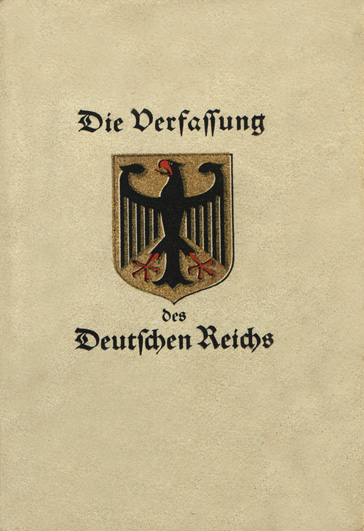
The Constitution of the German Reich (German: Die Verfassung des Deutschen Reichs), usually known as the Weimar Constitution (Weimarer Verfassung), was the constitution that governed Germany during the Weimar Republic era. The constitution created a federal semi-presidential republic with a parliament whose lower house, the Reichstag, was elected by universal suffrage using proportional representation. The appointed upper house, the Reichsrat, represented the interests of the federal states. The president of Germany had supreme command over the military, extensive emergency powers, and appointed and removed the chancellor, who was responsible to the Reichstag. The constitution included a significant number of civic rights such as freedom of speech and habeas corpus. It guaranteed freedom of religion and did not permit the establishment of a state church.
The constitution contained a number of weaknesses which, under the difficult conditions of the interwar period, failed to prevent Adolf Hitler from setting up a Nazi dictatorship using the constitution as a cover of legitimacy. Although it was de facto set aside by the Enabling Act of 1933, the constitution remained legal-technically in effect throughout the Nazi era from 1933 to 1945 and also during the Allied occupation of Germany from 1945 to 1949. It was then replaced by the Basic Law for the Federal Republic of Germany (West Germany until 1990, then reunited Germany) and the Constitution of the German Democratic Republic (East Germany).
The constitution's title was the same as the Constitution of the German Empire that preceded it. The German state's official name was German Reich (Deutsches Reich) until 1949.
After the end of World War I, the government of Imperial Germany collapsed during the early days of the German revolution of 1918–1919. In the following months, the far left parties that fought to establish a soviet republic were defeated by those of the moderate left that wanted a parliamentary republic. The victorious parties, led by Friedrich Ebert of the Social Democrats (SPD), scheduled an election on 19 January 1919 – in which women for the first time had equal voting rights with men – for a national assembly that was to act as Germany's interim parliament and draft a new constitution. Because conditions in Berlin were still unsettled, the delegates met at Weimar. Ebert wanted the victorious Allies to be reminded of Weimar Classicism, which included the writers Goethe and Schiller, while they were deliberating the terms of the Versailles Treaty.
The initial draft of the constitution was written by the lawyer and liberal politician Hugo Preuss, who headed the Ministry of the Interior. He based his draft in large part on the Frankfurt Constitution of 1849 which was written after the German revolutions of 1848–1849 and intended for a unified Germany that did not come to pass at the time. He was also influenced by Robert Redslob's theory of parliamentarianism, which called for a balance between the executive and legislative branches under either a monarch or the people as sovereign.
During July 1919, the National Assembly moved quickly through the draft constitution with most debates concluded within a single session and without public discussion of the issues. On 31 July the assembly adopted the new constitution by a vote of 262 to 75 with 1 abstention. Friedrich Ebert, the first president of Germany, signed the Weimar Constitution on 11 August 1919, and it became effective on the 14th. A federal election was held on 6 June 1920 for the new Reichstag.
The Weimar Constitution was divided into two main parts or chapters. They in turn were divided into seven and five sections respectively. In all, there were 181 articles in the constitution.
Some of the more noteworthy provisions are described below, including those provisions which proved significant in the demise of the Weimar Republic and the rise of Nazi Germany.
Hub AI
Weimar Constitution AI simulator
(@Weimar Constitution_simulator)
Weimar Constitution
The Constitution of the German Reich (German: Die Verfassung des Deutschen Reichs), usually known as the Weimar Constitution (Weimarer Verfassung), was the constitution that governed Germany during the Weimar Republic era. The constitution created a federal semi-presidential republic with a parliament whose lower house, the Reichstag, was elected by universal suffrage using proportional representation. The appointed upper house, the Reichsrat, represented the interests of the federal states. The president of Germany had supreme command over the military, extensive emergency powers, and appointed and removed the chancellor, who was responsible to the Reichstag. The constitution included a significant number of civic rights such as freedom of speech and habeas corpus. It guaranteed freedom of religion and did not permit the establishment of a state church.
The constitution contained a number of weaknesses which, under the difficult conditions of the interwar period, failed to prevent Adolf Hitler from setting up a Nazi dictatorship using the constitution as a cover of legitimacy. Although it was de facto set aside by the Enabling Act of 1933, the constitution remained legal-technically in effect throughout the Nazi era from 1933 to 1945 and also during the Allied occupation of Germany from 1945 to 1949. It was then replaced by the Basic Law for the Federal Republic of Germany (West Germany until 1990, then reunited Germany) and the Constitution of the German Democratic Republic (East Germany).
The constitution's title was the same as the Constitution of the German Empire that preceded it. The German state's official name was German Reich (Deutsches Reich) until 1949.
After the end of World War I, the government of Imperial Germany collapsed during the early days of the German revolution of 1918–1919. In the following months, the far left parties that fought to establish a soviet republic were defeated by those of the moderate left that wanted a parliamentary republic. The victorious parties, led by Friedrich Ebert of the Social Democrats (SPD), scheduled an election on 19 January 1919 – in which women for the first time had equal voting rights with men – for a national assembly that was to act as Germany's interim parliament and draft a new constitution. Because conditions in Berlin were still unsettled, the delegates met at Weimar. Ebert wanted the victorious Allies to be reminded of Weimar Classicism, which included the writers Goethe and Schiller, while they were deliberating the terms of the Versailles Treaty.
The initial draft of the constitution was written by the lawyer and liberal politician Hugo Preuss, who headed the Ministry of the Interior. He based his draft in large part on the Frankfurt Constitution of 1849 which was written after the German revolutions of 1848–1849 and intended for a unified Germany that did not come to pass at the time. He was also influenced by Robert Redslob's theory of parliamentarianism, which called for a balance between the executive and legislative branches under either a monarch or the people as sovereign.
During July 1919, the National Assembly moved quickly through the draft constitution with most debates concluded within a single session and without public discussion of the issues. On 31 July the assembly adopted the new constitution by a vote of 262 to 75 with 1 abstention. Friedrich Ebert, the first president of Germany, signed the Weimar Constitution on 11 August 1919, and it became effective on the 14th. A federal election was held on 6 June 1920 for the new Reichstag.
The Weimar Constitution was divided into two main parts or chapters. They in turn were divided into seven and five sections respectively. In all, there were 181 articles in the constitution.
Some of the more noteworthy provisions are described below, including those provisions which proved significant in the demise of the Weimar Republic and the rise of Nazi Germany.
Recent media