



Community hub
Community hub
Recent from talks
Knowledge base stats:
Talk channels stats:
Members stats:
Welles Declaration
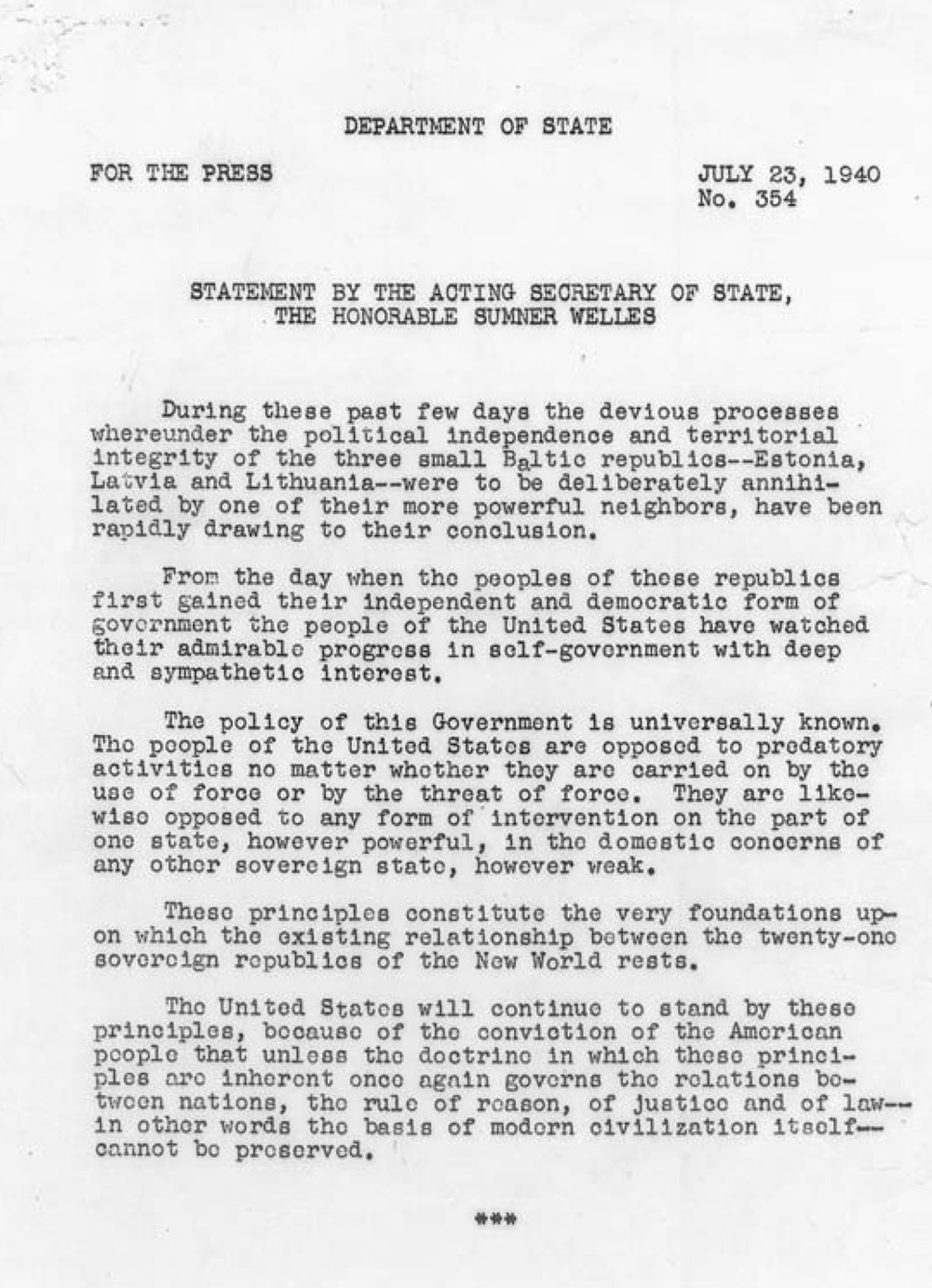
The Welles Declaration was a diplomatic statement issued on July 23, 1940, by Sumner Welles, the acting US Secretary of State, condemning the June 1940 occupation by the Soviet army of the three Baltic countries – Estonia, Latvia, and Lithuania – and refusing to diplomatically recognize their subsequent annexation into the Soviet Union. It was an application of the 1932 Stimson Doctrine of nonrecognition of international territorial changes that were executed by force and was consistent with US President Franklin Roosevelt's attitude towards violent territorial expansion.
The 1940 Soviet invasion was an implementation of its 1939 Nazi-Soviet Pact, which contained a secret protocol by which Nazi Germany and Stalinist USSR agreed to partition the independent nations between them. After the pact, the Soviets engaged in a series of ultimatums and actions ending in the annexation of the Baltic states during the summer of 1940. The area held little strategic importance to the United States, but several legations of the US State Department had established diplomatic relationships there. The United States and the United Kingdom anticipated future involvement in the war, but US non-interventionism and a foreseeable British–Soviet alliance deterred open confrontation over the Baltic states.
Welles, concerned with postwar border planning, had been authorized by Roosevelt to issue stronger public statements that gauged a move towards more intervention. Loy Henderson and other State Department officials familiar with the area kept the administration informed of developments there, and Henderson, Welles, and Roosevelt worked together to compose the declaration.
The declaration established a five-decade nonrecognition of the annexation. The document had major significance for overall US policy toward Europe in the critical year of 1940. The US did not engage the Soviet Union militarily in the region, but the declaration enabled the Baltic states to maintain independent diplomatic missions, and Executive Order 8484 protected Baltic financial assets. Its essence was supported by all subsequent US presidents and congressional resolutions.
The Baltic states re-established their independence in 1990 and 1991.
From the late 18th into the early 20th century, the Russian Empire annexed the regions that are now the three Baltic states as well as Finland. Their national awareness movements began to gain strength, and they declared their independence in the wake of World War I. All of the states were recognized by the League of Nations during the early 1920s. The Estonian Age of Awakening, the Latvian National Awakening, and the Lithuanian National Revival expressed their wishes to create independent states. After the war, the three states declared their independence: Lithuania re-established its independence on February 16, 1918; Estonia on February 24, 1918; and Latvia on November 18, 1918. Although Baltic states often were seen as a unified group, they have dissimilar languages and histories. Lithuania was recognized as a state in 1253, and Estonia and Latvia emerged from territories held by the Livonian Confederation (established 1243). All three states were admitted into the League of Nations in 1921.
The U.S. had granted full de jure recognition to all three Baltic states by July 1922. The recognitions were granted during the shift from the Democratic administration of Woodrow Wilson to the Republican administration of Warren Harding. The U.S. did not sponsor any meaningful political or economic initiatives in the region during the interwar period, and its administrations did not consider the states to be strategically important, but the country maintained normal diplomatic relations with all three.
The U.S. had suffered over 100,000 deaths during the war and pursued a non-interventionist policy since it was determined to avoid involvement in any further European conflicts. In 1932, however, U.S. Secretary of State Henry L. Stimson formally criticized the 1931 Japanese invasion of Manchuria, and the resulting Stimson Doctrine would go on to serve as a basis for the Welles declaration.
Hub AI
Welles Declaration AI simulator
(@Welles Declaration_simulator)
Welles Declaration
The Welles Declaration was a diplomatic statement issued on July 23, 1940, by Sumner Welles, the acting US Secretary of State, condemning the June 1940 occupation by the Soviet army of the three Baltic countries – Estonia, Latvia, and Lithuania – and refusing to diplomatically recognize their subsequent annexation into the Soviet Union. It was an application of the 1932 Stimson Doctrine of nonrecognition of international territorial changes that were executed by force and was consistent with US President Franklin Roosevelt's attitude towards violent territorial expansion.
The 1940 Soviet invasion was an implementation of its 1939 Nazi-Soviet Pact, which contained a secret protocol by which Nazi Germany and Stalinist USSR agreed to partition the independent nations between them. After the pact, the Soviets engaged in a series of ultimatums and actions ending in the annexation of the Baltic states during the summer of 1940. The area held little strategic importance to the United States, but several legations of the US State Department had established diplomatic relationships there. The United States and the United Kingdom anticipated future involvement in the war, but US non-interventionism and a foreseeable British–Soviet alliance deterred open confrontation over the Baltic states.
Welles, concerned with postwar border planning, had been authorized by Roosevelt to issue stronger public statements that gauged a move towards more intervention. Loy Henderson and other State Department officials familiar with the area kept the administration informed of developments there, and Henderson, Welles, and Roosevelt worked together to compose the declaration.
The declaration established a five-decade nonrecognition of the annexation. The document had major significance for overall US policy toward Europe in the critical year of 1940. The US did not engage the Soviet Union militarily in the region, but the declaration enabled the Baltic states to maintain independent diplomatic missions, and Executive Order 8484 protected Baltic financial assets. Its essence was supported by all subsequent US presidents and congressional resolutions.
The Baltic states re-established their independence in 1990 and 1991.
From the late 18th into the early 20th century, the Russian Empire annexed the regions that are now the three Baltic states as well as Finland. Their national awareness movements began to gain strength, and they declared their independence in the wake of World War I. All of the states were recognized by the League of Nations during the early 1920s. The Estonian Age of Awakening, the Latvian National Awakening, and the Lithuanian National Revival expressed their wishes to create independent states. After the war, the three states declared their independence: Lithuania re-established its independence on February 16, 1918; Estonia on February 24, 1918; and Latvia on November 18, 1918. Although Baltic states often were seen as a unified group, they have dissimilar languages and histories. Lithuania was recognized as a state in 1253, and Estonia and Latvia emerged from territories held by the Livonian Confederation (established 1243). All three states were admitted into the League of Nations in 1921.
The U.S. had granted full de jure recognition to all three Baltic states by July 1922. The recognitions were granted during the shift from the Democratic administration of Woodrow Wilson to the Republican administration of Warren Harding. The U.S. did not sponsor any meaningful political or economic initiatives in the region during the interwar period, and its administrations did not consider the states to be strategically important, but the country maintained normal diplomatic relations with all three.
The U.S. had suffered over 100,000 deaths during the war and pursued a non-interventionist policy since it was determined to avoid involvement in any further European conflicts. In 1932, however, U.S. Secretary of State Henry L. Stimson formally criticized the 1931 Japanese invasion of Manchuria, and the resulting Stimson Doctrine would go on to serve as a basis for the Welles declaration.