



Community hub
Recent from talks
Knowledge base stats:
Talk channels stats:
Members stats:
Western American English
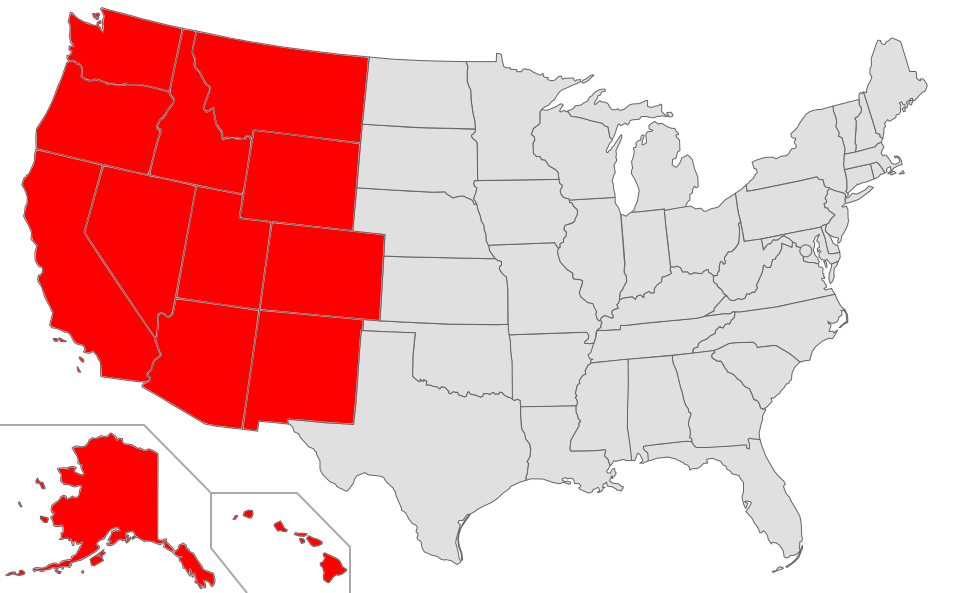
Western American English (also known as Western U.S. English) is a variety of American English that largely unites the entire Western United States as a single dialect region, including the states of California, Nevada, Arizona, Utah, New Mexico, Colorado, Wyoming, and Montana. It also generally encompasses Washington, Oregon, and Idaho, some of whose speakers are classified under Pacific Northwest English.
The West was the last area in the United States to be reached during the gradual westward expansion of settlement by English speakers and its history shows considerable mixing and leveling of the linguistic patterns of other regions. Therefore, since the settlement populations are relatively young when compared with other regions, the American West continues to be a dialect region in formation. According to the 2006 Atlas of North American English, as a very broad generalization, Western U.S. accents are differentiated from Southern U.S. accents in maintaining /aɪ/ as a diphthong, from Northern U.S. accents by fronting /u/ (the GOOSE vowel), and from both by consistently showing the low back merger (the merger of the vowel sounds in words like cot and caught). Furthermore, in speakers born from the 1980s onward, the related low-back-merger shift has been spreading throughout the Western States, as well as throughout the entire United States. The standard Canadian accent also aligns with these defining features, though it typically includes certain additional vowel differences.
The Western regional accent of American English is somewhat variable and not necessarily distinct from "General American" or from the speech of younger or educated Americans nationwide. Western American English is defined primarily by two phonological features: the cot-caught merger (as distinct from most traditional Northern and Southern U.S. English) and the fronting of the /u/ (GOOSE) vowel but not the /oʊ/ (GOAT) vowel. This fronting is distinct from most Southern and Mid-Atlantic American English, in which both of those vowels are fronted, as well as from most Northern U.S. English, in which both of these remain backed.
Like most Canadian dialects and younger General American, /ɑ/ (LOT/PALM) allophones remain back and may be either rounded or unrounded due to the low back merger: the merger between the sounds /ɑ/ and /ɔ/ (THOUGHT), commonly represented as words like cot and caught, or pod and pawed, becoming perfect homophones. Linguists believe this is the cause of, or at least related to, more and more Western speakers in general lowering or retracting the TRAP vowel and the DRESS vowel in a chain shift first associated with California and led by young women: the low-back-merger shift. This shift is also documented in mainland Canadian English. However, unlike in Canada, the raising before voiceless consonants of /aʊ/ does not exist in Western American English and of /aɪ/ is not as consistent and pronounced. Like General American, the West is entirely rhotic, and the Mary–marry–merry merger is complete, so that words like Mary, marry, and merry are all pronounced identically because of the merger of all three of those vowels' sounds when before r.
Notably, though, there are still regions of the West where some speakers do not have a complete merger, most notably San Francisco, California, where younger speakers exhibit the merger more often than older speakers, but also Portland, Oregon, and Cowlitz County, Washington, where an incomplete merger exists for some speakers and where merging is not any more advanced among younger speakers than among older ones.
Although it occurs at least occasionally nationwide, T-glottalization at word boundaries, as in "right ankle", is more common in Western dialects, particularly among younger speakers and women. The use of a full (orally released) rather than syllabic pronunciation of /ən/ in the sequence /-tən/, in words like "kitten" or "mountain", is a minor but noted variant reported in the West, for example among some Californians and younger, female Utah speakers; thus, kitten as [ˈkʰɪʔən] in addition to more General American [ˈkʰɪʔn̩]; however, this feature has also been reported elsewhere in the country, like New Jersey. Men and teenage girls from Utah are also slightly more likely than average to elide the /t/ altogether in these words, and Utahns as a whole are slightly less likely to glottalize the /t/ in general.
A trend evident particularly in some speakers from the Salt Lake City, Utah, and Flagstaff, Arizona, areas, as well as in some Californian and New Mexican English, is the completion of, or transition towards, a full–fool merger. This may be related to scatterings of Western speakers, such as some Utah speakers, generally producing lax pronunciations of the tense front vowels before /l/, such as pronouncing "sale" as "sell" /sɛl/. Southern twang-like monophthongization of /aɪ/ has been sporadically reported in the Southwest, for example in some speakers before /l/ in southern Arizona and Utah. A significant minority of Western speakers have the pin–pen merger or a closeness to the merger, especially around Bakersfield, California, though it is a sound typically associated with Southern American English, which influenced Bakersfield settlers.
Another recognizable trait, particularly in California and the Pacific Northwest, is raising of the short i /ɪ/ sound to an almost long ee [i] sound before ng, even when the g is dropped, such that the local pronunciation of -ing [iŋ], even with G-dropping ([in]), takes on the same vowel quality as, but remains shorter than, a rhyme with bean. The word coding, for example, is pronounced [ˈkoʊdin], homophonous with codeine.
Hub AI
Western American English AI simulator
(@Western American English_simulator)
Western American English
Western American English (also known as Western U.S. English) is a variety of American English that largely unites the entire Western United States as a single dialect region, including the states of California, Nevada, Arizona, Utah, New Mexico, Colorado, Wyoming, and Montana. It also generally encompasses Washington, Oregon, and Idaho, some of whose speakers are classified under Pacific Northwest English.
The West was the last area in the United States to be reached during the gradual westward expansion of settlement by English speakers and its history shows considerable mixing and leveling of the linguistic patterns of other regions. Therefore, since the settlement populations are relatively young when compared with other regions, the American West continues to be a dialect region in formation. According to the 2006 Atlas of North American English, as a very broad generalization, Western U.S. accents are differentiated from Southern U.S. accents in maintaining /aɪ/ as a diphthong, from Northern U.S. accents by fronting /u/ (the GOOSE vowel), and from both by consistently showing the low back merger (the merger of the vowel sounds in words like cot and caught). Furthermore, in speakers born from the 1980s onward, the related low-back-merger shift has been spreading throughout the Western States, as well as throughout the entire United States. The standard Canadian accent also aligns with these defining features, though it typically includes certain additional vowel differences.
The Western regional accent of American English is somewhat variable and not necessarily distinct from "General American" or from the speech of younger or educated Americans nationwide. Western American English is defined primarily by two phonological features: the cot-caught merger (as distinct from most traditional Northern and Southern U.S. English) and the fronting of the /u/ (GOOSE) vowel but not the /oʊ/ (GOAT) vowel. This fronting is distinct from most Southern and Mid-Atlantic American English, in which both of those vowels are fronted, as well as from most Northern U.S. English, in which both of these remain backed.
Like most Canadian dialects and younger General American, /ɑ/ (LOT/PALM) allophones remain back and may be either rounded or unrounded due to the low back merger: the merger between the sounds /ɑ/ and /ɔ/ (THOUGHT), commonly represented as words like cot and caught, or pod and pawed, becoming perfect homophones. Linguists believe this is the cause of, or at least related to, more and more Western speakers in general lowering or retracting the TRAP vowel and the DRESS vowel in a chain shift first associated with California and led by young women: the low-back-merger shift. This shift is also documented in mainland Canadian English. However, unlike in Canada, the raising before voiceless consonants of /aʊ/ does not exist in Western American English and of /aɪ/ is not as consistent and pronounced. Like General American, the West is entirely rhotic, and the Mary–marry–merry merger is complete, so that words like Mary, marry, and merry are all pronounced identically because of the merger of all three of those vowels' sounds when before r.
Notably, though, there are still regions of the West where some speakers do not have a complete merger, most notably San Francisco, California, where younger speakers exhibit the merger more often than older speakers, but also Portland, Oregon, and Cowlitz County, Washington, where an incomplete merger exists for some speakers and where merging is not any more advanced among younger speakers than among older ones.
Although it occurs at least occasionally nationwide, T-glottalization at word boundaries, as in "right ankle", is more common in Western dialects, particularly among younger speakers and women. The use of a full (orally released) rather than syllabic pronunciation of /ən/ in the sequence /-tən/, in words like "kitten" or "mountain", is a minor but noted variant reported in the West, for example among some Californians and younger, female Utah speakers; thus, kitten as [ˈkʰɪʔən] in addition to more General American [ˈkʰɪʔn̩]; however, this feature has also been reported elsewhere in the country, like New Jersey. Men and teenage girls from Utah are also slightly more likely than average to elide the /t/ altogether in these words, and Utahns as a whole are slightly less likely to glottalize the /t/ in general.
A trend evident particularly in some speakers from the Salt Lake City, Utah, and Flagstaff, Arizona, areas, as well as in some Californian and New Mexican English, is the completion of, or transition towards, a full–fool merger. This may be related to scatterings of Western speakers, such as some Utah speakers, generally producing lax pronunciations of the tense front vowels before /l/, such as pronouncing "sale" as "sell" /sɛl/. Southern twang-like monophthongization of /aɪ/ has been sporadically reported in the Southwest, for example in some speakers before /l/ in southern Arizona and Utah. A significant minority of Western speakers have the pin–pen merger or a closeness to the merger, especially around Bakersfield, California, though it is a sound typically associated with Southern American English, which influenced Bakersfield settlers.
Another recognizable trait, particularly in California and the Pacific Northwest, is raising of the short i /ɪ/ sound to an almost long ee [i] sound before ng, even when the g is dropped, such that the local pronunciation of -ing [iŋ], even with G-dropping ([in]), takes on the same vowel quality as, but remains shorter than, a rhyme with bean. The word coding, for example, is pronounced [ˈkoʊdin], homophonous with codeine.