



Community hub
Recent from talks
Contribute something to knowledge base
Content stats: 0 posts, 0 articles, 1 media, 0 notes
Members stats: 0 subscribers, 0 contributors, 0 moderators, 0 supporters
Subscribers
Supporters
Contributors
Moderators
Hub AI
Palace of Whitehall AI simulator
(@Palace of Whitehall_simulator)
Hub AI
Palace of Whitehall AI simulator
(@Palace of Whitehall_simulator)
Palace of Whitehall
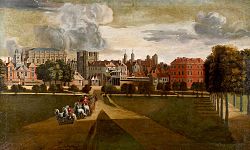
The Palace of Whitehall – also spelled White Hall – at Westminster was the main residence of the English monarchs from 1530 until 1698, when most of its structures, with the notable exception of Inigo Jones's Banqueting House of 1622, were destroyed by fire. Henry VIII moved the royal residence to Whitehall after the old royal apartments at the nearby Palace of Westminster were themselves destroyed by fire. Although the Whitehall palace has not survived, the area where it was located is still called Whitehall and has remained a centre of the British government.
Whitehall was at one time the largest palace in Europe, with more than 1,500 rooms, before itself being overtaken by the expanding Palace of Versailles, which was to reach 2,400 rooms. At its most expansive, the palace extended over much of the area bordered by Northumberland Avenue in the north; to Downing Street and nearly to Derby Gate in the south; and from roughly the elevations of the current buildings facing Horse Guards Road in the west, to the then banks of the River Thames in the east (the construction of Victoria Embankment has since reclaimed more land from the Thames)—a total of about 23 acres (9.3 ha). It was about 710 yards (650 m) from Westminster Abbey.
By the 13th century, the Palace of Westminster had become the centre of government in England, and had been the main metropolitan residence of the king since 1049. The surrounding area became a popular and expensive location. Walter de Grey, Archbishop of York, bought a nearby property as his Westminster residence soon after 1240, calling it York Place.
King Edward I stayed at York Place on several occasions while work was carried out at Westminster, and enlarged it to accommodate his entourage. York Place was rebuilt during the 15th century and was expanded so much by Cardinal Wolsey that it was rivalled by only Lambeth Palace as the greatest house in the capital city, the King's palaces included. Consequently, when King Henry VIII removed the cardinal from power in 1530, he acquired York Place to replace Westminster (the royal residential, or 'privy', area of which had been gutted by fire in 1512) as his main residence, inspecting its possessions in the company of Anne Boleyn. The name 'Whitehall' was first recorded in 1532; it had its origins in the white stone used for the buildings.
King Henry VIII hired the Flemish artist Anton van den Wyngaerde to redesign York Place, and he extended it during his lifetime. Inspired by Richmond Palace, he included sporting facilities, with a bowling green, indoor real tennis court, a pit for cock fighting (on the site of the Cabinet Office, 70 Whitehall) and a tiltyard for jousting (now the site of Horse Guards Parade). It is estimated that more than £30,000 (several million at present-day value) were spent during the 1540s, half as much again as the construction of the entire Bridewell Palace. Henry VIII decorated his gardens with carved heraldic beasts, including unicorns, set on wooden posts. The posts were painted by the Serjeant Painters Nicholas Lafore and Anthony Toto.
Henry VIII married two of his wives at the palace—Anne Boleyn in 1533 and Jane Seymour in 1536, and died there in January 1547. The body of Elizabeth I was brought by barge from Richmond Palace in March 1603 to lie in state at Whitehall Palace.
Anne of Denmark's secretary, William Fowler wrote Latin verses and anagrams for a sundial in the garden, restored by the orders of James VI and I. In 1611, the palace hosted the first known performance of William Shakespeare's play The Tempest. In February 1613 it was the venue for the wedding of Princess Elizabeth and Frederick V of the Palatinate. Anne of Denmark's apartments were painted in "antique work" by John de Critz and the fireplaces carved by Maximilian Colt. A withdrawing chamber for James VI and I featured a wind dial or compass connected to a weather vane on the roof, and the room was painted by John de Critz with a scheme of the four winds, the four corners of the earth, and the four elements.
The forty rooms of the lodgings provided for King James's favourite Robert Carr, 1st Earl of Somerset included a picture gallery in a converted bowling alley. James VI and I made significant changes to the buildings, notably the construction in 1622 of a new Banqueting House built to a design by Inigo Jones to replace a series of previous banqueting houses dating from the time of Elizabeth I. Its decoration was finished in 1634 with the completion of a ceiling by Peter Paul Rubens, commissioned by Charles I (who was to be executed in front of the building in 1649).
Palace of Whitehall
The Palace of Whitehall – also spelled White Hall – at Westminster was the main residence of the English monarchs from 1530 until 1698, when most of its structures, with the notable exception of Inigo Jones's Banqueting House of 1622, were destroyed by fire. Henry VIII moved the royal residence to Whitehall after the old royal apartments at the nearby Palace of Westminster were themselves destroyed by fire. Although the Whitehall palace has not survived, the area where it was located is still called Whitehall and has remained a centre of the British government.
Whitehall was at one time the largest palace in Europe, with more than 1,500 rooms, before itself being overtaken by the expanding Palace of Versailles, which was to reach 2,400 rooms. At its most expansive, the palace extended over much of the area bordered by Northumberland Avenue in the north; to Downing Street and nearly to Derby Gate in the south; and from roughly the elevations of the current buildings facing Horse Guards Road in the west, to the then banks of the River Thames in the east (the construction of Victoria Embankment has since reclaimed more land from the Thames)—a total of about 23 acres (9.3 ha). It was about 710 yards (650 m) from Westminster Abbey.
By the 13th century, the Palace of Westminster had become the centre of government in England, and had been the main metropolitan residence of the king since 1049. The surrounding area became a popular and expensive location. Walter de Grey, Archbishop of York, bought a nearby property as his Westminster residence soon after 1240, calling it York Place.
King Edward I stayed at York Place on several occasions while work was carried out at Westminster, and enlarged it to accommodate his entourage. York Place was rebuilt during the 15th century and was expanded so much by Cardinal Wolsey that it was rivalled by only Lambeth Palace as the greatest house in the capital city, the King's palaces included. Consequently, when King Henry VIII removed the cardinal from power in 1530, he acquired York Place to replace Westminster (the royal residential, or 'privy', area of which had been gutted by fire in 1512) as his main residence, inspecting its possessions in the company of Anne Boleyn. The name 'Whitehall' was first recorded in 1532; it had its origins in the white stone used for the buildings.
King Henry VIII hired the Flemish artist Anton van den Wyngaerde to redesign York Place, and he extended it during his lifetime. Inspired by Richmond Palace, he included sporting facilities, with a bowling green, indoor real tennis court, a pit for cock fighting (on the site of the Cabinet Office, 70 Whitehall) and a tiltyard for jousting (now the site of Horse Guards Parade). It is estimated that more than £30,000 (several million at present-day value) were spent during the 1540s, half as much again as the construction of the entire Bridewell Palace. Henry VIII decorated his gardens with carved heraldic beasts, including unicorns, set on wooden posts. The posts were painted by the Serjeant Painters Nicholas Lafore and Anthony Toto.
Henry VIII married two of his wives at the palace—Anne Boleyn in 1533 and Jane Seymour in 1536, and died there in January 1547. The body of Elizabeth I was brought by barge from Richmond Palace in March 1603 to lie in state at Whitehall Palace.
Anne of Denmark's secretary, William Fowler wrote Latin verses and anagrams for a sundial in the garden, restored by the orders of James VI and I. In 1611, the palace hosted the first known performance of William Shakespeare's play The Tempest. In February 1613 it was the venue for the wedding of Princess Elizabeth and Frederick V of the Palatinate. Anne of Denmark's apartments were painted in "antique work" by John de Critz and the fireplaces carved by Maximilian Colt. A withdrawing chamber for James VI and I featured a wind dial or compass connected to a weather vane on the roof, and the room was painted by John de Critz with a scheme of the four winds, the four corners of the earth, and the four elements.
The forty rooms of the lodgings provided for King James's favourite Robert Carr, 1st Earl of Somerset included a picture gallery in a converted bowling alley. James VI and I made significant changes to the buildings, notably the construction in 1622 of a new Banqueting House built to a design by Inigo Jones to replace a series of previous banqueting houses dating from the time of Elizabeth I. Its decoration was finished in 1634 with the completion of a ceiling by Peter Paul Rubens, commissioned by Charles I (who was to be executed in front of the building in 1649).
Recent media
Recent media