Hubbry Logo
Wilkins MicawberWilkins MicawberMain
Open search
Wilkins Micawber
Community hub
Wilkins Micawber
logo
8 pages, 0 posts
0 subscribers
Be the first to start a discussion here.
Wilkins Micawber
Wilkins Micawber
from Wikipedia
Wilkins Micawber
David Copperfield character
As illustrated in a 1912 edition of the book
Created byCharles Dickens
Based onJohn Dickens (Dickens's father)
In-universe information
GenderMale
OccupationVarious
NationalityBritish

Wilkins Micawber is a fictional character in Charles Dickens's 1850 novel David Copperfield. He is traditionally identified with the optimistic belief that "something will turn up."

His role in the story

[edit]

Micawber was incarcerated in debtors' prison (the King's Bench Prison) after failing to meet his creditors' demands. His long-suffering wife, Emma, stands by him despite his financial exigencies that force her to pawn all of her family's heirlooms. She lives by the maxims, "I will never desert Mr. Micawber!" and "Experientia does it!" (from Experientia docet, "One learns by experience.")

Micawber is responsible for a major financial setback to another character. The hardworking, reliable Tommy Traddles, who is saving to furnish a home for the young woman he hopes to marry, allows his optimism to overcome his common sense. He "lends his name" to Micawber by co-signing for his rent, and when Micawber fails to pay, Micawber's creditors seize all of the Micawber family's furniture and personal effects, along with those of Traddles. Although Traddles eventually recovers the little round table and flower pot that symbolize his hopes for future happiness, he hampers himself financially by paying off Micawber's debt.

Micawber is hired as a clerk by the scheming Uriah Heep, who assumes wrongly that Micawber's debts arise from dishonesty. But working for Heep allows Micawber to expose his boss as a forger and a cheat. To start anew, Micawber and his family emigrate to Australia with Daniel Peggotty and Little Em'ly, where Micawber becomes manager of the Port Middlebay Bank and a successful government magistrate. Prior to leaving, Micawber repays the money Traddles spent settling his loan.

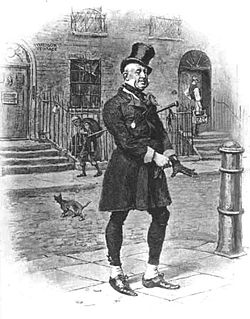
In Hablot Knight Browne's illustrations for the first edition, Micawber is shown wearing knee-breeches, a top hat, and a monocle. Micawber was modelled on Dickens' father, John Dickens.[1]

[edit]
As illustrated by Fred Barnard in an 1870s edition

Micawber is known for asserting his faith that "something will turn up."[2] His name has become synonymous with someone who lives in hopeful expectation. This has formed the basis for the Micawber Principle,[according to whom?] based upon his observation in Chapter 12:

Annual income twenty pounds, annual expenditure nineteen nineteen and six, result happiness. Annual income twenty pounds, annual expenditure twenty pounds nought and six, result misery.

Written in full, the expenditure amounts are nineteen pounds, nineteen shillings and sixpence (£19/19/6) and £20/0/6, the pre-decimal equivalents of £19.9712 and £20.0212 in modern British currency.

The character was played by W.C. Fields in the 1935 screen classic, Personal History, Adventures, Experience, and Observation of David Copperfield the Younger. Bob Hoskins took the role in a 1999 BBC serial. Peter Capaldi played Micawber in the 2019 Armando Iannucci film The Personal History of David Copperfield.

Keith Richards of the Rolling Stones named one of his guitars (an early 1950s Fender Telecaster with a Gibson PAF humbucking pickup installed in the neck position) "Micawber"; Richards is known to be a fan of Dickens. "There's no reason for my guitar being called Micawber, apart from the fact that it's such an unlikely name. There's no one around me called Micawber, so when I scream for Micawber everyone knows what I'm talking about."[citation needed]

The character formed the basis of Micawber, a 2001 ITV drama series written by John Sullivan and starring David Jason in the title leading role. In the U.S. Supreme Court opinion of Bell Atlantic Corp. v. Twombly, 550 U.S. 544, 562 (2007), Justice Souter criticized the court for an approach to pleading that "would dispense with any showing of a reasonably founded hope that a plaintiff would be able to make a case; Mr. Micawber's optimism would be enough.[3]"

Entry into general English

[edit]

The character of Wilkins Micawber has given rise to the English noun "Micawber" and the adjectives "Micawberish" and "Micawberesque." The Merriam-Webster Dictionary defines a Micawber as "one who is poor but lives in optimistic expectation of better fortune."[4] Judge David Halpern described Craig Whyte's legal arguments in a case heard in 2013 as "pure Micawberism."[5]

Quotations

[edit]
Mr Micawber by 'Kyd' c. 1890

Besides the Micawber Principle, Micawber is notable for a number of memorable quotations:

  • I have no doubt I shall, please Heaven, begin to be more beforehand with the world, and to live in a perfectly new manner, if—in short, anything turns up. (Chapter 11)
  • Every happiness and prosperity! If, in the progress of revolving years, I could persuade myself that my blighted destiny had been a warning to you, I should feel that I had not occupied another man's place altogether in vain. (Chapter 12)
  • You HEEP of infamy! (Chapter 52)
  • I trust that the labour and hazard of an investigation -of which the smallest results have been slowly pieced together, in the pressure of arduous avocations, under grinding penurious apprehensions, at rise of morn, at dewy eve, in the shadows of night, under the watchful eye of one whom it were superfluous to call Demon, combined with the struggle of parental Poverty to turn it, when completed, to the right account, may be as the sprinkling of a few drops of sweet water on my funeral pyre. I ask no more. Let it be, in justice, merely said of me, as of a gallant and eminent Naval Hero, with whom I have no pretensions to cope, that what I have done, I did, in despite of mercenary and selfish objectives, "FOR ENGLAND, HOME AND BEAUTY." Remaining always, &c, &c, Wilkins Micawber.
  • Welcome poverty!...Welcome misery, welcome houselessness, welcome hunger, rags, tempest, and beggary! Mutual confidence will sustain us to the end!

Film and television portrayals

[edit]
W. C. Fields in his famous role as Mr. Micawber
Art by Frank Reynolds.
Year Title Wilkins Micawber played by:
1935 David Copperfield W.C. Fields
1956 David Copperfield Hilton Edwards
1966 David Copperfield Bill Fraser
1969 David Copperfield Ralph Richardson
1974 David Copperfield Arthur Lowe
1993 David Copperfield Joseph Marcell
1999 David Copperfield Bob Hoskins
2000 David Copperfield Michael Richards
2002 Micawber David Jason
2019 The Personal History of David Copperfield Peter Capaldi

Quotations from the 1935 film

[edit]
  • Boy, as I have frequently had occasion to observe: "When the stomach is empty, the spirits are low!"
  • Remember my motto "Nil Desperandum! -Never despair!"

Quotation from the BBC TV/Masterpiece Theatre production

[edit]
  • (featuring Bob Hoskins as Micawber) "I could not depart this metropolis without paying a valedictory visit to my dear friend Copperfield, in whose debt I shall forever remain (I speak metaphorically of course!)"

Citations

[edit]
  1. ^ "Charles Dickens | Biography, Books, Characters, Facts, & Analysis". Encyclopedia Britannica. Retrieved 2021-07-03.
  2. ^ Ramchandani, Dilip (1992). "The hypomanic personality of Wilkins Micawber: A Dickensian case study". Psychiatric Quarterly. 63 (3): 245–249. doi:10.1007/BF01065295. ISSN 0033-2720. PMID 1488464. S2CID 19585049.
  3. ^ SUPREME COURT OF THE UNITED STATES BELL ATLANTIC CORPORATION, et al., PETI-TIONERS v. WILLIAM TWOMBLY et al.
  4. ^ Merriam-Webster Dictionary entry for Micawber
  5. ^ FARMER, BRIAN (18 December 2013). "Judge compares Craig Whyte to Dickens character". The Scotsman. Johnston Publishing. Retrieved 19 December 2013.

General and cited reference

[edit]
  • Bloom, Harold (1992). David Copperfield (Major Literary Characters Series). New York: Chelsea House Publishers.
  • Hawes, Donald (2002). Who's Who in Dickens. 2nd. ed. London: Routledge
  • Oddie, W. (1967). "Mr. Micawber and the redefinition of experience." The Dickensian 63:109.
[edit]
Revisions and contributorsEdit on WikipediaRead on Wikipedia
from Grokipedia
Wilkins Micawber is a fictional character in Charles Dickens's 1850 novel , renowned for his irrepressible optimism and chronic financial woes, often encapsulated in his belief that "something will turn up" to resolve his predicaments. He serves as a comedic yet poignant figure, providing David Copperfield with early guidance and later aiding in the exposure of the villainous Uriah Heep. Modeled in part on Dickens's own father, , Micawber embodies the struggles of Victorian debtors while highlighting themes of resilience and familial . Introduced in Chapter 11, Micawber appears as a stoutish, middle-aged man with a bald head, shabby genteel attire, and a verbose, expressive manner, lodgings to the young in . Married to the supportive Mrs. Micawber, he presides over a large family including twins, a young son (Master Micawber), a daughter (Miss Micawber), and a servant girl named Clickett. His financial philosophy is famously articulated as: "Annual income twenty pounds, annual expenditure nineteen nineteen and six, result happiness. Annual income twenty pounds, annual expenditure twenty pounds ought and six, result misery," underscoring his pattern of living beyond his means. Despite repeated arrests and imprisonment in the , Micawber maintains a hopeful demeanor, vowing never to his wife and relying on remittances that frequently fail. Throughout the narrative, Micawber relocates multiple times—from to Plymouth and later to —before playing a pivotal role in uncovering Uriah Heep's in Chapter 52 through his meticulous accounting. In the novel's conclusion, Micawber emigrates to with his family, where he achieves prosperity and becomes a , fulfilling his enduring . As a character, he offers while critiquing the debtor's prisons and social inequalities of 19th-century , cementing his status as one of Dickens's most beloved creations.

Origins and Characterization

Fictional Background

Wilkins Micawber is introduced in Charles Dickens's 1850 novel as a middle-aged man, portrayed as a formerly middle-class facing chronic financial distress that leads him into debtor's . He first appears around the age of 40, embodying the archetype of the optimistic debtor whose circumstances reflect the precariousness of Victorian lower-middle-class life. Micawber is depicted as unemployed at his initial encounter, having previously worked in clerical roles and occasionally taking commissions as a town traveller for miscellaneous businesses, though his prospects remain perpetually uncertain. He supports a family consisting of his wife, Emma Micawber—a thin, faded woman not yet middle-aged—and several young children, including infant twins, a boy of about four named Master Micawber, and a girl of about three named Miss Micawber, along with others such as a son named Wilkins. Physically, Micawber is described as stoutish, with a large, shiny head bearing little hair and an extensive face that conveys a sense of exaggerated gentility. He carries a quizzing-glass (eye-glass) and a jaunty walking-stick adorned with rusty tassels, accessories that underscore his pretensions to refinement despite his poverty. His attire further highlights this contrast: a shabby brown surtout coat, black tights and shoes, an imposing shirt-collar, and a bottle tucked into his breast pocket, all suggesting a formal, slightly outdated style ill-suited to his reduced circumstances. From his early appearances in the novel's chapters, Micawber exhibits an irrepressibly optimistic demeanor, maintaining cheerfulness and humming tunes even amid hardship, often expressing hope that "something will turn up" to resolve his woes. His speech patterns are notably verbose and florid, featuring long, elaborate sentences punctuated by phrases like "in short" and dramatic flourishes, such as declaring a situation "calculated to impress the mind with a sense of the instability and uncertainty of all human" affairs. These traits establish him as a figure of , providing humor through his exaggerated confidence, emotional volatility—such as sudden sobs followed by polishing his shoes—and genteel pretensions that lighten the narrative's darker tones.

Real-Life Inspirations

The character of Wilkins Micawber in ' David Copperfield draws heavily from Dickens' own father, , whose chronic financial instability and imprisonment for debt profoundly shaped the author's early life. In 1824, when Charles was just 12 years old, John Dickens was arrested for unpaid debts and incarcerated in the debtors' prison in , where he remained for approximately 14 weeks until an unexpected inheritance of around £450 allowed for his release. This event forced young Charles to leave school and take up grueling work at Warren's Blacking Factory, pasting labels on shoe polish bottles for six shillings a week, while the rest of the family joined John in the prison. John's profligate spending habits and inability to manage finances persisted throughout his life, leading to repeated embarrassments for Charles, who often had to bail out his father from further debts even after achieving literary success. Micawber embodies an exaggerated portrayal of ' personal qualities, particularly his charm, verbosity, and irrepressible hopefulness in the face of mounting debts. Like John, Micawber is depicted as a warm, affectionate man with a flair for dramatic rhetoric and an optimistic belief that "something will turn up" to resolve his financial woes, traits that mirrored John's own sociable yet imprudent nature. Dickens amplified these characteristics to create a comic yet poignant figure whose imprisonment in the (a fictional stand-in for the ) echoes his father's real ordeal, transforming personal humiliation into a broader social critique of debtor incarceration. Scholars have interpreted Micawber as Dickens' means of processing the deep-seated trauma of his childhood, stemming from the and isolation of his father's and his own descent into manual labor. This experience, which Dickens kept largely secret during his lifetime and only confided to his biographer John Forster over two decades later, left lasting psychological scars, fueling his aversion to debt and his drive for financial security. By channeling these memories into Micawber's character within the semi-autobiographical , Dickens employed fiction as a therapeutic tool, imaginatively distancing himself from the pain while reflecting on how it molded his identity and worldview. Literary analyses emphasize that this autobiographical fragment allowed Dickens to reclaim agency over his repressed memories, turning personal adversity into enduring art.

Role in David Copperfield

Introduction and Relationships

Wilkins Micawber enters the narrative of Charles Dickens's as a pivotal figure in the young protagonist's early experiences in , where David, aged ten, arrives to work at the warehouse of Murdstone & Grinby. Introduced through David's employer, Mr. Quinion, Micawber is presented as a shabby yet genteel man perpetually entangled in financial difficulties, who warmly invites the orphaned boy to lodge with his family at their modest home in Windsor Terrace. This initial encounter establishes Micawber as a surrogate parental figure, offering David a semblance of domestic stability amid his isolation in the city. In the Micawber household, David witnesses a chaotic but affectionate family dynamic marked by chronic and . Micawber's wife, Emma, is depicted as a long-suffering yet devoted partner, tirelessly managing their household and young children—including the twins, Master Micawber (aged four), and Miss Micawber (aged three)—despite frequent visits from creditors and the threat of eviction. The children, often underfed and boisterous, embody the precariousness of the family's circumstances, highlighting the instability of lower-middle-class life in Victorian . Emma's resilience and unwavering support for her husband underscore their bond, as she confides in and treats him with maternal kindness, such as embracing him warmly upon his arrival. Micawber assumes a mentor-like role for the impressionable David, dispensing worldly advice on life and finances despite his own repeated failures, such as accruing debts that lead to his imprisonment in the . He counsels the boy on the virtues of , famously illustrating with the arithmetic that an income of twenty pounds exceeded by even a small amount results in misery, while living just below it brings happiness—a lesson drawn from Micawber's own improvident habits. This guidance, delivered with theatrical flair and good humor, provides David emotional support during his lonely tenure in , fostering a deep, enduring affection between the two. Micawber's characteristic , encapsulated in his belief that "something will turn up," briefly influences David's outlook on adversity.

Key Events and Development

Wilkins Micawber first encounters financial ruin shortly after rents a room from him in , where creditors begin hounding the family for unpaid debts, leading to Micawber's and in the . While incarcerated, Micawber maintains an optimistic demeanor, engaging in activities like playing cards with his wife and strolling the prison grounds, until he secures his release through a successful under the Insolvent Debtors Act. Following his release, the Micawbers relocate to Plymouth in hopes of better prospects, though Micawber soon embarks on various entrepreneurial schemes, including an ill-fated attempt to establish a banking or money-lending , which ultimately fails due to lack of capital and interest from potential investors. David's occasional financial aid during these early crises provides temporary relief to the family. Years later, Micawber secures employment as a clerk for Uriah Heep in , where he meticulously documents Heep's fraudulent activities, such as forging documents and embezzling funds from Mr. Wickfield's firm. In a dramatic confrontation, Micawber presents this evidence, exposing Heep's crimes and contributing to his downfall, which marks a pivotal shift in Micawber's fortunes as he transitions from perpetual debtor to an instrumental figure in restoring justice. With financial support from , the Micawbers, along with Emily Peggotty, her uncle Daniel Peggotty, and Endell, emigrate to aboard a ship, seeking a fresh start; upon arrival, Micawber achieves stability and later rises to the position of a in the .

Character Analysis

Personality Traits

Wilkins Micawber is characterized by his unyielding , which manifests as a firm that circumstances will improve without proactive effort, often summarized by his expectation that "something will turn up" to resolve his predicaments. This trait leads him to avoid practical financial strategies, preferring instead to rely on chance or unforeseen opportunities, even as debts accumulate relentlessly. His serves as both a mechanism and a source of resilience, allowing him to rebound swiftly from setbacks involving creditors or employment woes. Micawber's communication style is marked by verbose and florid , transforming mundane discussions into elaborate, grandiose orations that reflect his self-perceived gentility. This rhetorical flourish underscores his aspirations to a higher social standing, despite his modest circumstances, and often employs archaic or overly formal phrasing to elevate everyday matters. Such expressiveness highlights his intellectual pretensions and adds a layer of theatricality to his interactions. Despite his financial irresponsibility, Micawber possesses a charismatic and affable demeanor that endears him to others, blending humor with underlying in his approach to and familial obligations. His irresponsibility stems from an inability to balance expenditures with income, resulting in chronic that burdens his , yet he remains devoted and supportive toward his and children. This combination of charm and recklessness creates a figure who inspires both amusement and sympathy, as his good intentions frequently clash with impractical actions.

Thematic Significance

Wilkins Micawber embodies the struggles of the Victorian class, illustrating the precarious existence of those ensnared by chronic financial and societal indifference to economic hardship. His repeated descents into , marked by improvident spending and inability to repay loans, culminate in imprisonment in the , a fate that underscores Dickens' incisive critique of the debtors' laws, which exacerbated class divisions by confining the impoverished without addressing root causes like limited opportunities for the . Central to Micawber's thematic role is his symbolism of hope clashing against unforgiving reality, encapsulated in his optimistic refrain that "something will turn up," which persists amid mounting debts and familial strain. This resilient mindset contrasts sharply with the innocent detachment of Mr. Dick, whose whimsical madness shields him from worldly woes, and the scheming resentment of Uriah Heep, whose false humility masks exploitative ambition; together, these oppositions highlight Dickens' exploration of varied human responses to social adversity, emphasizing Micawber's blend of folly and fortitude as a critique of capitalist exploitation. In the context of David's bildungsroman, Micawber functions as a flawed yet endearing mentor, providing the young with lessons in perseverance and the redemptive power of kindness during his vulnerable early years in , where David boards with the family and finds emotional refuge in Micawber's cheerful disposition. By later exposing Uriah Heep's fraudulence with David's assistance, Micawber reinforces themes of moral growth and , modeling for David how resilience and communal bonds can overcome class-imposed limitations.

Linguistic and Cultural Impact

Entry into English Language

The term "Micawber," derived from the character in Charles Dickens's 1850 novel David Copperfield, entered English usage by 1852 to denote a habitually improvident or chronically insolvent person who maintains an optimistic expectation of future financial windfalls. The adjective "Micawberish," describing an attitude of irresponsible or unfounded optimism akin to the character's passive reliance on providence, first appeared in 1859 and quickly adopted to characterize similar idlers or dreamers awaiting serendipitous resolutions. Micawber's emblematic phrase, "something will turn up," evolved into a recognized English symbolizing passive hope or deferral of action in the face of adversity. Dictionaries attribute its idiomatic status directly to the character's repeated declarations in the , marking its permeation into everyday as a cautionary expression of overly sanguine improvidence. In 19th- and 20th-century and , "Micawberish" and references to Micawber appeared to evoke this of cheerful financial irresponsibility; for instance, a 1986 New Yorker article used "Micawberish" to depict a society's indolent complacency toward systemic issues. By the late 19th century, the term had integrated into broader discussions of economic optimism, as seen in early dictionary inclusions and literary critiques extending Dickens's influence on proverbial speech.

Quotations and Phrases

Wilkins Micawber's dialogue in is characterized by its verbose, optimistic tone and frequent use of proverbial wisdom, often delivered in moments of financial desperation to impart life lessons to the young , David Copperfield. His speeches blend humor, , and resilience, reflecting Dickens's skill in crafting memorable, quotable lines that advance the plot by highlighting Micawber's improvident nature while providing . One of Micawber's most iconic statements occurs during a farewell dinner in Chapter 12, after his release from the King's Bench , where he advises on the perils of overspending: "Annual income twenty pounds, annual expenditure nineteen nineteen and six, result happiness. Annual income twenty pounds, annual expenditure twenty pounds ought and six, result misery." This remark, shared over a modest of and pudding as Micawber prepares to relocate his family to Plymouth in search of better prospects, underscores his hard-won insight into fiscal responsibility, serving as a pivotal device to equip with practical guidance amid his own uncertainties. The quote's rhythmic structure and precise arithmetic emphasize Micawber's pedantic style, turning personal failure into a teachable . Micawber's recurring mantra, "something will turn up," exemplifies his inveterate hopefulness and appears in various contexts of adversity, particularly during his in Chapter 11, when he reassures and his wife amid mounting debts: "Something will turn up." This phrase recurs in Chapter 12 during the same farewell, as Micawber expresses confidence in future opportunities—"In case of anything turning up (of which I am rather confident)"—while bidding goodbye at the coach office, and again in Chapter 17, where he muses, "reflecting upon the probability of something turning up (of which I am at present rather sanguine)," as he walks with after a chance reunion. In each instance, the line propels the forward by justifying Micawber's inaction, allowing Dickens to explore themes of expectation through repeated, lightly ironic that delays resolution in the characters' arcs. Micawber's rhetorical flourishes are prominently displayed in his farewell address to David in Chapter 12, framed as a personal missive of advice rather than a formal letter, where he elaborates on his with dramatic flair: "My dear young friend... At present, and until something turns up... I have nothing to bestow but advice... The blossom is blighted, the leaf is withered, the god of day goes down upon the dreary scene, and—and in short you are for ever floored." Delivered just after his release from , this effusion combines poetic imagery with colloquial bluntness, urging David to avoid —"Never do tomorrow what you can do today. is the . Collar him!"—and reinforcing the dictum. The speech's ornate and sudden shifts to plain speech highlight Micawber's theatrical , advancing the story by marking a in his fortunes while deepening David's affection for the family. These phrases from the novel have since permeated English , as explored in broader linguistic studies.

Adaptations and Portrayals

Stage and Theatrical Versions

Theatrical adaptations of began appearing during the novel's in , with early versions often condensing the expansive narrative to highlight key dramatic and comic elements, including Wilkins Micawber's optimistic financial predicaments and verbose mannerisms. George Almar's Born with a premiered at London's Strand on October 21, , presenting a burlesque-style interpretation that emphasized Micawber's role as a figure while shortening his arc to focus on his debts and family dynamics. Similarly, John Brougham's adaptation opened at Barnum's Museum in on November 6, , and was restaged at New York's Lyceum in January 1851, where Brougham himself portrayed Micawber, infusing the character with exaggerated cheerfulness to suit the era's sensationalist theater style. These early productions typically omitted much of the novel's introspective depth, prioritizing Micawber's humorous monologues and interactions with David to fit limited runtimes of around two hours. Charles Dickens contributed to Micawber's stage legacy through his public readings, which he began incorporating scenes from into as early as 1861 and expanded during his 1868 American tour. At venues like Philadelphia's Concert Hall on January 14 and 31, 1868, Dickens performed Micawber's scenes from memory, using vivid gestures and vocal inflections to capture the character's eternal and loquacious charm, drawing roars of from audiences who appreciated the lifelike humor. These solo performances, distinct from full adaptations, preserved Micawber's intact but isolated it from the broader plot, allowing Dickens to spotlight the character's thematic role as a benevolent mentor amid adversity. In the , stage interpretations of Micawber evolved to balance with , often amplifying his eccentricities for theatrical impact while streamlining his storyline to emphasize redemption arcs. Sir Herbert Beerbohm 's portrayal in Louis N. Parker's 1914 at London's His Majesty's —where he doubled as Dan'l —depicted Micawber as a larger-than-life , with Tree underscoring the character's bombastic energy and improvisational flair in scenes of domestic chaos. The production was revived in 1921 at Gould Hall in . Bransby Williams offered a more restrained, empathetic reading in his 1920s touring productions, where he highlighted Micawber's underlying dignity beneath the financial bluster, earning praise for avoiding caricature. The 1981 Broadway musical Copperfield, with , music, and lyrics by Al Kasha and Joel Hirschhorn, featured as Micawber, integrating his verbosity into upbeat songs that accentuated comic relief but truncated his to streamline the . Across these versions, actors interpreted Micawber's as a performative for vulnerability, adapting his lengthy speeches for stage pacing while retaining core phrases like "something will turn up" to evoke audience sympathy.

Film and Television Depictions

In the 1935 film adaptation of , directed by , portrayed Wilkins Micawber with a blend of expansive and subtle comedic flair, infusing the character with elements through improvised physicality and added humorous scenes, such as exaggerated reactions to financial woes, that heightened the role's value while staying true to Dickens's dialogue. The 1999 BBC two-part television , featuring a young as , cast as Micawber in a sympathetic interpretation that emphasized the character's underlying warmth and resilience amid perpetual debt, portraying him as a kooky yet endearing family man with humorous, heartfelt moments that toned down the exaggeration for emotional authenticity. In the 2000 Hallmark Entertainment television movie, brought a genial but unreliable energy to Micawber, focusing on the emotional turmoil of his debt-ridden life through buffoonish yet poignant scenes of familial struggle and , diverging from the novel's to highlight comedic vulnerability in his interactions with . The 2019 film The Personal History of David Copperfield, directed by , featured as an endearing yet broadly comic Micawber, capturing his self-importance and financial through lively, benevolent antics—like inept playing and scheming optimism—that expanded on the character's hopeful spirit in a vibrant, modern visual style with .

References

Add your contribution
Related Hubs
User Avatar
No comments yet.