


Community hub
Recent from talks
Contribute something
Nothing was collected or created yet.
Will Muschamp
View on Wikipedia
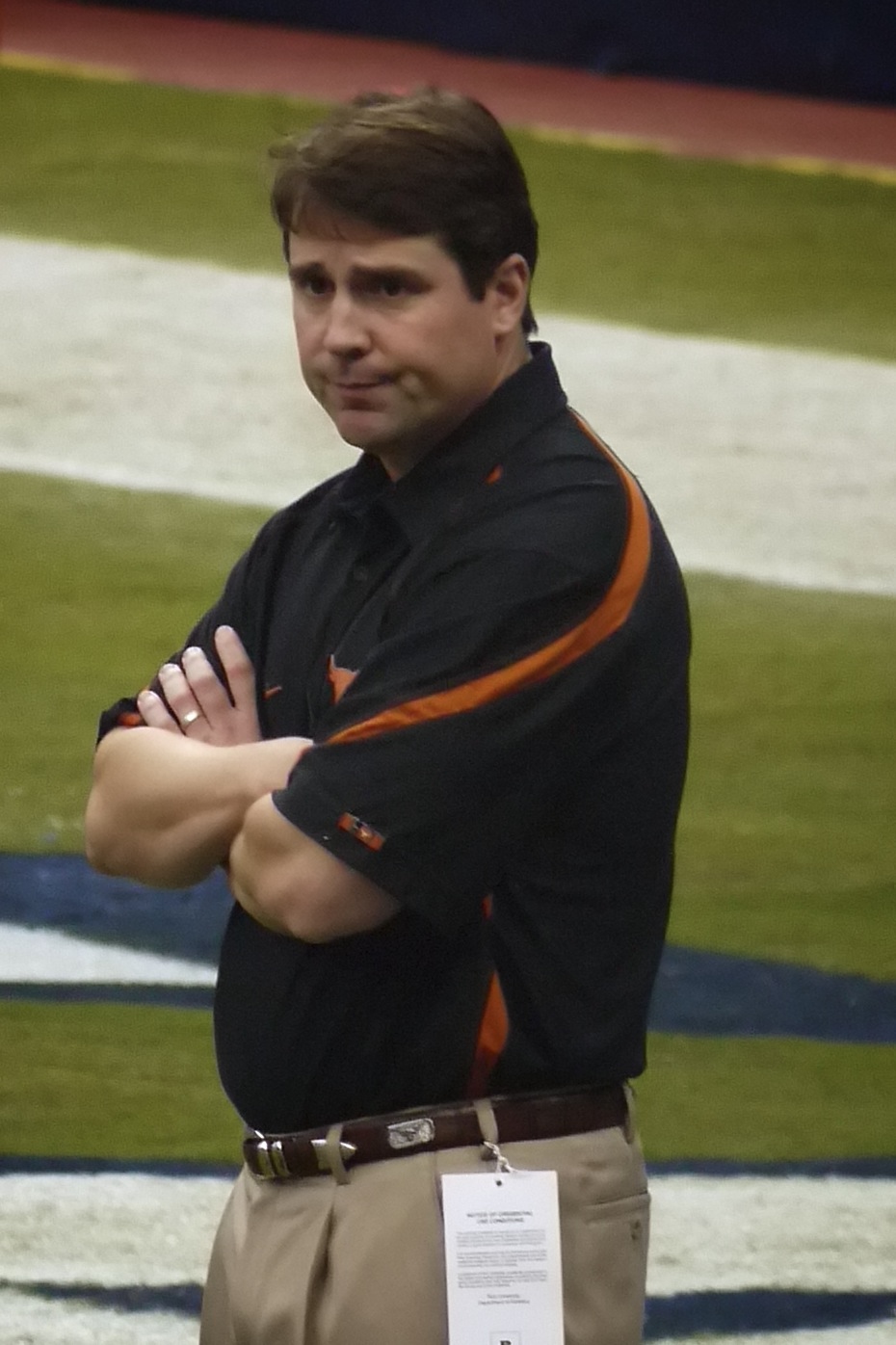
William Lawrence Muschamp[1] (born August 3, 1971) is an American football coach and former player who is the current defensive coordinator at the University of Texas at Austin. He served as head football coach at the University of Florida from 2011 to 2014 and at the University of South Carolina from 2016 to 2020.[2][3]
Key Information


In his second season as defensive coordinator at Auburn, in 2007, Muschamp was a finalist for the Broyles Award for the most outstanding assistant coach in college football.[4] Before he accepted the position of coach for Florida, the University of Texas announced that Muschamp would later succeed Mack Brown as head coach of the Longhorns designating him as the "head coach in waiting."[5]
Early years
[edit]Muschamp was born in Rome, Georgia but grew up in Gainesville, Florida. He attended Martha Manson Academy elementary school and Oak Hall High School in Gainesville. His family returned to Rome when his father became the Lower School Principal at Darlington School. Muschamp graduated from Darlington and during his tenure, played football, basketball, baseball, and ran track for the Darlington Tigers.[6]
College career
[edit]Muschamp attended the University of Georgia in Athens, Georgia. He walked on to the Georgia Bulldogs football team and played safety from 1991 to 1994. As an undergraduate, he was initiated into the Kappa Alpha Order (Gamma chapter) and also earned a spot on the SEC Academic Honor Roll in 1993.[7] He was a defensive team captain his senior season[8] and played in two bowl games with the Bulldogs. Bulldogs quarterback Mike Bobo, who was Muschamp's college teammate, described him as "a hard worker. Very physical. Very intense."[9] Muschamp graduated from the University of Georgia with a bachelor's degree in 1994.[10]
Coaching career
[edit]After graduating from Georgia, Muschamp became a graduate assistant coach at Auburn University, where he worked under defensive coordinators Wayne Hall and Bill Oliver in 1995 and 1996.[2] He earned a master's degree in education from Auburn in 1996, then spent a season each at the University of West Georgia and Eastern Kentucky University as the defensive backs coach, before becoming the defensive coordinator at Valdosta State University in 2000.[8]
LSU
[edit]Muschamp joined Nick Saban's staff at LSU as the linebackers coach in 2001, before becoming the LSU defensive coordinator in 2002. In 2003, LSU won the BCS Championship. That season Muschamp's defense led the nation in both scoring defense (11.0 points per game) and total defense (252.0 yards per game). The Tigers topped the SEC in every major defensive category and also ranked second nationally in defensive pass efficiency (89.8 rating) and third in rushing defense (67.0 yards per game).[6] While at LSU, Muschamp coached four All-Americans including Bradie James, Chad Lavalais, Corey Webster and Marcus Spears. Muschamp left LSU with Saban after the 2004 season to join the Miami Dolphins staff as the assistant head coach.
Miami Dolphins
[edit]As assistant head coach/defense of the Miami Dolphins, Muschamp along with defensive coordinator Richard Smith[11] supervised a defense that ranked fifteenth in total defense in the NFL. The Dolphins allowed 19.8 points per game and 317.4 total yards per game during the 2005 NFL season. The unit also ranked second in the NFL with 49 quarterback sacks.
Auburn
[edit]When the Auburn defensive coordinator position became available in January 2006, Muschamp took the opportunity to return to the college game. In 2006, Muschamp's first season at Auburn, the defense finished seventh among NCAA Division I-FBS teams in scoring defense, allowing only 21 touchdowns.[12] In 2007, Auburn led the SEC in scoring defense and finished in the top 10 in four defensive categories, ranking 7th nationally in pass efficiency[13] and 6th nationally in total defense,[14] passing defense,[15] and scoring defense[16] among NCAA Division I-FBS teams.
Texas
[edit]On January 3, 2008, Muschamp interviewed for the vacant co-defensive coordinator job for the University of Texas.[17] The next day, he resigned from Auburn to accept the position with Texas. Muschamp was slated to receive a raise to $425,000 per year with a two-year, no buyout, contract at Auburn for 2008, which would have made him the highest-paid assistant coach in the SEC.[18] Muschamp received a contract with a $425,000 annual salary at Texas, making him the highest-paid assistant coach in the Big 12.[19]
On November 18, 2008, the University of Texas announced Muschamp would succeed Brown whenever he retired. They agreed in principle to increase Muschamp's salary to $900,000. There was no timetable set for Brown's departure, and both Brown and UT said they expected Brown to stay a long time.[5][20] Fifty-nine-year-old Brown was under contract as head coach through 2016.[21][22] After Brown's retirement Muschamp was supposed to get a five-year contract as the head coach.[23]
In announcing the move the University of Texas said, "Muschamp's Longhorn defense is leading the Big 12 in rushing defense (82.5 ypg/25th NCAA) and scoring defense (19.5 ppg/25th NCAA). UT ranks second nationally with four sacks per game. The Horns have held all of their Big 12 opponents below their season scoring average and limited six foes to 14 points or less."[20] UT Athletics Director DeLoss Dodds said, "With the landscape in college football and all of the changes around the country, I've been looking at this for the last couple of years. When it's not working, you have to go outside and make changes. Things are going well here, it's working, so it's best to be prepared to build from inside and that's what we're doing. Mack has provided outstanding leadership and continues to elevate our football program to a level as high as anyone in the country. We hope he stays a long time and he will be our coach as long as he wants, but this assures us that when the time comes, we have the right guy to step up into that position and continue to build on the great things we're accomplishing."[20]
Prior to this announcement, Muschamp had been mentioned in association with head coaching job openings at Clemson, Tennessee, Washington, and Auburn.[7] He had been planning an off-week interview with Clemson[24] but as a result of this deal decided instead to wait his turn at Texas, saying, "This is a special place. I think it is 'the' elite job in the country."[7] Austin American-Statesman columnist Kirk Bohls predicted this would be good for the program: "Muschamp's ascension conveys to fans and recruits that Texas values what it has now as one of the elite programs in the country and wants to maintain. This smart, bold move should bring coaching stability, sustained recruiting and possibly expanded recruiting into the Southeast and a continued framework for success."[25]
Florida
[edit]
On December 11, 2010, University of Florida athletic director Jeremy Foley named Muschamp to succeed Urban Meyer as the 23rd head coach of the Florida Gators football program.[10] In his first year as head coach, Muschamp led the Gators to a 7–6 record overall and a 3–5 record in the SEC. This was the first losing conference record for the Gators since 1979. In 2011, Muschamp's Gators struggled on offense, ranking 98th in total offense and 83rd in passing offense. Muschamp's Gators earned a 24–17 Gator Bowl victory over the Ohio State Buckeyes playing under interim coach, Luke Fickell. The following spring, Muschamp brought in the No. 5 recruiting class in the nation according to Scout.com. However, the class had no top offensive talent and only two offensive linemen.
In 2012, Muschamp led the Gators to an 11–2 season with four wins over teams that were ranked among the top twelve of the BCS standings at the end of the regular season including Texas A&M, LSU, South Carolina, and Florida State. The season also included a near loss to a non-BCS school Louisiana-Lafayette and a loss to Georgia in which Muschamp's Gators scored no touchdowns, costing the Gators the SEC East Division title. The season ended with a disappointing 33–23 loss to the Louisville Cardinals in the Sugar Bowl. Although the 2012 Gators had a top defense, the season was primarily hampered by the lack of offensive output again. In 2012, the Gators offense ranked 97th in total offense and 116th (out of 124 teams) in passing offense. The following spring, Muschamp brought in the No. 7 recruiting class in the nation according to Scout.com.
It initially appeared the success would continue in 2013, when the Gators started out 4–1. However, they lost seven consecutive games, their longest losing streak in recent memory. The 4–8 record was the Gators' first losing season since 1979. Muschamp again had a losing record in the SEC, 3–5. This made Muschamp the first Gators coach to have two losing SEC records since the 1950s. This also ended a 22-year bowl streak that dated back to 1991. The season included two particularly humiliating losses. The first was a homecoming loss to Vanderbilt—their first loss to the Commodores since 1988 and first at home since 1945. Muschamp's Gators also lost to an FCS team, Georgia Southern, the first loss to a lower division team in the history of the program. Muschamp lost to traditional rival Georgia for the third consecutive year, and a 30-point loss to Florida State in the season's final game dropped his record against the Seminoles to 1–2. The Gator defense was again one of the best in the nation, ranking eighth in total defense. However, the Gator offense was again ineffective, ranking 114th nationally in total offense and 107th in passing. After the season, Florida athletic director Jeremy Foley brought Muschamp back for another season. The following spring, Muschamp's Gators brought in the No. 9 recruiting class, which trailed five other SEC teams and rival Florida State.
Despite a lackluster 2013 season, expectations were high for Muschamp and the Gators for the 2014 campaign. After a 42–13 homecoming loss to Missouri, some Gator fans called for Muschamp to be fired immediately. However, Foley refused to do so and allowed Muschamp to coach the annual Florida–Georgia game. Florida, a 10-point underdog started true freshman Treon Harris, who threw the ball only six times. The Gators compiled 428 yards rushing to upset the 11th ranked Bulldogs 38–20. However, after a 23–20 overtime home loss to South Carolina two weeks later on November 16, 2014, Foley announced that Muschamp would be stepping down following the conclusion of the 2014 regular season. Muschamp remarked, "I was given every opportunity to get it done here, and I simply didn't win enough games. That is the bottom line. I'm disappointed that I didn't get it done, and it is my responsibility to get it done."[26]
Return to Auburn
[edit]On December 12, 2014, a week after the end of the regular season, Muschamp became defensive coordinator for the Auburn Tigers. He agreed to a three-year deal with the Tigers that was worth between $1.6 million and $1.8 million annually.[27] This deal made him the highest-paid defensive coordinator in college football. He became Auburn's fourth defensive coordinator in five years and replaced Ellis Johnson, who was fired the day after the Tigers' 55-44 loss to Alabama in November of the same year.[28]
South Carolina
[edit]On December 6, 2015, Muschamp was announced as the 34th head football coach of the South Carolina Gamecocks.[29] Muschamp inherited a 3–9 team and went 6–7 in his first season as head coach of the Gamecocks.[30]
In his second season at the helm, Muschamp improved to 9–4, including a 26–19 win over Michigan in the Outback Bowl. South Carolina's 5–3 conference record marked the program's first winning record in conference play since 2013 under then-head coach Steve Spurrier.
In his third season as head coach of the Gamecocks, Muschamp led South Carolina to a 7–5 regular season record. Muschamp's 22 wins through his first three seasons at South Carolina is the most among Gamecock head football coaches.
His fourth season came with one of the toughest schedules in the nation. South Carolina finished the season 4–8, although they did upset #3 Georgia on the road. After that season, his record was 26–25, and his 25 losses through his first four seasons is the most among Gamecock head football coaches.
South Carolina fired Muschamp during the 2020 football season on November 15 following a disappointing outing. Offensive coordinator Mike Bobo replaced him as interim head coach with three games left in the season.[31]
Georgia
[edit]On February 3, 2021, Georgia head coach Kirby Smart announced that Muschamp had been hired as a defensive analyst. According to Smart, Muschamp would work with the defense and "help coach the coaches".[32] However, Muschamp assumed the mantle of special teams coordinator prior to the start of the 2021 season after Scott Cochran, the incumbent special teams coordinator, stepped away for health-related reasons.
Following the departure of Dan Lanning to become the head coach of the Oregon Ducks, Muschamp was promoted to co-defensive coordinator of the Bulldogs, alongside Glenn Schumann. On January 10, 2022, the Bulldogs won the National Championship against the Alabama Crimson Tide.[33] He won his second title with the Georgia coaching staff, and third overall, when they defeated TCU in the National Championship.[34]
On January 13, 2024, Georgia announced that Muschamp would transition to an off-field analyst role to spend more time with his family.[35] Travaris Robinson, who served on Muschamp's staff at Florida and South Carolina, was named as his replacement the same day.[36]
Return to Texas
[edit]On December 18, 2025, Texas announced that Muschamp would return to the program as its defensive coordinator, replacing Pete Kwiatkowski.[37]
Personal life
[edit]Muschamp's wife Carol (née Davis) is from Thomaston, Georgia. They have two sons, Jackson and Whit. His brother Mike Muschamp is the head football coach at The Lovett School in Atlanta; he led the team to a state championship in 2013.
Jackson is a walk-on backup quarterback for the Georgia Bulldogs.[38] Whit is a backup quarterback for the Vanderbilt Commodores.[39]
Head coaching record
[edit]| Year | Team | Overall | Conference | Standing | Bowl/playoffs | Coaches# | AP° | ||
|---|---|---|---|---|---|---|---|---|---|
| Florida Gators (Southeastern Conference) (2011–2014) | |||||||||
| 2011 | Florida | 7–6 | 3–5 | 3rd (Eastern) | W Gator | ||||
| 2012 | Florida | 11–2 | 7–1 | T–1st (Eastern) | L Sugar† | 10 | 9 | ||
| 2013 | Florida | 4–8 | 3–5 | 5th (Eastern) | |||||
| 2014 | Florida | 6–5 | 4–4 | 3rd (Eastern) | Birmingham[a] | ||||
| Florida: | 28–21 | 17–15 | |||||||
| South Carolina Gamecocks (Southeastern Conference) (2016–2020) | |||||||||
| 2016 | South Carolina | 6–7 | 3–5 | T–5th (Eastern) | L Birmingham | ||||
| 2017 | South Carolina | 9–4 | 5–3 | 2nd (Eastern) | W Outback | ||||
| 2018 | South Carolina | 7–6 | 4–4 | T–4th (Eastern) | L Belk | ||||
| 2019 | South Carolina | 4–8 | 3–5 | T–4th (Eastern) | |||||
| 2020 | South Carolina | 2–5[b] | 2–5 | (Eastern) | |||||
| South Carolina: | 28–30 | 17–22 | |||||||
| Total: | 56–51 | ||||||||
| National championship Conference title Conference division title or championship game berth | |||||||||
| |||||||||
- ^ Muschamp was fired after the regular season; D. J. Durkin coached the bowl game.
- ^ Muschamp was fired with three games remaining; Mike Bobo finished out the season.
See also
[edit]References
[edit]- ^ Sapakoff, Gene (September 13, 2021). "Sapakoff: Will Muschamp, from Gamecocks to a 'jolt of energy' for UGA". The Post and Courier. Retrieved December 5, 2022.
- ^ a b Woodbery, Evan (October 17, 2007). "Muschamp's intensity a hit with players". Mobile Press-Register. Archived from the original on June 9, 2011. Retrieved October 17, 2007.
- ^ Holt, Bob (August 3, 2006). "Coordinator switch not caging Tigers". Arkansas Democrat-Gazette. Archived from the original on October 23, 2007. Retrieved October 17, 2007.
- ^ "Muschamp Named A Finalist For Broyles Award". Auburn Athletic Department. November 27, 2007. Archived from the original on December 1, 2007. Retrieved November 27, 2007.
- ^ a b "Muschamp to succeed Brown as Texas head coach". Austin American-Statesman. Cox Enterprises. November 18, 2008. Retrieved November 18, 2008.
- ^ a b "The Will Muschamp File". MackBrown-TexasFootball.com. University of Texas & Host Interactive. November 18, 2008. Retrieved November 18, 2008.
- ^ a b c "Muschamp to take over Texas when Brown retires". SI.com. Time Inc. November 18, 2008. Archived from the original on December 6, 2008. Retrieved November 18, 2008.
- ^ a b "Auburn Names Will Muschamp Defensive Coordinator". Auburn University Athletics Department. February 6, 2006. Archived from the original on December 2, 2008. Retrieved October 17, 2007.
- ^ Handwerger, Bradley (November 6, 2006). "Muschamp remembers '94 AU-UGA game well". Decatur Daily. Archived from the original on October 14, 2007. Retrieved October 17, 2007.
- ^ a b Scott Carter, "One-Time Gainesville Native Will Muschamp Returns To Coach Florida Gators Archived October 6, 2011, at the Wayback Machine," GatorZone.com (December 11, 2010). Retrieved December 11, 2010.
- ^ "Miami Dolphins - All Time Roster - Coaches". Archived from the original on June 17, 2018. Retrieved December 7, 2014.
- ^ "2006 FBS National Team Report - Scoring Defense". NCAA.org. Retrieved November 27, 2007.
- ^ "2007 FBS National Team Report - Pass Efficiency Defense". NCAA.org. Retrieved January 5, 2007.
- ^ "2007 FBS National Team Report - Total Defense". NCAA.org. Retrieved January 5, 2007.
- ^ "2007 FBS National Team Report - Pass Defense". NCAA.org. Retrieved January 5, 2007.
- ^ "2007 FBS National Team Report - Scoring Defense". NCAA.org. Retrieved January 5, 2007.
- ^ "Austin American-Statesman: No deal yet with Muschamp". Archived from the original on January 5, 2008. Retrieved January 4, 2008.
- ^ Marshall, Phillip (January 4, 2008). "Muschamp resigns as Auburn defensive coordinator, accepts Texas offer". The Huntsville Times. Archived from the original on January 7, 2008. Retrieved January 4, 2008.
- ^ Dodd, Dennis (April 8, 2008). "Muschamp brings intensity, impressive resume to Texas' defense". CBS Sportsline. Retrieved April 9, 2008.
- ^ a b c "Muschamp to remain at Texas – Assistant coach to remain as Defensive Coordinator and eventually succeed Mack Brown as head coach". MackBrownTexasFootball.com. University of Texas & Host Interactive. November 18, 2008. Retrieved November 18, 2008.
- ^ Collier, Kiah (August 29, 2007). "Mack Brown's raise approved by UT regents". The Daily Texan. Texas Student Media. Archived from the original on August 31, 2007. Retrieved August 30, 2007.
- ^ Griffin, Tim (November 18, 2008). "Muschamp to take over as coach at Texas when Brown retires". ESPN.com. The Disney Company. Retrieved November 18, 2008.
- ^ Shah, Anup (November 19, 2008). "Football: Muschamp seals future in Texas – After one year as defensive coordinator, Musclecramp in line to take reigns from Brown". The Daily Texan. Texas Student Media. Archived from the original on December 8, 2008. Retrieved November 19, 2008.
- ^ Shad, Joe (November 19, 2008). "Virginia Tech AD wants to look in to Texas' coach-in-waiting plan". ESPN.com. The Disney Company. Retrieved November 19, 2008.
- ^ Bohls, Kirk (November 19, 2008). "Where there's a Will – Texas lands great successor". Austin American-Statesman. Cox Enterprises. Archived from the original on December 16, 2010. Retrieved November 19, 2008.
- ^ Carter, Scott. "Muschamp Out at End of Regular Season; Foley to Begin Search for Next Gators' Head Coach". Gatorzone.com. Retrieved November 16, 2014.
- ^ Low, Chris; Schlabach, Mark (December 13, 2014). "Muschamp lands rich deal as new Auburn DC". ESPN.com. Retrieved January 1, 2025.
- ^ Evans, Thayer. "Will Muschamp accepts offer to be Auburn's defensive coordinator". Sports Illustrated.
- ^ "Coach Boom: Gamecocks pick Muschamp to be 34th football coach". The State. December 6, 2015.
- ^ "2016 South Carolina Gamecocks Schedule and Results". College Football at Sports-Reference.com. Retrieved August 7, 2024.
- ^ Low, Chris (November 15, 2020). "South Carolina parts ways with coach Muschamp". ESPN. Retrieved November 15, 2020.
- ^ Weiszer, Marc (February 3, 2021). "Will Muschamp returns to UGA football on Kirby Smart's staff". OnlineAthens. Retrieved February 15, 2021.
- ^ Blinder, Alan (January 10, 2022). "How Georgia Beat Alabama to Win College Football's National Championship". The New York Times. Retrieved February 27, 2023.
- ^ Witz, Billy (January 9, 2023). "How Georgia Romped Past T.C.U. For a Second Straight Title". The New York Times. Retrieved February 27, 2023.
- ^ Roussel, Scott (January 13, 2024). "Saturday January 13, 2024". FootballScoop. Retrieved August 7, 2024.
- ^ "Archived copy". Archived from the original on January 13, 2024.
{{cite web}}: CS1 maint: archived copy as title (link) - ^ "Texas Football announces changes on defensive staff". University of Texas Athletics. Retrieved December 18, 2025.
- ^ Powell, Chaunte'l (February 6, 2020). "Why Georgia was the right move for Jackson Muschamp". Sports Illustrated. Retrieved February 15, 2021.
- ^ "Whit Muschamp". Vanderbilt Commodores Athletics. December 19, 2023. Retrieved August 7, 2024.
Bibliography
[edit]- 2012 Florida Football Media Guide, University Athletic Association, Gainesville, Florida (2012).
External links
[edit]Will Muschamp
View on GrokipediaEarly life
Childhood and high school
William Lawrence Muschamp was born on August 3, 1971, in Rome, Georgia, to Larry Muschamp, a high school football coach and school administrator, and Sally Muschamp.[12][13] As the youngest of three brothers, Muschamp grew up immersed in a family environment centered around sports, with his father's coaching role instilling an early appreciation for the game.[14] Larry's career influenced Will's aspirations, grooming him from a young age to pursue coaching by exposing him to practices, game preparations, and the demands of athletic leadership.[15] The Muschamp family relocated to Gainesville, Florida, when Will was about five years old, where they resided for about a decade, allowing young Will to attend Martha Manson Academy during elementary school and develop a deep passion for University of Florida football through attending games and local involvement.[12][16][17] This period shaped his early fandom for the Gators, as he frequently watched practices and games at Florida Field, fostering a lifelong connection to the program.[12] Prior to high school, the family returned to Rome when Larry accepted the headmaster position at Darlington School's lower campus, bringing Will back to his birthplace.[18] Muschamp attended Darlington School in Rome, Georgia, where he excelled as a multi-sport athlete, lettering in football (four years), basketball (three years), track (four years), and baseball (four years).[19] In football, he played as a running back and safety, demonstrating versatility and intensity that marked him as a standout performer.[14] His high school experiences, combined with his father's guidance, solidified his interest in football, leading him to pursue a playing career at the University of Georgia.[20]College playing career
Muschamp walked on to the University of Georgia Bulldogs football team in 1991 as a safety and earned a scholarship the following year in 1992.[21][14] Over his four seasons from 1991 to 1994, during which he lettered each year and served as defensive co-captain as a senior, Muschamp appeared in 44 games, recording 156 tackles and 3 interceptions.[22][23] A highlight of his playing career came in the 1994 regular-season finale against Auburn, where his 11 tackles helped the Bulldogs secure a 35-17 victory that snapped the Tigers' 20-game winning streak.[14] Academically, Muschamp graduated from the University of Georgia in 1994 with a bachelor's degree in speech communications.[24] He subsequently earned a master's degree in adult education from Auburn University in 1996 while starting his coaching career as a graduate assistant there.[25][26]Coaching career
Early positions (1995–2000)
Muschamp began his coaching career immediately after his playing days at the University of Georgia, serving as a graduate assistant at Auburn University from 1995 to 1996 under head coach Terry Bowden and defensive coordinators Wayne Shaw and Bill Oliver.[4] During this time, he focused on defensive responsibilities while completing his master's degree in adult education.[4][6] After Auburn, Muschamp took his first full-time position as outside linebackers coach at Jacksonville State University in 1997, before moving to defensive backs coach roles at the University of West Georgia in 1998 and Eastern Kentucky University in 1999.[6][15] At these Division II programs, he honed his skills in coaching the secondary, emphasizing fundamentals and player development in resource-limited environments.[6] In 2000, Muschamp served as defensive coordinator at Valdosta State University under head coach Chris Hatcher.[6] His defense propelled the Blazers to a 10-2 record, an 8-1 mark in conference play, and the Gulf South Conference championship.[6][27] The unit ranked among the nation's elite in Division II, allowing just 12.3 points per game and establishing a foundation for aggressive, attacking schemes.[28] These early roles allowed Muschamp to refine an aggressive defensive philosophy characterized by high-pressure coverage and relentless pursuit, influences that would define his later successes at higher levels.[29]LSU (2001–2004)
Muschamp joined the LSU Tigers as linebackers coach in 2001 under head coach Nick Saban, marking his entry into major college football after prior roles at smaller programs.[30] In this initial season, he contributed to a defense that helped the team achieve a 10-3 overall record and win the SEC West division title. Muschamp tutored standout linebacker Bradie James, who earned consensus All-American honors in 2002 after recording 154 tackles that year. Following the departure of the previous defensive coordinator, Muschamp was promoted to defensive coordinator while retaining his linebackers coaching duties in 2002.[6] He implemented an aggressive, attacking 4-3 scheme emphasizing speed, deception, and pressure on the quarterback, which became a hallmark of the Tigers' defenses during his tenure.[31] Under his coordination from 2002 to 2004, LSU's defenses consistently ranked among the nation's elite, with the 2003 unit leading the country in both scoring defense (11.0 points per game allowed) and total defense (252.0 yards per game allowed).[32] That season, the Tigers went 13-1, secured the SEC championship with a 34-13 victory over Georgia, and won the national championship by defeating Oklahoma 21-14 in the BCS National Championship Game.[33] The defenses coordinated by Muschamp from 2002 to 2004 finished in the top 15 nationally in scoring defense each year: 15th in 2002 (18.3 points per game), 1st in 2003 (11.0 points per game), and 14th in 2004 (17.1 points per game).[34][32][35] Over his full four years at LSU (2001-2004), the team compiled a 40-12 overall record, including two SEC titles (the 2001 West division and the 2003 conference championship).[36][33][37]Miami Dolphins (2005)
In 2005, following his successful tenure as defensive coordinator at LSU, where the Tigers won a national championship, Will Muschamp joined the NFL's Miami Dolphins as assistant head coach for defense under head coach Nick Saban, with whom he had previously collaborated at LSU.[38] In this position, Muschamp focused primarily on coaching the linebackers while supporting defensive coordinator Dom Capers and Richard Smith in implementing an aggressive, pro-style defensive scheme.[39] The Dolphins' defense, bolstered by veterans like linebacker Zach Thomas and defensive end Jason Taylor—who recorded a team-high 12 sacks that season—finished the year allowing 317 points and ranking ninth in the NFL with 43 sacks.[40] Under Saban and Muschamp's influence, the Dolphins achieved a 9-7 record in 2005, securing second place in the AFC East and returning to the playoffs after a one-year absence, though they lost in the wild-card round to the New England Patriots.[40] Taylor, whom Muschamp later credited as a professional standard for pass-rushers, built on his 2005 performance to earn NFL Defensive Player of the Year honors in 2006 after leading the league with 13.5 sacks. Muschamp's brief NFL experience provided him with direct exposure to professional-level defensive strategies and personnel management, elements he incorporated into subsequent college defensive coordinations.[41]Auburn (2006–2007)
In February 2006, Auburn head coach Tommy Tuberville hired Will Muschamp as defensive coordinator, bringing him from a secondary coach role with the NFL's Miami Dolphins to replace David Gibbs.[42] Muschamp's arrival marked a shift toward an aggressive, physical defensive scheme influenced by his prior SEC experience at LSU.[43] During Muschamp's first season in 2006, Auburn's defense ranked seventh nationally in total defense, allowing 292.3 yards per game, and also finished seventh in both scoring defense (13.9 points per game) and rushing defense (124.2 yards per game).[44] The unit led the SEC in fewest rushing yards allowed, contributing to Auburn's overall 11-2 record and SEC Western Division championship.[44] In 2007, the defense maintained elite status by ranking sixth nationally in total defense (297.9 yards per game) and scoring defense (16.9 points per game), while placing eighth against the pass (173.2 yards per game).[45] These efforts helped Auburn achieve a 9-4 finish, despite a challenging schedule that included losses to top-ranked opponents. Muschamp's coaching developed key talent, including freshman defensive lineman Antoine Carter, who earned Freshman All-SEC honors in 2007 for his disruptive play off the edge.[46] His success as a coordinator culminated in a finalist nomination for the 2007 Broyles Award, recognizing the nation's top assistant coach.[47]Texas (2008–2010)
Will Muschamp was hired by the University of Texas in January 2008 as defensive coordinator and linebackers coach, replacing Greg Robinson after a disappointing defensive performance in 2007.[48] His arrival was influenced by his success as Auburn's defensive coordinator, where the Tigers ranked 10th nationally in total defense in 2007.[49] In his first season, Muschamp's defense showed marked improvement, ranking 18th nationally in scoring defense by allowing 18.8 points per game and leading the nation in sacks with 44.[50] The unit contributed to a 12-1 record, including a Big 12 Championship Game appearance, and helped quarterback Colt McCoy finish as the Heisman Trophy runner-up.[51] Following the Fiesta Bowl victory over Alabama, Texas announced in November 2008 that Muschamp would serve as head coach in waiting to succeed Mack Brown upon his retirement, increasing his salary from $425,000 to $900,000 annually.[52] The 2009 season marked the peak of Muschamp's defensive tenure at Texas, with the Longhorns ranking third nationally in total defense (247.5 yards allowed per game) and 12th in scoring defense (16.7 points per game).[53][54] This performance propelled Texas to an undefeated 13-1 regular season, a Big 12 Championship win over Nebraska, and a No. 2 BCS ranking, earning a spot in the national championship game against Alabama (a 37-21 loss).[53] Muschamp's aggressive scheme emphasized turnovers and pressure, as the defense forced 27 takeaways while ranking sixth nationally in sacks (38).[51] In 2010, the defense regressed amid offensive struggles and injuries, allowing 24.4 points per game (75th nationally) en route to a 5-7 record—the program's first losing season since 1997.[55] Overall, Muschamp's three-year stint as defensive coordinator yielded a 30-9 team record (.769 winning percentage), with defenses consistently ranking in the top 25 in total defense and sacks.[50][53][55] He departed Austin in December 2010 for a head coaching opportunity elsewhere, leaving Texas to hire Manny Diaz as his successor.[56]Florida (2011–2014)
Will Muschamp was hired as head coach of the Florida Gators on December 11, 2010, succeeding Urban Meyer, who had resigned amid a transitional period following two national championships but marked by a 7-6 record in 2010 and off-field issues.[26] Muschamp, coming from a successful stint as defensive coordinator at Texas from 2008 to 2010, emphasized rebuilding the program's culture and defensive identity, aiming to restore discipline and physicality after Meyer's spread-offense era.[57] Over four seasons from 2011 to 2014, Muschamp compiled a 28-21 overall record and 17-15 mark in Southeastern Conference play, leading the Gators to two bowl appearances while transforming a roster hampered by injuries and talent gaps into a defensively dominant unit.[5] Muschamp's tenure saw early promise in 2012, when the Gators achieved an 11-2 record, including a 7-1 SEC mark that placed them second in the Eastern Division behind Georgia. The defense ranked among the nation's elite, allowing just 12.9 points per game (third nationally) and contributing to gritty victories like a 14-6 upset over then-No. 10 LSU, showcasing Muschamp's aggressive, physical scheme.[58] However, offensive struggles persisted, with the team averaging only 23.5 points per game despite strong recruiting efforts. The season ended with a 46-31 loss to Louisville in the Sugar Bowl, but it highlighted Muschamp's ability to instill resilience in a young squad.[59] Recruiting was a hallmark of Muschamp's time in Gainesville, where he earned the nickname "Flipper" for his success in swaying high-profile prospects. His staffs secured top-10 national classes each year according to major services: No. 4 in 2012 (featuring five-star cornerback Vernon Hargreaves III), No. 7 in 2013, and No. 9 in 2014, bolstering the defense with talents like edge rusher Dante Fowler Jr. and linebacker Antonio Riles.[60] These hauls, which included 18 four- or five-star recruits in 2013 alone, provided a foundation for future success under successor Jim McElwain, though offensive coordinator turnover hindered immediate impact. Muschamp prioritized in-state talent and cultural fits, helping stabilize the program post-Meyer by emphasizing toughness and accountability.[61] The momentum faltered in 2013 with a disappointing 4-8 record (3-5 SEC), plagued by quarterback injuries and an offense that ranked 121st nationally in scoring (18.3 points per game), leading to fan frustration despite a stout defense that held opponents to 17.6 points per game. In 2014, after a 4-1 start, the Gators stumbled to a 5-4 mark through nine games, prompting athletic director Jeremy Foley to fire Muschamp on November 16 following a 23-20 overtime loss to South Carolina.[57] Muschamp coached the final two regular-season games, finishing 7-5 overall, but his dismissal came with a $6.3 million buyout, reflecting the high expectations in the SEC East. Despite the abrupt end, Muschamp's emphasis on defensive culture laid groundwork for Florida's 2015 SEC East title under McElwain, using many of his recruits.[62]Return to Auburn (2015)
Following his dismissal as head coach at the University of Florida on November 16, 2014, after a 28-21 record over four seasons, Will Muschamp quickly returned to the Southeastern Conference as defensive coordinator for Auburn University.[63] On December 12, 2014, Auburn head coach Gus Malzahn announced Muschamp's hiring, praising his prior experience at the program from 2006 to 2007, where he had coordinated a defense that ranked among the nation's best, allowing just 11.3 points per game in 2007. This move marked Muschamp's second stint at Auburn, capitalizing on his established reputation as a defensive specialist and his familiarity with the SEC's competitive landscape. Muschamp's three-year contract with Auburn, valued at a minimum of $5.1 million, reflected the high demand for his expertise, with a base salary of $1.6 million for the 2015 season and incentives tied to defensive performance and team achievements.[64] In his only season leading Auburn's defense, Muschamp implemented an aggressive scheme emphasizing physicality and turnovers, which helped the Tigers improve from 78th in total defense in 2014 (under previous coordinator Ellis Johnson) to 27th nationally in 2015, allowing 351.5 yards per game. Auburn's defense forced 23 turnovers, ranking 13th in the FBS, and held opponents to 22.8 points per game, contributing to a 7-6 overall record, including a 6-6 regular season and a 34-31 victory over Memphis in the Music City Bowl. Key performances included a shutout against Jacksonville State (27-0) and a strong showing against Georgia (13-6 win), where the defense limited the Bulldogs to 232 total yards. Despite the defensive progress, Auburn's inconsistent offensive output and a midseason slump led to speculation about Muschamp's future. On December 6, 2015, just days after the regular season ended, Muschamp agreed in principle to become head coach at the University of South Carolina, ending his brief return to Auburn after one year. In reflecting on the tenure, Muschamp expressed regret over the 6-6 regular-season mark, citing execution issues but highlighting the unit's potential as a foundation for future success.[65] His time at Auburn reaffirmed his marketability in college football, bridging his head-coaching experience with a return to coordinating duties in a power conference.[63]South Carolina (2016–2020)
On December 6, 2015, Will Muschamp was hired as the 34th head football coach of the University of South Carolina, signing a five-year contract worth $16 million after serving as defensive coordinator at Auburn.[66][67] He inherited a program coming off a 3-9 season and focused on rebuilding through defensive fundamentals and player development, leveraging his prior head coaching experience at Florida.[68] Muschamp compiled a 28-30 overall record (.483 winning percentage) and 17-22 mark in Southeastern Conference play during his tenure from 2016 to 2020, with a 2-3 bowl record.[5] In his debut 2016 season, the Gamecocks finished 6-7 (3-5 SEC), qualifying for a bowl game for the first time since 2014 and marking the start of three consecutive postseason appearances—the first such streak for a South Carolina coach in program history.[69] They lost the Birmingham Bowl 46-39 in overtime to South Florida. The 2017 campaign brought improvement to 9-4 (5-3 SEC), including a second-place finish in the SEC East Division, capped by a 26-19 comeback victory over Michigan in the Outback Bowl.[70] In 2018, South Carolina went 7-6 (4-4 SEC) but fell 28-0 to Virginia in the Belk Bowl. The program regressed in 2019 with a 4-8 record (3-5 SEC), missing a bowl for the first time in four years. Muschamp emphasized recruiting to elevate the program's talent base, consistently securing top-20 national classes according to major services.[71] His 2017 class ranked No. 21 nationally, while the 2019 group was No. 16 by ESPN and featured high-end prospects that bolstered depth.[72][73] He also developed key players, notably quarterback Jake Bentley, who transferred from LSU in 2016 and became the starter midway through Muschamp's first season.[74] Bentley threw for over 8,000 yards in three seasons under Muschamp, setting school records for single-season passing yards (3,168 in 2017) and completions (269 in 2018), while leading the team to its 2017 bowl win.[75][76] The 2020 season, shortened by the COVID-19 pandemic, began with a 2-5 start marked by three consecutive blowout losses, prompting South Carolina to fire Muschamp on November 15, 2020.[77] Athletic director Ray Tanner cited the need for a change despite praising Muschamp's culture-building and 22 wins in his first three seasons—more than any prior South Carolina coach in that span.[78] Critics pointed to persistent offensive inconsistencies as a key shortcoming, with the team ranking outside the top 100 nationally in scoring multiple times.[79] The university agreed to a $12.9 million buyout settlement with Muschamp, who had four years left on his contract.[80]Georgia (2021–2024)
In January 2021, Will Muschamp returned to his alma mater, the University of Georgia, where he had played safety from 1991 to 1994, joining head coach Kirby Smart's staff as a defensive quality control coach and analyst.[81][82] In this off-field role, Muschamp focused on defensive analysis and special teams support, leveraging his extensive experience as a former head coach and defensive coordinator to aid the Bulldogs' staff.[83] His arrival marked a reunion with Smart, a former teammate and longtime colleague, and positioned Muschamp to contribute to Georgia's defensive preparations during the 2021 season.[38] Early in the 2021 campaign, Muschamp transitioned to an on-field role assisting with the defensive backs and special teams, helping Georgia's defense achieve the nation's top ranking in scoring defense at 10.7 points per game en route to a 14-1 record and the program's first College Football Playoff National Championship since 1980.[84][85] Following that title, he was promoted to co-defensive coordinator alongside Glenn Schumann for the 2022 and 2023 seasons, also serving as safeties coach.[86] Under this structure, Georgia's defense again led the country in scoring defense in 2022 (10.1 points per game allowed), contributing to a perfect 15-0 season and back-to-back national championships with a dominant 65-7 victory over TCU in the title game.[87][88] In January 2024, Muschamp stepped back to a senior defensive analyst position to prioritize family time while continuing to provide strategic input off the field.[89] He resumed an on-field presence during the postseason, supporting the Bulldogs in their playoff efforts despite a 10-3 finish that ended without a title.[90] Muschamp's tenure at Georgia thus spanned four seasons, during which his defensive expertise played a key role in securing two national championships and establishing one of the era's most formidable units.[91] Following the 2024 season, Muschamp stepped away from his formal coaching role, as he was not included in Georgia's 2025 media guide or staff listings released in July 2025, signaling the end of his active coaching career to date.[92][2] Smart confirmed Muschamp's ongoing informal ties to the program but emphasized his transition out of daily operations.[93]Personal life and legacy
Family and personal interests
Will Muschamp has been married to Carol (née Davis), a native of Thomaston, Georgia, since 1999.[94] The couple met in the late 1990s through family connections as Muschamp began his coaching career.[25] They have two sons: Jackson, born in 2001, who played as a walk-on quarterback at the University of Georgia from 2020 to 2024;[95] and Whit, born in 2004, a quarterback who committed to Vanderbilt University in March 2023 as part of the class of 2024, enrolled in 2024, and is a sophomore as of 2025.[6][96][97] The Muschamp family has accompanied him through multiple coaching transitions across the Southeastern Conference and beyond. During his time as head coach at the University of South Carolina from 2016 to 2020, the family made their home in the Columbia area, where Muschamp purchased a 9,417-square-foot residence on a private 1.74-acre island in Lake Murray for $1.85 million in early 2016.[98] This lakeside property, featuring five bedrooms, a pool, and a boat dock, provided a stable base amid the demands of his profession.[99] In his personal life, Muschamp prioritizes time with his family, often engaging in activities like grilling or jogging with Carol when his schedule permits.[25] In 2025, Muschamp attended Vanderbilt games to support Whit, reflecting his focus on family after departing Georgia.[11] He is recognized for an intense demeanor professionally, yet maintains a deeply family-oriented approach, influenced by his father, Larry Muschamp, a former high school football coach and headmaster whose emphasis on storytelling and responsibility shaped the family's values.[13][25]Coaching philosophy and impact
Will Muschamp's coaching philosophy centers on an aggressive, bend-but-don't-break defensive scheme characterized by heavy blitzing and versatility to disrupt opposing offenses. Influenced heavily by his time under Nick Saban at LSU and the Miami Dolphins, Muschamp prioritizes schemes that leverage personnel strengths, such as using the defensive line to occupy blockers and free linebackers for pursuit, drawing from elements of the 46 defense.[100][101][102] He places strong emphasis on player development, instilling discipline through rigorous fundamentals and accountability, while also elevating special teams as a core component of team identity. Muschamp's sideline intensity, often captured in his signature "Muschamp face"—a fierce, wide-eyed expression during high-stakes moments—reflects his demand for maximum effort and embodies the passionate, unrelenting style he fosters in his units.[103][104][105] Muschamp's impact is evident in his mentorship of 88 NFL-drafted players, including 15 first-round selections, many of whom credit his coaching for their professional success. As a coordinator and assistant, he contributed to three national championships: LSU's 2003 title as defensive coordinator, where his unit led the nation in scoring and total defense; and Georgia's 2021 and 2022 titles in roles escalating from analyst to co-defensive coordinator. However, as a head coach, he faced criticism for clock management decisions that occasionally cost games, such as controversial late-game calls at South Carolina.[106][9][4] In his legacy, Muschamp is revered as a top recruiter and builder of elite defenses, with his units ranking in the top 10 nationally in scoring defense during 10 of 13 seasons as a coordinator. His head coaching career yielded a .523 winning percentage (56-51 record), underscoring his reputation more as an exceptional assistant than a dominant head coach. Following his departure from Georgia's staff in 2025, Muschamp's influence persists through the defensive minds he has shaped across the SEC.[5][100][107]Career statistics
Head coaching record
Will Muschamp served as a head coach in college football for nine seasons from 2011 to 2020, compiling an overall record of 56–51 for a .523 winning percentage.[5] His teams appeared in five bowl games, achieving a 3–2 record.[5] Muschamp's head coaching tenure was divided between the University of Florida (2011–2014) and the University of South Carolina (2016–2020), where he posted records of 28–21 and 28–30, respectively.[108] Win percentages are calculated as wins divided by total games coached (wins + losses).[5] The following table summarizes Muschamp's year-by-year head coaching record, including overall and conference records, divisional/conference finishes, and bowl outcomes where applicable. Conference records reflect Southeastern Conference (SEC) play.| Year | Team | Overall | Conference | Finish | Bowl Game |
|---|---|---|---|---|---|
| 2011 | Florida | 7–6 | 3–5 | T–4th (SEC East) | W 24–17 vs. Ohio State (Gator Bowl) |
| 2012 | Florida | 11–2 | 7–1 | 2nd (SEC) | W 33–23 vs. Louisville (Sugar Bowl) |
| 2013 | Florida | 4–8 | 3–5 | 5th (SEC East) | — |
| 2014 | Florida | 6–5† | 3–4† | — | — |
| 2016 | South Carolina | 6–7 | 3–5 | T–5th (SEC East) | L 24–21 vs. Western Michigan (Belk Bowl) |
| 2017 | South Carolina | 9–4 | 5–3 | T–3rd (SEC East) | W 26–24 vs. Michigan (Outback Bowl) |
| 2018 | South Carolina | 7–6 | 4–4 | T–3rd (SEC East) | L 28–17 vs. Virginia (Citrus Bowl) |
| 2019 | South Carolina | 4–8 | 2–6 | 5th (SEC East) | — |
| 2020 | South Carolina | 2–5‡ | 2–5‡ | — | — |
‡ Muschamp was fired after seven games in 2020; his personal record excludes the final three games coached by an interim staff.
Sources for table data:[109]
Defensive coordinator highlights
Muschamp's defensive units during his coordinator tenures demonstrated consistent excellence, ranking in the top 10 nationally in scoring defense five times and total defense six times across his stints at LSU, Auburn, Texas, and Georgia.[4] These defenses emphasized aggressive play-calling, physical run-stopping, and opportunistic turnovers, contributing to teams that compiled an overall record of 104-36.[6] Key statistical highlights from select seasons illustrate the impact of Muschamp's schemes:| Year | Team | Scoring Defense Rank (PPG Allowed) | Total Defense Rank (YPG Allowed) | Notable Achievement |
|---|---|---|---|---|
| 2002 | LSU | 2nd (13.4) | 11th (299.8) | Led SEC in scoring defense[6] |
| 2003 | LSU | 1st (11.0) | 1st (252.0) | National champions; school-record 44 sacks[110] |
| 2006 | Auburn | 7th (16.8) | 12th (313.3) | No. 1 nationally in rushing yards allowed per game (68.7)[111] |
| 2009 | Texas | 6th (12.8) | 1st (247.3) | Led nation in rushing defense (73.1 YPG); BCS National Championship appearance[112] |
| 2022 | Georgia | 5th (14.3) | 6th (296.8) | No. 1 in rushing defense (94.1 YPG); National champions[38] |
| 2023 | Georgia | 5th (15.6) | 8th (289.1) | Strong defensive performance contributing to 13-1 season |