Hubbry Logo
Wire loop gameWire loop gameMain
Open search
Wire loop game
Community hub
Wire loop game
logo
8 pages, 0 posts
0 subscribers
Be the first to start a discussion here.
Wire loop game
Wire loop game
from Wikipedia
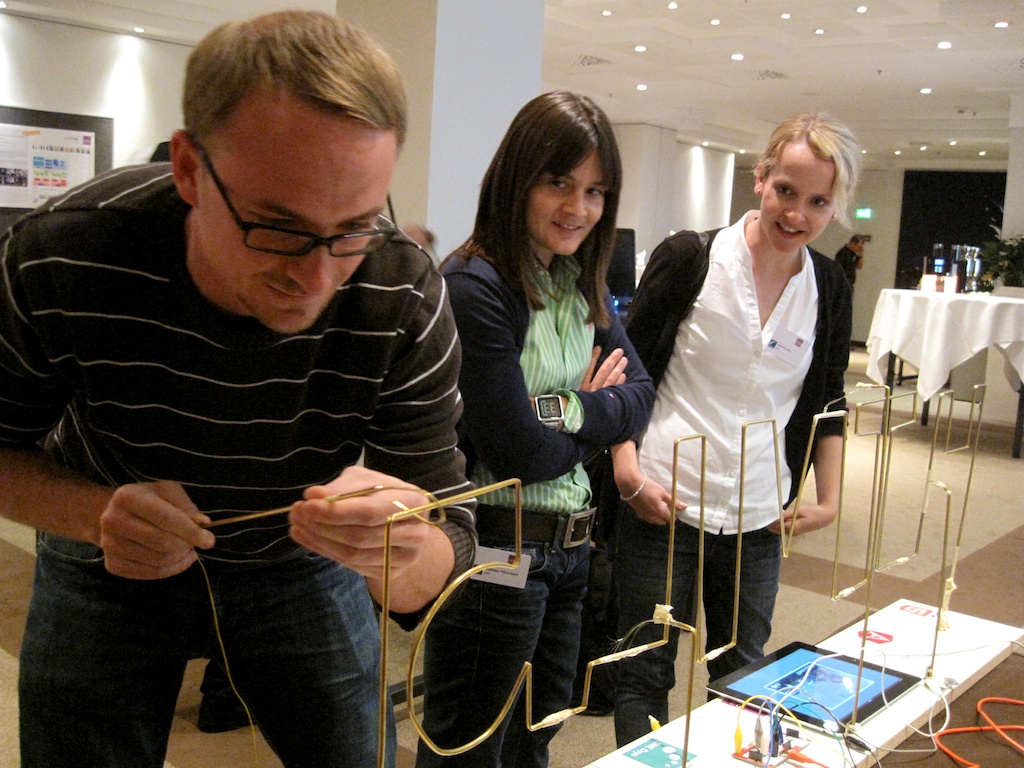
A man playing a version of the wire loop game.

A wire loop game, or buzz wire, is a game which involves guiding a metal loop (a 'probe') along a serpentine length of wire without touching the loop to the wire.[1] The loop and wire are connected to a power source in such a way that, if they touch, they form a closed electric circuit. The circuit is connected to a light or sound-emitting device of some sort, so that when the loop and the wire touch, the light-emitting device will light up, and the sound-emitting device will make a sound, traditionally a buzzing noise. In commercial implementations of the game the wire is usually bent along a single axis.[1]

This game is also called a steady-hand game or an electronic loop game.

History

[edit]

The electric buzz wire game was invented by Robert (Bob) Scrimshaw in Yorkshire in 1953. Bob was an electrician for RAF ground crew during WWII repairing planes, and was known as a very skilled electronic engineer. In 1953 Bob’s close friend John Waddington asked Bob if he could make a game for his garden party, and Bob created and brought along the ‘electronic loop game’. The game was a huge hit at the party, and John Waddington went on to parent Bob’s design before producing the first commercial ‘electronic loop game’ for sale from the mid 1950’s, through his Waddingtons Game Co.[2][3]

Types of buzz wire games

[edit]

Desktop buzz wires are widely available for purchase. A giant version of the game also exists and it is typically used outdoors or as a garden game. More sophisticated buzz wires have also been developed, to incorporate digital technology to add features like automated scorekeeping and player ranking.[4]

Virtual versions of this game exist, in which the pointer takes the place of the wire loop and must be guided down a narrow, twisting path without touching the sides. Both versions require well-developed hand–eye coordination. The difficulty of any particular game depends in part on the shape of the twisted wire and the size of the loop.

References

[edit]
Revisions and contributorsEdit on WikipediaRead on Wikipedia
from Grokipedia
A wire loop game, also known as a buzz wire or electric loop game, is a dexterity-based or in which a player holds a metal hoop or probe and guides it along a contorted, serpentine wire track from start to finish without allowing the hoop to touch . If contact occurs, the hoop and wire complete an electrical circuit, activating a or light to indicate failure and often resetting the game or deducting points. The game's simplicity, combined with its demand for steady hands and concentration, makes it a test of fine motor skills and patience. Invented in 1953 by Robert (Bob) Scrimshaw, a Yorkshire-based and former RAF member during , the game originated as a custom creation for a garden party hosted by his friend John Waddington, founder of the company Waddingtons. Waddington recognized its potential and patented the design, leading to commercial production by Waddingtons in the mid-1950s under names like "electric loop game" or "Beat the Bleep." By the late 20th century, it had become a fixture at funfairs, carnivals, and science exhibitions worldwide, appealing to all ages as an affordable skill challenge often found in amusement arcades. In contemporary settings, the wire loop game serves dual purposes as both entertainment and education, frequently incorporated into STEM projects to demonstrate fundamental electrical circuits, conductivity, and open/closed circuit principles for students aged 14 and older. DIY versions using household materials like batteries, wire, and buzzers are common in classrooms and maker spaces, fostering hands-on learning about . Digital adaptations, including iterations that replicate the physical challenge using motion controllers, have emerged since the , while a 2024 study in highlighted its use in assessing surgical dexterity, finding surgeons outperformed other hospital staff in completing the task more quickly and successfully.

Overview

Description

The wire loop game, also known as the buzz wire game, is a classic dexterity-based designed to challenge players' precision and control. It consists of a continuous metal wire shaped into a complex path, typically serpentine or themed like an animal outline, fixed to a stable base such as or . A separate metal loop, attached to an insulated handle for easy gripping, serves as the probe that players maneuver along the wire's contour. The core objective is to guide the loop from one end of the wire to the other in a single, uninterrupted motion without allowing the loop to touch the wire at any point. This setup demands steady hands and focused attention, as it tests hand-eye coordination and nerve control under increasing difficulty from the wire's twists and turns. Successful completion highlights the player's ability to maintain minimal clearance between the loop and wire throughout the path. If the loop makes contact with the wire, it closes an electrical circuit connected to a low-voltage power source, immediately activating an audible to signal the error. Many versions also incorporate visual feedback, such as an LED light that illuminates upon contact, enhancing the sensory alert and making the failure more engaging. This immediate response mechanism reinforces the need for precision without requiring complex scoring.

Gameplay Mechanics

The wire loop game, also known as the buzz wire game, requires players to grasp a handle attached to a metal loop and guide it along a continuous, shaped wire path from start to finish without making contact between the loop and the wire. If the loop touches the wire at any point, an electrical circuit completes, activating a buzzer to signal the error; in many versions, this requires the player to restart from the beginning, while others apply penalties such as added time or deducted points. This mechanic emphasizes precision, as the buzzer provides immediate auditory feedback for any deviation. Successful play demands fine , steady hand-eye coordination, and sustained concentration to navigate the wire's contours, with being essential to avoid rushed movements that increase the risk of contact. Difficulty escalates based on the wire's design, such as tighter bends, longer paths, or added vibrations, which test the player's ability to maintain a consistent gap between the loop and wire. Common challenges include involuntary hand tremors from fatigue or tension, as well as deceptive wire shapes like sharp zigzags or loops that demand slower, more deliberate maneuvering to prevent accidental touches. The primary winning condition is to traverse the entire wire path without triggering the , achieving a "clear run" that demonstrates mastery of the game's demands. In competitive variants, players may incorporate timing elements, aiming to complete the course as quickly as possible without errors, often within a set limit like 40 seconds to heighten the challenge.

History

Origins and Early Development

The wire loop game, commonly known as the buzz wire game, originated in 1953 in , , when electrician and electronic engineer Robert (Bob) Scrimshaw invented a simple dexterity toy featuring a metal probe guided along a twisted wire path without completing an electrical circuit. Scrimshaw, who had served as an RAF member during repairing , drew on his expertise to create this prototype at the request of his friend John Waddington for a garden party entertainment. The initial consisted of a basic wire frame shaped into a serpentine , a handheld metal loop probe, and a rudimentary electrical setup that triggered a buzzing upon contact between the loop and the frame. Constructed using readily available stiff metal wire for durability and conductivity, the device incorporated an early battery-powered , reflecting post-war advancements in accessible batteries and simple electronic components. This handmade version quickly proved engaging at the 1953 event, demonstrating the game's potential as a test of steady hand coordination. Recognizing its appeal, John Waddington, associated with the Waddingtons game manufacturing company, promptly patented Scrimshaw's design, marking the transition from personal prototype to formalized invention. Early documented designs emphasized minimalistic construction to highlight the core mechanic of avoiding circuit completion, setting the foundation for subsequent toy iterations without altering the fundamental wire-and-loop structure.

Commercialization and Popularity

Following its invention in 1953, the wire loop game underwent commercialization in the mid-1950s when British game manufacturer John Waddington Ltd. patented and began producing the device as the "electric loop game," marking its transition from a novelty invention to a marketable product. This led to a boom in availability during the 1950s, particularly in the UK, where it became a common sight at funfairs, carnivals, and parties as a skill-testing game often awarded as prizes. Waddingtons, renowned for board games like Monopoly, drove early production, while generic manufacturers in the UK and US contributed to broader distribution through toy stores and event suppliers. The game gained popularity through the late as a fixture at funfairs and carnivals worldwide. The game experienced a resurgence post-2000 in DIY and retro markets, fueled by online tutorials, craft kits, and nostalgic recreations for home and events.

Technical Components

Electrical Circuit Design

The electrical circuit in a wire loop game operates on a basic open-circuit principle, where the game wire serves as one conductor and the handheld loop as the other, remaining disconnected until contact occurs to complete the path and activate the . This design ensures no current flows during normal gameplay, preventing unintended activation. Key components include a low-voltage battery, such as a 9V unit or two AA batteries providing 3V total, to supply ; a piezo or electromagnetic that produces an audible alert upon circuit closure; and an optional to regulate current and protect the buzzer from overload. These elements are integrated in series, with the battery's positive terminal connected to one end of the , the buzzer's other terminal leading to the game wire, and the loop wired back to the battery's negative terminal. In the circuit diagram, the components form a single series loop: current flows from the battery through the only when the loop touches the wire, bridging the open gap and allowing electrons to complete the path, which triggers the buzzer's vibration via piezoelectric deformation or movement. The metal construction of the wire and loop ensures reliable conductivity at the point of contact. Safety is inherent in the low-voltage setup, typically under 9V, which eliminates shock risks and makes the game suitable for children under supervision.

Materials and Construction

The construction of a wire loop game, also known as a wire game, typically involves simple, accessible materials suitable for DIY projects aimed at hobbyists and educators. Essential components include 12- to 18-gauge galvanized or wire for the maze path, which provides conductivity and durability; a or wooden handle, such as a or pen body, for the handheld loop; a made from , , or wood to mount the structure; a small for auditory feedback; a accommodating 9V or AA batteries; and insulated connecting wires for assembly. Tools required for building include for bending and shaping the wire, wire strippers to expose conductive ends, and a for secure electrical connections, along with basics like a , glue gun, and for mounting. Assembly begins with shaping the main wire path: cut a length of 12- to 18-gauge or galvanized wire (approximately 1-1.2 meters) and bend it into a desired pattern with curves and obstacles using , then secure it to the by holes and gluing or screwing it in place. Next, form the handheld loop by shaping a smaller segment of the same wire into a circular or oval ring (about 2-5 cm in ) and attaching it to the with tape or , ensuring one end connects to a long insulated wire for circuit linkage. Wiring the circuit involves stripping ends and connections between the , , and wire path, while mounting all elements firmly on the to create a game board. Finally, test the setup by powering it on and guiding the loop along the path without contact. For customization, enthusiasts can vary the maze wire's thickness—using thinner gauges (higher numbers) to increase difficulty through tighter bends—or incorporate thematic elements like painted designs or optional LED lights attached to the base for visual appeal, without altering core functionality.

Variations and Adaptations

Traditional Buzz Wire Games

Traditional buzz wire games represent the foundational physical iterations of the wire loop challenge, where players guide a metal-handled loop along a contoured wire track mounted on a stable base, aiming to complete the path without making contact that completes an electrical circuit and sounds a buzzer. These handheld devices emphasize manual dexterity and steady nerves, with standard designs incorporating simple straight or gently curved paths to accommodate beginners, while more advanced variants introduce tighter bends and loops for increased difficulty. Typical lengths for these portable models range from 10 to 12 inches, making them suitable for tabletop or on-the-go play in homes, parties, or fairgrounds. To enhance engagement, traditional buzz wire games often feature themed wire shapes that transform the path into recognizable or imaginative forms, such as animal silhouettes, outlines, or abstract mazes. Examples include alien-shaped wires, where the loop must trace extraterrestrial contours like antennae and limbs, adding a playful sci-fi element to the challenge. Animal-themed designs, inspired by continuous line drawings, might depict an elephant's trunk or a in flight, requiring precise navigation through organic curves that mimic natural forms and heighten the test of coordination. outlines, such as a or , provide dynamic, linear-yet-twisted paths that evoke motion, while abstract mazes offer labyrinthine complexity without a literal theme. Manufacturing variations among traditional buzz wire games reflect adaptations for durability, portability, and user convenience, with bases commonly constructed from lightweight to house the wiring and , contrasted by rigid metal for the conductive loop and path to ensure reliable circuit completion. Power sources typically rely on battery operation—often AA cells—for compact, handheld units, though larger event-oriented models may incorporate plug-in electrical connections for sustained use without battery replacement. Collectible appeal centers on editions from the 1960s through 1980s, including branded releases like the 1980 "Buzz Off" skill game by Action GT, which featured colorful casings and themed packaging, now sought after by enthusiasts for their nostalgic design and historical tie to mid-century commercialization.

Digital and Virtual Reality Versions

Digital adaptations of the wire loop game have emerged as accessible alternatives to physical versions, primarily through mobile and browser-based applications that simulate the core challenge using touch or inputs. These digital versions typically feature a virtual wire path displayed on screen, where players guide a ring or hoop along the contour without contact, often accompanied by synthesized buzz sounds upon failure. For instance, the Ring - Wireloop Game, released in 2018, employs one-touch drag controls to maneuver a circle through increasingly complex wire shapes across multiple levels, with difficulty escalating as the ring's movement speed increases over time. Similarly, browser-based titles like Wire Hoop on Keygames.com utilize controls to navigate a bouncing hoop along twisted tracks, maintaining the steady-hand precision of the original while running directly in web browsers without downloads. Virtual reality implementations elevate the experience by incorporating immersive 3D environments and motion-tracked controllers for physical interaction. The Wire Loop Game VR, a 2016 Steam release developed for the , requires players to use a single to guide a virtual metal hoop along one of 50 progressively challenging wires, with failure triggered by contact or exceeding a time limit per level, accompanied by an audible buzzer. The game emphasizes dexterity and focus, allowing adjustable wire heights to accommodate different player preferences, and unlocks an achievement upon completing all wires. A port of this title was released for Meta Quest platforms on March 6, 2024, expanding accessibility to standalone VR headsets and maintaining the core mechanics with updated compatibility for modern VR systems. Enhancements in these digital and VR formats often include integrated scoring systems, timers, and progressive difficulty to boost replayability, though multiplayer modes remain rare. Mobile apps like Ring track performance through level completions and speed-based challenges, while browser games such as Wire Hoop imply implicit scoring via successful runs. In VR, The Wire Loop Game VR enforces per-wire timers to heighten tension, but lacks haptic feedback or competitive multiplayer, relying instead on solo progression. Post-2010 developments have seen Arduino-based DIY projects hybridize traditional wire loops with digital electronics, adding sensors, LEDs, and displays for enhanced feedback. These open-source builds, such as the 2020 Hackster.io project, use boards connected to touch-sensing wires, red and green LEDs for loss/win indicators, a for audio cues, and a 7-segment display to count attempts up to 10 before reset. Another example from Circuit Digest in 2020 integrates an LCD screen to show "Try Again" on contact or "Well Done" on success, employing digital pins with internal pull-up resistors to detect circuit completion via the wire loop. These additions provide quantifiable metrics like attempt counters and completion status, bridging analog play with programmable interactivity.

Cultural and Educational Impact

The wire loop game, also known as the buzz wire, has been a common fixture at carnivals and fairs since the mid-20th century, often used as a skill-based attraction where successful players win small prizes such as stuffed animals or candy. In media, the game has appeared as a comedic prop in British television, notably in the 1990s series , where the titular character comically cheats at a fairground version to secure a victory, highlighting its role in lighthearted entertainment. It has also featured in game shows, such as the international adventure series Fort Boyard, where contestants tackle vibrating wire loop challenges to earn points or keys since the late 1990s. The game's nostalgic appeal has driven a retro revival in the and beyond, with reproductions marketed as vintage toys and hipster evoking childhood memories. Digital adaptations, including mobile apps with retro visuals and versions, have extended its presence into modern entertainment, often shared in online challenges that emphasize hand-eye coordination. Celebrity toy enthusiasts, including comedian through his iconic Mr. portrayal, have indirectly boosted its cultural visibility by associating it with whimsical, enduring fun.

Applications in Education and Therapy

Wire loop games, including their digital adaptations, have been integrated into educational settings to teach fundamental concepts in and physics through hands-on construction and play. Students build the game using components such as wire, batteries, buzzers, and conductive loops, which demonstrates principles of electrical circuits, including current flow and continuity testing via the buzzer's activation upon contact. This approach fosters practical skills in wiring and assembly, often adapted for STEM curricula in grades suitable for introductory lessons, enhancing understanding of cause-and-effect relationships in simple circuits. In therapeutic contexts, particularly , wire loop games support fine-motor skill development and rehabilitation. The traditional buzz wire task requires precise hand-eye coordination to navigate a loop along a wire without contact, making it suitable for evaluating and improving in children aged 7–12. A involving 66 children demonstrated the game's ability to measure performance metrics like completion time and error rates (e.g., average 2.38–6.4 errors across tasks), with significant differences based on speed and loop size, confirming its low-cost, engaging utility in clinical assessments of eye-hand coordination and object control. A 2024 study published in The BMJ used the buzz wire game to assess dexterity among 254 hospital staff, finding surgeons completed it more quickly and successfully than other groups: 84% of surgeons finished within 5 minutes (average 89 seconds), compared to 57% of physicians (120 seconds), 54% of nurses, and 51% of non-clinical staff. The study also noted surgeons were more likely to swear during the task, underscoring the game's potential for evaluating professional manual skills in medical settings. Virtual reality adaptations, such as BuzzwireVR, extend these applications to upper-body rehabilitation following trauma like . This immersive system, developed using and Unity3D, tracks metrics including deviation (mean 0.4 cm with ) and completion time (18.4 seconds under optimal conditions), promoting steady finger movements and engagement in therapy sessions. Testing with 11 patients showed improved (median enjoyment score of 5/5) and measurable differences between strong and weak hands (26.5 s vs. 33.7 s), highlighting its role in supplementing fine-motor therapy without inducing .

References

Add your contribution
Related Hubs
User Avatar
No comments yet.