Hubbry Logo
Withdean StadiumWithdean StadiumMain
Open search
Withdean Stadium
Community hub
Withdean Stadium
logo
8 pages, 0 posts
0 subscribers
Be the first to start a discussion here.
Withdean Stadium
Withdean Stadium
from Wikipedia

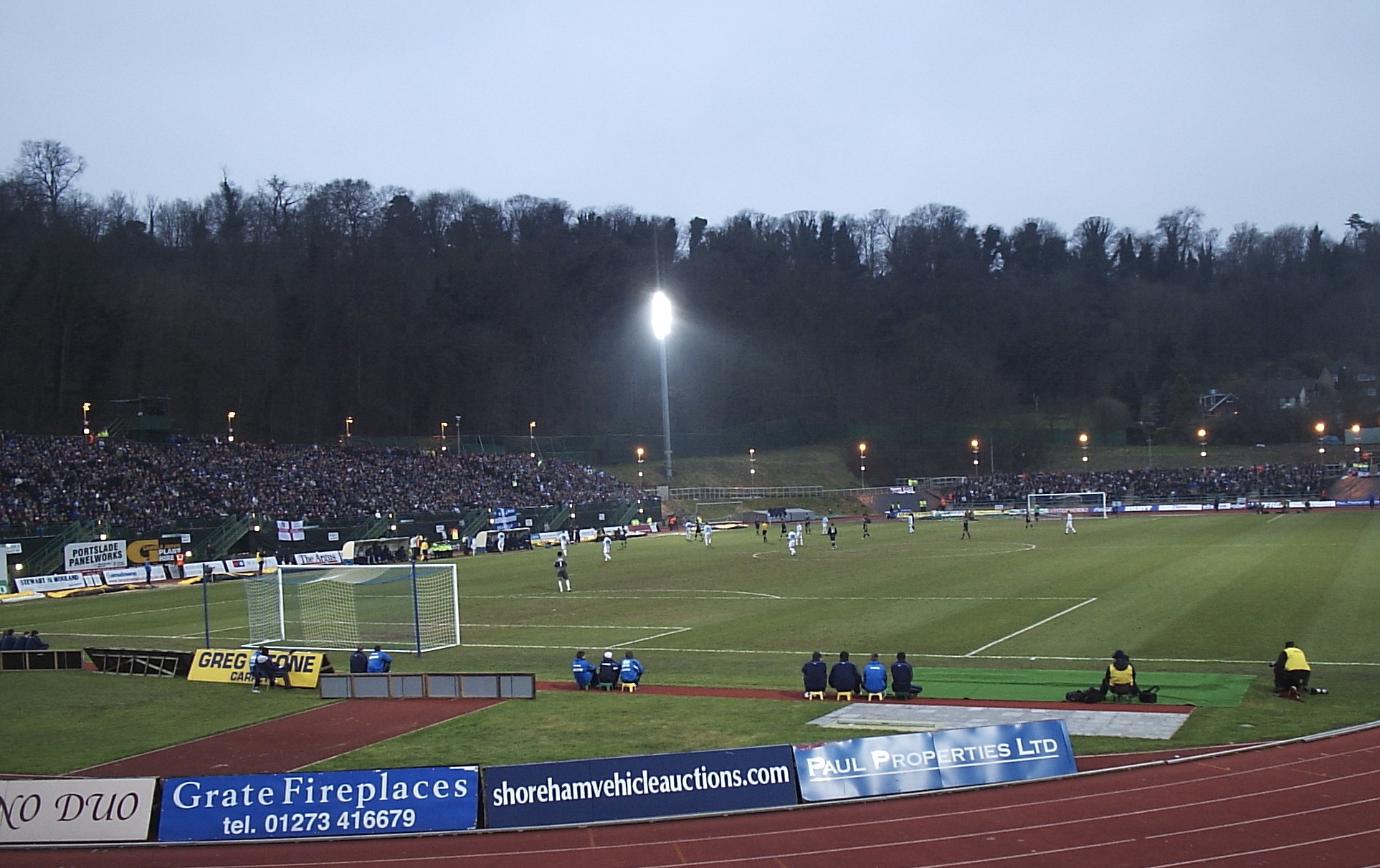
Withdean Stadium is an athletics stadium in Withdean, a suburb of Brighton. It was constructed in 1930. It was the home track of Olympic athlete Steve Ovett. Between 1999 and 2011 it was the home ground of football team Brighton & Hove Albion F.C.

Key Information

History

[edit]

The site was opened as a lawn tennis club venue in 1936, having been used as playing fields before this. The centre court had seating for 2,000 and was used for the Davis Cup match between Great Britain and New Zealand in the spring of 1939.[1] Later developments included a zoo[2] and miniature railway.

In 1955 the then mayor of Brighton, Walter Dudeney, opened Brighton Sports Arena as a new athletics arena hosting various sporting activities and events. The arena was upgraded over the years, with lighting added and additional squash courts. In 1980 Steve Ovett opened an all-weather running track,[3] which was resurfaced in 1997.[4] In 1999 the stadium became the temporary home of Brighton & Hove Albion F.C.

Use by Brighton & Hove Albion F.C.

[edit]

The club's original stadium, the Goldstone Ground, had been sold for commercial redevelopment in 1997. This resulted in the team playing their home matches for two seasons at Gillingham's Priestfield Stadium, over 70 miles (110 km) from Brighton, before moving to Withdean Stadium. The only other local option for Albion had been to play at Sussex CCC's County Cricket Ground, Hove.

North Stand in the distance, in the foreground a temporary stand that has since been removed
South Stand which existed while it was used by Brighton & Hove Albion F.C.

Withdean Stadium was voted the fourth worst football stadium in the UK by The Observer in 2004.[5] The temporary nature of the stadium was obvious - the stadium was primarily used for athletics; there was a single permanent stand along the north side, while the other stands were assembled from scaffolding, some of which also served as temporary seating at the Open Championship golf tournament. The largest was the South Stand, running the entire length of the pitch. The east end of the pitch contained two medium-sized and one small stand. One of the larger stands here was designated as the family stand. The West Stand was the designated away stand. Changing and hospitality facilities were provided with portable cabins placed haphazardly around the site, and there was very limited on-site car parking.

There was considerable opposition in the local neighbourhood to allowing the football club to use the stadium. After some unique concessions were made, the club was allowed to move into Withdean in 1999. Amplified music was banned during football matches (except for the traditional "Sussex by the Sea"), and matchday parking restrictions were imposed within a one-mile radius of the ground. After a year, the music restrictions were eased, but the parking limitations continued in force. The price of each match ticket also included a public transport voucher allowing free bus or rail travel throughout the Brighton and Hove area on match day.

For Albion's match against Sheffield United on 2 October 2004 the stadium was temporarily renamed Palookaville as it hosted the launch party for Fatboy Slim's album of the same name.[6] The album was released on Skint Records, then the club's shirt sponsor, and for that match the team wore shirts bearing the name Palookaville instead of Skint. The name Palookaville was also considered humorously appropriate by fans because it reflected the inadequacy of the club's temporary home.

Additional seating was added at the East and West Ends of the ground in November 2005. The club played their last game at Withdean on Saturday 30 April 2011 against Huddersfield Town.[7]

Since the club has moved out, the temporary seating and other structures have been removed with only the original North Stand remaining, with seating for around 1,300.

Withdean Sports Complex

[edit]

Today the Stadium is part of the Withdean Sports Complex leisure centre owned by Brighton and Hove City Council and operated by Freedom Leisure. Facilities include squash and tennis courts, a gym and rock climbing wall.[8]

References

[edit]
[edit]
Revisions and contributorsEdit on WikipediaRead on Wikipedia
from Grokipedia

Withdean Stadium is an athletics stadium located in the Withdean suburb of , , originally developed as a lawn tennis centre in 1936 by the Lawn Tennis Association. It primarily served events but functioned as the temporary home ground for & Hove Albion Football Club from 1999 to 2011, accommodating football matches amid the club's relocation challenges following the sale of their previous stadium.
The venue's design, centered around a , required temporary stands that expanded its capacity from an initial 6,000 to a record attendance of 8,729 for football, though this setup positioned fans distant from the pitch and largely exposed to the elements with minimal roofing. Despite these logistical drawbacks, & Hove Albion secured notable successes at Withdean, including Third Division championship in 2001, Second Division title in 2002, play-off promotion to the in 2004, and League One victory in 2010–11, fueling the club's resurgence from near-collapse. The stadium's era highlighted the Seagulls' resilience in unconventional conditions, with the athletics facility reverting to its primary use post-2011 upon the club's move to the .

Location and Physical Characteristics

Site and Construction History

Withdean Stadium is located in the Withdean suburb of , , on land owned by Brighton & Hove City Council. The site lies west of Withdean Road and south of Tongdean Lane. The venue originated as a tennis facility constructed in the early and formally opened in 1936, developed by the Lawn Tennis Association with support from Council. The layout included a centre court situated between an open seating area and earthen banking for spectators, with a concrete grandstand designed in style capable of holding 4,100 people. Prior to 1955, the site functioned primarily as a centre, hosting events such as Great Britain's tie against in 1939. During , it served as a mortuary, and postwar operations in 1947 resumed activities alongside a small incorporated . The council maintained ownership throughout, overseeing these early recreational and entertainment uses as part of a broader .

Design Features and Capacity

Withdean Stadium centers on a 400-meter track enclosing a grass infield pitch, designed primarily for events with surrounding facilities for jumps and throws. The track supports multi-lane running, including configurations for standard competitions, while the infield accommodates field events such as with adjacent sand-filled pits. Floodlighting enables evening use, and the layout complies with requirements for hosting regional meets under standards. The stadium's original permanent seating consists of a single stand with capacity for 1,350 spectators, reflecting its primary role as an athletics venue rather than a large-scale arena. For temporary adaptation to association football from 1999 to 2011, modular uncovered stands were installed along the east, north, and south sides, expanding all-seated capacity to 9,002. These temporary structures, including approximately 900 seats at the east end, were erected over the track's bends to position fans closer to the pitch, which measured 101 meters by 69 meters within the track oval. Architecturally, the open-air design lacks a or enclosed , leaving the venue exposed to prevailing conditions, a common feature in facilities prioritizing functionality over spectator comfort. During football usage, adaptations included placing goals proximate to long-jump pits and hammer-throw circles at one end, resulting in unconventional sightlines and atmospheric disruptions from the athletics infrastructure. This hybrid setup maintained the track's integrity while accommodating a full-size pitch, though it compromised optimal viewing distances typical of dedicated football stadia.

Historical Timeline

Origins and Pre-Athletics Use (1930–1954)

The site at Withdean, a of , was developed in the early as part of the area's interwar expansion in public recreation facilities, with initial construction occurring in 1930 on land previously used for playing fields and incorporating remnants of a small private animal collection from the at nearby Withdean Grange. By 1936, the Lawn Tennis Association had transformed it into a dedicated centre, featuring a accommodating up to 2,000 spectators in tiered seating, alongside multiple grass courts and supporting amenities like . This development responded to rising local demand for organized sports amid Brighton's growing population and tourism-driven economy, funded through LTA investment and municipal support. The venue quickly hosted competitive events, including Great Britain's match against in 1939, drawing international attention to its facilities. interrupted tennis activities, with championships canceled and the site repurposed as a temporary mortuary to meet wartime needs. Postwar recovery saw its relaunch on 22 May 1947 as the Brighton Olympic Stadium, initially emphasizing but incorporating broader entertainment to capitalize on public interest in amid economic constraints. From 1948, the site briefly integrated a small zoo operation, reopening as Brighton Zoo with exhibits of local and exotic animals, reflecting opportunistic driven by council-led initiatives to diversify revenue from events like military tattoos and public gatherings. The zoo closed around 1950–1952 due to maintenance challenges and shifting priorities, marking the end of pre-athletics experimentation before full conversion. These changes were pragmatic responses to funding limitations and community needs, without specialized infrastructure beyond basic enclosures added to existing sports layouts.

Athletics Development and Prominence (1955–1998)

In 1955, Council converted the former and entertainment venue at Withdean into an , renaming it the Sports Arena, at a cost of £28,000. The facility reopened on 14 May 1955, officiated by Mayor Walter Dudeney, featuring a new suitable for regional competitions and training sessions. Initially equipped with a cinder surface typical of mid-20th-century tracks, it hosted local and meets, contributing to grassroots development amid limited investment in national facilities. The 's permanent stood at approximately 1,350, primarily in a covered stand, supporting modest attendances for events focused on disciplines. The stadium gained prominence as the home training and competition venue for Olympic gold medalist Steve Ovett during the 1970s and 1980s. Ovett, a Brighton native born in 1955, set a Sussex record of 1 minute 52.5 seconds in the 800 meters at Withdean during the county championships, marking an early milestone in his career that progressed to international success, including the 800m gold at the 1980 Moscow Olympics. He frequently trained and raced there, including a 1983 event against Mark Rowland, leveraging the track's consistent conditions for interval and endurance work despite its regional-scale infrastructure. Ovett's association elevated the arena's profile, drawing aspiring athletes and fostering local talent through clubs like Arena 80, which originated from Withdean-based sessions. Over the subsequent decades, the facility underwent incremental upgrades, including lighting additions to enable evening events, sustaining its role in athletics despite competition from larger national venues. It served as a hub for youth and amateur competitions, underpinning regional growth in participation and performance metrics, such as improved county-level times attributable to regular access rather than elite funding. By the late , the track remained a vital asset for , though synthetic surfacing advancements were not yet implemented, preserving its cinder-era characteristics until later renovations. This period solidified Withdean's causal importance in nurturing middle-distance prowess, evidenced by Ovett's breakthroughs originating from site-specific preparation.

Football Adaptation Period (1999–2011)

Following the sale of the in 1997, which precipitated the club's entry into administration and two seasons of ground-sharing at Gillingham's , & Hove Albion secured a on Withdean Stadium as a temporary venue starting in the 1999–2000 season to ensure financial continuity and avoid liquidation. This adaptation was driven by the absence of viable alternatives in , with the council-owned athletics facility selected for its location within the city and potential for dual-use, though it required significant modifications to host Football League matches while retaining the for events. Temporary modular stands, constructed primarily from scaffolding and prefabricated elements, were erected around the perimeter of the existing 400-meter , preserving the infield grass for but creating a hybrid layout unsuited to professional football standards. The , positioned centrally within the track, measured standard dimensions but suffered from extended distances between the playing surface and spectator areas, compromising sightlines and atmosphere; capacity was initially limited to around 7,000, later expanded to a maximum of 8,850 through additional terracing and covered sections. Alterations included floodlights and basic roofing on select stands to meet league requirements, all implemented under temporary planning consents granted by Brighton & Hove City Council from 1999 onward, which stipulated reversion to primacy post-football tenancy. Despite these logistical constraints and exposure to weather elements without full enclosure, empirical attendance records reflected sustained supporter commitment, with averages exceeding 6,000 per match across the period—often approaching capacity during competitive seasons—underscoring the venue's role in stabilizing the club amid promotion campaigns, even as it highlighted the inadequacies of track-encircled pitches for football. This dual-use compromise, while enabling survival, imposed ongoing operational challenges, including higher maintenance for the shared turf and restrictions on permanent infrastructure to avoid undermining the site's primary athletics function.

Post-Football Era and Modernization (2012–Present)

Following the relocation of to on 31 May 2011, Withdean Stadium returned to its original role as a dedicated athletics venue, with the athletics track restored for events after temporary modifications for football had been reversed. The facility, remaining under ownership of & City Council, received ongoing maintenance to meet standards, ensuring usability for training and competitions without major structural overhauls. Operations of the stadium as part of the broader Withdean Sports Complex were managed by Freedom Leisure, a not-for-profit operator contracted by the council, which prioritized multi-sport programming to optimize public resource allocation over single-sport specialization. This approach facilitated year-round athletics access alongside complementary activities, with empirical usage data indicating sustained local participation in track events post-2011, though exact attendance figures reflect council-subsidized operations balancing costs against revenue from diverse programming. In 2025, refurbishment of the adjacent multi-use games area (MUGA) introduced a porous tarmac surface with enhanced drainage, enabling reliable play for , , , and regardless of weather, alongside upgraded LED floodlighting, fencing for security, and accessibility ramps. Approved by council planning in February 2025 and completed by , these works—undertaken by ETC Sports Surfaces—improved surface durability and reduced long-term maintenance needs through better water permeability, supporting higher utilization rates without disrupting athletics primacy at the stadium core. The multi-sport enhancements demonstrably expanded community access, as bookings via Freedom Leisure increased post-refurbishment, underscoring the causal benefits of versatile infrastructure in sustaining facility viability under public funding constraints.

Association Football Usage

Temporary Home for Brighton & Hove Albion F.C.

Following the sale of the Goldstone Ground by the club's board in 1995 for £7.4 million, which was finalized in 1997 and resulted in the stadium's demolition for housing development, Brighton & Hove Albion faced acute instability, playing home matches at Gillingham's Priestfield Stadium for two seasons from 1997 to 1999. This nomadic period exacerbated financial pressures during administration proceedings in 1997, prompting a search for a local venue to restore operational continuity. In 1999, the club secured a lease agreement with to utilize Withdean Stadium, an existing athletics facility, as a temporary football ground starting from the 1999–2000 season, despite initial local opposition from residents and prioritization of its athletics heritage. The arrangement, extended multiple times including through 2005, provided essential stability by enabling the club to host league fixtures in its home city without the higher relocation costs of prolonged away tenancy. This move aligned with the council's multi-use sports policy but required temporary seating installations around the running track, capping effective capacity at approximately 8,200 for safety-compliant football matches. The tenancy supported financial recovery amid post-administration constraints, as the council-owned venue avoided the capital outlays of ground ownership while generating matchday revenue, though limited by the reduced capacity compared to modern standards—typically hosting crowds under 8,000—which constrained commercial growth and sponsorship potential relative to peers in higher divisions. Despite these limitations, the setup facilitated competitive , evidenced by the club's qualification for the 2004 Football League Second Division play-offs, culminating in a 1–0 victory over Bristol City in the final to secure promotion to League One. Further progress followed with the 2010–11 League One title win, achieving back-to-back promotions under the venue's restrictions and underscoring its role in enabling ascent without evidence of insurmountable hindrance.

Key Matches, Achievements, and Challenges

During & Hove Albion's tenure at Withdean Stadium from 1999 to 2011, the club secured four promotions across the lower tiers of English football, including league titles in the 2000–01 Conference National and 2001–02 Third Division. These successes were hard-fought, with the 2003–04 playoff final victory over Bristol Rovers by 2–1 after extra time at the on May 29, 2004, marking a return to League One. The 2010–11 season culminated in promotion to the via the League One , highlighted by a 3–0 home win against & Redbridge on April 12, 2011, that confirmed their top position before the playoff triumph over Yeovil Town at . Derby matches against drew intense crowds, often pushing attendance toward the venue's reduced capacity of around 6,000 to 8,000 seats adapted for football. Average home attendances hovered above 6,000 supporters per match, sustaining fan support despite logistical strains and demonstrating resilience in ascending the leagues from near-extinction post-Goldstone Ground sale. This period's achievements, including three promotions as outright winners in their divisions, underscored the club's operational grit amid makeshift conditions, directly catalyzing the urgency for a permanent by exposing the unsustainability of an athletics track for professional matches. However, Withdean presented significant challenges for football operations, primarily due to the 8–10 meter track separating stands from the pitch, which impaired visibility and immersion for spectators. Weather exposure was acute, with open seating and minimal cover leading to frequent matchday discomfort, particularly in South Coast rains, as lamented by fans enduring "soakings" that tested loyalty. The West Stand, a temporary structure allocated to away supporters, was widely regarded as among the league's poorest, isolating visitors and complicating safety and atmosphere without integrated facilities. These inadequacies, rooted in the venue's primary design for track events rather than spectator football, contributed to criticisms of subpar professional standards, though they inadvertently galvanized community efforts for improved .

Integration with Withdean Sports Complex

Facility Expansion and Multi-Use Role

The Withdean Stadium functions as the athletics anchor within the Withdean Sports Complex, integrated with adjacent facilities including a , squash courts, indoor and outdoor courts, and multiple 3G pitches, allowing for combined training sessions that leverage the stadium's track alongside strength conditioning and racket sports. This physical adjacency supports infrastructural synergies, such as shared access paths and utilities, optimizing space utilization in a 22-acre site originally developed in the mid-20th century. Post-2011 redevelopment emphasized multi-use enhancements, with a £2.7 million overhaul completed in 2013 introducing a renewed synthetic athletics track surface and an expanded featuring 125 exercise stations to accommodate diverse user groups simultaneously with track activities. Further expansions included four floodlit pitches constructed on a former overflow car park and opened on April 17, 2024, providing dedicated all-weather surfaces for team sports proximate to the stadium, thereby enabling parallel programming without direct interference to track operations. In 2025, a refurbished multi-use games area (MUGA) added porous tarmac surfacing for , , and , completed in October and enhancing evening accessibility via integrated lighting. These developments underscore trade-offs in , such as converting underutilized parking to pitches, which increased but required adjusted circulation for event days, while the 's retained floodlights—originally augmented during the 1999–2011 football adaptation—facilitate extended hours for track sessions, promoting infield grass use for field events like jumps and throws alongside concurrent complex-wide activities. The overall configuration supports up to several hundred users across facilities at peak times, though exact post-2011 utilization metrics remain tied to seasonal athletics demand and partner club scheduling.

Current Operations and Programming

Withdean Stadium, integrated within the broader Withdean Sports Complex, is managed by Freedom Leisure under a agreement with & City Council, overseeing daily operations including facility maintenance, booking systems, and programmed activities. The stadium primarily supports athletics programming, serving as a training hub for third-party clubs such as & Athletic Club, which conducts sessions for adults and juniors on Tuesdays from 17:00 to 20:15 and Thursdays from 17:00 to 20:00, alongside Arena 80 Athletics Club's weekday track workouts focused on road, cross-country, and field events. Programming emphasizes regular track and field activities, including competitive meets like the Sussex AA Open Meeting held at the venue on dates such as 30 May 2025, alongside routine training for youth and senior athletes to foster participation and development. Community-oriented events integrate with the complex's offerings, such as coordinated fitness classes exceeding 150 weekly sessions across , , and squash facilities, enabling cross-programming for athletics participants seeking supplementary conditioning. Bookings for athletics track access are handled directly by clubs or through Freedom Leisure's online and app-based systems, with opening hours typically from 6:00 a.m. to 10:00 p.m. on weekdays. In , operations expanded with the October refurbishment of the adjacent multi-use games area (MUGA), featuring a new porous tarmac surface with enhanced drainage, line markings for , , and football, and improved fencing for security, resulting in measurable increases in booking availability and usage diversity as reported by the operator. This upgrade supports broader accessibility, with Freedom Leisure now accepting reservations for multi-sport sessions that complement athletics by accommodating small-group training and casual play, thereby elevating overall site utilization without disrupting core track programming.

Controversies and Criticisms

Stadium Adequacy for Professional Football

Withdean Stadium, originally designed as an athletics facility in 1930, exhibited significant shortcomings for professional football use during Brighton & Hove Albion's tenure from 1999 to 2011, primarily due to its encircling the pitch, which distanced spectators and players from the action, impairing visibility and atmosphere. The track created a physical and perceptual barrier, with fans and players reporting a sense of disconnection; for instance, visiting players like encountered unfamiliar elements such as long-jump sand pits adjacent to the pitch, contributing to discomfort and suboptimal playing conditions. This layout compromised sightlines, particularly from temporary seating areas, and diminished the intensity of supporter chants, as the separation reduced the immersive experience typical of dedicated football grounds. The West Stand, allocated to away supporters, was notoriously cramped and inadequate, often described as the worst in the Football League, with limited capacity around 500-1,000 seats in a segregated section that offered poor views and minimal facilities, exacerbating tensions and discomfort for visiting fans. Elemental exposure further hindered viability, as much of the stadium lacked substantial roofing, leaving stands open to ’s frequent rain and wind, which correlated with lower attendance on inclement days despite average crowds of 6,000-7,000 in a maximum capacity of approximately 8,850. metrics were marginally met for league standards, but comfort levels fell short, with temporary modular structures prone to and risks in high-demand matches. Despite these deficiencies, achieved notable success, securing promotions in the 2000–01 and 2001–02 seasons to reach the second tier, followed by League One title in 2010–11, ascending to the while based at Withdean. This resilience suggests that while the stadium's constraints may have fostered and operational efficiency under adversity, they also perpetuated a narrative of temporary adequacy that delayed permanent development for over a , arguably hindering long-term commercial growth and potential. Critics contend that reliance on such excuses overlooked the causal link between subpar facilities and suppressed revenues, which averaged below potential despite competitive on-pitch results.

Community and Environmental Disputes

near Withdean Stadium mounted significant opposition to its adaptation for professional football matches starting in 1999, culminating in the "Battle of Withdean" controversy, where local protests highlighted ignored community concerns over increased noise and disruption from crowds. A 1999 documentary by Albion TV amplified these grievances, alleging that planning approvals had been expedited without adequate resident input, prompting formal complaints to the from local officials who disputed its portrayal. John Catt, a neighboring resident, pursued multiple legal challenges against Brighton & Hove City Council's approvals for stadium use, arguing in a 2006 High Court case that assessments overlooked significant environmental impacts including noise, from floodlights, , and cumulative effects on residential amenity. The court found the council had exceeded its discretion by deeming no significant effects likely, though football operations continued pending development. These disputes reflected broader tensions, as delays in Falmer approvals—stemming from environmental opposition over proximity—extended Withdean reliance, intensifying local disturbances without resolution. Post-2011, after football relocation, analogous noise conflicts persisted at the Withdean Sports Complex, with residents reporting persistent disturbances from adjacent racket sports facilities. In early 2025, complaints described sounds from padel and pickleball courts as akin to "constant gunfire," spanning 29 months and prompting noise abatement notices. Such issues underscored recurring council-resident frictions, where planning permissions prioritized facility expansion over verified acoustic impacts, absent public decibel data but evidenced by formal nuisance declarations.

Recent Facility Change Proposals

In 2023, & Hove City Council approved plans for four small-sided artificial grass football pitches adjacent to the Withdean Stadium athletics track, utilizing a former car park site; construction commenced in early 2024 and includes floodlighting for extended use. These pitches, designed for community and club training, address identified shortages in local football facilities as outlined in the council's Local Football Facility Plan. Proposals for a new 25m by 10m community at the Withdean Sports Complex advanced in 2025, with initial designs unveiled in June and full approval in July; the £5.5 million modular facility, featuring a uniform 1.35m depth, is slated for construction starting early 2026 and completion by spring 2027. A professional design team was appointed in March 2025 to refine the project, emphasizing community access over competitive standards. Local athletics coaches raised concerns in May 2025 about insufficient parking expansion, potentially disrupting track users during peak hours. In February 2025, the 's planning committee unanimously approved upgrades to the multi-use games area (MUGA) near the stadium, including resurfacing with porous tarmac, improved , and enhanced ; work began in June 2025 and the facility reopened in October 2025. Separate 2025 proposals to convert two indoor courts to courts at the complex drew opposition, with over 1,000 petition signatures citing loss of traditional provision. Additionally, plans for gender-neutral tied to the new pool sparked criticism in June 2025 from campaigners arguing risks to women and children, though officials defended them as inclusive. These initiatives reflect ongoing efforts to diversify the complex's offerings beyond athletics, managed by Freedom Leisure under oversight, without altering the stadium's core track infrastructure.

References

Add your contribution
Related Hubs
User Avatar
No comments yet.