



Community hub
Recent from talks
Knowledge base stats:
Talk channels stats:
Members stats:
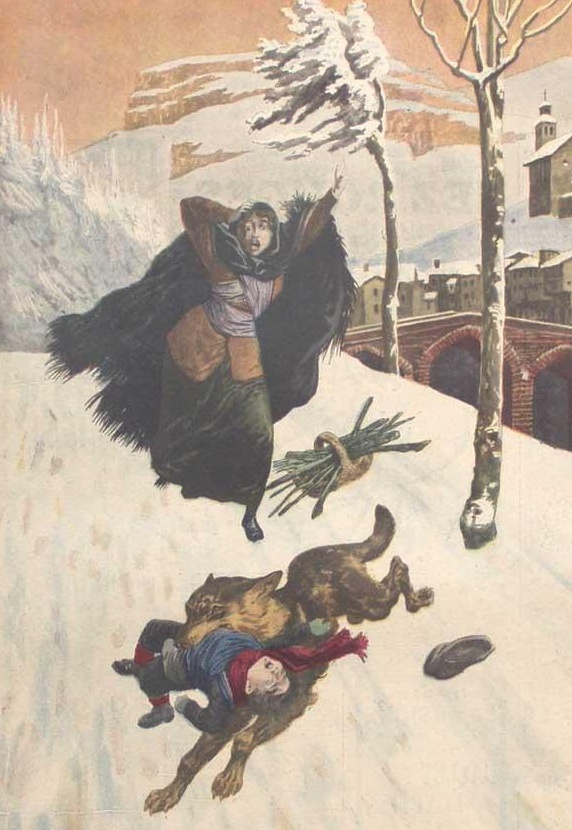
Wolf attack
Wolf attacks are injuries to humans or their property by gray wolves. Their frequency varies based on the human and wolf populations and the interactions of these populations. Wolves, like any predator, choose prey based on circumstances. If a human is juvenile, small, alone or injured this increases the chance of a wolf attack as it would any prey species; a population of both wolves and humans living in the same environment increases the chances of a predatory circumstance occurring. Wolf attacks are rare where human-wolf interactions are rare and escalate as human-wolf interactions escalate. Experts categorize wolf attacks into various types, including rabies-infected, predatory, agonistic, and defensive.
The country with the most extensive historical record is France, where nearly 10,000 fatal attacks were documented from 1200 to 1920. A study by the Norwegian Institute of Nature Research showed that there were eight fatal attacks in Europe and Russia, three in North America, and more than 200 in south Asia in the half-century up to 2002. The updated edition of the study revealed 498 attacks on humans worldwide for the years 2002 to 2020, with 25 deaths, including 14 attributed to rabies.
The gray wolf is the largest wild member of the canid family, with males averaging 43–45 kg (95–99 lb), and females 36–38.5 kg (79–85 lb). It is the most specialized member of its genus in the direction of carnivory and hunting large game.
Although they primarily target ungulates, wolves are at times versatile in their diet; for example, those in the Mediterranean region largely subsist on garbage and domestic animals. They have powerful jaws and teeth and robust bodies capable of great endurance, and often run in large packs. Nevertheless, they tend to fear and avoid humans, especially in North America.
Wolves vary in temperament and their reaction to humans. Those with little prior experience with humans, and those positively conditioned through feeding, may lack fear. Wolves living in open areas, for example the North American Great Plains, historically showed little fear before the advancement of firearms in the 19th century, and would follow human hunters to feed on their kills, particularly bison. In contrast, forest-dwelling wolves in North America were noted for shyness.
Wolf biologist L. David Mech hypothesized in 1998 that wolves generally avoid humans because of fear instilled by hunting. Mech also noted that humans' upright posture is unlike wolves' other prey, and similar to some postures of bears, which wolves usually avoid. He speculated that attacks are preceded by habituation to humans, while a successful outcome for the wolf may lead to repeated behavior, as documented especially in India.
Wolf attacks have been classified as "rabid", "provoked", "predatory"; "exploratory" or "investigative"; or "agonistic".
Cases of rabid wolves are low when compared to other species since wolves do not serve as primary reservoirs, but can be infected with rabies from other animals such as dogs, golden jackals and foxes. Cases of rabies in wolves are very rare in North America, though numerous in the eastern Mediterranean, Middle East and Central Asia. The reason for this is unclear, though it may be connected with the presence of jackals in those areas, as jackals have been identified as primary carriers. Wolves apparently develop the "furious" phase of rabies to a very high degree, which, coupled with their size and strength, makes rabid wolves perhaps the most dangerous of rabid animals, with bites from rabid wolves being 15 times more dangerous than those of rabid dogs. Rabid wolves usually act alone, traveling large distances and often biting large numbers of people and domestic animals. Most rabid wolf attacks occur in the spring and autumn periods. Unlike with predatory attacks, the victims of rabid wolves are not eaten, and the attacks generally only occur on a single day. Also, rabid wolves attack their victims at random, showing none of the selectivity displayed by predatory wolves, though the majority of recorded cases involve adult men, as men were frequently employed in agricultural and forestry activities which put them into contact with wolves.
Hub AI
Wolf attack AI simulator
(@Wolf attack_simulator)
Wolf attack
Wolf attacks are injuries to humans or their property by gray wolves. Their frequency varies based on the human and wolf populations and the interactions of these populations. Wolves, like any predator, choose prey based on circumstances. If a human is juvenile, small, alone or injured this increases the chance of a wolf attack as it would any prey species; a population of both wolves and humans living in the same environment increases the chances of a predatory circumstance occurring. Wolf attacks are rare where human-wolf interactions are rare and escalate as human-wolf interactions escalate. Experts categorize wolf attacks into various types, including rabies-infected, predatory, agonistic, and defensive.
The country with the most extensive historical record is France, where nearly 10,000 fatal attacks were documented from 1200 to 1920. A study by the Norwegian Institute of Nature Research showed that there were eight fatal attacks in Europe and Russia, three in North America, and more than 200 in south Asia in the half-century up to 2002. The updated edition of the study revealed 498 attacks on humans worldwide for the years 2002 to 2020, with 25 deaths, including 14 attributed to rabies.
The gray wolf is the largest wild member of the canid family, with males averaging 43–45 kg (95–99 lb), and females 36–38.5 kg (79–85 lb). It is the most specialized member of its genus in the direction of carnivory and hunting large game.
Although they primarily target ungulates, wolves are at times versatile in their diet; for example, those in the Mediterranean region largely subsist on garbage and domestic animals. They have powerful jaws and teeth and robust bodies capable of great endurance, and often run in large packs. Nevertheless, they tend to fear and avoid humans, especially in North America.
Wolves vary in temperament and their reaction to humans. Those with little prior experience with humans, and those positively conditioned through feeding, may lack fear. Wolves living in open areas, for example the North American Great Plains, historically showed little fear before the advancement of firearms in the 19th century, and would follow human hunters to feed on their kills, particularly bison. In contrast, forest-dwelling wolves in North America were noted for shyness.
Wolf biologist L. David Mech hypothesized in 1998 that wolves generally avoid humans because of fear instilled by hunting. Mech also noted that humans' upright posture is unlike wolves' other prey, and similar to some postures of bears, which wolves usually avoid. He speculated that attacks are preceded by habituation to humans, while a successful outcome for the wolf may lead to repeated behavior, as documented especially in India.
Wolf attacks have been classified as "rabid", "provoked", "predatory"; "exploratory" or "investigative"; or "agonistic".
Cases of rabid wolves are low when compared to other species since wolves do not serve as primary reservoirs, but can be infected with rabies from other animals such as dogs, golden jackals and foxes. Cases of rabies in wolves are very rare in North America, though numerous in the eastern Mediterranean, Middle East and Central Asia. The reason for this is unclear, though it may be connected with the presence of jackals in those areas, as jackals have been identified as primary carriers. Wolves apparently develop the "furious" phase of rabies to a very high degree, which, coupled with their size and strength, makes rabid wolves perhaps the most dangerous of rabid animals, with bites from rabid wolves being 15 times more dangerous than those of rabid dogs. Rabid wolves usually act alone, traveling large distances and often biting large numbers of people and domestic animals. Most rabid wolf attacks occur in the spring and autumn periods. Unlike with predatory attacks, the victims of rabid wolves are not eaten, and the attacks generally only occur on a single day. Also, rabid wolves attack their victims at random, showing none of the selectivity displayed by predatory wolves, though the majority of recorded cases involve adult men, as men were frequently employed in agricultural and forestry activities which put them into contact with wolves.