Recent from talks
Wootz steel
Knowledge base stats:
Talk channels stats:
Members stats:
Wootz steel
Wootz steel is a type of ultra high in carbon crucible steel historically produced in India and Sri Lanka, known for its strength, sharpness, and characteristic banded microstructure. It originated by at least the mid-1st millennium BCE and was widely exported across Asia, the Middle East, and Europe.
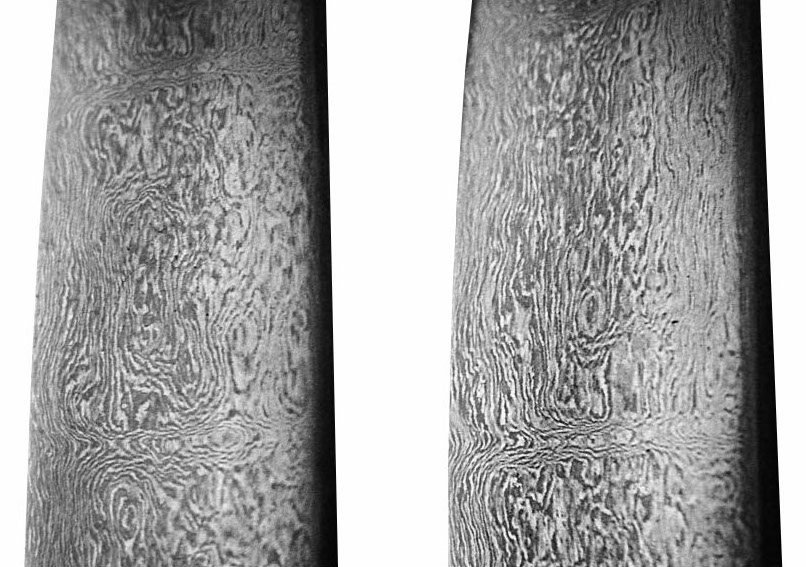
Wootz steel is characterized by high carbon content, typically between 1.0% and 2.0%, and distinctive banding patterns formed by carbide segregation during slow solidification and forging. Historically, wootz steel ingots were exported and forged into Damascus steel blades in the Middle East, which became renowned for their mechanical performance and patterned appearance.
The term wootz is derived from anglicized forms of South Indian words for steel, including Tamil urukku, Kannada ukku, and Telugu ukku, meaning "steel" or "melted metal".
Wootz steel originated in the mid-1st millennium BC in India. It was made in Golconda in Telangana, Karnataka, Tamilnadu and Sri Lanka. The steel was exported as cakes of steely iron that came to be known as "wootz". The method was to heat black magnetite ore in the presence of carbon in a sealed clay crucible inside a charcoal furnace to completely remove slag. An alternative was to smelt the ore first to give wrought iron, then heat and hammer it to remove slag. The carbon source was bamboo and leaves from plants such as Avārai. Locals in Sri Lanka adopted the production methods of creating wootz steel from the Cheras by the 5th century BC. In Sri Lanka, this early steel-making method employed a unique wind furnace, driven by the monsoon winds. Production sites from antiquity have emerged, in places such as Anuradhapura, Tissamaharama and Samanalawewa, as well as imported artifacts of ancient iron and steel from Kodumanal. Recent archaeological excavations (2018) of the Yodhawewa site (in Mannar District) discovered the lower half of a spherical furnace, crucible fragments, and lid fragments related to the crucible steel production through the carburization process. In the South East of Sri Lanka, there were some of the oldest iron and steel artifacts and production processes to the island from the classical period.
Trade between India and Sri Lanka through the Arabian Sea introduced wootz steel to Arabia. The term muhannad مهند or hendeyy هندي in pre-Islamic and early Islamic Arabic refers to sword blades made from Indian steel, which were highly prized, and are attested in Arabic poetry. Further trade spread the technology to the city of Damascus, where an industry developed for making weapons of this steel. This led to the development of Damascus steel. The 12th century Arab traveler Edrisi mentioned the "Hinduwani" or Indian steel as the best in the world. Arab accounts also point to the fame of 'Teling' steel, which can be taken to refer to the region of Telangana, the Golconda region of Telangana clearly being the nodal center for the export of wootz steel to West Asia.
Wootz steel was widely exported and traded throughout ancient Europe and the Arab world, and became particularly famous in the Middle East, with steel manufactured in Kutch (in present-day India) particularly enjoyed a widespread reputation, similar to those manufactured at Glasgow and Sheffield. One sign of the reputation of wootz steel blades has persisted in a Persian phrase – to give an "Indian answer", meaning "a cut with an Indian sword".
Specimens of daggers and other weapons were sent by the Rajas of India to the Great Exhibition in London in 1851 and 1862 International Exhibition. Though the arms of the swords were beautifully decorated and jeweled, they were most highly prized for the quality of their steel. The swords of the Sikhs were said to bear bending and crumpling, and yet be fine and sharp.
Archaeological and metallurgical evidence indicates that crucible steel production associated with wootz steel originated in the Indian subcontinent by at least the mid-first millennium BCE.
Hub AI
Wootz steel AI simulator
(@Wootz steel_simulator)
Wootz steel
Wootz steel is a type of ultra high in carbon crucible steel historically produced in India and Sri Lanka, known for its strength, sharpness, and characteristic banded microstructure. It originated by at least the mid-1st millennium BCE and was widely exported across Asia, the Middle East, and Europe.
Wootz steel is characterized by high carbon content, typically between 1.0% and 2.0%, and distinctive banding patterns formed by carbide segregation during slow solidification and forging. Historically, wootz steel ingots were exported and forged into Damascus steel blades in the Middle East, which became renowned for their mechanical performance and patterned appearance.
The term wootz is derived from anglicized forms of South Indian words for steel, including Tamil urukku, Kannada ukku, and Telugu ukku, meaning "steel" or "melted metal".
Wootz steel originated in the mid-1st millennium BC in India. It was made in Golconda in Telangana, Karnataka, Tamilnadu and Sri Lanka. The steel was exported as cakes of steely iron that came to be known as "wootz". The method was to heat black magnetite ore in the presence of carbon in a sealed clay crucible inside a charcoal furnace to completely remove slag. An alternative was to smelt the ore first to give wrought iron, then heat and hammer it to remove slag. The carbon source was bamboo and leaves from plants such as Avārai. Locals in Sri Lanka adopted the production methods of creating wootz steel from the Cheras by the 5th century BC. In Sri Lanka, this early steel-making method employed a unique wind furnace, driven by the monsoon winds. Production sites from antiquity have emerged, in places such as Anuradhapura, Tissamaharama and Samanalawewa, as well as imported artifacts of ancient iron and steel from Kodumanal. Recent archaeological excavations (2018) of the Yodhawewa site (in Mannar District) discovered the lower half of a spherical furnace, crucible fragments, and lid fragments related to the crucible steel production through the carburization process. In the South East of Sri Lanka, there were some of the oldest iron and steel artifacts and production processes to the island from the classical period.
Trade between India and Sri Lanka through the Arabian Sea introduced wootz steel to Arabia. The term muhannad مهند or hendeyy هندي in pre-Islamic and early Islamic Arabic refers to sword blades made from Indian steel, which were highly prized, and are attested in Arabic poetry. Further trade spread the technology to the city of Damascus, where an industry developed for making weapons of this steel. This led to the development of Damascus steel. The 12th century Arab traveler Edrisi mentioned the "Hinduwani" or Indian steel as the best in the world. Arab accounts also point to the fame of 'Teling' steel, which can be taken to refer to the region of Telangana, the Golconda region of Telangana clearly being the nodal center for the export of wootz steel to West Asia.
Wootz steel was widely exported and traded throughout ancient Europe and the Arab world, and became particularly famous in the Middle East, with steel manufactured in Kutch (in present-day India) particularly enjoyed a widespread reputation, similar to those manufactured at Glasgow and Sheffield. One sign of the reputation of wootz steel blades has persisted in a Persian phrase – to give an "Indian answer", meaning "a cut with an Indian sword".
Specimens of daggers and other weapons were sent by the Rajas of India to the Great Exhibition in London in 1851 and 1862 International Exhibition. Though the arms of the swords were beautifully decorated and jeweled, they were most highly prized for the quality of their steel. The swords of the Sikhs were said to bear bending and crumpling, and yet be fine and sharp.
Archaeological and metallurgical evidence indicates that crucible steel production associated with wootz steel originated in the Indian subcontinent by at least the mid-first millennium BCE.
Recent media