Hubbry Logo
Wrest Point Hotel CasinoWrest Point Hotel CasinoMain
Open search
Wrest Point Hotel Casino
Community hub
Wrest Point Hotel Casino
logo
8 pages, 0 posts
0 subscribers
Be the first to start a discussion here.
Wrest Point Hotel Casino
from Wikipedia

Wrest Point Hotel Casino
Wrest Point Casino logo
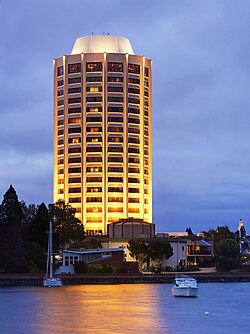
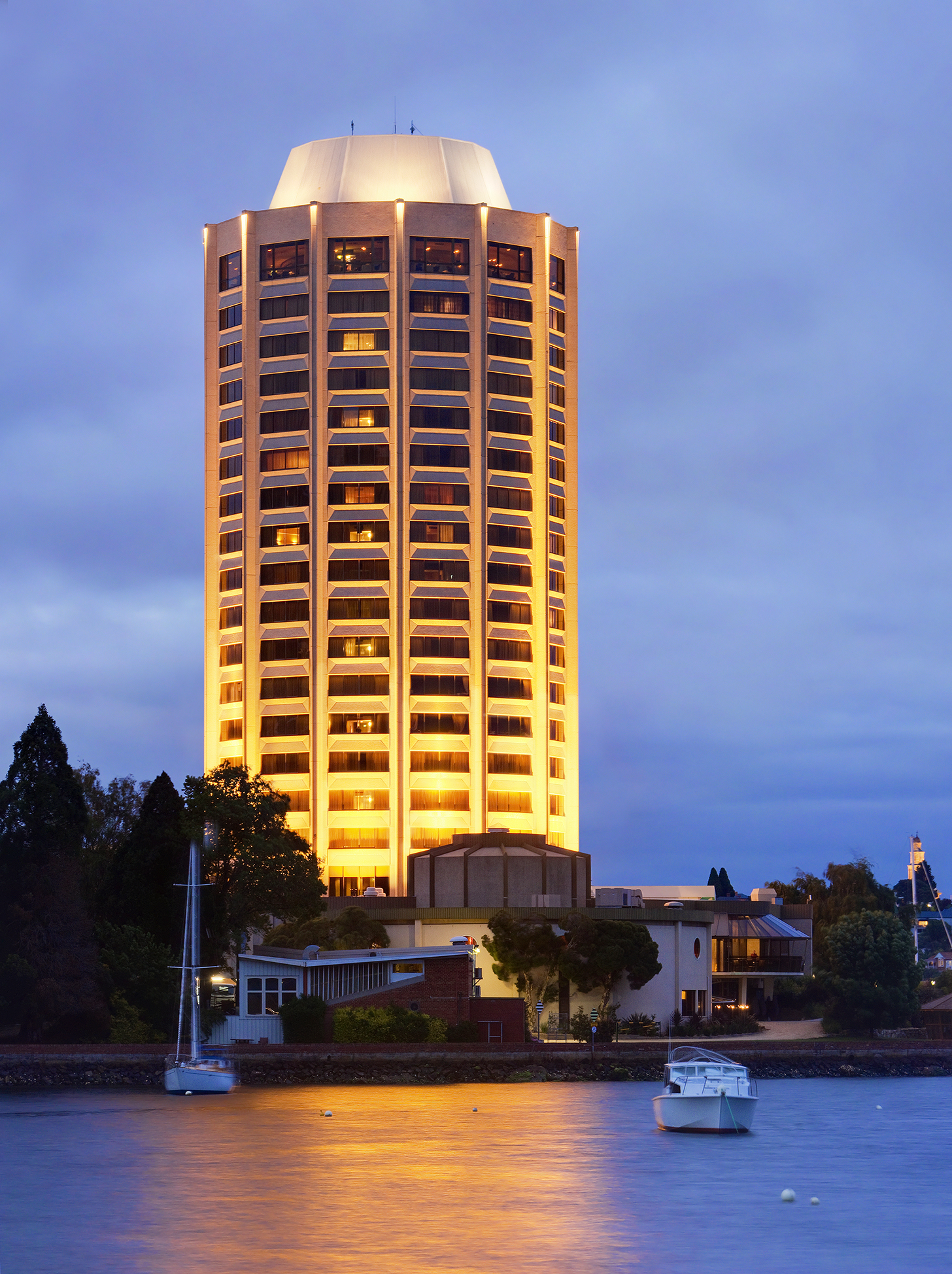
Wrest Point Hotel Casino at night
Map
Interactive map of Wrest Point Hotel Casino
Location Hobart, Tasmania,
Australia
Opening date10 February 1973; 53 years ago (1973-02-10)
No. of rooms269
Notable restaurants5 + 6 bars
Casino typeResort
OwnerFederal Hotels
Operating license holderFederal Group
ArchitectColin Philp (1939)
D. Hartley Wilson (1939)
Roy Grounds (1973)
Coordinates42°54′7″S 147°20′17″E / 42.90194°S 147.33806°E / -42.90194; 147.33806
WebsiteOfficial Site
Place ID7,496[1]
StatusPermanently Registered

The Wrest Point Hotel Casino is a casino in Tasmania. It was Australia's first legal casino, opening in the suburb of Sandy Bay in Hobart, on 10 February 1973. The hotel tower is the tallest building in Hobart as well as Tasmania.

History

[edit]

Historically, Dunkley's Point was a camping ground held by the semi-nomadic Mouheneener people, who held a permanent settlement at nearby Long Beach called kreewer.[2][3] Norfolk Islander Thomas Chaffey constructed his residence on the point between 1808 and 1813, during the British colonisation of Tasmania, which became known as Chaffey's Point by the end of his life. The Traveller's Wrest Hotel, which is still standing today on Sandy Bay Road, was erected by his son William Chaffey in 1836. David Dunkley purchased the Chaffey's Point estate from William Chaffey in 1847. He constructed his residence, St. Helena and renamed the area Dunkley's Point. George G. Robertson purchased St. Helena in 1898 and rebuilt it, adding a jetty and a boat house. Mrs. G. Minette Lucas purchased the estate in 1928 and erected her mansion, known as Wrest Point. The estate was purchased by entrepreneur Arthur James Drysdale in 1936.

Wrest Point Riviera Hotel

[edit]

Designed by architects Colin Philp and David Hartley Wilson, the streamline moderne Wrest Point Riviera Hotel was considered "one of the most modern establishments of its kind in Australia" upon opening on 5 December 1939.[4] 400 guests attended the opening, including Tasmanian Premier Edmund Dwyer-Gray.[5]

Wrest Point Riviera Hotel, 1940s

Built at a cost exceeding £A70,000, the luxurious hotel featured accommodation for 500 patrons. The entirety of Dunkley's Point was also redeveloped, featuring tiered garden beds, a heated saltwater bathing pool, tennis court and a private jetty with a steamboat named Arcadia offering scenic cruises and a yacht named Acushla. Both the pool and tennis courts were walled as a means to protect patrons from undesirably strong winds.[6]

Bathing pool, circa 1940s

During World War II the hotel was "booming" and the hotel was sold to Australia's oldest hotel group, Federal Hotels, in March 1956.[7]

Granting of the casino licence

[edit]

On 14 December 1968, a statewide referendum was held asking voters whether they supported the granting of a casino licence to Wrest Point, conditional on the proposed redevelopment of the hotel. [8] The proposal was approved by with 56% support, and the Wrest Point Casino Licence and Development Act 1968 was subsequently passed by the Tasmanian Parliament.[9]

Development

[edit]

The development of the casino included the construction of the 17-storey hotel tower, with a revolving restaurant, designed by Sir Roy Grounds, a landmark that is nationally identified with Hobart, and the 64-metre (210 feet) dodecagonal prism tower remains the city's tallest building.

In 1984, Federal Group constructed Australia’s first purpose-built convention and entertainment complex on site at a cost of over $20 million, called Wrest Point Convention Centre.[10] Later, in 1996, the construction of the boardwalk was completed.

50Th Anniversary Redevelopment

Between 2018 and 2023, Federal Group undertook a staged redevelopment program at Wrest Point Hotel Casino, completing a renovation project reported to total approximately AUD $65 million to coincide with the property’s 50th anniversary.[11] The redevelopment was implemented progressively across multiple years. In 2018, works included refurbishment of the Point Revolving Restaurant, followed in 2019 by upgrades to tower accommodation and the Boardwalk area. [12] In 2021, renovations extended to the casino facilities, including reconfiguration of the gaming floor and upgrades to associated amenities.[13] Further works undertaken in 2022 included the introduction of new food and beverage venues such as the Longhorn Smokehouse, expansion of the Birdcage Bar, redevelopment of the main reception area, and the establishment of a dedicated lounge for Forte members.[14] The redevelopment program concluded in 2023 with refurbishment of Water Edge and Motor Inn accommodation, upgrades to tower floors one to five, and renewal of mezzanine and corridor areas, completing the multi-stage renewal of Tasmania’s tallest hotel building.[15]

Heritage Listing

[edit]

Wrest Point Hotel Casino was added to the Tasmanian Heritage Register on the basis of its historical, social, and architectural significance, rather than age alone.[16] The Tasmanian Heritage Council assessed Wrest Point as significant because it was Australia’s first legal casino, opened in February 1973, and because of its role in the development of Tasmania’s post-war tourism and hospitality industry.[17] while the Heritage Council’s decision was based on formal heritage criteria, the listing generated mixed public responses, highlighting broader debate about how “heritage” is defined, particularly in relation to modernist architecture and twentieth-century commercial buildings.[18]

[edit]

See also

[edit]

References

[edit]
[edit]
Revisions and contributorsEdit on WikipediaRead on Wikipedia
from Grokipedia
Wrest Point Hotel Casino is a casino resort complex situated in the Sandy Bay suburb of Hobart, Tasmania, Australia. Established on the site of a former hotel dating to 1839, it opened as the nation's first legal casino on 10 February 1973 following a public referendum approving its development. Owned by the Federal Group, Australia's oldest continuously operating hotel company, which acquired the property in 1956, Wrest Point features a 64-metre tower that remains Hobart's tallest building and includes extensive gaming facilities, accommodation, and convention spaces. The casino's advent marked a pivotal expansion of Tasmania's tourism sector, drawing international attention and establishing the state as a pioneer in regulated gambling. While celebrated for its architectural innovation by designer Roy Grounds and contributions to , the venue has been embroiled in debates over the broader impacts of poker machines and Federal Group's dominant position in Tasmania's gaming market, including political influences on licensing since the 1970s.

History

Origins and Pre-Casino Era

The site of what would become Wrest Point Hotel Casino originated with the construction of an inn known as the Traveller's Rest by William Chaffey in 1839, shortly after European settlement in the area. This early establishment catered to travelers in Sandy Bay, , , marking the initial hospitality development on the promontory overlooking the Derwent River. In the early 20th century, the property was acquired by Arthur Drysdale, who redeveloped it into the Wrest Point Riviera Hotel, a luxury Art Deco establishment that opened in 1939. The hotel featured amenities such as a bathing pool and became a prestigious venue, attracting notable guests during the 1940s and 1950s while experiencing a surge in popularity amid World War II demand. Federal Hotels, part of the Federal Group with roots in the 19th-century Company, purchased the Wrest Point Riviera Hotel in March 1956. Under Federal ownership, the hotel continued operations as a key player in Tasmanian , providing accommodations, dining, and event spaces without elements, thereby supporting local economic activity through visitor stays and modest contributions to revenue prior to 1973.

Licensing and Approval Process

The push for Tasmania's first legal originated with Federal Hotels Ltd's proposal to redevelop the Wrest Point Hotel site into a complex, aiming to capitalize on gaming to boost state and revenue. Premier Reece's Labor introduced enabling in 1968, but encountered internal cabinet divisions and opposition from figures like Liberal leader Angus Bethune, who raised concerns over potential social harms and the absence of input. In response, Reece withdrew the bill and committed to a to legitimize the process, framing it as a means to evaluate support for economic diversification amid Tasmania's reliance on limited industries. Tasmanian voters went to the polls on December 14, 1968, with a single question on whether to grant a to Federal Hotels at Wrest Point, marking Australia's inaugural legal approval. The "yes" vote prevailed narrowly at 53% against 47%, reflecting polarized views along political, regional, and religious lines, with proponents emphasizing projected tourism inflows and tax revenues modeled on international precedents like those in . Opponents highlighted risks of gambling addiction and undue favoritism toward a private entity, yet the slim majority enabled swift legislative action. Post-referendum, the Tasmanian Parliament enacted the Wrest Point Casino Licence and Development Act 1968, which formalized the exclusive license to Federal Hotels (later Federal Group) for 25 years, stipulating development commitments in exchange for monopoly gaming rights at the site. This grant sparked debates on monopoly perils—such as reduced stifling innovation—versus incentives for substantial private , with Reece's administration justifying it through anticipated fiscal returns exceeding initial setup costs. The process underscored Tasmania's pragmatic pivot toward gaming as a tool, informed by empirical observations of interstate visitor patterns to non-casino entertainment hubs, though lacking direct Australian comparators at the time.

Construction, Opening, and Early Operations

Construction of the Wrest Point Casino complex began officially in October 1970 on the site of the former Wrest Point Riviera in Sandy Bay, , . The project, developed by the Federal Group, transformed the existing grounds into Australia's inaugural legal casino facility over a two-year period, culminating in completion in 1973. Designed by prominent Australian architect Roy Grounds, the development featured a distinctive 17-storey octagonal tower rising 64 metres, which remains 's tallest building. The tower incorporated modern structural elements, including with steel reinforcements, and included a atop the structure. The gaming floor was integrated into the lower levels, emphasizing secure and controlled access in line with pioneering regulatory standards for legal venues. The casino officially opened on 10 February 1973, marking the debut of legal casino gambling in Australia. Initial gaming offerings centered on table games such as roulette, supported by state-of-the-art security systems to ensure compliance with Tasmania's strict oversight framework. The opening ceremony drew significant attention, highlighting the facility's luxurious amenities including saunas and the panoramic views from the tower. Early operations demonstrated rapid success, with the venue quickly attracting substantial patronage and boosting local as Australia's pioneering destination. Regulatory monitoring by Tasmanian authorities focused on maintaining operational integrity, contributing to the 's role in establishing precedents for controlled expansion nationwide. The immediate influx of visitors underscored the facility's appeal, though precise early revenue figures reflected the nascent industry's emphasis on sustainable growth under government taxation and licensing stipulations.

Ownership Changes and Expansions

The Federal Group, a family-owned entity led by the Farrell family, has retained uninterrupted ownership of Wrest Point Hotel Casino since acquiring the original Wrest Point Hotel site in March 1956. This continuity predates the casino's establishment, with the group securing Tasmania's inaugural casino license in 1973, enabling the transformation of the property into Australia's first legal casino. Post-opening, ownership stability facilitated operational expansions tied to legislated monopoly extensions granted by the , which preserved Federal Group's exclusive rights to casino gaming and, later, poker machines statewide. In the early , these agreements enabled the integration of poker machines into Wrest Point's gaming floor, starting with an initial allocation of 50 machines, as part of broader state initiatives to enhance revenue for amid fiscal pressures. Subsequent ministerial approvals allowed incremental increases in machine numbers and gaming space, aligning with monopoly renewals that bundled gaming rights with commitments to infrastructure investments. These developments under sustained Federal Group control expanded the casino's capacity without altering core ownership, supporting measurable growth in gaming throughput and visitor accommodation utilization through the late , though precise room additions in the remain undocumented in beyond general tourism-driven enhancements.

Facilities and Operations

Hotel Accommodations

The Wrest Point Hotel Casino provides lodging primarily in its 17-story tower, which houses deluxe rooms and suites offering views of the Derwent River or kunanyi/Mount Wellington. The tower accommodates over 200 guests with options including Deluxe Harbour King rooms featuring king beds and river vistas, Deluxe Mountain King rooms oriented toward the mountain, Deluxe Harbour Twin rooms with two queen beds, and Harbour Suites providing separate living areas and enhanced waterfront panoramas. These configurations suit tourists desiring scenic outlooks of Hobart landmarks and business travelers needing convenient access to adjacent convention spaces. Room interiors incorporate modern updates from the $65 million refurbishment completed in 2023, such as timber accents, textured soft furnishings sourced locally, and amenities like LCD televisions, complimentary wireless internet, coffee machines, and en-suite bathrooms with contemporary fixtures. The renovations emphasized comfort and functionality without altering the tower's structural integrity, ensuring waterfront proximity enhances guest experiences. Beyond the tower, supplementary accommodations include the budget-oriented Motor Inn with standard rooms and the Water Edge category offering garden or river views in a four-star setting, expanding capacity to approximately 259 total rooms across the property. All options prioritize accessibility, with features like spacious layouts in accessible king rooms and direct pathways to hotel amenities.

Casino Gaming Offerings

The Wrest Point Casino gaming floor houses nearly 500 electronic gaming machines, spread across the main casino area and the adjacent Boardwalk floor, offering a variety of pokies with denominations starting from one cent per wager. These machines operate daily, with Boardwalk hours from 9am to 3am Sunday through Thursday and until 5am on Fridays and Saturdays, while the main floor runs from noon to 1am on weekdays and extended on weekends. Table games at Wrest Point include , Federal pontoon, (available from 5pm), , and big wheel, with approximately 22 to 25 tables in operation. Tables open from 5pm to 1am Sunday to Thursday and extend to 3am on Fridays and Saturdays, supplemented by rapid roulette starting at 1pm daily. A dedicated poker room hosts and tournaments, featuring Texas Hold'em with a 10% rake capped at $10 per hand on pots over $20. Additional gaming options encompass and TASkeno, accessible from 9am daily. The casino operates under an exclusive license held by the Federal Group, granting it monopoly status for casino-style gaming in , including table games and electronic machines regulated by the Tasmanian Liquor and Gaming Commission. Entry is restricted to individuals aged 18 and over, with strict of identification checks to comply with state laws. VIP gaming areas, including two dedicated rooms, cater to high-stakes players with enhanced privacy and services. All gaming equipment adheres to regulatory standards for fairness, utilizing certified generators monitored by the licensing authority.

Dining, Entertainment, and Additional Amenities

The Wrest Point Hotel features multiple dining outlets emphasizing Tasmanian ingredients alongside international cuisines. The Point , situated on the 17th floor, offers French-inspired with panoramic 360-degree views of the Derwent River and skyline, operating Tuesday through Saturday from 6:00 p.m. Additional venues include Boardwalk Bistro for casual bistro fare with riverfront seating, Kwan Ho Bar for Japanese dishes, Boardwalk Café for lighter meals, and Longhorn Smokehouse for options. These establishments cater to diverse preferences, from buffets at the former Wrest Point Buffet & Coffee Shop to premium cocktails at on-site bars. Entertainment options center on live performances and themed events at dedicated venues like Birdcage Bar, a retro lounge established in the 1970s that hosts cocktail tastings, high tea served in birdcage presentations, and regular live music sessions. The bar features premium cocktails and has been nominated for local awards such as Pulse Tasmania's Best Bar. Broader programming includes comedy shows by acts like Jimmy Carr, magic performances such as Magic Men, and music events like Hindley Street Country Club appearances, drawing crowds for non-gaming nightlife. Conference and event facilities provide 16 versatile spaces, including the Tasman Room auditorium accommodating up to 1,000 guests for galas, symphonies, business conferences, or exhibitions with full theatre-style staging. These amenities support tailored events, from intimate boardroom meetings to large-scale functions, often incorporating adjacent dining areas for hybrid gatherings. The waterfront setting enhances leisure appeal with direct river views, complemented by an indoor pool, sauna, and steam room for relaxation.

Economic Impact

Revenue, Taxation, and State Contributions

Federal Group, operator of Wrest Point Hotel Casino, has delivered consistent tax revenues to the through gaming duties, payroll taxes, land taxes, , and licensing fees. In the 2015–16 financial year, these payments totaled $87.4 million, equivalent to approximately 8.5% of the state's overall . This included gaming taxes levied on casino table games, electronic gaming machines, and operations at Wrest Point and the affiliated Casino, with gross gaming expenditure reaching $235.7 million across Federal Group's casinos that year. Contributions extend to federal obligations, including $21.4 million in net GST from gaming activities, which is redistributed to states via , alongside company taxes and fringe benefits tax totaling $32.8 million. Under Tasmania's casino monopoly framework, these inflows—cumulatively surpassing hundreds of millions since Wrest Point's opening—have provided a reliable fiscal base, insulating state budgets from volatility through fixed licensing structures and percentage-based gaming levies that capture a stable share of operator profits regardless of visitor fluctuations. Such mechanisms direct funds toward public services, yielding economic benefits that offset critiques of concentrated private gains by sustaining expenditures at rates exceeding broader industry averages.

Employment and Tourism Stimulation

The Wrest Point Hotel Casino directly employs approximately 398 staff across its , gaming, and operations roles, positioning it as a significant employer in Hobart's sector. These positions encompass diverse functions, including gaming attendants, services, and administrative support, with the venue serving as a ground for professionals. Indirect employment effects extend to supply chains and ancillary services, contributing to broader job creation in Tasmania's economy through Federal Group's operations, which supported 1,012 indirect positions statewide as of assessments in the early 2020s. Since its opening, Wrest Point has stimulated Hobart's by drawing interstate and international visitors, evidenced by a 50% rise in Tasmania's overall visitor numbers within a decade, culminating in nearly 600,000 annual arrivals by 1983. This influx correlated with heightened hotel occupancy rates and expanded accommodation demand in the region, as the casino's novelty as Australia's first legal gaming venue attracted gamblers and sightseers alike. The casino's catalyzed longitudinal growth in related industries, including increased routes and investments, as new flights and restaurants emerged to accommodate rising volumes. While later competition from additional Tasmanian casinos diluted some , Wrest Point's pioneering role fostered sustained sector confidence and infrastructure development, underpinning Tasmania's evolution into a more diversified destination without reliance on gaming alone.

Social and Regulatory Impacts

Problem Gambling Prevalence and Responsible Gaming Initiatives

Problem gambling prevalence in Tasmania stands at approximately 2.1% for moderate-risk or problem gambling among adults, as estimated in the Fifth Social and Economic Impact Study of Gambling in Tasmania released in July 2021, reflecting a decline from earlier surveys such as the 2008 study. Among individuals seeking gambling support services, 75.5% attributed their issues primarily to electronic gaming machines (EGMs) in hotels and clubs, while only 39.5% cited EGMs in casinos, underscoring a comparatively lower incidence of severe harm linked to casino environments versus community venues. Total poker machine losses in Tasmania exceeded $1 billion from 2018 to mid-2024, with $687 million occurring in non-casino pubs and clubs hosting the majority of the state's approximately 2,300 machines, compared to the fewer EGMs in the two licensed casinos. These figures align with broader patterns where a small subset of at-risk gamblers—estimated at around 2,000 problem gamblers and 6,000 moderate-risk individuals statewide—accounts for a disproportionate share of expenditures, while the vast majority of participants experience no such escalation. Wrest Point Hotel Casino, operated by the Federal Group, implements measures mandated under 's Code of Practice for , including mandatory staff training on recognizing distress signs, pre-commitment options for deposit and time limits, and immediate access to counseling referrals via partnerships with services like Gambling Support . The venue's program allows voluntary bans ranging from 24 hours to lifetime, with over 500 active exclusions reported in Federal Group venues as of recent audits, enforced through facial recognition and database sharing across gaming sites. Compliance with these initiatives is monitored by the Liquor and Gaming Commission, which in its 2020-2021 noted full adherence to harm minimization standards in operations, including restrictions on inducements and targeted at vulnerable groups. These protocols emphasize individual accountability in a regulated activity, countering unsubstantiated narratives of ubiquitous ruin by highlighting that empirical data shows contained risks for the 98% of gamblers who do not develop problems.

Monopoly Structure and Effects on Competition

The Wrest Point Hotel Casino, operated by the Federal Group, has held Tasmania's exclusive casino license since its opening on February 10, 1973, granting it sole authority for table games and related operations in the state. This monopoly structure was extended in 1993 to encompass electronic gaming machines (EGMs, or poker machines) across casinos, clubs, and hotels, allowing Federal Group to own and operate all approximately 3,500 machines statewide under a single deed of agreement with the Tasmanian government. The rationale centered on creating investment incentives through assured revenue predictability, enabling large-scale capital commitments to infrastructure like hotel expansions and tourism facilities without the risks of competitive bidding eroding returns. Proponents of the arrangement argued it facilitated centralized regulatory control, concentrating oversight in fewer venues to mitigate social harms associated with dispersed access, while generating stable tax revenues for the state—estimated at hundreds of millions annually from and EGM operations during the monopoly era. Empirical data supports claims: Tasmania's gambling expenditure as a of household disposable income stood at 1.3% in recent assessments, ranking third-lowest nationally and 0.8 percentage points below the Australian average of 2.1%, indicating no of market saturation or inflated consumer costs under monopoly conditions. EGM density, measured by machines per adult population, has remained stable without exponential growth, challenging narratives of inefficiency by demonstrating consistent output and revenue without competitive pressures driving over-expansion. Critics, including economic analyses, contend the exclusivity stifled potential entrants, potentially reducing innovation in service offerings and pricing, as Federal Group's dominance—controlling over 90% of state gaming revenue—eliminated market discipline. However, causal evidence from the period reveals no verifiable decline in ; investments in Wrest Point's facilities, such as tower expansions, proceeded apace, yielding multipliers without the fragmentation risks of multiple operators fragmenting regulatory . The structure's harm-reduction benefits, via venue concentration, are substantiated by lower-than-average rates tied to EGMs compared to competitive jurisdictions like , where higher venue density correlates with elevated participation risks. Overall, the monopoly's outcomes align more with regulatory pragmatism than anti-competitive detriment, as evidenced by sustained revenue stability and sub-national expenditure benchmarks.

Initial Licensing Disputes

The granting of Australia's first legal license to Federal Hotels for the Wrest Point site in emerged from secretive negotiations between the Tasmanian Labor government under Premier Eric Reece and the company in the late , bypassing open tender processes and raising concerns over favoritism and lack of competition. Critics, including anti- advocates and opposition politicians, highlighted moral risks of introducing casino —such as increased and —as well as the grant of a 25-year monopoly to a single entity without broader evaluation, amid a broader public resistance rooted in Tasmania's conservative social fabric. These disputes reflected tensions between proponents' arguments for tourism-driven revenue in a small and detractors' fears of social decay, with negotiations conducted behind closed doors to secure development commitments like hotel expansion and job creation. To resolve opposition, the government legislated the Wrest Point Casino Licence and Development Act 1968, followed by a public on December 14, 1968, asking voters whether to approve the specific license grant to Federal Hotels; it passed narrowly with 59,053 yes votes (53.4%) against 51,640 no votes, providing democratic legitimacy despite procedural critiques. Allegations of irregularities, including the absence of competitive bidding and opaque deal-making, prompted limited legal scrutiny, but no successful judicial invalidation occurred, as courts deferred to the legislative and outcomes, affirming the process's validity under Tasmanian . This mirrored early casino licensing models globally, such as in , where single-operator monopolies facilitated regulatory control and operational efficiency in nascent industries, prioritizing contained experimentation over fragmented competition. Empirically, the license's implementation proved the pro-casino case through the casino's opening on , 1973, which immediately attracted interstate and international visitors, generating substantial revenue—estimated at millions in initial years—and stimulating Hobart's sector without the catastrophic social harms predicted by opponents. Post-opening data showed Wrest Point contributing to Tasmania's economic diversification, with visitor numbers surging and laying groundwork for the state's gaming sector, causally linking the monopoly structure to focused and state tax inflows that offset early risks. While monopoly concerns persisted, the absence of alternative bidders and the venture's success in boosting GDP without proportional social costs validated the outcome, as evidenced by subsequent national emulation of Tasmania's model.

Role in the 2018 Tasmanian Election

The 2018 Tasmanian state election, held on 3 March, featured poker machine policy as a central contention, with Federal Group's monopoly on supplying machines to non-casino venues drawing scrutiny. Labor, led by Rebecca White, pledged to remove poker machines from pubs and clubs over five years, a reform that would have curtailed Federal's dominant revenue stream from licensing fees, estimated to constitute the bulk of its Tasmanian gaming income. In opposition, the Liberal Party under Premier Will Hodgman defended the status quo, emphasizing economic risks such as potential job losses in hospitality—rhetoric echoed by industry groups warning of up to 1,000 positions at stake—while avoiding commitments to dismantle the monopoly structure. Federal Group contributed significantly to this dynamic through donations; alongside the Tasmanian Hospitality Association, it provided over $500,000 to the Liberals in the year leading to the election, funding campaigns that highlighted Labor's proposal as disruptive to community venues. The Liberals secured victory with 14 seats in the 25-member House of Assembly, forming a with crossbench support and thereby preserving Federal's pub and club licensing arrangement in the immediate term. Critics, including anti-gambling advocates, framed the monopoly as exploitative "plunder," alleging it enabled undue profits from without competition; however, Federal's financials for the year ending June 2018 showed profits nearly doubling to $24.4 million on $543 million revenue, driven by sustained player expenditure rather than isolated policy windfalls, as Tasmanian gaming losses totaled approximately $250 million annually pre- and post-election, indicating persistent market . This outcome underscored voluntary participation in gaming, where monopoly pricing captures consumer surplus amid inelastic from habitual play, rather than coercive extraction unsupported by empirical uptake. Subsequent reforms under the Liberal government introduced limited competition, legislating in 2021 for venues to own or lease machines directly from mid-2023 onward, thereby eroding Federal's supply monopoly for non- sites while exempting operations like Wrest Point, which retained exclusive gaming rights and generated over $448 million in losses from 2018 to 2024. These changes imposed minimal short-term disruption to Federal's revenues, as transition provisions allowed phased implementation and exclusivity buffered core earnings, with overall Tasmanian poker machine expenditure climbing to $178 million in 2021-22 despite the policy shift. The episode highlighted how electoral outcomes, influenced by targeted donations, sustained industry incumbency against radical overhaul, prioritizing stability over immediate antitrust measures in a sector where demand elasticity remained low.

Subsequent Regulatory Challenges and Reforms

In November 2021, the Tasmanian Parliament passed amendments to the Gaming Control Act 1993, reforming the state's gaming licensing structure by ending Federal Group's long-held monopoly on electronic gaming machines (EGMs) outside s, effective from mid-2023. This allowed pubs and clubs to own or lease their own poker machines, eroding the exclusive arrangement established under a 2003 deed that had granted Federal Group control over nearly 3,500 machines statewide. To balance this shift and protect casino core operations, the legislation permitted Federal Group to retain exclusive casino licenses for Wrest Point and Country Club Casino, while reducing the tax rate on EGMs within those venues from 25.8% to incentivize continued investment. Federal Group initially contested the draft reforms, arguing they threatened operational stability, but the changes proceeded amid broader efforts to distribute licensing more competitively without disrupting casino protections. A separate operational challenge arose in April 2021, when a cyber-attack targeted Federal Group's systems, forcing the shutdown of poker machines and hotel booking functions at Wrest Point and Country Club Casino for several days. The company refused to pay the demanded , incurring millions in lost revenue and recovery costs, but resolved the incident without evidence of long-term financial or regulatory fallout, restoring operations through internal cybersecurity measures. The Tasmanian Liquor and Gaming Commission (TLGC) and associated inquiries, including the Fifth Social and Economic Impact Study (SEIS) for 2020–21, supported ongoing regulatory tightening, such as mandatory pre-commitment limits and cashless gaming trials, while noting that these measures had minimal deterrent effects on voluntary participation rates. The SEIS affirmed net economic benefits from gaming after accounting for social costs, informing phased reforms like delayed but advancing pokies pre-commitment cards introduced in stages from 2022. These adjustments emphasized adaptive oversight, with TLGC disciplinary actions—such as censures for compliance lapses at Wrest Point—ensuring accountability without broader structural upheaval.

Recent Developments

50th Anniversary Refurbishments (2022–2023)

In commemoration of its 50th anniversary, owner Federal Group invested approximately $65 million in a comprehensive refurbishment of Wrest Point Hotel Casino, with key phases completed by February 2023. This marked the first total overhaul in the property's 50-year history, targeting the main hotel entry, foyer, historic Birdcage Bar, casino gaming areas, showroom, and guest accommodations. Renovations blended modern updates with heritage elements, including custom carpets, crystal peacock decorations, and expanded lounge spaces in the Birdcage Bar, alongside refreshed interiors in harbour-view suites featuring updated furnishings and bathrooms. New amenities introduced during the project included the Longhorn Smokehouse restaurant, an American-style venue with an open wood-fired grill emphasizing Tasmanian beef and seasonal produce, which opened in late 2022. Gaming floors were reconfigured into spaces, enhancing the casino's layout while preserving its waterfront integration. The grand reopening on February 6, 2023, highlighted these changes, coinciding with the original 1973 opening date. Funded entirely by private capital from Federal Group, the refurbishment demonstrated operator-driven preservation of an aging , yielding positive reviewer assessments of refreshed aesthetics, spacious rooms with panoramic views, and competitive pricing starting at $179 per night, which bolstered the venue's draw for tourists and locals. Such investments maintained operational viability amid evolving demands, without external fiscal support.

Ongoing Operations and Future Outlook

As of 2024, Wrest Point Hotel Casino maintains daily operations, with gaming floors accessible from morning hours until 3:00 a.m. on weekdays and 5:00 a.m. on weekends, complemented by ongoing live such as music performances and shows to attract patrons. Post-COVID recovery has been evidenced by substantial growth in Tasmania's gaming sector, including a statewide increase of 55.91% in poker machine for the 2023–24 financial year, reflecting heightened patronage amid broader economic rebound and lifted restrictions. The casino's adherence to responsible gaming measures includes programs and spending limits, aligning with Tasmania's regulatory framework that caps annual poker machine expenditure at AU$5,000 unless opted out. Problem gambling prevalence in Tasmania remains low, with the state's most recent social and economic impact study reporting a rate drop to under 1% among adults, supporting the stability of operations despite national trends of rising participation. This contrasts with elevated losses—totaling over AU$1.14 billion on poker machines since 2018—but underscores that harm levels have not escalated proportionally to revenue, which funds state dependencies including . Looking ahead, Wrest Point's integration with Tasmania's sector positions it for sustained viability, leveraging the island's visitor growth and Federal Group's hospitality expansions, such as redevelopments, to enhance waterfront appeal without major announced overhauls. However, prospective overregulation, including delayed mandatory carded play for pokies originally slated for , risks undermining revenue streams critical to the local economy, given stable harm metrics and the casino's monopoly status. from low problem persistence suggests that balanced policies preserving operational flexibility would better sustain its economic niche than stringent caps, which have yet to demonstrably reduce harms in comparable jurisdictions.

References

Add your contribution
Related Hubs
User Avatar
No comments yet.