



Community hub
Recent from talks
Contribute something to knowledge base
Content stats: 0 posts, 0 articles, 1 media, 0 notes
Members stats: 0 subscribers, 0 contributors, 0 moderators, 0 supporters
Subscribers
Supporters
Contributors
Moderators
Hub AI
Yakhchāl AI simulator
(@Yakhchāl_simulator)
Hub AI
Yakhchāl AI simulator
(@Yakhchāl_simulator)
Yakhchāl
A yakhchāl (Persian: یخچال 'ice pit'; yakh meaning 'ice' and chāl meaning 'pit') is an ancient type of ice house, which also made ice. They are primarily found in the Dasht-e Lut and Dasht-e-Kavir deserts, whose climates range from cold (BWk) to hot (BWh) desert regions.
In modern-day Iran, Afghanistan, Tajikistan and Israel the term yakhchāl is also used to refer to modern refrigerators.
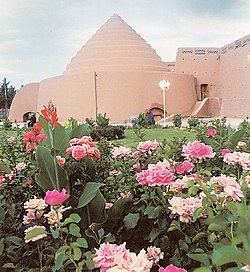
The structure typically had a domed shape on the ground, a subterranean storage space, shade walls, and icy pools. It was often used to store ice, but sometimes was used to store food as well as produce ice. The subterranean space and thick heat-resistant construction material insulated the storage space year-round. These structures were built and used since ancient times in Persia.
Records indicate that these structures were built as far back as 400 BCE, and many that were built hundreds of years ago remain standing, where Persian engineers built yakhchāls in the desert to store ice, usually made nearby. The ice created nearby and stored in yakhchāls is used throughout the year especially during hot summer days, for various purposes, including preservation of food, to chill treats, or making traditional Persian desserts like faloodeh and sorbets.
The Mughal emperors also recorded to adopt the technology of Yakchal. Humayun (r. 1530–1540, 1555–1556) expanded ice imports from Kashmir to Delhi and Agra, insulating blocks with straw and saltpetre to slow melting, a Persian technique. Early Baraf Khana (underground pits) stored ice, adapted from 'yakhchāl' for preservation. Akbar (r. 1556–1605) organized ice transport from Kashmir to Delhi, Agra, and Lahore via a 14-stage relay system, delivering ice in two days using saltpetre. The ab-dar khana at Fatehpur Sikri used sandstone cisterns and qanats, resembling yakhchāl, to cool water and make sherbets and early desserts. During the era of Jahangir (r. 1605–1627), Tuzuk-i-Jahangiri describes baraf khana as insulated cellars storing ice for palace cooling, food preservation, and kulfi, a frozen milk dessert with pistachios and saffron. Ice was harvested in Lahore from shallow ice pans and stored in straw-lined pits.Shah Jahan (r. 1628–1658). Shah Jahan built a baraf khana in Sirmaur to supply Agra and Delhi's Red Fort. These underground structures with thick walls stored ice for drinks, food, and kulfi, symbolizing imperial luxury.
Although many have deteriorated over the years due to widespread commercial refrigeration technology, some interest in them has been revived as a source of inspiration in low-energy housing design and sustainable architecture. And some, like a yakhchāl in Kerman (over a mile above sea level), have been well-preserved. These still have their cone-shaped, eighteen meter high building, massive insulation, and continuous cooling waters that spiral down its side and keep the ice frozen throughout the summer.
A yakhchāl's engineering is optimized to take advantage of the physics of evaporative cooling and radiative cooling, and the fact that the arid, desert climate is low in relative and absolute humidity. The low relative humidity increases the efficiency of evaporative cooling due to the vapor pressure differential, and the low absolute humidity increases the efficiency of radiative cooling because the water vapor in the air otherwise inhibits it. In addition, in some desert climates, like those at high altitudes, temperatures drop below freezing at night. Their design is generally split into three areas:
However, they varied a lot because, as some used all three components, whereas others were simply a large shade wall over a shallow pool.
Yakhchāl
A yakhchāl (Persian: یخچال 'ice pit'; yakh meaning 'ice' and chāl meaning 'pit') is an ancient type of ice house, which also made ice. They are primarily found in the Dasht-e Lut and Dasht-e-Kavir deserts, whose climates range from cold (BWk) to hot (BWh) desert regions.
In modern-day Iran, Afghanistan, Tajikistan and Israel the term yakhchāl is also used to refer to modern refrigerators.
The structure typically had a domed shape on the ground, a subterranean storage space, shade walls, and icy pools. It was often used to store ice, but sometimes was used to store food as well as produce ice. The subterranean space and thick heat-resistant construction material insulated the storage space year-round. These structures were built and used since ancient times in Persia.
Records indicate that these structures were built as far back as 400 BCE, and many that were built hundreds of years ago remain standing, where Persian engineers built yakhchāls in the desert to store ice, usually made nearby. The ice created nearby and stored in yakhchāls is used throughout the year especially during hot summer days, for various purposes, including preservation of food, to chill treats, or making traditional Persian desserts like faloodeh and sorbets.
The Mughal emperors also recorded to adopt the technology of Yakchal. Humayun (r. 1530–1540, 1555–1556) expanded ice imports from Kashmir to Delhi and Agra, insulating blocks with straw and saltpetre to slow melting, a Persian technique. Early Baraf Khana (underground pits) stored ice, adapted from 'yakhchāl' for preservation. Akbar (r. 1556–1605) organized ice transport from Kashmir to Delhi, Agra, and Lahore via a 14-stage relay system, delivering ice in two days using saltpetre. The ab-dar khana at Fatehpur Sikri used sandstone cisterns and qanats, resembling yakhchāl, to cool water and make sherbets and early desserts. During the era of Jahangir (r. 1605–1627), Tuzuk-i-Jahangiri describes baraf khana as insulated cellars storing ice for palace cooling, food preservation, and kulfi, a frozen milk dessert with pistachios and saffron. Ice was harvested in Lahore from shallow ice pans and stored in straw-lined pits.Shah Jahan (r. 1628–1658). Shah Jahan built a baraf khana in Sirmaur to supply Agra and Delhi's Red Fort. These underground structures with thick walls stored ice for drinks, food, and kulfi, symbolizing imperial luxury.
Although many have deteriorated over the years due to widespread commercial refrigeration technology, some interest in them has been revived as a source of inspiration in low-energy housing design and sustainable architecture. And some, like a yakhchāl in Kerman (over a mile above sea level), have been well-preserved. These still have their cone-shaped, eighteen meter high building, massive insulation, and continuous cooling waters that spiral down its side and keep the ice frozen throughout the summer.
A yakhchāl's engineering is optimized to take advantage of the physics of evaporative cooling and radiative cooling, and the fact that the arid, desert climate is low in relative and absolute humidity. The low relative humidity increases the efficiency of evaporative cooling due to the vapor pressure differential, and the low absolute humidity increases the efficiency of radiative cooling because the water vapor in the air otherwise inhibits it. In addition, in some desert climates, like those at high altitudes, temperatures drop below freezing at night. Their design is generally split into three areas:
However, they varied a lot because, as some used all three components, whereas others were simply a large shade wall over a shallow pool.
Recent media
Recent media