



Community hub
Recent from talks
Contribute something
Nothing was collected or created yet.
Yamaha OPL
View on Wikipedia | This article has multiple issues. Please help improve it or discuss these issues on the talk page. (Learn how and when to remove these messages)
|


The OPL (FM Operator Type-L) series is a family of sound chips developed by Yamaha. It consists of low-cost sound chips providing FM synthesis for use in computing, music and video game applications.
The OPL series of chips enabled the creation of affordable sound cards for IBM PC compatibles in the late 1980s such as the AdLib and Sound Blaster, effectively becoming a de-facto standard until they were supplanted by "wavetable synthesis" cards in the early-to-mid 1990s.
Internal operation
[edit]![[icon]](https://en.wikipedia.org/wiki/File:Wiki_letter_w_cropped.svg) | This section needs expansion with: less technical description of operation, sourced from a reliable source. You can help by adding to it. (January 2024) |
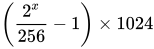
The internal operation of the chips is completely digital. Each FM-tone is generated by a digital oscillator using a form of direct digital synthesis. A low-frequency oscillator and an envelope generator drive an FM operator to produce floating-point output for the DAC. Decapsulation of the chips shows two look-up tables, one for calculating exponents and one for log-sine.[1] This allows the FM operator to calculate its output without any multipliers, using the formula and two 256-entry look-up tables. Both tables are stored as pairs of values rounded to the nearest whole number, with the second value represented as the difference between it and the first value.
![{\displaystyle \exp[\log \sin[\varphi _{2}+\exp[\log \sin[\varphi _{1}]+A_{1}]]+A_{2}]}](https://wikimedia.org/api/rest_v1/media/math/render/svg/1a8ade11559f0fad2b0c07df021f1fa0d284a812)
A quarter of the log-transformed sine waveform is stored as a sampled approximation in a 256-word read-only memory (ROM) table, computed by for values of 0 to 255. The rest of the sine-waveform is extrapolated via its property of symmetry. Scaling the output of an oscillator to a wanted volume would normally be done by multiplication, but the YM3526 avoids multiplications by operating on log-transformed signals, which reduces multiplications into computationally cheaper additions.[2]

Another 256-word ROM stores the exponential function as a lookup table, used to convert the logarithmic scale signal back to linear scale when required, as the final stage where the oscillator-outputs are summed together (just prior to the DAC-output bus), with the modulator waveform always delayed by one sample before the carrier waveform.[3] This table is computed by for values of 0 to 255. To compute the exponent, 1024 is added to the value at the index given by the least significant byte of input; this becomes the significand and the remaining bits of input become the exponent of the floating point output.
Chips in the series
[edit]OPL
[edit]
The YM3526, a.k.a. OPL (and sometimes as OPL1), was the first chip in the OPL family introduced in 1984, providing a nine channel, two operator synthesizer. A very closely related chip is the Y8950, or MSX-AUDIO, which was used as an MSX expansion. It is essentially a YM3526 with ADPCM recording and playback capability.
The circuit has 244 different write-only registers. It can produce 9 channels of sound (or 6 channels with 5 percussion instruments available), each made of two oscillators. Each oscillator can produce sine waves and has its own ADSR envelope generator. Its main method of synthesis is frequency modulation synthesis, accomplished via phase modulation of the phase of one channel's oscillators by the output of another.
The YM3526's output, a sequence of floating point numbers clocked at a sampling frequency of approximately 49716 Hz, is sent to a separate digital-to-analog converter (DAC) chip, the YM3014B. This DAC chip was also used on other FM chips such as the YM2151 and YM2203.
Overview of a channel's registers:
For the whole channel:
- Main frequency (10 bits)
- Octave (3 bits)
- Note on/off
- Synthesis mode (FM or just additive)
- Feedback (0–7, the modulator modulating itself)
For each one of the two oscillators:
- Frequency multiply (can be set to 1⁄2, 1 to 10, 12 or 15)
- Waveform (Sine)
- Volume (0–63, logarithmic)
- Attack, decay, sustain, release (4 bits each, logarithmic)
- Tremolo (on or off)
- Vibrato (on or off)
- Sustain (on or off)
- Envelope scaling per key (on or off)
- Volume scaling per key (0–3)
There are also a few parameters that can be set for the whole chip:
- Vibrato depth
- Tremolo depth
- Percussion mode (uses 3 channels to provide 5 percussion sounds)
- Composite sine mode (see Oscillator sync)
OPL2
[edit]
The YM3812, a.k.a. OPL2, was the second member of the OPL family, released in 1985. It is an improved version of the YM3526, and was backwards compatible with the former alongside its variant, the Y8950 or MSX-AUDIO. Another related chip is the YM2413 (OPLL), which is a cut down version of the YM3812.
Among its newly-added features is the ability to pick between four waveforms for each individual oscillator by setting a register. In addition to the original sine wave, three modified waveforms can be produced: half-sine waves (where the negative part of the sine is muted), absolute-sine waves (where the negative part is inverted), and pseudo-sawtooth waves (quarter sine waves upward only with silent sections in between). This odd way of producing waveforms give the YM3812 a characteristic sound.[5]
Limited to two-operator FM synthesis, the YM3812 is unable to accurately reproduce timbres of real instruments and percussive sounds unlike other FM chips. Melody polyphony is limited to nine voices in melodic mode and six voices in percussive mode.[6]: 27.14–17.16 The YM3812 is used with an external YM3014B monophonic DAC chip to output its audio in analog form, like with the YM3526.
Having little competition on the market at the time of introduction of Adlib and Sound Blaster in the late 1980s, the chip became the de-facto standard for "Sound Blaster compatible" sound cards.[6]: 27.14
-
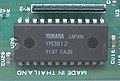 Yamaha YM3812 (OPL2 chip)
 -
 Creative Labs and other companies often hid the original Yamaha labels
 -
 Yamaha YM3812-F SMD (surface mount OPL2 chip)
 -
 Decapsulated YM3812, showing the die surface


OPL3
[edit]
The YMF262, a.k.a. OPL3, was the third member of the OPL family, released in 1990.[7][a] It is an upgraded version of the YM3812, which improves on the feature-set of its predecessor while also notably including the ability to use four-operator FM synthesis. This makes the YMF262 produce more harmonically richer sound than that of its predecessors, similar to contemporary consumer synthesizer keyboards of the time such as the Yamaha DX100.[6]: 27.16
The following features were added:[8]
- twice as many channels (18 instead of 9)
- simple stereo (hard left, center or hard right)
- 4 channel sound output
- 4 new waveforms (alternating-sine, "camel"-sine, square and logarithmic sawtooth)
- 4 operator mode, pairing 2 channels together to create up to six 4 operator FM voices
- reduced latency for host-register access (the OPL2 had much longer I/O access delays)
- subtle differences in the sine-wave lookup table and envelope generator to YM3812 (e.g. the modulator waveform on YM3812 is delayed by one sample, whereas both carrier and modulator waveforms on OPL3 are properly synchronized)[3]
The YMF262's FM synthesis mode can be configured in different ways:[6]: 27.16–27.18 [8]
- Its basic mode provides 18 two-operator FM channels.
- One setting, common with the rest of the OPL line, converts 3 of the FM channels into a 5-channel percussion set.
- Another setting, introduced with this chip, causes 12 of the channels to be paired up into six four-operator channels. This trades in polyphony for more complex sound formation.
- These two settings above can be used separately or in conjunction, resulting in four total modes:
- 18 2-operator channels
- 15 2-operator channels + 5 drum channels (drum setting on)
- 6 2-operator channels + 6 4-operator channels (4-op setting on)
- 3 2-operator channels + 6 4-operator channels + 5 drum channels (both settings on)
The four-operator mode allows two channels with two operators to be combined into one single channel with four operators, which can then be used to generate sound using eight of the 31 possible algorithms.
The YMF262 also removed support for the seldom-used CSM (Composite sine mode) mode that was present on the YM3526 and YM3812,[3] which was equivalent to triggering multiple channels simultaneously. Like its predecessors, the OPL3 outputs audio in digital form, requiring an external DAC chip such as the specially-made YAC512.
The YMF262 was used in the revised Sound Blaster Pro, Sound Blaster 16, AdLib Gold, Media Vision’s Pro AudioSpectrum cards, and Microsoft’s Windows Sound System cards.[4]: 45 Competing sound chip vendors (such as ESS,[9] OPTi,[10] Crystal[11] and others) have also designed their own OPL3-compatible audio chips, with varying degrees of faithfulness to the original OPL3.
-
 Yamaha YMF262 (OPL3 chip, manuf. year 1994)
 -
 Decapsulated YMF262, showing the die surface


Yamaha YMF289
[edit]The YMF289 (OPL3-L) is a fully compatible, low-power variant of the YMF262 released in 1995, targeting PCMCIA sound cards and laptop computers.[12] It was also used in some Sound Blaster 16 sound cards made by Creative Technology.
The YMF289 is fully register-compatible with and retains the feature-set of the YMF262, with a number of differences:[12]
- Supports 5 or 3.3 volt operation.
- The registers can be read or written by the host CPU, whereas on the YMF262 they are write-only.
- 44,100 Hz (44.1 kHz) output sample rate.
- A power-down mode is added.
- Somewhat smaller overall footprint, including DAC, compared to a full YMF262 implementation.
- 33.868 MHz input clock, compared to the 14.32 MHz input clock used for the YMF262.
- Internal linear interpolator.
The YMF289B is paired with a YAC513 or YAC516 companion floating-point DAC chip, like the YMF262.
-
 Yamaha YMF289B and companion YAC516 DAC

ESS ESFM
[edit]ESS Technology's in-house developed derivative, termed ESFM, is an enhanced 72-operator OPL3-compatible clone incorporating two operating modes, a Native mode and a Legacy mode, which controls its feature-set and behavior.[9] In Native mode, ESFM allows 18 4-operator FM voices to be mapped, each with per-operator frequency control and LFO depth,[13] potentially allowing for a significant increase in the complexity of tones generated. The drivers for Windows 9x incorporate their own custom instrument patches which make use of this extended mode. Conversely, Legacy mode provides full backward-compatibility with Yamaha's YMF262.[9] ESFM's output in this mode is moderately faithful to the YMF262 overall, but some tones are rendered quite differently, resulting in unique distortions in the sound and music of some games.
ESFM is available in ESS sound chips starting with the ISA-based ES1688 AudioDrive, up to the PCI-based ES1946 Solo-1E, whereas earlier chips required an external FM synthesizer chip (typically a Yamaha YMF262). ESS's Maestro series of PCI-based sound chips rely on a software implementation of FM synthesis that lacks ESFM's special features.
-
 The ES1869F is one of several ESS-developed sound chips which incorporate their unique ESFM function.

OPL3-SA, DS-XG, OPL4
[edit]Yamaha's later PC audio controllers, including the YMF278 (OPL4), the single-chip Yamaha YMF718/719S, and the PCI YMF724/74x family, included the YMF262's FM synthesis block for backward compatibility with legacy software. See YMF7xx for more information.
-
 Yamaha OPL YMF715B-S chipset

Products using the OPL series
[edit]The YM3526 was notably used in a Commodore 64 expansion, the Sound Expander, as well as several arcade games, such as Terra Cresta and Bubble Bobble. A modified version of the YM3526 with ADPCM audio known as the Y8950 (MSX-AUDIO) was used in the MSX computer as an optional expansion.
The YM3812 saw wide use in IBM PC-based sound cards such as the AdLib, Sound Blaster and Pro AudioSpectrum (8bit),[14] as well as several arcade games by Nichibutsu, Toaplan and others.
The YM2413 was used in the FM Sound Unit expansion for the Sega Mark III and the Japanese model Sega Master System, as well as the MSX-MUSIC standard, which was released both as separate enhancement cards (such as the Panasonic FM-PAC) and built-in into several MSX2+ and the MSX TurboR computers. It was also used in some arcade games by Atari, SNK and Alpha Denshi, among others.
The YMF262 was used in many IBM PC-based sound cards, firstly with the popular Sound Blaster Pro 2 in 1991 and then later with the Sound Blaster 16 ASP in 1992, as well as the Pro AudioSpectrum (16bit).[14] Later models of the Sound Blaster 16 and Sound Blaster AWE series integrated the OPL3 with other chips, with Creative Labs using an OPL3 clone chip, the CQM, integral with other chips in later models from late 1995.[15] It is also used in several arcade games by Tecmo and others.
The YMF278 was used in the Moonsound card for the MSX, as well as the Sound Edge card by Yamaha for IBM PC compatibles.
Synthesizers
[edit]Synthesizers that use the YM3812:[16]
- Yamaha PSR-11 49-keys 16-sounds (1986)
- Yamaha PSR-12 49-keys 32-sounds (1987)
- Yamaha PSR-21 49-keys 16-sounds, 2 steps sliders (1986)
- Yamaha PSR-22 49-keys 32-sounds, 2 steps sliders (1987)
- Yamaha PSR-31 61-keys 16-sounds, additional YM3301 chip[17] for drums (1986)
- Yamaha PSR-32 61-keys 32-sounds, additional YM3301 chip[17] for drums (1987)
- Yamaha PSS-360 49 mini-keys 21-sounds, 5 steps sliders, low-cost mono version of PSS-460 (1986)
- Yamaha PSS-460 49 mini-keys 21-sounds, 5 steps sliders (1986)
- Yamaha PSS-470 49 mini-keys 21-sounds, 5 steps sliders (1987)
- Yamaha PSS-560 49 mini-keys 21-sounds, 5 steps sliders, additional YM3301 chip[17] for drums (1986)
- Yamaha PSS-570 49 mini-keys 21-sounds, 5 steps sliders, additional YM3301 chip[17] for drums (1987)
Synthesizers that use the YM2413 (cost reduced YM3812):[16]
- Yamaha PSR-6 49-keys 100-sounds (1994)
- Yamaha PSS-140 37 mini-keys 100-sounds (1988); the PSS-140 actually uses the YM2420, a slightly modified variant of the YM2413 with different registers[18]
- Yamaha PSS-170 44 mini-keys 100-sounds (1986)
- Yamaha PSS-270 49 mini-keys 100-sounds (1986)
Variants and derivatives
[edit]An open-source RTL implementation of the OPL3 was written in SystemVerilog and adapted to an FPGA in 2015.[19]
Notes
[edit]- ^ Many sources claim that the YMF262 (OPL3) was released in 1988, however this is erroneous, as this relates to the copyright year printed on the reference manual of the chips.
See also
[edit]References
[edit]- ^ "Adlib / OPL2 / YM3812 – iki.fi/o". 11 January 2009.
- ^ "OPLx decapsulated". Google Docs.
- ^ a b c "Data". dev.kewl.org. Retrieved 2021-10-07.
- ^ a b c Leinecker, Richard C (1994). Making noise : creating sounds on your PC. New York: M & T Books. ISBN 1558513868.
- ^ Sanglard, Fabien (2019). "3.6.2. Music". Game Engine Black Book: Wolfenstein 3D. Software Wizards. p. 95.
- ^ a b c d Keyes, Jessica (1997). The Ultimate multimedia handbook. New York: McGraw Hill. ISBN 978-0-07-034530-0.
- ^ "Nuked OPL3 emulator". VOGONS. Retrieved 2024-02-09.
- ^ a b "YMF262 datasheet" (PDF). www.fit.vutbr.cz. Archived from the original (PDF) on 2003-05-20. Retrieved 2021-10-07.
- ^ a b c "Manual" (PDF). ftp.alsa-project.org. Archived from the original (PDF) on 2020-05-21. Retrieved 2021-10-07.
- ^ "82C925(100QFP) PDF Datasheet - OPTi Technologies, Inc". www.datasheets360.com.
- ^ "Archived copy" (PDF). gd.tuwien.ac.at. Archived from the original (PDF) on 6 February 2018. Retrieved 15 January 2022.
{{cite web}}: CS1 maint: archived copy as title (link) - ^ a b "Info" (PDF). doc.chipfind.ru. Retrieved 2021-10-07.
- ^ "esfm". www.github.com.com. Retrieved 2020-07-07.
- ^ a b "Ad-Lib Sound Card for the Parallel Port". 13 December 2017 – via www.youtube.com.
- ^ "PC audio for luddites". flaterco.com.
- ^ a b "Meet the little-known "Soundblaster" Keyboards". The 8-Bit Guy, Youtube. August 2015. Retrieved 19 August 2015.
- ^ a b c d "Edward D-tech, Yamaha Chips, YM series". Edward D-tech. Archived from the original on 16 May 2016. Retrieved 25 January 2016.
- ^ "The Yamaha PSS-140 - a vintage keyboard that sounds like a Sound Blaster card". Preece Music, Youtube. 3 January 2024. Retrieved 16 January 2024.
- ^ "opl3_fpga". September 28, 2021 – via GitHub.
External links
[edit]- http://www.oplx.com/ OPL series programming info
- MIDIbox FM, a YMF262-based DIY synthesizer
- AdlibTracker.net Adlib Tracker II (YMF262-Tracker)
- RAD Reality Adlib Tracker (YMF262-Tracker)
- An YMF262 emulator with an online player for OPL3 music.
- OPLx decapsulated (a reverse engineering report)
- OPL3_FPGA GitHub Reverse engineered OPL3 in an FPGA
- Analysis of the OPL3 math
- Nuked-OPL3 YMF262 emulator
Yamaha OPL
View on GrokipediaOverview and History
Development and Origins
The OPL series marked Yamaha's strategic entry into affordable FM synthesis chips during the mid-1980s, driven by the need for compact, low-cost audio solutions in consumer electronics. The series began with the YM3526 (OPL), released in 1984 by Yamaha's LSI division, providing 9 channels of 2-operator FM synthesis with sine waves only.[3] This was followed by the YM3812, designated as OPL2 (FM Operator Type-L II), released in 1985 as an upgrade. The YM3812 maintained the 9-channel architecture but added selectable waveforms, supporting 9-channel polyphony for melodic voices (or 6 melodic plus 5 percussion instruments in rhythm mode), all while minimizing external components compared to earlier discrete FM implementations used in arcade hardware.[5][2][7] Designed primarily for the Japanese market, the YM3812 targeted applications in personal computers and teletext systems like CAPTAIN, enabling richer sound generation in compact devices without the high costs of multi-chip setups.[5][8] Its architecture facilitated the transition of arcade-style audio to home computing, where space and budget constraints were paramount, allowing developers to port games more feasibly by integrating FM capabilities directly into motherboards or add-on cards. The YM3526 similarly saw use in devices like the Commodore 64 Sound Expander and early arcade cabinets.[3] The chip's adoption extended to Western markets through early sound card pioneers, notably AdLib, which integrated the YM3812 into its 1987 Music Synthesizer Card for IBM PC compatibles. This move standardized FM audio for PC gaming, further reducing hardware overhead for arcade-to-home ports and establishing the OPL as a cornerstone of 1980s digital sound.[2][9]Key Innovations and FM Synthesis Basics
The Yamaha OPL series pioneered low-cost FM synthesis for digital sound generation, utilizing phase modulation between operators to create rich harmonics from simple sine waves, eliminating the need for waveform storage in memory. This approach, rooted in John Chowning's foundational work on FM but optimized for hardware efficiency, allows the chips to produce a wide range of timbres including bells, brass, and percussion by modulating one operator's phase against another. Unlike additive or subtractive synthesis, FM in OPL generates sidebands that add complexity to the spectrum, enabling compact yet expressive audio for early personal computers and game consoles.[10][11] At the core of OPL's FM synthesis is a two-operator structure per channel: the modulator operator influences the carrier operator by adding its output to the carrier's phase accumulator, effectively implementing phase modulation (PM) misnamed as frequency modulation (FM) in Yamaha's terminology. The modulator does not produce audible sound directly; instead, only the carrier's output is heard, modulated to create harmonic overtones based on the frequency ratio between the operators. The original OPL (YM3526) supported 9 monophonic channels, each with 2 operators for a total of 18 operators and sine waveforms only, while the OPL2 (YM3812) added 4 selectable waveforms; later variants like OPL3 (YMF262) double this to 18 channels or mix with percussion modes for enhanced polyphony.[11][12][4][3] The fundamental output equation for a basic 2-operator FM/PM pair is: where is the carrier amplitude, is the carrier frequency, is the modulator frequency (typically an integer multiple of ), and is the modulation index determining sideband strength. Phase accumulates via frequency ratios, with the modulator's sine output scaled by before addition.[10][11] Key synthesis parameters shape the sound's character and include frequency control via F-number and block settings to tune pitch across octaves; amplitude modulation (AM) sensitivity for depth of vibrato or tremolo; keyboard scaling to adjust volume and envelope based on note velocity and range; and waveform selection from four sine-derived options (e.g., sine, half-sine, absolute sine, double sine) in OPL2, expanding to eight in OPL3, all generated from compact logarithmic sine tables in ROM for efficient computation without multipliers. These parameters allow programmatic timbre design, balancing computational cost with musical versatility in resource-constrained environments.[11][12]Technical Architecture
Internal Operation Principles
The internal operation of Yamaha OPL chips revolves around the coordinated activity of phase generators, envelope generators, and mixing stages within each operator to produce and shape FM-synthesized audio in real time. Sound generation begins with the phase generator, which computes waveform phases for sine table lookup. This component features a 10-bit phase accumulator that increments based on frequency parameters, enabling precise pitch control. The increment value derives from 10-bit fine tuning (F-number, 0-1023) and 3-bit coarse tuning (block/octave, 0-7) registers, with the effective frequency calculated as approximately F-Num × 2^block / 2^20 relative to the chip's internal sampling rate of ~49.7 kHz, allowing for standard musical intervals and detuning capabilities.[4][13] Following phase advancement, the envelope generator modulates the operator's output amplitude across four stages: attack, decay, sustain, and release (ADSR). It employs exponential curves to mimic acoustic instrument behaviors, where amplitude decreases nonlinearly over time for realism. Each stage's rate is set via 4-bit values (0-15), with 0 indicating the slowest or no change and 15 the fastest transition; sustain uses a 4-bit level (0 for full amplitude to 15 for ~ -93 dB attenuation). These rates interact with key-scaling factors based on note pitch, dynamically adjusting envelope durations—shorter for higher notes—to conserve processing resources and enhance timbral variation. The generator outputs a scaled value that multiplies the sine wave sample, gating the signal from key-on to key-off events.[4][13] Operator outputs feed into a flexible mixing system that combines signals for channel-level synthesis. In base configurations (e.g., YM3812 OPL2), two operators per channel support additive or FM modes, where one operator modulates the phase of the other before mixing. OPL3 (YMF262) extends this to 4-operator modes, offering algorithmic variations such as parallel (independent 2-operator pairs summed) and serial (cascaded modulation, e.g., op1 modulates op2, whose output modulates op3, with op4 as final carrier) to create richer harmonics and textures. All channel outputs accumulate into a stereo or mono mix, processed at the chip's sampling rate. The entire system runs on a master clock of 3.58 MHz (NTSC-derived) or 4.43 MHz (PAL-derived), divided by 72 to yield ~50 kHz samples, with the final waveform converted via an integrated 8-bit DAC for analog output or provided as unsigned 8-bit digital values.[4][13]Operator and Channel Structure
The core building block of Yamaha OPL chips is the operator, a self-contained unit responsible for generating sinusoidal waveforms and applying modulation effects central to FM synthesis. Each operator comprises a phase generator that produces the base frequency using a 10-bit counter and lookup table for sine wave approximation, a modulator for frequency or amplitude adjustments, an envelope generator (EG) for shaping the sound's amplitude over time through attack, decay, sustain, and release stages, and an amplitude/phase modulator to control output level and apply effects like feedback or vibrato.[14] These components enable flexible tone creation within the constraints of selectable waveforms—1 (sine only) for the original OPL (YM3526), 4 for OPL2 (YM3812), and 8 for OPL3 (YMF262)—and fixed logarithmic scaling for volume.[14][4] Channel organization in the OPL series centers on polyphonic voice allocation using paired operators for algorithmic FM synthesis. The original OPL (YM3526) supports 9 channels, each configured with 2 operators in either serial (modulator-carrier for FM) or parallel (additive) modes, yielding 18 operators total for melodic voices.[14] The OPL3 (YMF262) expands this architecture through dual register banks, doubling capacity to 18 channels and 36 operators while maintaining backward compatibility, allowing mixtures of 2-operator and 4-operator configurations for enhanced expressiveness.[15][4] Programming access to operators and channels occurs via a standardized register interface, implemented as a 256-byte address space mapped to I/O ports 0x388 through 0x38B in typical PC applications. Writes involve selecting an 8-bit register address at port 0x388 (also the status read port) followed by data at port 0x389, enabling real-time parameter updates for frequency, envelopes, and modulation without interrupting synthesis.[14] The status register at 0x388 provides flags for busy state, timers, and interrupts, ensuring synchronized host-chip communication.[14] Fixed hardware elements enforce specific polyphony limits and specialized modes across the series. In the OPL3, the 36 operators are flexibly allocated, with rhythm mode repurposing 5 channels (derived from channels 7-9 in the first bank) for percussion instruments including bass drum (using 2 operators), snare drum, tom-tom, top cymbal, and hi-hat (each using 1 operator), supplemented by a noise generator for realism while reducing melodic channels to 6.[15] This percussion configuration, inherited from earlier OPL variants, prioritizes drum emulation efficiency over full polyphony.[14]Chips in the Series
OPL (YM3526)
The Yamaha YM3526, known as the original OPL (FM Operator Type-L), is a frequency modulation (FM) synthesis sound chip released in 1984.[2] It was housed in a 24-pin DIP package and operated on a 5 V power supply, with typical power consumption around 100 mW, making it suitable for integration into compact computer peripherals of the era.[16] The chip supported master clock frequencies of 3.58 MHz (for NTSC systems) or 4.43 MHz (for PAL systems), enabling real-time audio generation for early digital sound applications.[17] As the foundational model in the OPL series, it provided low-cost FM sound synthesis without the need for extensive external components. Key features of the YM3526 include 9 melodic channels, each utilizing 2 operators for FM synthesis, allowing for the generation of complex tones through modulation between operators.[2] In rhythm mode, this configuration could be reallocated to 6 melodic channels plus 5 dedicated rhythm channels, supporting a basic percussion kit consisting of bass drum, snare drum, tom-tom, top cymbal, and hi-hat sounds generated via shared operators.[3] The chip employed only sine waveforms and 2-operator FM algorithms, limiting synthesis depth compared to later models, and featured built-in vibrato and tremolo effects for tonal variation. It was designed for mono audio output, interfacing directly with external DACs like the YM3014 for analog conversion.[2] The YM3526's limitations, including sine-only waveforms and no support for additional timbres or 4-operator synthesis, positioned it for cost-sensitive applications such as the Commodore 64 Sound Expander and early arcade games like Bubble Bobble.[3][2]OPL2 (YM3812)
The Yamaha YM3812, known as the OPL2 (FM Operator Type-L2), is a frequency modulation (FM) synthesis sound chip released in 1985.[2] It was housed in a 24-pin DIP package and maintained pin compatibility with the YM3526 to facilitate easy integration into existing designs. The chip operates at a clock speed of 3.58–14.32 MHz and outputs mono audio via an integrated 10-bit DAC interface, supporting applications in personal computers and embedded audio systems. Key enhancements in the OPL2 include selectable waveforms for greater timbral variety, including sine, half-sine (negative portions clamped to zero), absolute sine, and quarter sine (alternating positive/negative pulses). These additions expand the expressive range of FM synthesis beyond the original OPL's sine-only limitation, allowing for more nuanced instrument emulation without requiring significant hardware changes. It supports 9 melodic channels of 2-operator FM synthesis, or 6 melodic plus 5 rhythm instruments, with built-in vibrato, tremolo, and a basic percussion kit. The OPL2 ensures backward compatibility with original OPL software by defaulting to sine-only waveforms unless explicitly enabled otherwise, detectable via a dedicated status register that reports feature availability. This detection mechanism permits applications to query the chip's capabilities at runtime, adapting as needed. The OPL2 gained widespread adoption as the core FM synthesizer in the AdLib sound card (1987) and Creative Labs' Sound Blaster series (starting 1989), where it powered music and sound effects in thousands of PC games with its distinctive metallic timbre.[2]OPL3 (YMF262)
The Yamaha YMF262, known as the OPL3 (FM Operator Type-L3), represents the evolution in the OPL series, released in 1990 as an enhanced FM synthesis chip designed for stereo audio applications. Architecturally, it incorporates two YM3812 (OPL2) dies within a single 24-pin SOP package (YMF262-M variant) using silicon gate CMOS technology, effectively doubling the synthesis capacity to support 18 channels of 2-operator FM or a mix of 6 four-operator channels and 6 two-operator channels, yielding up to 18-voice polyphony in standard 2-operator mode or 12 voices when fully utilizing four-operator configurations. This design builds on the OPL2's foundation by extending the register set to 256 locations with a second bank for additional channels, enabling access while maintaining backward compatibility with prior OPL chips. The chip operates on a 5V single supply and interfaces with external components like the YAC512 stereo DAC for output.[15][2][6] A core advancement of the OPL3 is its native support for four-operator algorithms per channel, which pairs adjacent channels to create more intricate FM timbres through configurable modulation paths (FM-FM, FM-AM, AM-FM, AM-AM), enhancing harmonic complexity beyond the two-operator limitation of earlier models. Each operator features eight selectable waveforms—including sine, half-sine, quarter-sine, absolute sine, and additional variants—for greater sonic versatility and improved quality in melody and percussion generation. The chip also includes a dedicated rhythm section that expands on previous designs, utilizing channels 13-16 to produce five percussion instruments (bass drum, snare drum, tom-tom, top cymbal, and hi-hat) simultaneously, enabling configurations like 15 two-operator melody voices plus rhythm support. Additional features encompass a low-frequency oscillator (LFO) for vibrato and tremolo effects, two programmable timers for synchronization, and reduced latency in register access compared to the OPL2, facilitating faster real-time control in embedded systems. Stereo output is achieved via separate left and right channels, plus two auxiliary outputs, providing four-channel audio capability overall.[15][3] The OPL3 gained prominence through its integration into PC sound cards, most notably the Creative Labs Sound Blaster 16 series launched in 1992, where it served as the primary FM synthesizer for music and sound effects in DOS-era gaming and multimedia applications. Some implementations, such as advanced Sound Blaster variants, paired the YMF262 with a dedicated MIDI UART (like the UART6850) for hardware-level MIDI processing, allowing direct connection to external controllers and sequencers without software overhead. This combination made the OPL3 a staple in mid-1990s computing, powering iconic titles like Doom and contributing to the era's distinctive chiptune aesthetic.[18][19]Advanced Variants
OPL3 Derivatives (YMF289, ESFM)
The YMF289, designated as OPL3-L, represents Yamaha's low-power adaptation of the OPL3 (YMF262) synthesizer, introduced in the mid-1990s for integration into battery-constrained devices such as notebook computers and PCMCIA Type II sound cards.[20] This derivative retains the core FM synthesis architecture of the OPL3, providing register-level compatibility with both the YMF262 and earlier YM3812 (OPL2), enabling seamless support for existing software while optimizing for reduced power consumption through features like a power-down mode and selectable 5 V or 3.3 V operation.[20] Available in compact 44-pin or 48-pin QFP packages, the YMF289 supports up to 18 two-operator voices or 6 four-operator voices in stereo output at 44.1 kHz, making it suitable for portable audio applications without introducing new synthesis paradigms beyond the OPL3's capabilities.[20] In the context of Yamaha's broader OPL3-SA family, the YMF289 served as a foundational FM component, integrated into multi-function chips like the YMF701 to combine OPL3-compatible synthesis with additional PCM sample playback via a built-in 16-bit Sigma-Delta stereo CODEC.[21] The OPL3-SA variants, such as the YMF701 in its 100-pin QFP package, preserved the YMF289's FM core for 18-voice polyphony while adding support for programmable sample rates up to 48 kHz and compressed formats including IMA ADPCM, A-Law, and μ-Law, thus extending OPL3 functionality into hybrid FM/PCM environments for Sound Blaster Pro and Windows Sound System compatibility.[21] This integration emphasized efficiency for PC sound cards, though the YMF289 itself focused solely on FM without native wavetable features, relying on external DAC interfaces like YACS 16 for output.[20] ESS Technology's ESFM (Enhanced Sound Font Music) emerged as a licensed OPL3 clone developed in-house during the early 1990s, embedded within the company's AudioDrive ES-1xxx series chips—such as the ES1688, ES1868, and ES1879—for cost-effective integration into ISA sound cards aimed at DOS-based gaming and multimedia.[22] As a register-compatible superset of the OPL3, ESFM expands on the original's 36 operators to 72 operators across 20 voices, operating in dual modes: a Legacy (emulation) mode that mirrors OPL3 timing and registers for backward compatibility via standard I/O ports (e.g., 388h–38Bh), and a Native mode that enables advanced configurations like more than six four-operator voices for richer tonal complexity.[22] This design prioritized low-cost PC integration, often pairing ESFM with 16-bit stereo CODECs and MPU-401 UART interfaces in single-chip solutions compliant with Sound Blaster Pro standards.[22] While ESFM achieves high fidelity in Legacy mode, it introduces minor implementation tweaks for AudioDrive optimization, resulting in subtle sonic variances from genuine Yamaha OPL3 chips, particularly in timbre rendering and note sustain.[23] Notably, ESFM omits certain Yamaha-specific registers present in the OPL3 for specialized effects, which can lead to partial incompatibility with software relying on those features, though its superset nature ensures broad adherence to OPL3 protocols in typical DOS gaming scenarios.[23] These adaptations made ESFM a popular choice for budget sound cards, enhancing FM synthesis accessibility without requiring discrete OPL3 hardware.[22]OPL3-SA, OPL4, and DS-XG
The OPL3-SA (YMF701), introduced around 1995, represents an integrated evolution of the OPL3 by combining its 18-channel FM synthesis capabilities with an 8-channel ADPCM decoder for sample-based playback, enabling hybrid audio generation on single-chip solutions for PC sound cards.[2] This addition of ADPCM support allowed for basic digital audio decoding alongside FM tones, enhancing compatibility with Sound Blaster Pro 2 standards while maintaining OPL3's register compatibility for backward support of earlier OPL variants.[18] The chip also incorporated a 16-bit stereo CODEC, MPU-401-compatible MIDI interface, and joystick port, making it suitable for multimedia applications in ISA-based systems.[21] Building on this integration trend, the OPL4 (YMF278B), released in 1994, advanced the architecture by merging an 18-channel FM synthesizer compatible with the OPL3 with a 24-channel wavetable synthesis engine using Advanced Wave Memory (AWM) technology, for a combined polyphony of up to 42 voices (18 FM + 24 wavetable).[3] The FM section remained fully compatible with OPL3 registers and supported 4-operator algorithms, while the wavetable component handled up to 512 samples stored in external ROM (typically 2-4 MB), sampled at 16-bit/44.1 kHz resolution, to produce General MIDI-compliant sounds.[24] Designed for embedded and add-in card use, the OPL4 featured six analog output channels and direct connectivity to floating D/A converters like the YAC513, facilitating high-fidelity stereo output in compact devices.[25] To extend the OPL4's functionality toward modern MIDI standards, Yamaha developed DS-XG as a software driver and protocol extension, adding XG-mode support with enhanced effects processing including 11 reverb types, 11 chorus types, and 42 variations, alongside multi-part multitimbrality for richer soundscapes.[26] This extension enabled OPL4-equipped hardware to emulate full XG tone generation, blending FM and wavetable voices with dynamic effects sends via MIDI controllers, and was used in products like the Yamaha Sound Edge sound card and the MSX MoonSound cartridge.[2] The OPL4 thus served as the final hardware iteration in Yamaha's OPL lineage emphasizing dedicated FM synthesis, preceding the broader industry transition to software-defined audio processing in the late 1990s.[2]Applications and Products
PC Sound Cards and Adapters
The AdLib Music Synthesizer Card, released in August 1987, was the first widely adopted PC sound card to incorporate a Yamaha OPL chip, specifically the YM3812 (OPL2), enabling frequency modulation (FM) synthesis for music and sound effects in DOS-based applications.[27][9] Priced at $219.99, it established FM synthesis as a de facto standard for PC gaming and multimedia, supporting 9 channels of polyphonic sound and inspiring widespread software compatibility.[28] Creative Labs entered the market with the original Sound Blaster card in late 1989, featuring the YM3812 OPL2 chip for AdLib-compatible FM synthesis alongside digitized audio capabilities via an 8-bit DAC and CMS chip emulation.[29] The Sound Blaster Pro, launched in 1990, enhanced this with dual YM3812 OPL2 chips to provide stereo FM output and 18 channels total, broadening support for richer audio in games and applications.[29] By 1992, the Sound Blaster 16 introduced the YMF262 OPL3 chip, doubling channels to 18 for full stereo FM while maintaining backward compatibility through DOS drivers that emulated prior Sound Blaster modes.[30][31] Other early ISA cards included the Covox Sound Master II, an 8-bit card from 1990 that integrated the YM3812 OPL2 for FM synthesis with an 8-bit mono DAC for sampled audio, targeting budget-conscious gamers seeking Sound Blaster-like functionality.[32] The MediaVision Thunder Board, released in 1991, also employed an OPL2 chip for 11-voice FM support and 8-bit mono playback at 22 kHz, positioning itself as a cost-effective alternative in the competitive early 1990s market.[33] These OPL-based cards dominated PC audio throughout the late 1980s and early 1990s, powering the majority of DOS games with affordable FM synthesis until the 1994 release of the Sound Blaster AWE32, which shifted toward wavetable synthesis via the EMU8000 chip for more realistic instrumentation.[34][35] This era's hardware established FM as the cornerstone of PC gaming sound, influencing software development and market standards before digital sample-based alternatives gained prominence.[36]Synthesizers and Music Devices
The Yamaha OPL series chips were integrated into several entry-level synthesizers and music devices, enabling affordable FM synthesis for home musicians and early digital composition. These implementations prioritized simplicity and compatibility, often combining OPL-generated voices with basic accompaniment features to support amateur music production. The Yamaha PSR-11, released in 1986, marked one of the earliest dedicated synthesizers employing the YM3812 (OPL2) chip, delivering 9 voices of 2-operator FM synthesis across 16 preset sounds and featuring MIDI implementation for connectivity with external controllers and sequencers.[7] This portable keyboard, with its 49 full-size keys, provided users with vibrato, tremolo, and rhythm accompaniment, making FM tones accessible beyond professional studio environments. Subsequent models like the PSR-12 (1987) expanded to 32 sounds while retaining the same core OPL2 architecture for consistent tonal character.[7] In the late 1980s and 1990s, the OPL chips powered various models in Yamaha's PSR and PSS home keyboard series, integrating FM voices for melodic and percussion elements alongside auto-accompaniment. Devices such as the PSR-31 (1991) and PSS-470 (1987) utilized the YM3812 for up to 21 sounds, often pairing it with dedicated drum chips like the YM3301, to create versatile setups for hobbyists exploring digital music creation.[7] These keyboards emphasized ease of use, with built-in rhythms and one-touch playback, contributing to the popularity of FM synthesis in consumer-grade music tools during the era. Early music production software also leveraged OPL chips for composition, particularly through DOS-based trackers that targeted PC sound cards equipped with YM3812 or YM3816 hardware. Scream Tracker, developed in the early 1990s, supported OPL2 FM synthesis with 9 melodic channels, allowing users to create multi-layered arrangements by assigning instruments to operators and incorporating effects like pitch slides and volume envelopes.[37] This software facilitated the production of chiptune-style tracks, bridging hardware limitations with creative sequencing and influencing demoscene music culture. The widespread adoption of OPL-equipped PC sound cards further amplified such software's reach, enabling composers to prototype ideas transferable to dedicated MIDI devices.Game Consoles and Embedded Uses
The Yamaha YM2413, known as the OPLL and a low-cost variant of the OPL2 (YM3812) within the broader OPL family, was integrated into the MSX-Music standard introduced in 1987 to provide FM synthesis capabilities for MSX home computers. This chip enabled nine melodic channels or six melodic plus five percussion channels, supporting enhanced audio in software designed for the platform. Konami extensively utilized the YM2413 in their MSX games, such as titles from the Kukeiha Club collection, to deliver richer soundtracks that leveraged its FM synthesis for memorable chiptune compositions.[38][39][40] In video game consoles, the Sega Genesis (known as Mega Drive outside North America), released in 1988, incorporated the YM2612 chip, a Yamaha FM chip from the OPN series sharing foundational operator-based FM synthesis principles with the OPL series, delivering six channels of 4-operator FM synthesis for dynamic game audio. This integration allowed for versatile sound design in titles like Sonic the Hedgehog, where the chip's capabilities produced the console's signature metallic and percussive tones. Unlike the 2-operator focus of core OPL chips, the YM2612's design expanded on FM principles to suit the console's multimedia demands.[41][42] Arcade hardware also adopted related Yamaha FM chips for cost-effective audio. The Namco System 2 board, debuted in 1987, featured the Yamaha YM2151 (OPM) as its primary FM chip, providing 8-channel synthesis with 4 operators per channel for immersive soundscapes in games such as World Stadium '89. This setup combined FM with custom PCM playback, influencing arcade audio standards by blending efficiency with expanded polyphony.[43] Beyond consoles, OPL chips found use in embedded systems for compact audio generation. Mobile devices, including Japanese cell phones from the late 1990s and 2000s, employed OPL-based variants like the Yamaha MA-1 and MA-2 series, which were nearly identical to the YMF262 (OPL3) and used for polyphonic ringtones and simple chiptunes. These chips enabled lightweight FM synthesis in resource-constrained environments, such as portable gadgets and electronic toys, where their low power and small footprint supported basic melodic playback without dedicated DACs.[44]Legacy and Derivatives
Influence on Digital Audio
The Yamaha OPL series of FM synthesis chips became the de facto standard for digital audio in DOS-era personal computers, powering the soundtracks and effects in countless games through their integration into ubiquitous sound cards like the AdLib and Sound Blaster. Released starting with the YM3812 (OPL2) in 1985, these chips provided efficient, low-cost frequency modulation synthesis capable of generating up to 9 melodic voices plus percussion, making them ideal for resource-constrained systems. This widespread adoption established OPL as the baseline for PC multimedia audio, influencing MIDI protocols by enabling direct hardware control for sequenced music; many games used OPL-compatible drivers to approximate General MIDI instrument mappings, ensuring portability across FM-equipped hardware before full wavetable adoption.[2][10] Culturally, the OPL chips played a pivotal role in shaping the chiptune genre, a style of electronic music rooted in the limitations and timbres of early computer sound hardware. Their bright, metallic tones—produced via algorithmic modulation of sine waves—defined the auditory identity of 1990s PC gaming, as heard in seminal titles like Doom (1993), where composer Bobby Prince leveraged OPL3 for its intense, driving tracks, and The Secret of Monkey Island (1990), whose adventurous scores captured the era's whimsical yet gritty sound palette. These examples not only popularized chiptune as a nostalgic subgenre but also inspired later demoscene and remix communities to explore OPL's expressive range, blending retro aesthetics with modern production.[45][46] The technical legacy of OPL extends into contemporary digital audio through software emulations that preserve its algorithmic efficiency. The expiration of foundational FM synthesis patents in 1995—stemming from John Chowning's original work licensed to Yamaha—freed developers to create open-source recreations, leading to VST plugins like discoDSP's OPL, which faithfully models the YM3812 and YM262 chips for use in digital audio workstations. This paved the way for software-based FM synthesis in tools supporting chiptune production, allowing producers to integrate OPL-style timbres into genres from electronic to retro-inspired sound design without proprietary restrictions.[10][47][48] By the mid-1990s, OPL's dominance waned as wavetable synthesis gained prominence, offering superior realism through sampled waveforms that better emulated acoustic instruments and aligned with emerging General MIDI standards. Integrated into advanced sound cards like the Sound Blaster AWE32, wavetable technology provided 32-voice polyphony and richer timbres, rendering FM's abstract sounds less competitive for mainstream applications. Nevertheless, OPL experienced a revival in retro computing circles during the 2010s and beyond, fueled by enthusiast projects such as USB-based OPL3 interfaces and archival music collections, which sustain its use in authentic DOS emulation and new chiptune compositions.[49][46]Modern Emulations and Clones
In the post-2000 era, software emulations of Yamaha OPL chips have played a key role in preserving and recreating the distinctive FM synthesis sounds from 1980s and 1990s computing. DOSBox, an x86 PC emulator first released in 2002, integrated OPL3 emulation from its inception to faithfully reproduce audio in DOS games, supporting the YMF262 chip's stereo and four-operator capabilities for accurate playback on modern hardware. Advancements in emulation accuracy followed, with the open-source Nuked OPL3 emulator emerging in 2015 as a cycle-accurate implementation of the YMF262, achieving bit-perfect output compared to physical chips through reverse-engineered register behavior and timing.[50] This emulator has been widely adopted in projects like MAME for arcade audio fidelity, DOSBox Staging for enhanced DOS gaming, and DOSBox-X for extended compatibility, replacing less precise earlier cores.[51] Hardware recreations, particularly FPGA-based clones, have enabled low-latency, hardware-accelerated OPL synthesis in retro computing platforms since the 2010s. The MiSTer FPGA project incorporates OPL3 emulation in its ao486 core, simulating a 1990s PC environment; a 2024 update introduced a new FPGA implementation derived from detailed reverse engineering, improving timing precision and resource efficiency on the DE10-Nano board.[52][53] The 2020s have seen OPL technology revived in creative and accessible formats, including web-based tools and modular hardware for chiptune and experimental synthesis. Emulators like opljs, a JavaScript library wrapping DOSBox's OPL3 core, leverage the Web Audio API to generate authentic FM sounds in browsers, facilitating chiptune composition and online playback without native plugins.[54] Similarly, DIY Eurorack modules incorporating original YM3812 (OPL2) chips or FPGA equivalents have emerged, allowing integration of classic OPL tones into modern modular synthesizers for live performance and sound design.[55]References
- https://doomwiki.org/wiki/OPL_emulation