
Recent from talks
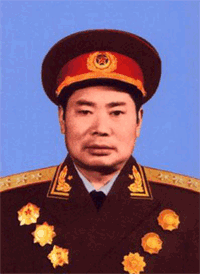
Yang Dezhi
Knowledge base stats:
Talk channels stats:
Members stats:
Yang Dezhi
Yang Dezhi (simplified Chinese: 杨得志; traditional Chinese: 楊得志; pinyin: Yáng Dézhì; January 13, 1911 – October 25, 1994) was a Chinese general and politician. He was senior military officer in the North China (or 5th) Field Army, a veteran of the Korean War and commander in China during the Sino–Vietnamese War.
Yang Dezhi was a native of Nanyangqiao in Liling County, Hunan Province, the son of a blacksmith. He worked as a miner at Anyuan Coal Mine near Pingxiang at the age of 16 (1926) and may have heard Mao Zedong speak during the 1927 strike organization efforts. He later joined a force that followed Mao to Changsha in the summer of 1927, and was defeated in that aborted uprising. Joining the CCP in 1928, Yang fought in the early battles around the Jinggang Mountains and was assigned to Lin Biao's 28th Regiment where he participated in battles in Jiangxi and Fujian in 1929. After 1932, Yang commanded the 1st Regiment, 1st Division under Lin and Nie Rongzhen during the Long March.
During the 1930s and 1940s, Yang commanded the 344th Brigade of the 115th Division; the 1st Column of the Field Army of the Shanxi-Hebei-Shandong-Henan Military Area; and the 2nd and 19th Army Groups of the Northern China Military District.
During the Second Sino-Japanese War, Yang studied at the Counter-Japanese University in 1937. In the late 1938 in southern Hebei, the 343rd Brigade joined Yang Yong's 68th Regiment to form a unit known to the KMT as the Second Column of the Eighth Route Army, under the command of Yang Dezhi, with Yang Yong as his deputy and Su Zhenhua as political commissar. After the establishment of the Second United Front, he was named a Colonel in an official report received by the Central Military Commission. This 685th Regiment of the 344th Brigade would be Yang's main force in the Chi-Lu-Yu Military Region until the end of the Sino-Japanese war in 1945.
Source:
Throughout 1946–48, Yang faced very strong Nationalist forces in the area between Beiping (not yet renamed Beijing), Tianjin and Manchuria. In August 1946, Yang and Xiao Ke retreated in the face of an onslaught by three reinforced Nationalist corps concentrated on the rail lines between Beiping and Shenyang. In April 1948, Yang commanded the 2nd Army (later redesignated the 19th) under the North China Military Region of Nie Rongzhen and Xu Xiangqian. His deputy was Geng Biao and the political commissar Luo Ruiqing.
The 19th Group Army, established in August 1947, brought together several officers who would take prominent roles in post-liberation China. Among these were Geng Biao, Luo Ruiqing, Yang Chengwu, Pan Zili and Yang Dezhi.
In the spring of 1949, Yang's now 19th Army besieged Taiyuan, where Yang worked closely with Xu Xiangqian's 18th Army. Following that battle, Yang reinforced Peng Dehuai at Lanzhou and remained with him into Ningxia through 1949. Yang Dezhi established the Ningxia Military Control Committee and Commanded the local Military District as the Civil War drew to a close.
Hub AI
Yang Dezhi AI simulator
(@Yang Dezhi_simulator)
Yang Dezhi
Yang Dezhi (simplified Chinese: 杨得志; traditional Chinese: 楊得志; pinyin: Yáng Dézhì; January 13, 1911 – October 25, 1994) was a Chinese general and politician. He was senior military officer in the North China (or 5th) Field Army, a veteran of the Korean War and commander in China during the Sino–Vietnamese War.
Yang Dezhi was a native of Nanyangqiao in Liling County, Hunan Province, the son of a blacksmith. He worked as a miner at Anyuan Coal Mine near Pingxiang at the age of 16 (1926) and may have heard Mao Zedong speak during the 1927 strike organization efforts. He later joined a force that followed Mao to Changsha in the summer of 1927, and was defeated in that aborted uprising. Joining the CCP in 1928, Yang fought in the early battles around the Jinggang Mountains and was assigned to Lin Biao's 28th Regiment where he participated in battles in Jiangxi and Fujian in 1929. After 1932, Yang commanded the 1st Regiment, 1st Division under Lin and Nie Rongzhen during the Long March.
During the 1930s and 1940s, Yang commanded the 344th Brigade of the 115th Division; the 1st Column of the Field Army of the Shanxi-Hebei-Shandong-Henan Military Area; and the 2nd and 19th Army Groups of the Northern China Military District.
During the Second Sino-Japanese War, Yang studied at the Counter-Japanese University in 1937. In the late 1938 in southern Hebei, the 343rd Brigade joined Yang Yong's 68th Regiment to form a unit known to the KMT as the Second Column of the Eighth Route Army, under the command of Yang Dezhi, with Yang Yong as his deputy and Su Zhenhua as political commissar. After the establishment of the Second United Front, he was named a Colonel in an official report received by the Central Military Commission. This 685th Regiment of the 344th Brigade would be Yang's main force in the Chi-Lu-Yu Military Region until the end of the Sino-Japanese war in 1945.
Source:
Throughout 1946–48, Yang faced very strong Nationalist forces in the area between Beiping (not yet renamed Beijing), Tianjin and Manchuria. In August 1946, Yang and Xiao Ke retreated in the face of an onslaught by three reinforced Nationalist corps concentrated on the rail lines between Beiping and Shenyang. In April 1948, Yang commanded the 2nd Army (later redesignated the 19th) under the North China Military Region of Nie Rongzhen and Xu Xiangqian. His deputy was Geng Biao and the political commissar Luo Ruiqing.
The 19th Group Army, established in August 1947, brought together several officers who would take prominent roles in post-liberation China. Among these were Geng Biao, Luo Ruiqing, Yang Chengwu, Pan Zili and Yang Dezhi.
In the spring of 1949, Yang's now 19th Army besieged Taiyuan, where Yang worked closely with Xu Xiangqian's 18th Army. Following that battle, Yang reinforced Peng Dehuai at Lanzhou and remained with him into Ningxia through 1949. Yang Dezhi established the Ningxia Military Control Committee and Commanded the local Military District as the Civil War drew to a close.
Recent media