
Recent from talks
Yellow anaconda
Knowledge base stats:
Talk channels stats:
Members stats:
Yellow anaconda
The yellow anaconda (Eunectes notaeus), also known as the Paraguayan anaconda, is a boa species endemic to southern South America. It is one of the largest snakes in the world but smaller than its close relative, the green anaconda. No subspecies are currently recognized. Like all boas and pythons, it is non-venomous and kills its prey by constriction.
The Neo-Latin specific name notaeus derives from Ancient Greek: νωταίος, romanized: nōtaios, lit. 'dorsal' (νωταίος is a poetic form of νωτιαίος/nōtiaios). In distinguishing his new species Eunectes notaeus from Eunectes murinus, Edward Drinker Cope stated, "Dorsal scales are larger and in fewer rows."
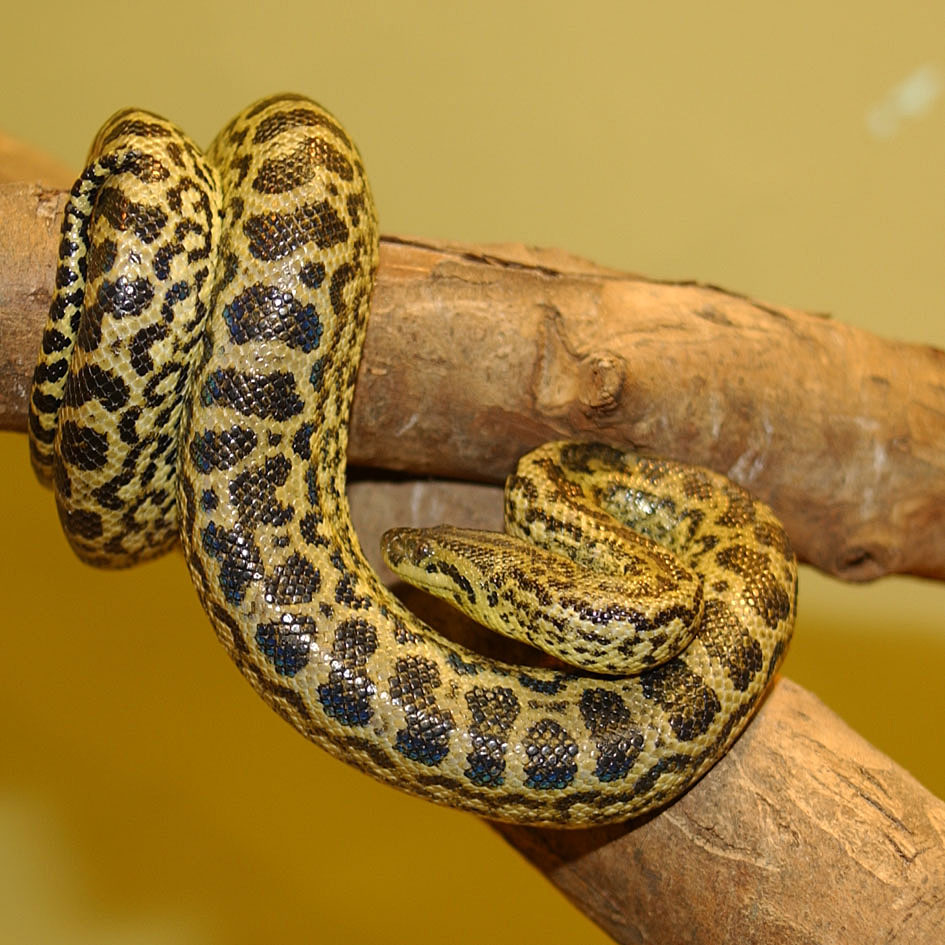
Adults grow to an average of 3.7 m (12 ft 1+1⁄2 in) in total length. Females are generally larger than males and have been reported up to 4.6 m (15 ft 1 in) in length. They commonly weigh 25 to 35 kg (55 to 77 lb), but specimens weighing more than 55 kg (121 lb) have been observed. The color pattern consists of a yellow, golden-tan or greenish-yellow ground color overlaid with a series of black or dark brown saddles, blotches, spots and streaks.
The range of the yellow anaconda encompasses the drainage of the Paraguay River and its tributaries, from the Pantanal region in Bolivia, Paraguay, and western Brazil to northeastern Argentina and northern Uruguay. The anaconda's most suitable habitat occurs mostly in northern Argentina and southern Paraguay. It prefers mostly aquatic habitats, including swamps, marshes, and brush-covered banks of slow-moving rivers and streams. The species appears to have been introduced in Florida, although it is unknown whether the small population (thought to derive from escaped pets) is reproductive.
The taxonomic sinking of Eunectes beniensis and Eunectes deschauenseei into Eunectes notaeus proposed by Rivas et al. (2023) results in this species also being found in western Bolivia, northern Brazil and coastal French Guiana.
Yellow anacondas are mostly sequentially monogamous. Males will follow the scent of a female's pheromones in the air to begin courtship which usually happens in the water. Yellow anacondas can form breeding balls which consist of one female and several males at a time. In the breeding ball, the males will fight for access to the female and the largest male typically succeeds. The breeding period for yellow anacondas occurs every year between April and May. The gestation period for female yellow anacondas is 6 months. Females are ovoviviparous, so they will incubate the eggs inside of their body and give birth to live young. The female can give birth anywhere from 4 to 82 young which can be around 60 cm in length. The female leaves the young directly after they are born to fend for themselves. Sexual maturity for yellow anacondas is 3 to 4 years old.
The yellow anaconda forages predominantly in shallow water in wetland habitats. Most predation occurs from June to November, when flooding has somewhat subsided and wading birds are the most common prey. Observations and analysis of gut and waste contents from regularly flooded areas in the Pantanal region of southwestern Brazil indicate that they are generalist feeders that employ both ambush predation and wide-foraging strategies.
Their prey consists nearly exclusively of aquatic or semi-aquatic species, including a wide variety of mammals, birds, reptiles, amphibians, fish and eggs. Larger specimens can prey upon larger animals, such as brocket deer, capybaras or peccaries. The prey-to-predator weight ratio is often much higher than for other types of Boidae. Cannibalism has been observed in this species, though it is not clear how often this occurs.
Hub AI
Yellow anaconda AI simulator
(@Yellow anaconda_simulator)
Yellow anaconda
The yellow anaconda (Eunectes notaeus), also known as the Paraguayan anaconda, is a boa species endemic to southern South America. It is one of the largest snakes in the world but smaller than its close relative, the green anaconda. No subspecies are currently recognized. Like all boas and pythons, it is non-venomous and kills its prey by constriction.
The Neo-Latin specific name notaeus derives from Ancient Greek: νωταίος, romanized: nōtaios, lit. 'dorsal' (νωταίος is a poetic form of νωτιαίος/nōtiaios). In distinguishing his new species Eunectes notaeus from Eunectes murinus, Edward Drinker Cope stated, "Dorsal scales are larger and in fewer rows."
Adults grow to an average of 3.7 m (12 ft 1+1⁄2 in) in total length. Females are generally larger than males and have been reported up to 4.6 m (15 ft 1 in) in length. They commonly weigh 25 to 35 kg (55 to 77 lb), but specimens weighing more than 55 kg (121 lb) have been observed. The color pattern consists of a yellow, golden-tan or greenish-yellow ground color overlaid with a series of black or dark brown saddles, blotches, spots and streaks.
The range of the yellow anaconda encompasses the drainage of the Paraguay River and its tributaries, from the Pantanal region in Bolivia, Paraguay, and western Brazil to northeastern Argentina and northern Uruguay. The anaconda's most suitable habitat occurs mostly in northern Argentina and southern Paraguay. It prefers mostly aquatic habitats, including swamps, marshes, and brush-covered banks of slow-moving rivers and streams. The species appears to have been introduced in Florida, although it is unknown whether the small population (thought to derive from escaped pets) is reproductive.
The taxonomic sinking of Eunectes beniensis and Eunectes deschauenseei into Eunectes notaeus proposed by Rivas et al. (2023) results in this species also being found in western Bolivia, northern Brazil and coastal French Guiana.
Yellow anacondas are mostly sequentially monogamous. Males will follow the scent of a female's pheromones in the air to begin courtship which usually happens in the water. Yellow anacondas can form breeding balls which consist of one female and several males at a time. In the breeding ball, the males will fight for access to the female and the largest male typically succeeds. The breeding period for yellow anacondas occurs every year between April and May. The gestation period for female yellow anacondas is 6 months. Females are ovoviviparous, so they will incubate the eggs inside of their body and give birth to live young. The female can give birth anywhere from 4 to 82 young which can be around 60 cm in length. The female leaves the young directly after they are born to fend for themselves. Sexual maturity for yellow anacondas is 3 to 4 years old.
The yellow anaconda forages predominantly in shallow water in wetland habitats. Most predation occurs from June to November, when flooding has somewhat subsided and wading birds are the most common prey. Observations and analysis of gut and waste contents from regularly flooded areas in the Pantanal region of southwestern Brazil indicate that they are generalist feeders that employ both ambush predation and wide-foraging strategies.
Their prey consists nearly exclusively of aquatic or semi-aquatic species, including a wide variety of mammals, birds, reptiles, amphibians, fish and eggs. Larger specimens can prey upon larger animals, such as brocket deer, capybaras or peccaries. The prey-to-predator weight ratio is often much higher than for other types of Boidae. Cannibalism has been observed in this species, though it is not clear how often this occurs.
Recent media