
Recent from talks
Z3 (computer)
Knowledge base stats:
Talk channels stats:
Members stats:
Z3 (computer)
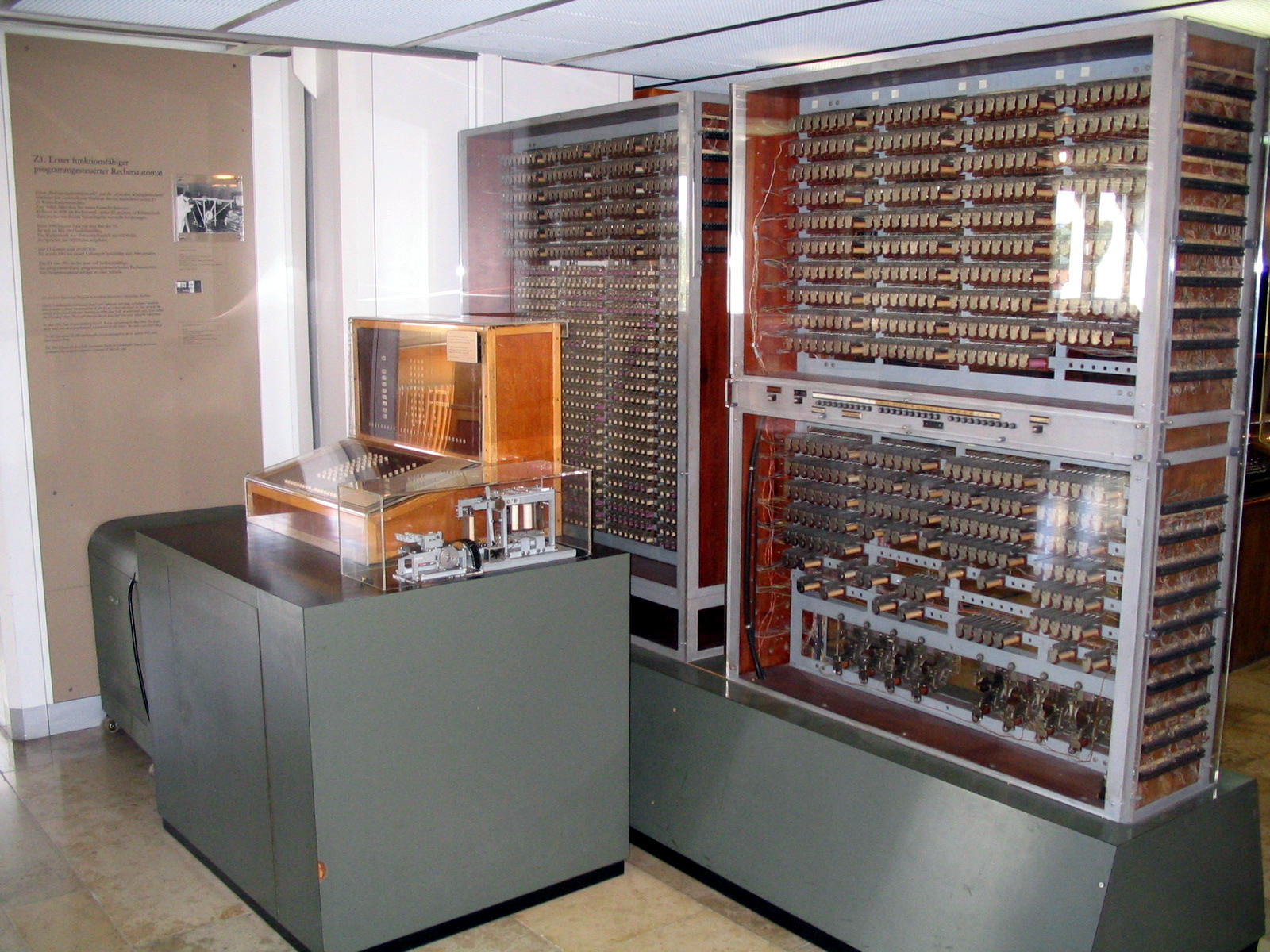
The Z3 was a German electromechanical computer designed by Konrad Zuse in 1938, and completed in 1941. It was the world's first working programmable, fully automatic digital computer. The Z3 was built with 2,600 relays, implementing a 22-bit word length that operated at a clock frequency of about 5–10 Hz. Program code was stored on punched film. Initial values were entered manually.
The Z3 was completed in Berlin in 1941. It was not considered vital, so it was never put into everyday operation. Based on the work of the German aerodynamics engineer Hans Georg Küssner (known for the Küssner effect), a "Program to Compute a Complex Matrix" was written and used to solve wing flutter problems. Zuse asked the German government for funding to replace the relays with fully electronic switches, but funding was denied during World War II since such development was deemed "not war-important".
The original Z3 was destroyed on 21 December 1943 during an Allied bombardment of Berlin. That Z3 was originally called V3 (Versuchsmodell 3 or Experimental Model 3) but was renamed so that it would not be confused with Germany's V-weapons. A fully functioning replica was built in 1961 by Zuse's company, Zuse KG, which is now on permanent display at Deutsches Museum in Munich.
The Z3 was demonstrated in 1998 to be, in principle, Turing-complete. However, because it lacked conditional branching, the Z3 only meets this definition by speculatively computing all possible outcomes of a calculation.
Thanks to this machine and its predecessors, Konrad Zuse has often been suggested as the inventor of the computer.
Zuse designed the Z1 in 1935 to 1936 and built it from 1936 to 1938. The Z1 was wholly mechanical and only worked for a few minutes at a time at most. Helmut Schreyer advised Zuse to use a different technology. As a doctoral student at the Technische Hochschule in Charlottenburg (now Technische Universität Berlin) in 1937 he worked on the implementation of Boolean operations and (in today's terminology) flip-flops on the basis of vacuum tubes. In 1938, Schreyer demonstrated a circuit on this basis to a small audience, and explained his vision of an electronic computing machine – but since the largest operational electronic devices contained far fewer tubes this was considered practically infeasible. In that year when presenting the plan for a computer with 2,000 electron tubes, Zuse and Schreyer, who was an assistant at Wilhelm Stäblein's Telecommunication Institute at Technische Universität Berlin, were discouraged by members of the institute who knew about the problems with electron tube technology. Zuse later recalled: "They smiled at us in 1939, when we wanted to build electronic machines ... We said: The electronic machine is great, but first the components have to be developed." In 1940, Zuse and Schreyer managed to arrange a meeting at the Oberkommando der Wehrmacht (OKW) to discuss a potential project for developing an electronic computer, but when they estimated a duration of two or three years, the proposal was rejected.
Zuse decided to implement the next design based on relays. The realization of the Z2 was helped financially by Kurt Pannke, who manufactured small calculating machines. The Z2 was completed and presented to an audience of the Deutsche Versuchsanstalt für Luftfahrt ("German Laboratory for Aviation") in 1940 in Berlin-Adlershof. Zuse was lucky – this presentation was one of the few instances where the Z2 actually worked and could convince the DVL to partly finance the next design.
In 1941, improving on the basic Z2 machine, he built the Z3 in a highly secret project of the German government. Joseph Jennissen (1905–1977), member of the "Research-Leadership" (Forschungsführung) in the Reich Air Ministry acted as a government supervisor for orders of the ministry to Zuse's company ZUSE Apparatebau. A further intermediary between Zuse and the Reich Air Ministry was the aerodynamicist Herbert A. Wagner.
Hub AI
Z3 (computer) AI simulator
(@Z3 (computer)_simulator)
Z3 (computer)
The Z3 was a German electromechanical computer designed by Konrad Zuse in 1938, and completed in 1941. It was the world's first working programmable, fully automatic digital computer. The Z3 was built with 2,600 relays, implementing a 22-bit word length that operated at a clock frequency of about 5–10 Hz. Program code was stored on punched film. Initial values were entered manually.
The Z3 was completed in Berlin in 1941. It was not considered vital, so it was never put into everyday operation. Based on the work of the German aerodynamics engineer Hans Georg Küssner (known for the Küssner effect), a "Program to Compute a Complex Matrix" was written and used to solve wing flutter problems. Zuse asked the German government for funding to replace the relays with fully electronic switches, but funding was denied during World War II since such development was deemed "not war-important".
The original Z3 was destroyed on 21 December 1943 during an Allied bombardment of Berlin. That Z3 was originally called V3 (Versuchsmodell 3 or Experimental Model 3) but was renamed so that it would not be confused with Germany's V-weapons. A fully functioning replica was built in 1961 by Zuse's company, Zuse KG, which is now on permanent display at Deutsches Museum in Munich.
The Z3 was demonstrated in 1998 to be, in principle, Turing-complete. However, because it lacked conditional branching, the Z3 only meets this definition by speculatively computing all possible outcomes of a calculation.
Thanks to this machine and its predecessors, Konrad Zuse has often been suggested as the inventor of the computer.
Zuse designed the Z1 in 1935 to 1936 and built it from 1936 to 1938. The Z1 was wholly mechanical and only worked for a few minutes at a time at most. Helmut Schreyer advised Zuse to use a different technology. As a doctoral student at the Technische Hochschule in Charlottenburg (now Technische Universität Berlin) in 1937 he worked on the implementation of Boolean operations and (in today's terminology) flip-flops on the basis of vacuum tubes. In 1938, Schreyer demonstrated a circuit on this basis to a small audience, and explained his vision of an electronic computing machine – but since the largest operational electronic devices contained far fewer tubes this was considered practically infeasible. In that year when presenting the plan for a computer with 2,000 electron tubes, Zuse and Schreyer, who was an assistant at Wilhelm Stäblein's Telecommunication Institute at Technische Universität Berlin, were discouraged by members of the institute who knew about the problems with electron tube technology. Zuse later recalled: "They smiled at us in 1939, when we wanted to build electronic machines ... We said: The electronic machine is great, but first the components have to be developed." In 1940, Zuse and Schreyer managed to arrange a meeting at the Oberkommando der Wehrmacht (OKW) to discuss a potential project for developing an electronic computer, but when they estimated a duration of two or three years, the proposal was rejected.
Zuse decided to implement the next design based on relays. The realization of the Z2 was helped financially by Kurt Pannke, who manufactured small calculating machines. The Z2 was completed and presented to an audience of the Deutsche Versuchsanstalt für Luftfahrt ("German Laboratory for Aviation") in 1940 in Berlin-Adlershof. Zuse was lucky – this presentation was one of the few instances where the Z2 actually worked and could convince the DVL to partly finance the next design.
In 1941, improving on the basic Z2 machine, he built the Z3 in a highly secret project of the German government. Joseph Jennissen (1905–1977), member of the "Research-Leadership" (Forschungsführung) in the Reich Air Ministry acted as a government supervisor for orders of the ministry to Zuse's company ZUSE Apparatebau. A further intermediary between Zuse and the Reich Air Ministry was the aerodynamicist Herbert A. Wagner.
Recent media