Hubbry Logo
Impedance parametersImpedance parametersMain
Open search
Impedance parameters
Community hub
Impedance parameters
logo
7 pages, 0 posts
0 subscribers
Be the first to start a discussion here.
Impedance parameters
from Wikipedia

Impedance parameters or Z-parameters (the elements of an impedance matrix or Z-matrix) are properties used in electrical engineering, electronic engineering, and communication systems engineering to describe the electrical behavior of linear electrical networks. They are also used to describe the small-signal (linearized) response of non-linear networks. They are members of a family of similar parameters used in electronic engineering, other examples being: S-parameters,[1] Y-parameters,[2] H-parameters, T-parameters or ABCD-parameters.[3][4]

Z-parameters are also known as open-circuit impedance parameters as they are calculated under open circuit conditions. i.e., Ix=0, where x=1,2 refer to input and output currents flowing through the ports (of a two-port network in this case) respectively.

The Z-parameter matrix

[edit]

A Z-parameter matrix describes the behaviour of any linear electrical network that can be regarded as a black box with a number of ports. A port in this context is a pair of electrical terminals carrying equal and opposite currents into and out-of the network, and having a particular voltage between them. The Z-matrix gives no information about the behaviour of the network when the currents at any port are not balanced in this way (should this be possible), nor does it give any information about the voltage between terminals not belonging to the same port. Typically, it is intended that each external connection to the network is between the terminals of just one port, so that these limitations are appropriate.

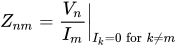
For a generic multi-port network definition, it is assumed that each of the ports is allocated an integer n ranging from 1 to N, where N is the total number of ports. For port n, the associated Z-parameter definition is in terms of the port current and port voltage, and respectively.

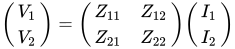
For all ports the voltages may be defined in terms of the Z-parameter matrix and the currents by the following matrix equation:

where Z is an N × N matrix the elements of which can be indexed using conventional matrix notation. In general the elements of the Z-parameter matrix are complex numbers and functions of frequency. For a one-port network, the Z-matrix reduces to a single element, being the ordinary impedance measured between the two terminals. The Z-parameters are also known as the open circuit parameters because they are measured or calculated by applying current to one port and determining the resulting voltages at all the ports while the undriven ports are terminated into open circuits.

Two-port networks

[edit]
The equivalent circuit for Z-parameters of a two-port network.
The equivalent circuit for Z-parameters of a reciprocal two-port network.

The Z-parameter matrix for the two-port network is probably the most common. In this case the relationship between the port currents, port voltages and the Z-parameter matrix is given by:

.

where

For the general case of an N-port network,
Impedance relations

[edit]

The input impedance of a two-port network is given by:
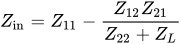
where ZL is the impedance of the load connected to port two.

Similarly, the output impedance is given by:
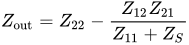
where ZS is the impedance of the source connected to port one.

Relation to S-parameters

[edit]

The Z-parameters of a network are related to its S-parameters by[5]
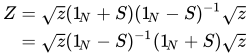
 

and[5]

 

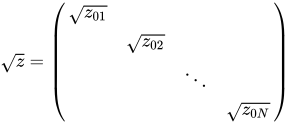
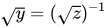
where is the identity matrix, is a diagonal matrix having the square root of the characteristic impedance at each port as its non-zero elements,

and is the corresponding diagonal matrix of square roots of characteristic admittances. In these expressions the matrices represented by the bracketed factors commute and so, as shown above, may be written in either order.[5][note 1]
Two port

[edit]

In the special case of a two-port network, with the same characteristic impedance at each port, the above expressions reduce to


Where

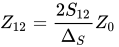
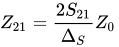
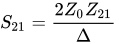
The two-port S-parameters may be obtained from the equivalent two-port Z-parameters by means of the following expressions[6]

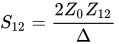
where

The above expressions will generally use complex numbers for and . Note that the value of can become 0 for specific values of so the division by in the calculations of may lead to a division by 0.

Relation to Y-parameters

[edit]

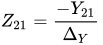
Conversion from Y-parameters to Z-parameters is much simpler, as the Z-parameter matrix is just the inverse of the Y-parameter matrix. For a two-port:

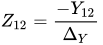
where

is the determinant of the Y-parameter matrix.

Notes

[edit]

References

[edit]

Bibliography

[edit]

See also

[edit]
Revisions and contributorsEdit on WikipediaRead on Wikipedia
from Grokipedia
Impedance parameters, commonly referred to as Z-parameters, are a fundamental set of four linear electrical parameters that characterize the behavior of a by relating the total voltages at its input and output ports to the currents entering those ports under open-circuit conditions at the opposite port. These parameters are particularly useful in analyzing passive and active circuits where voltage-current relationships need to be modeled precisely, such as in amplifiers, filters, and transmission lines. In , Z-parameters provide a framework for simplifying complex network interactions by expressing them in matrix form, enabling straightforward calculations for network performance. The Z-parameters are defined through the following voltage-current relationships for a : [V1V2]=[Z11Z12Z21Z22][I1I2]\begin{bmatrix} V_1 \\ V_2 \end{bmatrix} = \begin{bmatrix} Z_{11} & Z_{12} \\ Z_{21} & Z_{22} \end{bmatrix} \begin{bmatrix} I_1 \\ I_2 \end{bmatrix} Here, Z11Z_{11} is the with the output port open-circuited (V1/I1V_1 / I_1 when I2=0I_2 = 0), Z22Z_{22} is the with the input port open-circuited (V2/I2V_2 / I_2 when I1=0I_1 = 0), Z12Z_{12} is the reverse voltage ratio (V1/I2V_1 / I_2 when I1=0I_1 = 0), and Z21Z_{21} is the forward voltage ratio (V2/I1V_2 / I_1 when I2=0I_2 = 0). All Z-parameters have units of ohms (Ω), reflecting their impedance nature, and they are measured or calculated assuming small-signal linear operation. For reciprocal networks, which lack non-symmetric elements like gyrators, the Z-parameters satisfy Z12=Z21Z_{12} = Z_{21}, ensuring symmetry in the transfer impedances. This property is crucial in passive circuit design. Z-parameters are especially advantageous for series-connected two-port networks, as the overall Z-matrix is simply the sum of individual matrices, facilitating cascaded system analysis. In practical applications, such as RF and microwave engineering, they aid in modeling device impedances for matching networks and stability assessments, while in low-frequency circuit analysis, they support the evaluation of transistor amplifiers and feedback systems.

Fundamentals of Two-Port Networks

Definition and Configuration

A is a linear circuit element characterized by two pairs of terminals, known as s, through which energy enters and exits the device. Each consists of a pair of terminals defining a voltage and current, with the network assumed to be linear and lumped, meaning it behaves as discrete components without distributed effects like wave propagation over significant distances. This setup allows the network's behavior to be described using port variables: voltages V1V_1 at port 1 and V2V_2 at port 2, and currents I1I_1 and I2I_2, where I1I_1 is directed into port 1 and I2I_2 into port 2, following the passive sign convention for power flow. The configurations of two-port networks facilitate different measurement and analysis approaches, including series-series, parallel-parallel, and series-parallel setups. In a series-series configuration, currents are common across both ports while voltages add, suitable for impedance-based under open-circuit conditions at one . Parallel-parallel connects voltages across both ports with currents adding, ideal for measurements with short-circuit conditions. Series-parallel combines series connection at the input and parallel at the output, supporting hybrid parameter evaluations. These configurations provide the foundational framework for extraction, particularly emphasizing open-circuit terminations for impedance parameters to isolate input-output relationships. Two-port networks serve as a prerequisite for systematic parameter-based in circuit theory, enabling the characterization of complex systems through simplified models. For impedance parameters specifically, open-circuit conditions at the output port allow determination of , while similar setups at the input yield transfer characteristics, assuming the network's . Other parameter families, such as or , offer alternatives suited to short-circuit or matched-load conditions, respectively. This approach originated in early 20th-century , pioneered by engineers like George Campbell for in , with key contributions including his 1911 work on cisoidal oscillations.

Parameter Families Overview

In electrical network analysis, two-port parameters provide a systematic framework for characterizing the behavior of linear circuits with two pairs of terminals, enabling the modeling of interactions between input and output ports. The primary parameter families encompass Z-parameters (open-circuit impedance parameters), which relate input and output voltages to currents under open-circuit conditions at the opposite port; Y-parameters (short-circuit admittance parameters), which relate currents to voltages with short-circuited ports; H-parameters (hybrid parameters), combining voltage and current measurements for mixed input-output analysis, often used in modeling; ABCD-parameters (transmission or chain parameters), which describe voltage and current propagation from input to output in a cascade-friendly manner; and S-parameters (scattering parameters), which quantify power wave reflections and transmissions relative to reference impedances, particularly suited for high-frequency applications. Each family offers distinct advantages tailored to circuit configurations and analysis needs. Z-parameters excel in voltage-driven scenarios and series-connected networks, as they directly express impedances without requiring short circuits that might be impractical. In contrast, Y-parameters are preferable for current-driven and parallel or shunt configurations, facilitating admittance-based computations. H-parameters provide a hybrid mix ideal for active devices like amplifiers, balancing computational simplicity with practical measurements. ABCD-parameters simplify the analysis of cascaded multi-stage systems, such as transmission lines, by allowing straightforward for overall network response. S-parameters are advantageous at high frequencies, where open- or short-circuit conditions are challenging due to parasitic effects, as they incorporate matched terminations to minimize reflections and enable stable measurements in RF and circuits. Common use cases highlight these strengths: Z-parameters are routinely applied in low-frequency , such as audio amplifiers and power systems, where voltage sources predominate. Y-parameters find employment in shunt-dominated filters and integrated circuits emphasizing current flows. H-parameters are standard in small-signal models for discrete and IC design. ABCD-parameters support the modeling of interconnected transmission systems, like in power grids or coaxial cables. S-parameters dominate RF and , including antenna arrays and wireless components, due to their compatibility with 50-ohm standards and vector network analyzer measurements. The evolution of these parameter families traces back to foundational work at Bell Laboratories during the and , driven by demands for efficient and . Pioneers like Otto Zobel developed filter sections using two-port concepts for constant-impedance matching in carrier systems, while Edward Lawry Norton's theorem (1926) and subsequent contributions from Sidney Darlington advanced , formalizing impedance-based analyses in mid-20th-century texts. This era's innovations, rooted in post-World War I communication needs, established the comparative framework still used today.

Z-Parameter Definition

Matrix Representation

The impedance parameters, also known as Z-parameters, provide a for a by expressing the port voltages in terms of the port currents under open-circuit conditions. For a , the relationship is given by the matrix equation [V1V2]=[Z11Z12Z21Z22][I1I2],\begin{bmatrix} V_1 \\ V_2 \end{bmatrix} = \begin{bmatrix} Z_{11} & Z_{12} \\ Z_{21} & Z_{22} \end{bmatrix} \begin{bmatrix} I_1 \\ I_2 \end{bmatrix}, where V1V_1 and V2V_2 are the voltages at ports 1 and 2, respectively, and I1I_1 and I2I_2 are the corresponding currents, with the convention that currents are directed into the network at the positive voltage terminals. The Z-matrix is a 2×2 complex matrix whose elements represent impedances in ohms and are generally frequency-dependent. The individual elements of the Z-matrix are defined from open-circuit measurements as follows: Z11=V1/I1Z_{11} = V_1 / I_1 with I2=0I_2 = 0 (input impedance with output open-circuited), Z12=V1/I2Z_{12} = V_1 / I_2 with I1=0I_1 = 0 (reverse transfer impedance), Z21=V2/I1Z_{21} = V_2 / I_1 with I2=0I_2 = 0 (forward transfer impedance), and Z22=V2/I2Z_{22} = V_2 / I_2 with I1=0I_1 = 0 (output impedance with input open-circuited). These elements are determined as ratios of voltage to current and thus carry units of ohms (Ω\Omega). Each ZijZ_{ij} is a complex quantity, where the real part corresponds to resistance and the imaginary part to reactance, reflecting the network's dissipative and storage behaviors. This matrix formulation extends naturally to multi-port networks. For an N-port network, the voltages and currents are related by V=ZI\mathbf{V} = \mathbf{Z} \mathbf{I}, where V\mathbf{V} and I\mathbf{I} are column vectors, and Z\mathbf{Z} is an N×N square impedance matrix with elements Zmn=Vm/InZ_{mn} = V_m / I_n (all other currents zero). Under reciprocity conditions, the Z-matrix is symmetric (Zmn=ZnmZ_{mn} = Z_{nm}). Like the two-port case, the elements are complex impedances in ohms and depend on .

Element Interpretations

The Z-parameters provide a physical interpretation of the behavior of a by relating input and output voltages to currents under specific open-circuit conditions. The parameter Z11Z_{11} represents the driving-point at port 1, defined as the ratio of the voltage to the current at port 1 when port 2 is open-circuited (Z11=V1/I1I2=0Z_{11} = V_1 / I_1 \big|_{I_2=0}
Add your contribution
Related Hubs
User Avatar
No comments yet.