Hubbry Logo
Smith chartSmith chartMain
Open search
Smith chart
Community hub
Smith chart
logo
8 pages, 0 posts
0 subscribers
Be the first to start a discussion here.
Contribute something
Smith chart
Smith chart
from Wikipedia

The Smith chart (sometimes also called Smith diagram, Mizuhashi chart (水橋チャート), Mizuhashi–Smith chart (水橋スミスチャート),[1][2][3] Volpert–Smith chart (Диаграмма Вольперта—Смита)[4][5] or Mizuhashi–Volpert–Smith chart) is a graphical calculator or nomogram designed for electrical and electronics engineers specializing in radio frequency (RF) engineering to assist in solving problems with transmission lines and matching circuits.[6][7][8][9][10]

It was independently[11][4][12][5] proposed by Tōsaku Mizuhashi (水橋東作) in 1937,[13] and by Amiel R. Volpert [ru] (Амиэ́ль Р. Во́льперт)[14][4] and Phillip H. Smith in 1939.[15][16] Starting with a rectangular diagram, Smith had developed a special polar coordinate chart by 1936, which, with the input of his colleagues Enoch B. Ferrell and James W. McRae, who were familiar with conformal mappings, was reworked into the final form in early 1937, which was eventually published in January 1939.[15][9][17] While Smith had originally called it a "transmission line chart"[15][16] and other authors first used names like "reflection chart", "circle diagram of impedance", "immittance chart" or "Z-plane chart",[9] early adopters at MIT's Radiation Laboratory started to refer to it simply as "Smith chart" in the 1940s,[9][17] a name generally accepted in the Western world by 1950.[18][19]

The Smith chart can be used to simultaneously display multiple parameters including impedances, admittances, reflection coefficients, scattering parameters, noise figure circles, constant gain contours and regions for unconditional stability.[20][21]: 93–103  The Smith chart is most frequently used at or within the unity radius region. However, the remainder is still mathematically relevant, being used, for example, in oscillator design and stability analysis.[21]: 98–101  While the use of paper Smith charts for solving the complex mathematics involved in matching problems has been largely replaced by software based methods, the Smith chart is still a very useful method of showing[22] how RF parameters behave at one or more frequencies, an alternative to using tabular information. Thus most RF circuit analysis software includes a Smith chart option for the display of results and all but the simplest impedance measuring instruments can plot measured results on a Smith chart display.[23]

An impedance Smith chart (with no data plotted).

Overview

[edit]
A network analyzer set up to display measured data on a Smith chart.

The Smith chart is a mathematical transformation of the two-dimensional Cartesian complex plane. Complex numbers with positive real parts map inside the circle. Those with negative real parts map outside the circle. If we are dealing only with impedances with non-negative resistive components, our interest is focused on the area inside the circle. The transformation, for an impedance Smith chart, is:
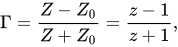
where z = Z/Z0, i.e., the complex impedance, Z, normalized by the reference impedance, Z0. The impedance Smith chart is then an Argand plot of impedances thus transformed. Impedances with non-negative resistive components will appear inside a circle with unit radius; the origin will correspond to the reference impedance, Z0.

The Smith chart is plotted on the complex reflection coefficient plane in two dimensions and may be scaled in normalised impedance (the most common), normalised admittance or both, using different colours to distinguish between them. These are often known as the Z, Y and YZ Smith charts respectively.[21]: 97  Normalised scaling allows the Smith chart to be used for problems involving any characteristic or system impedance which is represented by the center point of the chart. The most commonly used normalization impedance is 50 ohms. Once an answer is obtained through the graphical constructions described below, it is straightforward to convert between normalised impedance (or normalised admittance) and the corresponding unnormalized value by multiplying by the characteristic impedance (admittance). Reflection coefficients can be read directly from the chart as they are unitless parameters.

The Smith chart has a scale around its circumference or periphery which is graduated in wavelengths and degrees. The wavelengths scale is used in distributed component problems and represents the distance measured along the transmission line connected between the generator or source and the load to the point under consideration. The degrees scale represents the angle of the voltage reflection coefficient at that point. The Smith chart may also be used for lumped-element matching and analysis problems.

Use of the Smith chart and the interpretation of the results obtained using it requires a good understanding of AC circuit theory and transmission-line theory, both of which are prerequisites for RF engineers.

As impedances and admittances change with frequency, problems using the Smith chart can only be solved manually using one frequency at a time, the result being represented by a point. This is often adequate for narrow band applications (typically up to about 5% to 10% bandwidth) but for wider bandwidths it is usually necessary to apply Smith chart techniques at more than one frequency across the operating frequency band. Provided the frequencies are sufficiently close, the resulting Smith chart points may be joined by straight lines to create a locus.

A locus of points on a Smith chart covering a range of frequencies can be used to visually represent:

  • how capacitive or how inductive a load is across the frequency range
  • how difficult matching is likely to be at various frequencies
  • how well matched a particular component is.

The accuracy of the Smith chart is reduced for problems involving a large locus of impedances or admittances, although the scaling can be magnified for individual areas to accommodate these.

Mathematical basis

[edit]
Most basic use of an impedance Smith chart. A wave travels down a transmission line of characteristic impedance Z0, terminated at a load with impedance ZL and normalised impedance z = ZL/Z0. There is a signal reflection with coefficient Γ. Each point on the Smith chart simultaneously represents both a value of z (bottom left), and the corresponding value of Γ (bottom right), related by z = (1 + Γ)/(1 − Γ).

Actual and normalised impedance and admittance

[edit]

A transmission line with a characteristic impedance of may be universally considered to have a characteristic admittance of where

Any impedance, expressed in ohms, may be normalised by dividing it by the characteristic impedance, so the normalised impedance using the lower case zT is given by

Similarly, for normalised admittance

The SI unit of impedance is the ohm with the symbol of the upper case Greek letter omega (Ω) and the SI unit for admittance is the siemens with the symbol of an upper case letter S. Normalised impedance and normalised admittance are dimensionless. Actual impedances and admittances must be normalised before using them on a Smith chart. Once the result is obtained it may be de-normalised to obtain the actual result.

The normalised impedance Smith chart

[edit]
Transmission lines terminated by an open circuit (top) and a short circuit (bottom). A pulse reflects perfectly off both these terminations, but the sign of the reflected voltage is opposite in the two cases. Black dots represent electrons, and arrows show the electric field.

Using transmission-line theory, if a transmission line is terminated in an impedance () which differs from its characteristic impedance (), a standing wave will be formed on the line comprising the resultant of both the incident or forward () and the reflected or reversed () waves. Using complex exponential notation:

and

where

is the temporal part of the wave
is the spatial part of the wave and
where
is the angular frequency in radians per second (rad/s)
is the frequency in hertz (Hz)
is the time in seconds (s)
and are constants
is the distance measured along the transmission line from the load toward the generator in metres (m)

Also

is the propagation constant which has SI units radians/meter

where

is the attenuation constant in nepers per metre (Np/m)
is the phase constant in radians per metre (rad/m)

The Smith chart is used with one frequency () at a time, and only for one moment () at a time, so the temporal part of the phase () is fixed. All terms are actually multiplied by this to obtain the instantaneous phase, but it is conventional and understood to omit it. Therefore,

and

where and are respectively the forward and reverse voltage amplitudes at the load.

The variation of complex reflection coefficient with position along the line

[edit]
Looking towards a load through a length of lossless transmission line, the impedance changes as increases, following the blue circle; this impedance is characterized by its reflection coefficient Vreflected/Vincident. The blue circle, centered within the impedance Smith chart, is sometimes called an SWR circle (short for constant standing wave ratio).

The complex voltage reflection coefficient is defined as the ratio of the reflected wave to the incident (or forward) wave. Therefore,

where C is also a constant.

For a uniform transmission line (in which is constant), the complex reflection coefficient of a standing wave varies according to the position on the line. If the line is lossy ( is non-zero) this is represented on the Smith chart by a spiral path. In most Smith chart problems however, losses can be assumed negligible () and the task of solving them is greatly simplified. For the loss free case therefore, the expression for complex reflection coefficient becomes

where is the reflection coefficient at the load, and is the line length from the load to the location where the reflection coefficient is measured. The phase constant may also be written as

where is the wavelength within the transmission line at the test frequency.

Therefore,

This equation shows that, for a standing wave, the complex reflection coefficient and impedance repeats every half wavelength along the transmission line. The complex reflection coefficient is generally simply referred to as reflection coefficient. The outer circumferential scale of the Smith chart represents the distance from the generator to the load scaled in wavelengths and is therefore scaled from zero to 0.50.

The variation of normalised impedance with position along the line

[edit]

If and are the voltage across and the current entering the termination at the end of the transmission line respectively, then

and

.

By dividing these equations and substituting for both the voltage reflection coefficient

and the normalised impedance of the termination represented by the lower case z, subscript T

gives the result:

Alternatively, in terms of the reflection coefficient

These are the equations which are used to construct the Z Smith chart. Mathematically speaking and are related via a Möbius transformation.

Both and are expressed in complex numbers without any units. They both change with frequency so for any particular measurement, the frequency at which it was performed must be stated together with the characteristic impedance.

may be expressed in magnitude and angle on a polar diagram. Any actual reflection coefficient must have a magnitude of less than or equal to unity so, at the test frequency, this may be expressed by a point inside a circle of unity radius. The Smith chart is actually constructed on such a polar diagram. The Smith chart scaling is designed in such a way that reflection coefficient can be converted to normalised impedance or vice versa. Using the Smith chart, the normalised impedance may be obtained with appreciable accuracy by plotting the point representing the reflection coefficient treating the Smith chart as a polar diagram and then reading its value directly using the characteristic Smith chart scaling. This technique is a graphical alternative to substituting the values in the equations.

By substituting the expression for how reflection coefficient changes along an unmatched loss-free transmission line

for the loss free case, into the equation for normalised impedance in terms of reflection coefficient

and using Euler's formula

yields the impedance-version transmission-line equation for the loss free case:[24]

where is the impedance 'seen' at the input of a loss free transmission line of length terminated with an impedance

Versions of the transmission-line equation may be similarly derived for the admittance loss free case and for the impedance and admittance lossy cases.

The Smith chart graphical equivalent of using the transmission-line equation is to normalise to plot the resulting point on a Z Smith chart and to draw a circle through that point centred at the Smith chart centre. The path along the arc of the circle represents how the impedance changes whilst moving along the transmission line. In this case the circumferential (wavelength) scaling must be used, remembering that this is the wavelength within the transmission line and may differ from the free space wavelength.

Regions of the Z Smith chart

[edit]

If a polar diagram is mapped on to a cartesian coordinate system it is conventional to measure angles relative to the positive x-axis using a counterclockwise direction for positive angles. The magnitude of a complex number is the length of a straight line drawn from the origin to the point representing it. The Smith chart uses the same convention, noting that, in the normalised impedance plane, the positive x-axis extends from the center of the Smith chart at to the point The region above the x-axis represents inductive impedances (positive imaginary parts) and the region below the x-axis represents capacitive impedances (negative imaginary parts).

If the termination is perfectly matched, the reflection coefficient will be zero, represented effectively by a circle of zero radius or in fact a point at the centre of the Smith chart. If the termination was a perfect open circuit or short circuit the magnitude of the reflection coefficient would be unity, all power would be reflected and the point would lie at some point on the unity circumference circle.

Circles of constant normalised resistance and constant normalised reactance

[edit]

The normalised impedance Smith chart is composed of two families of circles: circles of constant normalised resistance and circles of constant normalised reactance. In the complex reflection coefficient plane the Smith chart occupies a circle of unity radius centred at the origin. In cartesian coordinates therefore the circle would pass through the points (+1,0) and (−1,0) on the x-axis and the points (0,+1) and (0,−1) on the y-axis.

Since both and are complex numbers, in general they may be written as:

with a, b, c and d real numbers.

Substituting these into the equation relating normalised impedance and complex reflection coefficient:

gives the following result:

This is the equation which describes how the complex reflection coefficient changes with the normalised impedance and may be used to construct both families of circles.[25]

The Y Smith chart

[edit]

The Y Smith chart is constructed in a similar way to the Z Smith chart case but by expressing values of voltage reflection coefficient in terms of normalised admittance instead of normalised impedance. The normalised admittance yT is the reciprocal of the normalised impedance zT, so

Therefore:

and

The Y Smith chart appears like the normalised impedance, type but with the graphic nested circles rotated through 180°, but the numeric scale remaining in its same position (not rotated) as the Z chart.

Similarly taking

for real and gives an analogous result, although with more and different minus signs:

The region above the x-axis represents capacitive admittances and the region below the x-axis represents inductive admittances. Capacitive admittances have positive imaginary parts and inductive admittances have negative imaginary parts.

Again, if the termination is perfectly matched the reflection coefficient will be zero, represented by a 'circle' of zero radius or in fact a point at the centre of the Smith chart. If the termination was a perfect open or short circuit the magnitude of the voltage reflection coefficient would be unity, all power would be reflected and the point would lie at some point on the unity circumference circle of the Smith chart.

Practical examples

[edit]
Example points plotted on the normalized impedance Smith chart.

A point with a reflection coefficient magnitude 0.63 and angle 60° represented in polar form as , is shown as point P1 on the Smith chart. To plot this, one may use the circumferential (reflection coefficient) angle scale to find the graduation and a ruler to draw a line passing through this and the centre of the Smith chart. The length of the line would then be scaled to P1 assuming the Smith chart radius to be unity. For example, if the actual radius measured from the paper was 100 mm, the length OP1 would be 63 mm.

The following table gives some similar examples of points which are plotted on the Z Smith chart. For each, the reflection coefficient is given in polar form together with the corresponding normalised impedance in rectangular form. The conversion may be read directly from the Smith chart or by substitution into the equation.

Some examples of points plotted on the normalised impedance Smith chart
Point identity Reflection coefficient (polar form) Normalised impedance (rectangular form)
P1 (Inductive)
P2 (Inductive)
P3 (Capacitive)

Working with both the Z Smith chart and the Y Smith charts

[edit]

In RF circuit and matching problems sometimes it is more convenient to work with admittances (representing conductances and susceptances) and sometimes it is more convenient to work with impedances (representing resistances and reactances). Solving a typical matching problem will often require several changes between both types of Smith chart, using normalised impedance for series elements and normalised admittances for parallel elements. For these a dual (normalised) impedance and admittance Smith chart may be used. Alternatively, one type may be used and the scaling converted to the other when required. In order to change from normalised impedance to normalised admittance or vice versa, the point representing the value of reflection coefficient under consideration is moved through exactly 180 degrees at the same radius. For example, the point P1 in the example representing a reflection coefficient of has a normalised impedance of . To graphically change this to the equivalent normalised admittance point, say Q1, a line is drawn with a ruler from P1 through the Smith chart centre to Q1, an equal radius in the opposite direction. This is equivalent to moving the point through a circular path of exactly 180 degrees. Reading the value from the Smith chart for Q1, remembering that the scaling is now in normalised admittance, gives . Performing the calculation

manually will confirm this.

Once a transformation from impedance to admittance has been performed, the scaling changes to normalised admittance until a later transformation back to normalised impedance is performed.

The table below shows examples of normalised impedances and their equivalent normalised admittances obtained by rotation of the point through 180°. Again, these may be obtained either by calculation or using a Smith chart as shown, converting between the normalised impedance and normalised admittances planes.

Values of reflection coefficient as normalised impedances and their equivalent normalised admittances
Normalised impedance Normalised admittance
P1 () Q1 ()
P10 () Q10 ()
Values of complex reflection coefficient plotted on the normalized impedance Smith chart and their equivalents on the normalized admittance Smith chart.

Choice of Smith chart type and component type

[edit]

The choice of whether to use the Z Smith chart or the Y Smith chart for any particular calculation depends on which is more convenient. Impedances in series and admittances in parallel add while impedances in parallel and admittances in series are related by a reciprocal equation. If is the equivalent impedance of series impedances and is the equivalent impedance of parallel impedances, then

For admittances the reverse is true, that is

Dealing with the reciprocals, especially in complex numbers, is more time-consuming and error-prone than using linear addition. In general therefore, most RF engineers work in the plane where the circuit topography supports linear addition. The following table gives the complex expressions for impedance (real and normalised) and admittance (real and normalised) for each of the three basic passive circuit elements: resistance, inductance and capacitance. Using just the characteristic impedance (or characteristic admittance) and test frequency an equivalent circuit can be found and vice versa.

Expressions for impedance and admittance
normalised by impedance Z0 or admittance Y0
Element type Impedance (Z or z) or Reactance (X or x) Admittance (Y or y) or Susceptance (B or b)
Actual
(Ω)
Normalised
(no units)
Actual
(S)
Normalised
(no units)
Resistance (R)
Inductance (L)
Capacitance (C)

Using the Smith chart to solve conjugate matching problems with distributed components

[edit]

Distributed matching becomes feasible and is sometimes required when the physical size of the matching components is more than about 5% of a wavelength at the operating frequency. Here the electrical behaviour of many lumped components becomes rather unpredictable. This occurs in microwave circuits and when high power requires large components in shortwave, FM and TV broadcasting.

For distributed components the effects on reflection coefficient and impedance of moving along the transmission line must be allowed for using the outer circumferential scale of the Smith chart which is calibrated in wavelengths.

The following example shows how a transmission line, terminated with an arbitrary load, may be matched at one frequency either with a series or parallel reactive component in each case connected at precise positions.

Smith chart construction for some distributed transmission-line matching.

Supposing a loss-free air-spaced transmission line of characteristic impedance , operating at a frequency of 800 MHz, is terminated with a circuit comprising a 17.5 resistor in series with a 6.5 nanohenry (6.5 nH) inductor. How may the line be matched?

From the table above, the reactance of the inductor forming part of the termination at 800 MHz is

so the impedance of the combination () is given by

and the normalised impedance () is

This is plotted on the Z Smith chart at point P20. The line OP20 is extended through to the wavelength scale where it intersects at the point . As the transmission line is loss free, a circle centred at the centre of the Smith chart is drawn through the point P20 to represent the path of the constant magnitude reflection coefficient due to the termination. At point P21 the circle intersects with the unity circle of constant normalised resistance at

.

The extension of the line OP21 intersects the wavelength scale at , therefore the distance from the termination to this point on the line is given by

Since the transmission line is air-spaced, the wavelength at 800 MHz in the line is the same as that in free space and is given by

where is the velocity of electromagnetic radiation in free space and is the frequency in hertz. The result gives , making the position of the matching component 29.6 mm from the load.

The conjugate match for the impedance at P21 () is

As the Smith chart is still in the normalised impedance plane, from the table above a series capacitor is required where

Rearranging, we obtain

.

Substitution of known values gives

To match the termination at 800 MHz, a series capacitor of 2.6 pF must be placed in series with the transmission line at a distance of 29.6 mm from the termination.

An alternative shunt match could be calculated after performing a Smith chart transformation from normalised impedance to normalised admittance. Point Q20 is the equivalent of P20 but expressed as a normalised admittance. Reading from the Smith chart scaling, remembering that this is now a normalised admittance gives

(In fact this value is not actually used). However, the extension of the line OQ20 through to the wavelength scale gives . The earliest point at which a shunt conjugate match could be introduced, moving towards the generator, would be at Q21, the same position as the previous P21, but this time representing a normalised admittance given by

.

The distance along the transmission line is in this case

which converts to 123 mm.

The conjugate matching component is required to have a normalised admittance () of

.

From the table it can be seen that a negative admittance would require an inductor, connected in parallel with the transmission line. If its value is , then

This gives the result

A suitable inductive shunt matching would therefore be a 6.5 nH inductor in parallel with the line positioned at 123 mm from the load.

Using the Smith chart to analyze lumped-element circuits

[edit]

The analysis of lumped-element components assumes that the wavelength at the frequency of operation is much greater than the dimensions of the components themselves. The Smith chart may be used to analyze such circuits in which case the movements around the chart are generated by the (normalized) impedances and admittances of the components at the frequency of operation. In this case the wavelength scaling on the Smith chart circumference is not used. The following circuit will be analyzed using a Smith chart at an operating frequency of 100 MHz. At this frequency the free space wavelength is 3 m. The component dimensions themselves will be in the order of millimetres so the assumption of lumped components will be valid. Despite there being no transmission line as such, a system impedance must still be defined to enable normalization and de-normalization calculations and is a good choice here as . If there were very different values of resistance present a value closer to these might be a better choice.

A lumped-element circuit which may be analyzed using a Smith chart.
Smith chart with graphical construction for analysis of a lumped circuit.

The analysis starts with a Z Smith chart looking into R1 only with no other components present. As is the same as the system impedance, this is represented by a point at the centre of the Smith chart. The first transformation is OP1 along the line of constant normalized resistance in this case the addition of a normalized reactance of -j0.80, corresponding to a series capacitor of 40 pF. Points with suffix P are in the Z plane and points with suffix Q are in the Y plane. Therefore, transformations P1 to Q1 and P3 to Q3 are from the Z Smith chart to the Y Smith chart and transformation Q2 to P2 is from the Y Smith chart to the Z Smith chart. The following table shows the steps taken to work through the remaining components and transformations, returning eventually back to the centre of the Smith chart and a perfect 50 ohm match.

Smith chart steps for analysing a lumped-element circuit
Transformation Plane x or b Normalized value Capacitance/Inductance Formula to Solve Result
Capacitance (Series)
Inductance (Shunt)
Z Capacitance (Series)
Y Capacitance (Shunt)

3D Smith chart

[edit]
3D Smith chart representation.

A generalization of the Smith chart to a three dimensional sphere, based on the extended complex plane (Riemann sphere) and inversive geometry, was proposed by Muller, et al in 2011.[26]

The chart unifies the passive and active circuit design on little and big circles on the surface of a unit sphere, using a stereographic conformal map of the reflection coefficient's generalized plane. Considering the point at infinity, the space of the new chart includes all possible loads: The north pole is the perfectly matched point, while the south pole is the completely mismatched point.[26]

The 3D Smith chart has been further extended outside of the spherical surface, for plotting various scalar parameters, such as group delay, quality factors, or frequency orientation. The visual frequency orientation (clockwise vs. counter-clockwise) enables one to differentiate between a negative / capacitance and positive / inductive whose reflection coefficients are the same when plotted on a 2D Smith chart, but whose orientations diverge as frequency increases.[27]

The Relation between impedance and reflectance

[edit]
The Smith Chart maps the right hand half plane to the unit disk

This animation shows how impedances with positive real part are mapped to reflectances with less than unit magnitude.

See also

[edit]

References

[edit]

Further reading

[edit]
[edit]
Revisions and contributorsEdit on WikipediaRead on Wikipedia
from Grokipedia
The Smith chart is a graphical calculator and used in (RF) and to solve problems involving transmission lines, , and reflection coefficients by plotting normalized complex impedances on a polar . It represents the as a function of normalized load impedance, with the chart's circular boundary encompassing all possible passive impedances and overlaid grids for resistance, reactance, conductance, and susceptance to enable visual transformations and calculations. Invented by American electrical engineer Phillip H. Smith during his work at Bell Telephone Laboratories in the late 1920s and early 1930s, the chart originated from efforts to compute input impedances for shortwave transmission lines using standing-wave ratios and circular loci on impedance planes. Smith first published a detailed description in January 1939 in Electronics magazine, presenting it as a versatile circular for and circuit analysis, which rapidly became indispensable for microwave design during development. By 1975, over nine million copies of the chart had been distributed, underscoring its enduring impact on RF engineering practices. Key applications include single- and double-stub matching to achieve maximum power transfer by conjugately matching source and load impedances, analyzing the effects of lengths on , and visualizing S-parameter data from vector network analyzers for component evaluation. The chart's bilinear transformation maps the right-half onto a unit disk, with the center representing a perfect match (zero reflection, normalized impedance of 1 + j0), short circuit at the left extremity, and open circuit at the right, allowing rotations along constant-|Γ| circles to simulate line lengths in wavelengths. Modern variants extend to three-dimensional representations for multi-port networks and software implementations, but the original two-dimensional form remains a fundamental educational and practical tool in electromagnetics.

Introduction

Definition and Purpose

The Smith chart is a graphical tool used in (RF) and , consisting of a polar plot of the complex Γ\Gamma overlaid with contours of normalized impedance z=r+jxz = r + jx, where impedances are normalized to the Z0Z_0 of the system, typically set to 50 Ω\Omega or 1 for simplicity. This representation allows engineers to visualize and manipulate complex quantities associated with transmission lines without relying on algebraic computations. Its primary purposes include simplifying impedance matching between sources and loads, analyzing standing wave patterns along transmission lines, determining the voltage standing wave ratio (VSWR), and designing components such as stub tuners for antenna systems and matching networks. By plotting load impedances and tracing transformations due to line lengths or components, the chart facilitates rapid solutions to problems in RF circuits, such as minimizing reflections in radar and communication systems. The characteristic impedance Z0Z_0 serves as the reference, assuming basic familiarity with electromagnetics concepts like wave propagation on transmission lines. Key benefits stem from its intuitive geometric depiction of bilinear transformations, where rotations around the chart's correspond to phase shifts along a , and concentric circles of constant Γ|\Gamma| directly represent loci of constant VSWR, enabling quick assessment of mismatch severity. This visual approach reduces the need for complex algebra, making it particularly valuable for iterative designs in high-frequency applications. Developed by Phillip H. Smith starting in the late 1920s and early 1930s at Bell Laboratories to address tedious manual calculations for transmission lines, the chart gained prominence during for system design, replacing laborious computations in antenna and analysis.

Historical Development

The Smith chart was developed by electrical engineer Phillip H. Smith starting in the late 1920s while employed at Bell Telephone Laboratories, initially as a graphical aid resembling a to simplify calculations for impedances in applications, with initial rectangular diagrams in 1929–1930 and the circular polar form completed by 1938. A similar chart was independently developed by Japanese engineer Tōsaku Mizuhashi and published in 1937. The tool was first publicly described in his article "Transmission Line Calculator," published in the January 1939 issue of magazine. The onset of significantly boosted the Smith chart's adoption, particularly for and at and the , where it facilitated rapid analysis of high-frequency systems operating up to 10 GHz. An enhanced version with improved accuracy appeared in Smith's January 1944 Electronics article, "An Improved Transmission Line Calculator." Postwar, Smith detailed its broader applications in his seminal 1969 book, Electronic Applications of the Smith Chart in Waveguide, Circuit, and Component Analysis, published by McGraw-Hill, which solidified its role in . In the mid-20th century, the chart evolved to include admittance coordinates overlaid on the impedance grid, enabling efficient handling of shunt elements and circuit transformations, as incorporated in commercial versions by the 1950s. Commercialization accelerated in the 1960s with the production of transparent plastic overlays and printed charts, leading to over 9 million units distributed worldwide by 1975; in the 1970s, Smith founded Analog Instruments Company, which further supplied printed Smith charts. By the 1980s, the advent of personal computers enabled digital implementations, such as software for plotting impedances on virtual Smith charts, marking a shift toward integrated CAD tools. Despite the proliferation of computational software, the Smith chart endures as a core educational and design resource in RF engineering, offering visual intuition for reflection coefficients, matching networks, and wave propagation that digital simulations often abstract. In 2015, the IEEE Microwave Theory and Techniques Society acquired its trademark to ensure , underscoring its lasting impact.

Mathematical Foundations

Normalization of Impedance and Admittance

Normalization in the Smith chart involves scaling complex electrical parameters to dimensionless values relative to a reference impedance, enabling graphical analysis that is independent of specific system characteristics. The normalized impedance zz is defined as z=ZZ0z = \frac{Z}{Z_0}, where Z=R+jXZ = R + jX is the complex impedance with resistance RR and reactance XX, and Z0Z_0 is the of the reference , commonly 50 Ω in RF applications. Similarly, the normalized yy is given by y=YY0y = \frac{Y}{Y_0}, where Y=G+jBY = G + jB is the complex with conductance GG and susceptance BB, and Y0=1Z0Y_0 = \frac{1}{Z_0}. This process requires a foundational understanding of complex impedance from basic circuit theory, where impedances represent the opposition to flow in passive networks. The primary purpose of normalization is to create a scale-independent representation that allows a single Smith chart to apply universally across different transmission line impedances, mapping the right-half complex impedance plane (Re{Z}0\operatorname{Re}\{Z\} \geq 0) onto the unit disk where the magnitude of the reflection coefficient satisfies Γ1|\Gamma| \leq 1. By dividing by Z0Z_0, the normalized values zz and yy become dimensionless, facilitating the plotting of constant resistance and reactance loci as circular arcs on the chart without needing custom scales for each application. This normalization also aligns with the 's role in wave propagation, though detailed mapping is addressed elsewhere. To obtain practical values from chart readings, denormalization reverses the process by multiplying normalized results by the actual Z0Z_0. For instance, a normalized impedance z=1+j0.5z = 1 + j0.5 on a 50 Ω system corresponds to an actual impedance Z=zZ0=50+j25Z = z \cdot Z_0 = 50 + j25 Ω, representing a load with moderate resistive and inductive components. Another example is z=1j0.75z = 1 - j0.75, which denormalizes to Z=50j37.5Z = 50 - j37.5 Ω, useful for capacitive loads in matching networks. These conversions ensure that graphical solutions translate directly to physical component values in . For , normalization leverages the reciprocal relationship y=1zy = \frac{1}{z}, which is particularly advantageous for analyzing shunt (parallel) elements where admittances add directly, unlike series impedances. This duality allows seamless transitions between impedance and admittance representations on the chart, essential for parallel circuit configurations such as stub matching or multi-element networks, by simply inverting the normalized impedance to find the corresponding point.

Reflection Coefficient and Transmission Line Behavior

The reflection coefficient, denoted as Γ\Gamma, quantifies the ratio of the reflected voltage wave to the incident voltage wave at a point along a transmission line, providing a fundamental measure of impedance mismatch. For a load impedance ZLZ_L connected to a transmission line with characteristic impedance Z0Z_0, the load reflection coefficient is given by ΓL=ZLZ0ZL+Z0.\Gamma_L = \frac{Z_L - Z_0}{Z_L + Z_0}. This expression arises from the boundary condition at the load, where the total voltage and current must satisfy the load impedance relation ZL=V(L)/I(L)Z_L = V(L)/I(L), leading to the ratio of backward to forward wave amplitudes. For passive loads, where the real part of ZLZ_L is non-negative, the magnitude satisfies ΓL1|\Gamma_L| \leq 1, with strict inequality ΓL<1|\Gamma_L| < 1 unless the load is purely reactive or a short/open circuit. Along a lossless transmission line, the reflection coefficient varies with position due to phase progression of the waves. Defining z=0z = 0 at the load and zz increasing toward the generator, the reflection coefficient at distance z|z| from the load is Γ(z)=ΓLej2βz,\Gamma(z) = \Gamma_L e^{-j 2 \beta z}, where β=2π/λ\beta = 2\pi / \lambda is the propagation constant and λ\lambda is the wavelength. As the distance toward the generator increases (i.e., zz becomes more negative), the phase term ej2βze^{-j 2 \beta z} causes Γ(z)\Gamma(z) to rotate clockwise in the complex plane at a rate of 2β2\beta radians per unit length, while the magnitude Γ(z)=ΓL|\Gamma(z)| = |\Gamma_L| remains constant due to the absence of losses. This rotational behavior reflects the round-trip phase shift experienced by the reflected wave relative to the incident wave. The input impedance at a distance dd from the load is then Zin(d)=Z0ZL+jZ0tan(βd)Z0+jZLtan(βd),Z_{\text{in}}(d) = Z_0 \frac{Z_L + j Z_0 \tan(\beta d)}{Z_0 + j Z_L \tan(\beta d)}, which can be derived by enforcing continuity of voltage and current waves. The magnitude of the reflection coefficient directly relates to the voltage standing wave ratio (VSWR), a key indicator of mismatch severity along the line. Specifically, VSWR=1+Γ1Γ,\text{VSWR} = \frac{1 + |\Gamma|}{1 - |\Gamma|}, which represents the ratio of the maximum to minimum voltage amplitude on the line. Since Γ|\Gamma| is invariant along a lossless line, the VSWR remains constant regardless of position, simplifying analysis of standing wave patterns. For a matched load where Γ=0\Gamma = 0, VSWR = 1 (no standing waves), while VSWR approaches infinity for total reflection as in open or short circuits. The connection between impedance and reflection coefficient is established through a bilinear transformation, which maps the normalized impedance plane to the unit disk of the reflection coefficient plane. The normalized load impedance zL=ZL/Z0z_L = Z_L / Z_0 relates to ΓL\Gamma_L via zL=1+ΓL1ΓL,z_L = \frac{1 + \Gamma_L}{1 - \Gamma_L}, with the inverse mapping ΓL=(zL1)/(zL+1)\Gamma_L = (z_L - 1)/(z_L + 1). This conformal transformation preserves angles and maps the right-half impedance plane (passive loads) to the interior of the unit circle (Γ<1|\Gamma| < 1), facilitating graphical representations of transmission line effects.

Derivation of Constant Resistance and Reactance Loci

The Smith chart overlays families of circles in the reflection coefficient plane, Γ=u+jv\Gamma = u + jv, that correspond to lines of constant normalized resistance r={z}r = \Re\{z\} and constant normalized reactance x={z}x = \Im\{z\}, where z=r+jxz = r + jx is the normalized complex impedance related to Γ\Gamma by the bilinear transformation Γ=(z1)/(z+1)\Gamma = (z - 1)/(z + 1). This mapping, which conformally transforms the right-half impedance plane into the unit disk Γ1|\Gamma| \leq 1, ensures that constant resistance and reactance loci appear as circular arcs within the chart. To derive the constant resistance loci, substitute z=r+jxz = r + jx into the expression for the real part of the inverse transformation, z=(1+Γ)/(1Γ)z = (1 + \Gamma)/(1 - \Gamma). This yields {z}=(1u2v2)/[(1u)2+v2]=r\Re\{z\} = (1 - u^2 - v^2)/[(1 - u)^2 + v^2] = r. Rearranging terms gives 1u2v2=r[(1u)2+v2]1 - u^2 - v^2 = r[(1 - u)^2 + v^2], which simplifies to (ur/(r+1))2+v2=[1/(r+1)]2(u - r/(r + 1))^2 + v^2 = [1/(r + 1)]^2. Thus, the locus of constant rr is a circle centered at (r/(r+1),0)(r/(r + 1), 0) with radius 1/(r+1)1/(r + 1). For r=0r = 0, the circle degenerates to the unit circle Γ=1|\Gamma| = 1; as rr increases, the centers move rightward along the real axis and the radii decrease, with all circles tangent to the unit circle at Γ=1\Gamma = 1 (corresponding to open-circuit conditions). For constant reactance loci, use {z}=2v/[(1u)2+v2]=x\Im\{z\} = 2v/[(1 - u)^2 + v^2] = x. This equation rearranges to (u1)2+(v1/x)2=(1/x)2(u - 1)^2 + (v - 1/x)^2 = (1/x)^2 for x0x \neq 0. The locus is therefore a circle centered at (1,1/x)(1, 1/x) with radius 1/x|1/x|. Positive xx (inductive) yields arcs above the real axis, while negative xx (capacitive) yields arcs below; these circles do not intersect the real axis and extend as arcs from the origin Γ=0\Gamma = 0 (short-circuit, z=0z = 0) toward infinity along the unit circle boundary. As x|x| \to \infty, the locus approaches the real axis (pure resistance). The constant admittance loci follow similarly, as normalized admittance y=1/zy = 1/z relates to reflection coefficient by Γy=(y1)/(y+1)=Γz\Gamma_y = (y - 1)/(y + 1) = -\Gamma_z, producing circles identical to the impedance loci but rotated 180° in the Γ\Gamma-plane. Alternatively, deriving directly from y=g+jby = g + jb yields constant conductance gg circles centered at (g/(g+1),0)(g/(g + 1), 0) with radius 1/(g+1)1/(g + 1), and constant susceptance bb circles centered at (1,1/b)(1, 1/b) with radius 1/b|1/b|, overlaid on the same chart for convenience. These resistance and reactance families are orthogonal, intersecting at right angles, due to the conformal nature of the bilinear map preserving angles. To verify, consider a constant-rr circle with center C1=(r/(r+1),0)C_1 = (r/(r + 1), 0) and radius ρ1=1/(r+1)\rho_1 = 1/(r + 1), and a constant-xx circle with center C2=(1,1/x)C_2 = (1, 1/x) and radius ρ2=1/x\rho_2 = |1/x|. The distance dd between centers satisfies d2=[1/(r+1)]2+[1/x]2=ρ12+ρ22d^2 = [1/(r + 1)]^2 + [1/x]^2 = \rho_1^2 + \rho_2^2, confirming orthogonal intersection. The reactance arcs span from the short-circuit point Γ=0\Gamma = 0 to asymptotic behavior near the open-circuit pole at Γ=1\Gamma = 1.

Chart Construction and Interpretation

Structure of the Impedance Smith Chart

The impedance Smith chart is a polar plot of the complex reflection coefficient Γ in the complex plane, overlaid with families of circles and arcs representing constant normalized resistance and reactance values. The chart is bounded by a unit circle where |Γ| = 1, corresponding to total reflection, with the interior region (|Γ| < 1) mapping to passive impedances with positive real parts. Normalized impedance z = r + jx, where r is the normalized resistance (ranging from 0 to ∞) and x is the normalized reactance (ranging from -∞ to +∞), is plotted using these curves: constant-r circles are centered along the horizontal real axis of Γ, with the r = 0 circle coinciding with the unit circle boundary and r = 1 circle passing through the center, while constant-x arcs are orthogonal to these circles, bulging from the right side of the chart. The central regions of the chart are divided by the horizontal real axis, which represents pure resistive impedances (x = 0), with r increasing from 0 at the leftmost point (short circuit, Γ = -1) to ∞ at the rightmost point (open circuit, Γ = 1). The upper half-plane corresponds to inductive reactance (x > 0), where points above the axis indicate loads with positive imaginary impedance components, while the lower half-plane represents capacitive reactance (x < 0), for negative imaginary components. The center of the chart marks the matched condition (Γ = 0, z = 1 + j0), serving as the reference point for a purely resistive load equal to the characteristic impedance. Angular scales encircle the chart's periphery to facilitate transmission line analysis: the outer scale measures electrical distance in wavelengths toward the generator (clockwise from the positive real Γ axis, spanning 0 to 0.5λ) and toward the load (counterclockwise), allowing users to trace impedance transformations along a line by rotating from the load point. An inner concentric scale often denotes the magnitude of the reflection coefficient |Γ| (from 0 at the center to 1 at the boundary) or equivalently the voltage standing wave ratio (VSWR), providing quick assessment of mismatch severity. Rotations on the chart proceed clockwise to simulate movement toward the generator, reflecting the phase progression of Γ along the line. Conventional rendering uses solid lines for constant resistance circles (frequently in red) and dashed or curved lines for constant reactance arcs (often in blue) to distinguish the overlaid families visually. An optional admittance overlay, rotated 180° from the impedance grid, may be included on combined charts for simultaneous Z-Y analysis, though the core impedance structure remains focused on the Γ plane mapping. These features enable intuitive graphical solving of impedance problems without complex arithmetic.

Regions and Scales on the Chart

The Smith chart is divided into distinct regions that facilitate the visualization of impedance characteristics. The upper half, where the imaginary part of the reflection coefficient Γ is positive (Im{Γ} > 0), corresponds to inductive reactances, while the lower half, with Im{Γ} < 0, represents capacitive reactances. Near the center of the chart, normalized resistance values are high (around 1 or greater), indicating loads closer to the characteristic impedance, whereas low resistance values (approaching 0) are located near the outer edge, particularly along the left side representing short-circuit conditions. Concentric circles on the chart delineate constant voltage standing wave ratio (VSWR) regions, defined by circles of constant reflection coefficient magnitude |Γ|. For instance, the circle at |Γ| = 0.5 corresponds to a VSWR of 3:1, calculated as VSWR = (1 + |Γ|)/(1 - |Γ|), allowing quick assessment of mismatch severity. Points within the innermost region near the center (VSWR ≈ 1) indicate well-matched loads with minimal reflections, while positions near the outer boundary signify total reflection, such as open or short circuits at VSWR = ∞. Peripheral scales enable the measurement of electrical lengths along transmission lines. The "wavelengths toward generator" scale increases in the clockwise direction, starting from 0 at the rightmost point (voltage maximum for an open circuit), while the "wavelengths toward load" scale increases counterclockwise; a full 360° rotation around the chart equates to 0.5 wavelengths due to the bilinear transformation mapping line length to twice the phase angle. Auxiliary markings provide additional analytical aids. Transmission line loss contours, often in 1-dB steps, appear as radial or curved lines showing attenuation effects on the reflection coefficient, with values like 10^{-0.1} for 1-dB loss. Q-factor arcs for resonators curve across the chart to indicate quality factors, and power division lines relate reflected power fractions to return loss, such as 1/3 reflected power at approximately 1.9 dB. These features support rapid evaluation without numerical computation, emphasizing the chart's utility for interpretive analysis.

Admittance Smith Chart and Z-Y Relationships

The admittance Smith chart is constructed analogously to the impedance Smith chart but represents normalized admittance y=g+jby = g + j b, where gg is the normalized conductance and bb is the normalized susceptance. It features families of orthogonal circles for constant conductance gg and arcs for constant susceptance bb, overlaid on the complex reflection coefficient plane. This chart is obtained by rotating the standard impedance Smith chart by 180 degrees, transforming the constant resistance circles and reactance arcs into their admittance counterparts while preserving the bilinear mapping from the right-half impedance plane to the unit disk in the reflection coefficient plane. The relationship between impedance and admittance representations stems from the duality y=1/zy = 1/z, where z=r+jxz = r + j x is the normalized impedance. In terms of the reflection coefficient, this duality implies Γy=Γz\Gamma_y = -\Gamma_z for the same reference plane and characteristic admittance equal to the reciprocal of the characteristic impedance, positioning the admittance point diametrically opposite to the impedance point on the chart. Consequently, normalized conductance and susceptance are given by g=r/(r2+x2)g = r / (r^2 + x^2) and b=x/(r2+x2)b = -x / (r^2 + x^2), enabling direct transformation between zz and yy coordinates without recalculating the reflection coefficient magnitude. To facilitate simultaneous use of both representations, combined impedance-admittance Smith charts have been developed, featuring overlaid grids where the admittance contours are printed on the reverse side or as a transparent overlay for superposition. These dual charts allow users to read both zz and yy values from a single reflection coefficient point, with the admittance grid inherently rotated by 180 degrees relative to the impedance grid. The admittance Smith chart is particularly suited for analyzing shunt (parallel) elements, such as open- or short-circuited stubs and parallel capacitors, because additions in the admittance domain correspond to simple vector movements along constant susceptance arcs. In contrast, series elements are more naturally handled on the impedance chart. Conversion between impedance and admittance points on the chart can be achieved by rotating the position marker by 180 degrees around the chart's center or by advancing the point by 0.25 wavelengths toward the generator on the outer wavelength scale, as this distance induces a 180-degree phase shift in the reflection coefficient.

Basic Usage Techniques

Tracing Impedance Along a Transmission Line

One fundamental application of the Smith chart is to determine the input impedance at any point along a lossless transmission line by graphically transforming the normalized load impedance zLz_L as a function of distance from the load. To begin, the normalized load impedance zL=rL+jxLz_L = r_L + j x_L is plotted as a point on the chart, corresponding to the position d=0d = 0 at the load end. From this point, the impedance transformation is traced by moving clockwise along the constant reflection coefficient magnitude Γ|\Gamma| circle, which is equivalent to the constant voltage standing wave ratio (VSWR) circle centered at the chart's origin. This movement utilizes the outer "wavelengths toward generator" scale, where the electrical length is measured in fractions of a wavelength; the phase shift is given by θ=2βd\theta = 2 \beta d, with β=2π/λ\beta = 2\pi / \lambda the propagation constant and dd the distance from the load toward the generator. The clockwise rotation reflects the progressive phase delay along the line, with the input normalized impedance zinz_{in} read directly from the intersection of the arc with the resistance and reactance circles. A key insight is that the impedance traces a full 360° rotation on this constant VSWR circle every half-wavelength (d=λ/2d = \lambda/2), returning to the original zLz_L value due to the periodic nature of the transmission line. This graphical method provides rapid visualization of how mismatches propagate, emphasizing that the magnitude of the reflection coefficient—and thus the VSWR—remains invariant along a lossless line. For a concrete example, consider a normalized load zL=2+j1z_L = 2 + j1. Plot this point on the chart and draw the constant Γ|\Gamma| circle through it. To find the input impedance at d=λ/8d = \lambda/8 toward the generator, advance clockwise by 0.125 wavelengths on the scale, arriving at approximately zin1j1z_{in} \approx 1 - j1, as read from the chart's curves. This approximation arises from the graphical interpolation inherent to the , which aligns with analytical solutions but prioritizes speed in design iterations. In the case of lossy transmission lines, where attenuation is present, the ideal circular path distorts into an inward spiral on the , starting from the load and converging toward the center (representing matched conditions) as distance increases toward the generator. This spiral accounts for the decreasing Γ|\Gamma| due to power dissipation, and while detailed loss contours can be overlaid for precision, the approximation is often sufficient for moderate losses by iteratively adjusting the radius inward along the path. The procedure ties directly to the analytical input impedance formula Zin=Z0ZL+Z0tanh(γd)Z0+ZLtanh(γd)Z_{in} = Z_0 \frac{Z_L + Z_0 \tanh(\gamma d)}{Z_0 + Z_L \tanh(\gamma d)}, where γ=α+jβ\gamma = \alpha + j\beta includes the attenuation constant α\alpha, but the chart's visual approach enables quicker assessment without explicit computation.

Representing Lumped Components

Lumped components, such as , , and , can be represented on the Smith chart by modifying the normalized impedance or of a load through series or shunt connections. These modifications allow engineers to visualize the effects of discrete elements on circuit impedance without complex calculations, facilitating and analysis in RF designs. For series elements, the change in normalized impedance is given by Δz=Δr+jΔx\Delta z = \Delta r + j \Delta x, where Δr\Delta r is the normalized resistance addition and Δx\Delta x is the normalized reactance addition, performed via vector addition in the zz-plane. On the chart, this is approximated geometrically by moving along tangent lines or, for purely reactive components, along constant resistance circles: clockwise for inductive reactance (positive Δx\Delta x) and counterclockwise for capacitive reactance (negative Δx\Delta x). Inductors are normalized as xL=ωL/Z0x_L = \omega L / Z_0, where ω\omega is the angular frequency and Z0Z_0 is the characteristic impedance, while capacitors use xC=1/(ωCZ0)x_C = -1 / (\omega C Z_0). Series resistors simply shift the point radially outward along a constant reactance arc, increasing the resistance value. Shunt elements are handled using the admittance Smith chart, obtained by rotating the impedance chart 180 degrees, where the normalized admittance y=g+jby = g + j b is modified. The addition of a shunt susceptance jbj b transforms the admittance as y=y+jby' = y + j b, which geometrically appears as a combination of rotation and scaling on the chart: clockwise along constant conductance circles for capacitive susceptance (positive bb) and counterclockwise for inductive susceptance (negative bb). Normalized values are bL=1/(xL)b_L = -1 / (x_L) for inductors and bC=ωCZ0b_C = \omega C Z_0 for capacitors, with shunt resistors increasing conductance along constant susceptance arcs. For convenience, Z-Y switching can be referenced to toggle between charts without redrawing. As an example, adding a series inductor to a normalized load impedance z=0.5+j0z = 0.5 + j 0 shifts the point upward along the constant r=0.5r = 0.5 circle by an amount corresponding to xLx_L, increasing the inductive reactance while preserving resistance. This movement visually demonstrates how the inductor tunes the circuit toward resonance. The accuracy of these representations is best at low frequencies where lumped approximations hold, and high-Q components enable narrowband applications with minimal parasitic effects; however, at higher frequencies, distributed effects and losses degrade the precision, requiring verification with full simulations.

Reading Reflection Coefficient and VSWR

The reflection coefficient Γ\Gamma, a complex quantity representing the ratio of reflected to incident voltage waves at a load, is directly visualized on the Smith chart as a point in the complex plane. The magnitude Γ|\Gamma|, denoted as ρ\rho, is determined by the radial distance from the chart's center to the point, normalized such that the center corresponds to ρ=0\rho = 0 (perfect match) and the chart's periphery to ρ=1\rho = 1 (total reflection). The phase arg(Γ)\arg(\Gamma) is read from the angular scale around the chart, measured counterclockwise from the positive real axis. For phase interpretation, a matched load at the center has arg(Γ)\arg(\Gamma) undefined due to ρ=0\rho = 0, while points on the rim represent ρ=1\rho = 1 with phases indicating specific conditions: 0° for an open circuit (purely reflective with no phase inversion) and 180° for a short circuit (reflective with 180° phase inversion). This phase ties to return loss (RL), a measure of reflected power, calculated as RL (dB)=20log10Γ\text{RL (dB)} = -20 \log_{10} |\Gamma| where lower RL values (higher dB) indicate better matching; for example, ρ=0.5\rho = 0.5 yields RL = 6 dB. The voltage standing wave ratio (VSWR), quantifying mismatch along a transmission line, is extracted from the same point using constant-VSWR circles centered at the chart's origin. These circles intersect the positive real axis at values equal to the VSWR; alternatively, apply the formula VSWR=1+ρ1ρ\text{VSWR} = \frac{1 + \rho}{1 - \rho} where ρ=Γ\rho = |\Gamma|, with VSWR = 1 at the center and increasing toward the rim. Practical reading requires aligning the chart with a protractor or built-in angular scale for precise phase measurement, while magnitude and VSWR are read from peripheral scales labeled "Reflection Coefficient" and "SWR." In digital tools, software equivalents like interactive plots allow cursor-based extraction for enhanced accuracy. For instance, a point at ρ=0.33\rho = 0.33 and arg(Γ)=90\arg(\Gamma) = 90^\circ (inductive mismatch) yields VSWR 2\approx 2 via the formula and RL 9.6\approx 9.6 dB, illustrating moderate reflection suitable for many RF applications.

Matching Applications

Conjugate Matching Principles

Conjugate matching, also known as complex conjugate impedance matching, is achieved when the load impedance ZLZ_L equals the complex conjugate of the source impedance ZSZ_S^*, resulting in a reflection coefficient Γ=0\Gamma = 0 at the interface between the source and load. In terms of normalized impedances, where impedances are divided by the characteristic impedance Z0Z_0 (typically 50 Ω in RF systems), this condition becomes zg=zlz_g = z_l^*, which corresponds to the center point (1 + j0) on the . This matching principle maximizes power transfer from the source to the load by ensuring the real parts of the impedances are equal, {Zg}={Zl}\Re\{Z_g\} = \Re\{Z_l\}, and the imaginary parts are negatives of each other, {Zg}={Zl}\Im\{Z_g\} = -\Im\{Z_l\}, thereby delivering all available power from the source without reflection losses. On the Smith chart, the graphical goal of conjugate matching is to transform the normalized load impedance zLz_L to the center point 1 + j0 using a matching network composed of reactive elements, such as inductors, capacitors, or transmission line sections. The Smith chart facilitates this process by providing a visual representation of impedance transformations, where the path from zLz_L to the center follows allowable trajectories determined by the network elements—for instance, circular arcs for lumped reactive components or constant-resistance circles for series stubs. These trajectories allow engineers to iteratively adjust the network to achieve the conjugate match while monitoring related parameters like voltage standing wave ratio (VSWR). Conjugate matching is inherently a narrowband approximation, suitable for frequencies where the reactive components vary slowly, but its effective bandwidth is limited by the quality factor (Q-factor) of the matching network, which quantifies the trade-off between the depth of the match and the frequency range over which it remains valid. Higher Q-factors enable sharper impedance transformations near the center of the band but narrow the overall bandwidth, often requiring compromises in broadband applications.

Distributed Element Matching Methods

Distributed element matching methods utilize sections of transmission lines and stubs to achieve impedance matching at microwave frequencies, leveraging the to graphically determine the required lengths and positions. These techniques are particularly suitable for high-frequency applications where lumped elements become impractical due to parasitic effects. On the , transmission line sections correspond to rotations along constant-radius circles representing the reflection coefficient magnitude, while stubs add pure imaginary susceptance or reactance at specific points. Single-stub matching is a fundamental distributed technique that introduces a single stub—either shunt or series—connected to the main transmission line to cancel the imaginary part of the input impedance while normalizing the real part to unity. In the more common shunt stub configuration, the procedure begins by normalizing the load admittance yLy_L and plotting it on the Smith chart, treated as an admittance chart. A distance dd toward the generator is determined by rotating clockwise along the constant reflection coefficient circle until intersecting the unit conductance circle (g=1g = 1), ensuring the real part of the admittance is Y0Y_0. At this intersection point, the imaginary part bb is noted, and a shunt stub is added with susceptance bstub=bb_{\text{stub}} = -b to achieve a match. The stub length ll is then found using tan(βl)=b\tan(\beta l) = -b for a short-circuited stub or cot(βl)=b\cot(\beta l) = b for an open-circuited stub, starting from the short or open point on the chart and rotating to the required susceptance value. The series stub variant, though less common due to implementation challenges in parallel-line or coaxial systems, directly employs the impedance Smith chart. Here, the normalized load impedance zLz_L is plotted, and a distance dd is rotated clockwise to intersect the unit resistance circle (r=1r = 1), normalizing the real part to Z0Z_0. The stub reactance is set to xstub=xx_{\text{stub}} = -x, where xx is the imaginary part at that point, with length determined similarly via tan(βl)=x\tan(\beta l) = -x (shorted) or equivalent for open stubs, rotating from the short or open point on the r=0r = 0 circle. This method avoids the need for admittance conversion but is rarer in practice because series connections are harder to realize without discontinuities. Double-stub matching extends the single-stub approach by using two stubs separated by a fixed distance, such as λ/8\lambda/8, to provide greater flexibility and avoid repositioning stubs when the load varies. On the , the load admittance yLy_L is plotted, and the first stub's susceptance b1b_1 is adjusted to transform the admittance to a point on the g=1g = 1 circle after accounting for the fixed spacing rotation. This intersection ensures the real part remains Y0Y_0 post-spacing. The second stub's susceptance b2=bb_2 = -b', where bb' is the imaginary part after the first transformation and spacing, is then added to reach the center (pure conductance g=1g = 1, b=0b = 0). The procedure may yield no solution if the load falls in a "forbidden region" where the constant VSWR circle does not intersect allowable g=1g = 1 points, typically for loads with very low resistance. Stub lengths are calculated analogously using tangent or cotangent functions based on the required susceptances. The quarter-wave transformer represents a special case of distributed matching using a λ/4\lambda/4 section of line with characteristic impedance ZT=Z0ZLZ_T = \sqrt{Z_0 Z_L}
Add your contribution
Related Hubs
Contribute something
User Avatar
No comments yet.