Hubbry Logo
Advanced and retracted tongue rootAdvanced and retracted tongue rootMain
Open search
Advanced and retracted tongue root
Community hub
Advanced and retracted tongue root
logo
7 pages, 0 posts
0 subscribers
Be the first to start a discussion here.
Advanced and retracted tongue root
from Wikipedia
Advanced tongue root (+ATR)
◌̘
◌᫠
◌꭪
IPA number417
Retracted tongue root (−ATR)
◌̙
◌᫡
◌꭫
IPA number418
Retracted tongue root (RTR)
◌ˤ
IPA number423

In phonetics, advanced tongue root (ATR or +ATR), or expanded pharynx, and retracted tongue root (RTR or −ATR) are contrasting states of the pharynx during the pronunciation of vowels in some languages, especially in West and East Africa, but also in Kazakh and Mongolian. ATR vs RTR was once suggested to be the basis for the distinction between tense and lax vowels in European languages such as German, but Ladefoged and Maddieson have found that the tongue root position in Germanic languages is not an independent gesture.[1]

Advanced tongue root

[edit]

Advanced tongue root, abbreviated ATR or +ATR, also called expanded,[2] involves the expansion of the pharyngeal cavity by moving the base of the tongue forward, lowering the larynx, and otherwise expanding the walls of the pharynx during the pronunciation of a vowel.[3] This may result in +ATR vowels being longer than −ATR vowels. The lowering of the larynx sometimes adds a breathy quality to the vowel.

Voiced stops such as [b], [d], [ɡ] can often involve non-contrastive tongue root advancement. Results can be seen occasionally in sound changes relating stop voicing and vowel frontness, such as voicing stop consonants before front vowels in the Oghuz Turkic languages; or in Adjarian's law (the fronting of vowels after voiced stops in certain dialects of Armenian).[4]

True uvular consonants appear to be incompatible with advanced tongue root, i.e. they are inherently [−ATR]. Combined with the above tendency for voiced stops to be [+ATR], that motivates the extreme rarity of the voiced uvular stop [ɢ] compared to its voiceless counterpart [q].[4]

The International Phonetic Alphabet represents ATR with a "left tack" diacritic, [◌̘ ].

In languages in which they occur, advanced-tongue-root vowels very often contrast with retracted tongue root (RTR) vowels in a system of vowel harmony, which occurs commonly in large parts of West Africa.[5]

ATR vowels involve a certain tension in the tongue, often in the lips and jaw as well; the ear can often perceive this tension as a "brightness" (narrow formants) compared to RTR vowels[citation needed]. Nonetheless, phoneticians do not refer to ATR vowels as tense vowels since the word tense already has several meanings in European phonetics.

Retracted tongue root

[edit]

Retracted tongue root, abbreviated RTR, is the retraction of the base of the tongue in the pharynx during the pronunciation of a vowel, the opposite articulation of advanced tongue root. This type of vowel has also been referred to as pharyngealized.[6]

The neutral position of the tongue during the pronunciation of a vowel, contrasting with advanced tongue root and thus marked -ATR, is also sometimes referred to as retracted tongue root.[citation needed]

The diacritic for RTR in the International Phonetic Alphabet is the right tack, [◌̙ ].

Tongue root position and vowel harmony

[edit]

As mentioned above, many African languages, such as Maasai, have systems of vowel harmony based on tongue root position. That is illustrated here with the Fante dialect of Akan, which has fifteen vowels: five +ATR vowels, five −ATR vowels, and five nasal vowels.

Fante ±ATR vowels
Ortho-
graphy
+ATR
value
−ATR
value
Approx. European
equivalents
i /i̘/ [i]
e /e̘/ /i/ [e], [ɪ]
ɛ /e/ [ɛ]
a /a̘/ /a/ [æ], [ɑ]
ɔ /o/ [ɔ]
o /o̘/ /u/ [o], [ʊ]
u /u̘/ [u]

There are two harmonization rules that govern the vowels that may co-occur in a word:

  1. All −ATR vowels become +ATR when followed by a peripheral +ATR vowel (/i̘ u̘/). That is, orthographic e ɛ a ɔ o become i e a o u before i u and sometimes before a.
  2. As long as it does not conflict with the previous rule, the +ATR mid vowels (/e̘ o̘/) become −ATR high vowels (/i u/) when preceded by a −ATR non-high vowel (/e a o/). (It is not reflected in the orthography; underlying and surface vowels are both spelled e o.)

In the Asante dialect, the ±ATR distinction has merged in the low vowel and so /a/ is harmonically neutral, occurring with either set of vowels. In addition, the two vowels written e (/e̘/ and /i/) and o (/o̘/ and /u/) are often not distinguished and are approximately equivalent to European [e] and [o], as reflected in the orthography; for such people, the second harmonization rule does not apply.[7]

Tongue root and phonation

[edit]

With advances in fiber-optic laryngoscopy at the end of the twentieth century, new types of phonation were discovered that involve more of the larynx than just the glottis. One of the few languages studied thus far, the Togolese language Kabiyé, has a vocalic distinction that had been assumed to be one of tongue root. However, it turned out to be a phonation distinction of faucalized voice versus harsh voice.[8]

It is not yet clear whether that is characteristic of ±ATR distinctions in general.

Additional images

[edit]
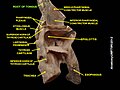
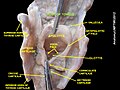
Root of tongue

See also

[edit]

References

[edit]

Sources

[edit]
  • Ladefoged, Peter; Maddieson, Ian (1996). The Sounds of the World's Languages. Oxford: Blackwell.
[edit]
Revisions and contributorsEdit on WikipediaRead on Wikipedia
from Grokipedia
In , advanced tongue root (ATR, denoted [+ATR]) and retracted tongue root (RTR, denoted [-ATR]) are binary articulatory features describing the position of the tongue root relative to the pharyngeal wall during production. [+ATR] involves advancement of the tongue root forward toward the front of the , which expands the pharyngeal cavity and is associated with a tense or " quality, while [-ATR] involves retraction of the tongue root backward, constricting the pharyngeal space and yielding a lax or " quality. These features were first systematically analyzed in the context of in Akan, a Kwa language spoken in , where they distinguish two harmonizing sets of s. The primary phonological role of ATR and RTR lies in vowel harmony systems, prevalent in numerous African languages such as Akan, Igbo, Maasai, and Dagbani, where all vowels in a morphological word must agree in tongue root position to satisfy harmony constraints. In such systems, [+ATR] is typically dominant, spreading to adjacent vowels and often triggered by high vowels, while [-ATR] vowels may be more restricted or recessive; neutral vowels like /a/ can occur in either set without triggering harmony. For example, in Maasai, words like the verb "to lead" (with all [+ATR] vowels) contrast with "to nauseate" (with all [-ATR] vowels), altering the word's meaning based solely on tongue root agreement. Beyond Africa, similar contrasts appear in some Eurasian languages, though less commonly, and ATR/RTR distinctions can also influence consonant articulation in emphatic or pharyngeal sounds. Articulatorily, studies confirm that [+ATR] s exhibit a consistently more anterior root position across vowel heights, independent of body raising, whereas [-ATR] positions vary but remain posterior relative to [+ATR]. Acoustically, these features correlate with patterns: [+ATR] s often show lowered first (F1) values, indicating greater pharyngeal openness, while [-ATR] s have higher F1, reflecting constriction; second (F2) effects depend on vowel height and language-specific realizations. In languages like English, an analogous (though not identical) tense-lax distinction in s such as /i/ in "beat" ([+tense, advanced root]) versus /ɪ/ in "bit" ([-tense, retracted root]) provides a perceptual bridge for non-native speakers encountering ATR . These features highlight the root's role as a secondary , enabling subtle yet phonemically contrastive inventories in harmony-governed languages.

Phonetic Definitions

Advanced Tongue Root

Advanced tongue root (ATR) is a phonetic feature primarily associated with vowels, defined by the forward advancement of the root toward the anterior , which enlarges the pharyngeal cavity. This articulation contrasts with neutral or retracted positions by promoting a more open vocal tract configuration. Articulatorily, +ATR involves the root being positioned more anteriorly and often lowered, accompanied by a concomitant lowering of the to facilitate pharyngeal expansion. imaging studies confirm that this results in a measurably advanced root position for +ATR vowels compared to their -ATR counterparts, with the root advancing by approximately 1-2 cm in some languages. This gesture frequently correlates with adjustments in , such as raising the body for tense-like qualities, though it can also co-occur with lax vowels in systems like English where short vowels exhibit partial -ATR retraction. In contrast to retracted root configurations, +ATR widens rather than constricts the . The feature was first systematically described in 1967 by J.M. Stewart in his analysis of Akan , where he identified tongue root position as the key distinguishing harmonic vowel sets. This work highlighted ATR's role in cross-height vowel contrasts, establishing it as a distinct parameter beyond traditional height or . Subsequent articulatory investigations, including and later data, validated Stewart's observations by demonstrating consistent tongue root advancement in +ATR vowels. In phonological feature geometry, +ATR is typically represented as a binary feature [+ATR] branching from a tongue root or pharyngeal node under the dorsal articulator, as proposed in models by G.N. Clements. This hierarchical structure allows [+ATR] to spread autosegmentally in harmony systems while maintaining articulatory coherence with other vocalic features like height. Clements' framework integrates ATR with height scales, treating it as an independent that modulates pharyngeal volume without directly subsuming under openness or centrality.

Retracted Tongue Root

Retracted root (RTR) is a phonetic feature primarily associated with vowels, characterized by the retraction of the root toward the posterior pharyngeal , which narrows the pharyngeal cavity. This articulatory configuration contrasts with advanced root (ATR) by involving a backward displacement rather than forward advancement of the root. In terms of articulatory mechanics, the production of RTR vowels involves the tongue root moving posteriorly to constrict the pharyngeal space, a typically linked to tense or qualities in various languages. This retraction pulls the body backward, contributing to a more constricted vocal tract configuration compared to neutral or advanced positions. The term RTR gained prominence in linguistic analysis during the , particularly through the work of Larry Hyman, who applied it to systems in African languages such as Bantu. Phonological models commonly denote RTR using the feature specification [RTR] or its binary counterpart [-ATR] to explicitly capture the retracted position and distinguish it from [+ATR] in feature geometries. This notation allows for precise representation of tongue root contrasts in both consonantal and vocalic articulations, emphasizing the retracted gesture as a distinct phonological primitive.

Articulatory and Acoustic Properties

Pharyngeal Effects

Advanced tongue root (ATR) articulation primarily involves forward advancement of the tongue root, which widens the pharyngeal cavity by increasing its cross-sectional area and overall volume. This expansion enlarges the space between the oral and pharyngeal regions, enhancing the of the through greater acoustic coupling. In contrast, retracted tongue root (RTR) articulation features backward retraction of the tongue root toward the posterior pharyngeal wall, causing narrowing of the pharyngeal cavity and a reduction in its volume. This diminishes the space, producing darker or more muffled sounds due to the smaller cavity size. Biomechanically, both ATR and RTR gestures require coordinated involvement of the pharyngeal constrictor muscles and hyoid bone movements to achieve the respective expansions or constrictions. For ATR, depression of the hyoid bone lowers the larynx, facilitating pharyngeal widening through relaxation of the constrictors; for RTR, elevation of the hyoid raises the larynx, enabling constriction via activation of these muscles. Cross-linguistic articulatory evidence from X-ray and MRI studies confirms these pharyngeal configurations, showing significant area changes associated with tongue root position. In Akan, for instance, MRI data reveal larger pharyngeal volumes for +ATR vowels compared to -ATR counterparts, highlighting the gesture's role in vowel production across languages.

Acoustic Correlates

The primary acoustic correlate distinguishing advanced tongue root ([+ATR]) from retracted tongue root ([-ATR] or RTR) vowels is a shift in the first frequency (F1), where [+ATR] vowels exhibit systematically lower F1 values than their [-ATR] counterparts, typically by 100–300 Hz or more, due to pharyngeal expansion and lowering that enlarges the vocal tract cavity. For instance, in like Ikposo and LuBwisi, [+ATR] high front vowels show F1 values around 246–300 Hz compared to 311–434 Hz for [-ATR] pairs. Similarly, in Igbo, acoustic analyses using software reveal F1 differences of approximately 200 Hz between [+ATR] and [-ATR] vowels, with [-ATR] forms displaying higher F1 alongside broader F1 bandwidth (B1) and elevated normalized center of gravity, reflecting pharyngeal constriction. In RTR-dominated systems, such as those analyzed in like Ewen where lax vowels are associated with tongue root retraction, F1 is raised for retracted high vowels (e.g., ~407 Hz for [+RTR] /ɪ/ vs. ~330 Hz for [-RTR] /i/), akin to the centralization effects observed in back or constricted vowels. Spectral characteristics further differentiate the two, with [+ATR] vowels generally displaying a lower center of gravity and greater concentration of energy in lower frequencies, often indicated by narrower B1 and higher H1–H2 differences (measuring relative amplitude of the first two harmonics). In Anii, for example, [+ATR] high vowels show H1–H2 values elevated by up to 10 dB compared to [-ATR] pairs, contributing to a perception of "open" or resonant quality, while [-ATR] vowels exhibit a higher center of gravity (e.g., 528 Hz vs. 463 Hz in Kinande) and relatively flatter spectral slopes with more distributed energy. These patterns underscore how pharyngeal resonance alters the overall spectral tilt, with [+ATR] forms having steeper negative slopes in nine-vowel systems. Centralized formants in [-ATR] vowels, particularly elevated F2 in some back pairs, enhance their "brighter" timbre relative to the deeper resonance of [+ATR]. Perceptually, listeners rely heavily on these F1 shifts and pharyngeal resonance cues to distinguish [+ATR] from [-ATR] vowels, as demonstrated in psychoacoustic experiments where acoustic similarity overrides phonological categories. In Akan, AX and ABX discrimination tasks showed high accuracy (over 95%) for pure ATR pairs like /i/–/ɪ/ due to robust F1 differences, but near-chance performance (around 24%) for ATR+height pairs like /ɪ/–/e/ with overlapping formants, indicating that listeners prioritize spectral proximity over harmony-driven expectations. Such cues are particularly salient in vowel harmony contexts, where pharyngeal expansion in [+ATR] enhances low-frequency resonance for easier detection, while RTR constriction raises F1 to signal retraction, as confirmed in cross-linguistic perception studies from the 1990s onward.

Applications in Vowel Harmony

ATR-Dominated Systems

In ATR-dominated systems, the feature [+ATR] typically spreads from root vowels to affixes either rightward or bidirectionally, resulting in the assimilation of target vowels to a [+ATR] value and often neutralizing contrasts that are perceptually linked to . This enforces agreement across the word domain, with [+ATR] exerting dominance over [-ATR], such that roots containing [+ATR] vowels trigger harmony in suffixes while the reverse is rarer or blocked. The spreading is phonetically motivated by the expansion of the pharyngeal cavity, which facilitates easier articulation and co-occurrence among [+ATR] vowels. Phonological analyses within feature geometry frameworks, such as that proposed by Archangeli and Pulleyblank, model [+ATR] as a dominant trigger under the tongue root node, where grounded constraints link its spreading to universal phonetic tendencies favoring pharyngeal advancement over retraction. These constraints ensure that [+ATR] propagates without interference from conflicting features, prioritizing resolution through delinking and relinking of the [ATR] specification in targets. In such systems, the dominance of [+ATR] reflects a typological toward advancement as the unmarked or preferred state in . Typologically, ATR-dominated is most prevalent among Niger-Congo languages, where it affects over 200 documented cases, often with harmony scopes confined to and adjacent suffixes rather than extending across the entire word or . control predominates, with affixes alternating based on root features, though some systems exhibit partial or opaque spreading limited by morphological boundaries. Historical reconstructions from the 1990s indicate that ATR harmony in developed from proto-systems dominated by vowel height harmony, where mid-vowel alternations in suffixes gradually reinterpreted height distinctions as [ATR] contrasts through chain shifts and analogical leveling. This evolution is evidenced by comparative evidence across Bantu branches, showing a transition from symmetric height agreement to asymmetric [+ATR] dominance in derived systems. Unlike RTR-dominated systems, where retraction propagates more aggressively, ATR systems in this lineage emphasize advancement as the harmonizing force.

RTR-Dominated Systems

In RTR-dominated harmony systems, the retracted ([RTR]) feature serves as the primary harmonizing property, requiring vowels within a prosodic domain—typically the word—to agree in pharyngeal . This mechanism involves the spreading of [RTR] from a trigger to non-initial targets, promoting uniformity in position while in some systems, such as certain , respecting height constraints by applying primarily between vowels of matching height (leading to opacity across mismatches), in others like Mongolic, operating across heights with specific transparencies or blockings. Such spreading enforces pharyngeal retraction in suffixes and adjacent vowels, contrasting with the expansion typical in ATR systems by prioritizing over advancement. Phonological analyses model [RTR] as a privative feature, specified only on retracted vowels and absent on their advanced counterparts, facilitating asymmetric spreading where the presence of [RTR] dominates. This privative treatment aligns with agreement-by-correspondence frameworks, which capture long-distance assimilation through similarity-based constraints on output forms, as developed in models of systems. In these rules, to [RTR] is modulated by constraints that prioritize within bounded domains, often neutralizing contrasts in lower-ranked features like height or rounding when [RTR] agreement is at stake. Typologically, RTR-dominated systems are characteristic of non-African languages, especially in Northeast Asian families including Mongolic and Tungusic, where frequently operates via left-to-right propagation from the or initial syllables. -controlled spreading is common, with stems dictating alternations, though some varieties exhibit bidirectional or iterative extension within the word, bounded by prosodic edges. These patterns underscore RTR's role in maintaining perceptual uniformity in sequences across diverse inventories. Historically, RTR harmony in traces its origins to consonantal retraction in proto-forms, which gradually reinterpreted pharyngeal features as vocalic, leading to full [RTR] systems in daughter languages by the medieval period. Comparative studies from the highlight this shift, showing how initial uvular or pharyngeal consonants conditioned retraction, evolving into autonomous vocalic harmony as consonantal triggers weakened or merged.

Interactions with Other Features

Relation to Phonation

The advanced tongue root (+ATR) gesture correlates with breathier in several languages, as the forward advancement of the tongue root relaxes glottal tension and enlarges the pharyngeal cavity, facilitating a more open . In Maa, an Eastern Nilotic language, +ATR vowels exhibit significantly breathier voice quality compared to -ATR vowels, characterized by steeper negative spectral tilt and higher open quotient values in electroglottographic measures. This association enhances perceptual distinctiveness, as breathy amplifies the acoustic effects of pharyngeal expansion. Conversely, the retracted tongue root (RTR) position often associates with creakier or tense , due to pharyngeal narrowing that increases glottal resistance and arytenoid adduction. In languages like those of the Altaic family, RTR vowels show acoustic markers of , such as increased spectral tilt and irregular glottal pulses, though this is not universal across all systems. Some exhibit this pattern, where RTR contributes to tense laryngeal settings alongside click accompaniments. Phonetic evidence from 2000s imaging studies demonstrates interactions between tongue root gestures and laryngeal settings, with +ATR promoting breathier modes and RTR creakier tension. These articulatory interactions are supported by observations in Austronesian languages, where tongue root position may covary with laryngeal height during register contrasts. In theoretical models of feature geometry, tongue root features ([+ATR] and [RTR]) are integrated under a Guttural node that links to the Laryngeal tier, allowing them to condition phonation specifications such as [spread glottis] for breathy voice or [constricted glottis] for creaky voice. This hierarchical structure accounts for observed co-occurrence and spreading in harmony systems. Recent perceptual studies, such as those on Akan (as of 2023), continue to confirm the covariation of tongue root position with voice quality distinctions.

Influence from Consonants

Pharyngeal and uvular fricatives induce retracted root (RTR) in neighboring vowels through coarticulatory assimilation, as the retracted position required for these consonants overlaps with articulation, reducing pharyngeal cavity size and influencing adjacent segments. This effect is particularly evident in pharyngealized consonants, where root retraction and body depression propagate to vowels, altering their articulatory and acoustic properties via . Dorsal consonants, such as velar stops, promote advanced root (ATR) or RTR in adjacent s based on the dorsum height involved in their production, according to coarticulation studies. In contexts with front s, velar stops engage the root in forward positioning to facilitate the dorsal , leading to anticipatory advancements in root gestures. Neutral consonants, often coronals like liquids and fricatives, exhibit blocking effects by interrupting the propagation of tongue root features across sequences, preventing assimilation due to their lack of compatible articulatory gestures. Electromagnetic articulography (EMA) data from the late and reveal anticipatory tongue root adjustments driven by preceding consonants and reflecting the biomechanical overlap in lingual gestures. These findings highlight the temporal extent of coarticulatory influences, with greater retraction or advancement observed in response to pharyngeal versus dorsal consonants.

Examples Across Languages

ATR in African Languages

In Igbo, a Niger-Congo language spoken primarily in southeastern Nigeria, the vowel inventory consists of eight oral vowels: the [+ATR] set (i, e, o, u) and the [-ATR] set (ɪ, ɛ, ɔ, ʊ), with /a/ neutral to harmony. In dialects like Imilike, the system includes additional contrasts such as schwa. This system distinguishes vowels through ATR harmony operating as a root-controlled process where the [+ATR] feature typically spreads from the root vowel to affixes and other vowels within the word. For example, in verbs like chí 'carry' (with [+ATR] i), suffixes harmonize to [+ATR], yielding forms such as chífè 'carry-PST', while roots with [-ATR] vowels, as in gụ̀ 'read', trigger [-ATR] in affixes like gụ̀tá 'read-PFV'. This harmony ensures phonological uniformity across morpheme boundaries, reinforcing the language's expansive vowel contrast. In standard Igbo, /a/ remains neutral; in dialects like Imilike, additional distinctions such as ATR and RTR schwa occur. Yoruba, another Niger-Congo language of the Yoruboid branch spoken in southwestern Nigeria and Benin, employs ATR as a primary tense-lax distinction in its seven oral vowels: [+ATR] high and mid vowels (i, u, e, o) contrast with [-ATR] counterparts (ɪ, ʊ, ɛ, ɔ), while /a/ patterns as [-ATR] and remains neutral to harmony. ATR harmony in Yoruba primarily affects mid vowels, spreading [+ATR] progressively from the root, as seen in forms like gbẹ́ 'kill' harmonizing with [+ATR] suffixes versus gbɛ̀ 'buy' with [-ATR]. Historical records from the 19th century, including missionary documentation by Samuel Crowther, reveal mergers such as the raising of nasal /ɪ̃/ to /ĩ/, reflecting early phonological shifts in the ATR system amid dialectal variation and contact influences. These mergers, noted in early orthographies, underscore the evolution of Yoruba's tense-lax oppositions from proto-Yoruboid stages. In Akan, a Kwa language of the Niger-Congo family spoken in Ghana, ATR harmony exhibits bidirectional spreading, with [+ATR] propagating both progressively within words from root to suffixes and regressively between words in phrases. The vowel system includes [+ATR] (i, e, o, u, a) and [-ATR] (ɪ, ɛ, ɔ, ʊ, ɑ) sets, where harmony maintains uniformity, as in ká 'say' [+ATR] influencing adjacent elements like suffixes or phrases. Exceptions arise in loanwords, particularly English borrowings, which often undergo adaptation to fit Akan's ATR rules; for instance, "school" is realized as skúúl with [+ATR] high vowels to satisfy harmony, though some retain foreign [-ATR] qualities in casual speech. This bidirectional mechanism, distinct from unidirectional systems elsewhere, highlights Akan's phrasal sensitivity to tongue root position. Recent studies from the 2020s on ATR acquisition among child learners in these languages reveal early sensitivity to cues. In Akan-speaking infants aged 9-11 months, exposure to multilingual environments facilitates segmentation using bidirectional [+ATR] as a prosodic , with experimental showing preferential to harmonious sequences by 10 months. For Igbo, articulatory analyses of child productions indicate that root-controlled [+ATR] spreading emerges around age 3-5, though with initial overgeneralization of [+ATR] to [-ATR] contexts in dialectal variants like Imilike. In Yoruba learners, perceptual studies document the tense-lax ATR contrast stabilizing by preschool age, influenced by historical merger patterns that simplify acquisition in urban dialects. These findings, drawn from longitudinal recordings and tasks, emphasize the role of input frequency in mastering ATR features across African contexts.

RTR in Asian and Native American Languages

In Korean, the contrast between tense and lax vowels has been analyzed in some studies, such as historical ones, as involving retracted tongue root (RTR) for the tense series, with tense vowels like /e, o/ exhibiting pharyngeal retraction relative to lax /ɛ, ɔ/. This RTR feature underlies historical vowel harmony patterns in , where tense vowels triggered spreading of retraction to suffixes, creating harmonic sets such as non-RTR /i, ɨ, u/ versus RTR /ʌ, o, a/. imaging studies have verified this retraction, showing a lower tongue root position during tense vowel production, which enhances the pharyngeal cavity adjustment and distinguishes the series acoustically through lowered F1 and F2 values. Turkish is predominantly governed by backness, but partial RTR effects emerge in back vowel contexts, particularly influencing low and rounded vowels through historical conditioning by uvular consonants. In Old Turkish, uvulars like /q/ induced pharyngeal retraction on adjacent vowels, evolving into modern back harmony where RTR traces persist in the realization of /a, ɯ, o, u/ as a subtle pharyngeal narrowing, especially in suffixes following back stems (e.g., ev-ler "houses" versus at-lar "horses"). This diachronic shift from uvular-driven RTR to backness dominance illustrates how consonantal influences shaped the system, with acoustic evidence of lowered F2 in s reflecting residual retraction. Recent documentation of the endangered Yurok language, an Algic isolate, reveals RTR involvement in its rhotic vowel harmony, where the retracted tongue root contributes to the central rhotic vowel /ɚ/ spreading to non-high vowels like /a, e, o/, altering them to rhotics in anticipatory fashion (e.g., /weʔɚ/ "water" harmonizes preceding vowels). However, 2020s revitalization efforts, amid intensive English contact, show progressive loss of this RTR-dependent harmony among younger fluent speakers, with simplification to non-rhotic realizations in elicited speech, attributed to incomplete acquisition and substrate influence from English phonology. This erosion underscores contact-induced feature reduction in small speech communities, as observed in community-based phonological surveys.

References

Add your contribution
Related Hubs
User Avatar
No comments yet.