


Community hub
Recent from talks
Contribute something
Nothing was collected or created yet.
31 Aquilae
View on Wikipedia  | |
| Observation data Epoch J2000 Equinox J2000 | |
|---|---|
| Constellation | Aquila[1] |
| Right ascension | 19h 24m 58.19997s[2] |
| Declination | +11° 56′ 39.8885″[2] |
| Apparent magnitude (V) | 5.16[3] |
| Characteristics | |
| Evolutionary stage | subgiant[2] |
| Spectral type | G8 IV[3] |
| U−B color index | +0.42[4] |
| B−V color index | +0.77[3] |
| Astrometry | |
| Radial velocity (Rv) | −100.5[5] km/s |
| Proper motion (μ) | RA: +721.292[2] mas/yr Dec.: +642.968[2] mas/yr |
| Parallax (π) | 67.0153±0.0657 mas[2] |
| Distance | 48.67 ± 0.05 ly (14.92 ± 0.01 pc) |
| Absolute magnitude (MV) | +4.26[1] |
| Details | |
| Mass | 1.16±0.07[6] M☉ |
| Radius | 1.379±0.042[7] R☉ |
| Luminosity | 1.904±0.045[7] L☉ |
| Surface gravity (log g) | 4.18±0.03[6] cgs |
| Temperature | 5,510±90[3] K |
| Metallicity [Fe/H] | +0.37[8] dex |
| Age | 4.5±0.2[6] Gyr |
| Other designations | |
| BD+11 3833, FK5 1503, HD 182572, GJ 759, NLTT 47763, HIP 95447, HR 7373, LFT 1477, LHS 3463, LTT 15668, NSV 11994, SAO 104807.[9] | |
| Database references | |
| SIMBAD | data |
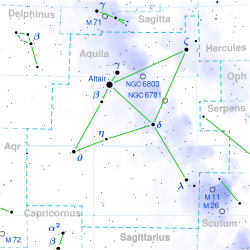
31 Aquilae (abbreviated 31 Aql) is a star in the equatorial constellation of Aquila. 31 Aquilae is its Flamsteed designation though it also bears the Bayer designation b Aquilae. This star has an apparent visual magnitude of 5.16 and is 49.5 light years from Earth. It has no known companions.
Properties
[edit]31 Aquilae has an apparent visual magnitude of 5.16,[3] making it bright enough to be seen with the naked eye in dark skies. The annual parallax shift of 67.0 mas[2] yields a distance estimate of 48.7 light-years (14.9 parsecs) from Earth. It is a variable star with a magnitude change of less than 0.02.[6]
With a stellar classification of G8 IV,[3] the luminosity class of IV indicates this is a subgiant star. Compared to the Sun, it has 116%[6] of the mass and 138%[7] of the radius. It is radiating nearly double[7] the luminosity of the Sun from its outer atmosphere at an effective temperature of 5,510 K,[3] giving it the yellow hue of a G-type star.[10] Its age is probably similar to NGC 188, the oldest open cluster known, which was calculated to be over 5 billion years. For its age, it is surprisingly rich in elements other than hydrogen or helium, contrary to common assumptions that the oldest stars should be metal-poor.
No certain substellar companion has been detected so far around 31 Aquilae. McDonald Observatory team has set limits to the presence of one or more planets [11] around 31 Aquilae with masses between 0.22 and 1.9 Jupiter masses and average separations spanning between 0.05 and 5.2 Astronomical Units.
Optical companions
[edit]The following stars are optical companions that are coincidentally aligned near the line of sight to 31 Aquilae.
| Companion | HD 231345 | BD+11 3833C |
|---|---|---|
| Right ascension | 19h 24m 51.8595s | 19h 24m 50.8s |
| Declination | +11° 57′ 14.692″ | +11° 57′ 36″ |
| Magnitude | 8.56 | 10.6 |
| Spectral type | G0 | |
| Reference | Simbad | Simbad |
References
[edit]- ^ a b Anderson, E.; Francis, Ch. (2012), "XHIP: An extended hipparcos compilation", Astronomy Letters, 38 (5): 331, arXiv:1108.4971, Bibcode:2012AstL...38..331A, doi:10.1134/S1063773712050015.
- ^ a b c d e f g Vallenari, A.; et al. (Gaia collaboration) (2023). "Gaia Data Release 3. Summary of the content and survey properties". Astronomy and Astrophysics. 674: A1. arXiv:2208.00211. Bibcode:2023A&A...674A...1G. doi:10.1051/0004-6361/202243940. S2CID 244398875. Gaia DR3 record for this source at VizieR.
- ^ a b c d e f g Malagnini, M. L.; Morossi, C. (November 1990), "Accurate absolute luminosities, effective temperatures, radii, masses and surface gravities for a selected sample of field stars", Astronomy and Astrophysics Supplement Series, 85 (3): 1015–1019, Bibcode:1990A&AS...85.1015M.
- ^ Johnson, H. L.; et al. (1966), "UBVRIJKL photometry of the bright stars", Communications of the Lunar and Planetary Laboratory, 4 (99): 99, Bibcode:1966CoLPL...4...99J.
- ^ Wielen, R.; et al. (1999), "Sixth Catalogue of Fundamental Stars (FK6). Part I. Basic fundamental stars with direct solutions", Veroeffentlichungen des Astronomischen Rechen-Instituts Heidelberg, 35 (35), Astronomisches Rechen-Institut Heidelberg: 1, Bibcode:1999VeARI..35....1W.
- ^ a b c d e Trevisan, M.; et al. (November 2011), "Analysis of old very metal rich stars in the solar neighbourhood", Astronomy & Astrophysics, 535: A42, arXiv:1109.6304, Bibcode:2011A&A...535A..42T, doi:10.1051/0004-6361/201016056, S2CID 49565866. See Table 13.
- ^ a b c d Boyajian, Tabetha S.; et al. (February 2012), "Stellar Diameters and Temperatures. I. Main-sequence A, F, and G Stars", The Astrophysical Journal, 746 (1): 101, arXiv:1112.3316, Bibcode:2012ApJ...746..101B, doi:10.1088/0004-637X/746/1/101, S2CID 18993744. See Table 10.
- ^ Soubiran, C.; et al. (2008), "Vertical distribution of Galactic disk stars. IV. AMR and AVR from clump giants", Astronomy and Astrophysics, 480 (1): 91–101, arXiv:0712.1370, Bibcode:2008A&A...480...91S, doi:10.1051/0004-6361:20078788, S2CID 16602121.
- ^ "* b Aql". SIMBAD. Centre de données astronomiques de Strasbourg. Retrieved 2012-07-22.
- ^ "The Colour of Stars", Australia Telescope, Outreach and Education, Commonwealth Scientific and Industrial Research Organisation, December 21, 2004, archived from the original on February 22, 2012, retrieved 2012-01-16
- ^ Detection Limits from the McDonald Observatory Planet Search Program
External links
[edit]- The Old Disk Metal-Rich Subgiant 31 Aquilae doi:10.1086/151065
- Image 31 Aquilae
- HR 7373
- CCDM 19249+1157
- R.A. Wittenmeyer et al., "Detection Limits from the McDonald Observatory Planet Search Program", The Astronomical Journal, Volume 132, Issue 1, pp. 177–188, May 2006.
