


Community hub
Recent from talks
Contribute something
Nothing was collected or created yet.
35 Aquilae
View on Wikipedia  | |
| Observation data Epoch J2000 Equinox J2000 | |
|---|---|
| Constellation | Aquila |
| Right ascension | 19h 29m 00.98694s[1] |
| Declination | +01° 57′ 01.6168″[1] |
| Apparent magnitude (V) | 5.80[2] |
| Characteristics | |
| Evolutionary stage | main sequence[3][1] |
| Spectral type | A0 V[4] |
| U−B color index | +0.07[2] |
| B−V color index | +0.08[2] |
| Variable type | δ Sct[5] |
| Astrometry | |
| Radial velocity (Rv) | +12[6] km/s |
| Proper motion (μ) | RA: −2.892[1] mas/yr Dec.: −32.443[1] mas/yr |
| Parallax (π) | 16.5652±0.0430 mas[1] |
| Distance | 196.9 ± 0.5 ly (60.4 ± 0.2 pc) |
| Details | |
| Mass | 2.38[7] M☉ |
| Radius | 1.55[7] R☉ |
| Luminosity | 17[7] L☉ |
| Surface gravity (log g) | 4.43[7] cgs |
| Temperature | 9,376[7] K |
| Metallicity [Fe/H] | −1.30±0.50[8] dex |
| Rotational velocity (v sin i) | 110[9] km/s |
| Age | 448[10] Myr |
| Other designations | |
| V1431 Aquilae, AG+01°2294, BD+01°4010, GCRV 11908, HD 183324, HIP 95793, HR 7400, SAO 124675[11] | |
| Database references | |
| SIMBAD | data |
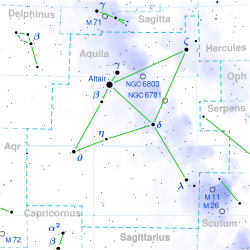
35 Aquilae (abbreviated 35 Aql) is a star in the equatorial constellation of Aquila. 35 Aquilae is its Flamsteed designation though it also bears the Bayer designation c Aquilae. The apparent visual magnitude of this star is 5.8,[2] which means it is a faint star but visible to the naked eye from dark suburban or rural skies. It has an annual parallax shift of 16.34 mas that is caused by the Earth's orbit around the Sun. This yields a distance estimate of 200 light-years (61 parsecs), give or take a 4 light-year margin of error. At this distance, the visual magnitude is diminished by 0.26 from extinction caused by interstellar gas and dust.[8]
The spectrum of 35 Aquilae fits a stellar classification of A0 V,[4] indicating it is an A-type main sequence star. Compared to the Sun, it has 238% of its mass and 155% of its radius.[7] As such, it is much brighter than the Sun, emitting 17 times the luminosity from its outer atmosphere at an effective temperature of 9,376 K.[7] This heat causes it to glow with the white-hot hue of an A-type star.[12] 35 Aquilae is spinning rapidly with a projected rotational velocity of 110 km/s.[9]

In 1994 it was discovered that 35 Aquilae is a variable star with a pulsation period of just 30 minutes.[13] It was determined to be a Delta Scuti variable, which is a type of star found on the instability strip that undergoes short period pulsations.[5] Observation with the Spitzer Space Telescope shows that 35 Aquilae is radiating an excess level of infrared radiation for a star of its type. This excess may be explained by the heating of nearby interstellar dust belonging to a diffuse cloud of material that the star is passing through. This interaction may also explain the Lambda Boötis categorization for this star.[14]
References
[edit]- ^ a b c d e f Vallenari, A.; et al. (Gaia collaboration) (2023). "Gaia Data Release 3. Summary of the content and survey properties". Astronomy and Astrophysics. 674: A1. arXiv:2208.00211. Bibcode:2023A&A...674A...1G. doi:10.1051/0004-6361/202243940. S2CID 244398875. Gaia DR3 record for this source at VizieR.
- ^ a b c d Johnson, H. L.; Iriarte, B.; Mitchell, R. I.; Wisniewskj, W. Z. (1966), "UBVRIJKL photometry of the bright stars", Communications of the Lunar and Planetary Laboratory, 4: 99–110, Bibcode:1966CoLPL...4...99J.
- ^ Zorec, J.; Royer, F. (2012). "Rotational velocities of A-type stars. IV. Evolution of rotational velocities". Astronomy and Astrophysics. 537: A120. arXiv:1201.2052. Bibcode:2012A&A...537A.120Z. doi:10.1051/0004-6361/201117691.
- ^ a b Cowley, A.; et al. (April 1969), "A study of the bright A stars. I. A catalogue of spectral classifications", Astronomical Journal, 74: 375–406, Bibcode:1969AJ.....74..375C, doi:10.1086/110819.
- ^ a b Rodríguez, E.; Breger, M. (January 2001), "delta Scuti and related stars: Analysis of the R00 Catalogue", Astronomy and Astrophysics, 366: 178–196, Bibcode:2001A&A...366..178R, doi:10.1051/0004-6361:20000205.
- ^ Evans, D. S. (June 20–24, 1966), "The Revision of the General Catalogue of Radial Velocities", in Batten, Alan Henry; Heard, John Frederick (eds.), Determination of Radial Velocities and their Applications, Proceedings from IAU Symposium no. 30, vol. 30, University of Toronto: International Astronomical Union, p. 57, Bibcode:1967IAUS...30...57E.
- ^ a b c d e f g Stassun, Keivan G.; et al. (2019). "The Revised TESS Input Catalog and Candidate Target List". The Astronomical Journal. 158 (4): 138. arXiv:1905.10694. Bibcode:2019AJ....158..138S. doi:10.3847/1538-3881/ab3467.
- ^ a b Koleva, M.; Vazdekis, A. (February 2012), "Stellar population models in the UV. I. Characterisation of the New Generation Stellar Library", Astronomy & Astrophysics, 538: A143, arXiv:1111.5449, Bibcode:2012A&A...538A.143K, doi:10.1051/0004-6361/201118065, S2CID 53999614.
- ^ a b Royer, F.; Zorec, J.; Gómez, A. E. (February 2007), "Rotational velocities of A-type stars. III. Velocity distributions", Astronomy and Astrophysics, 463 (2): 671–682, arXiv:astro-ph/0610785, Bibcode:2007A&A...463..671R, doi:10.1051/0004-6361:20065224, S2CID 18475298.
- ^ Squicciarini, V.; Mazoyer, J.; Lagrange, A.-M.; Chomez, A.; Delorme, P.; Flasseur, O.; Kiefer, F.; Bergeon, S.; Albert, D.; Meunier, N. (2025). "The COBREX archival survey: Improved constraints on the occurrence rate of wide-orbit substellar companions: I. A uniform re-analysis of 400 stars from the GPIES survey". Astronomy and Astrophysics. 693. arXiv:2411.06157. Bibcode:2025A&A...693A..54S. doi:10.1051/0004-6361/202452310.
- ^ "35 Aql". SIMBAD. Centre de données astronomiques de Strasbourg. Retrieved 2012-07-21.
- ^ "The Colour of Stars", Australia Telescope, Outreach and Education, Commonwealth Scientific and Industrial Research Organisation, December 21, 2004, archived from the original on February 22, 2012, retrieved 2012-07-21.
- ^ a b Kuschnig, R.; Paunzen, E.; Weiss, W. W. (August 1994), "HD183324, A Pulsating lambda Boo Star?", Information Bulletin on Variable Stars, 4070: 1, Bibcode:1994IBVS.4070....1K.
- ^ Martínez-Galarza, J. R.; et al. (March 2009), "Infrared Emission by Dust Around λ Bootis Stars: Debris Disks or Thermally Emitting Nebulae?", The Astrophysical Journal, 694 (1): 165–173, arXiv:0812.2198, Bibcode:2009ApJ...694..165M, doi:10.1088/0004-637X/694/1/165, S2CID 14298654.
