


Community hub
Recent from talks
Contribute something
Nothing was collected or created yet.
9 Cephei
View on Wikipedia  | |
| Observation data Epoch J2000.0 Equinox J2000.0 | |
|---|---|
| Constellation | Cepheus |
| Right ascension | 21h 37m 55.22469s[1] |
| Declination | +62° 04′ 54.9825″[1] |
| Apparent magnitude (V) | 4.69 - 4.78[2] |
| Characteristics | |
| Spectral type | B2 Ib[3] |
| U−B color index | −0.54[4] |
| B−V color index | +0.30[4] |
| Variable type | α Cyg[2] |
| Astrometry | |
| Radial velocity (Rv) | −13.50 ± 0.8[5] km/s |
| Proper motion (μ) | RA: −1.64 ± 0.17[1] mas/yr Dec.: −3.02 ± 0.16[1] mas/yr |
| Parallax (π) | 0.48±0.14 mas[1] |
| Distance | 950[6] pc |
| Absolute magnitude (MV) | −6.44[3] |
| Details | |
| Searle et al 2008[3] | |
| Mass | 21 M☉ |
| Radius | 39.8 R☉ |
| Luminosity | 151,000 L☉ |
| Surface gravity (log g) | 2.50 cgs |
| Temperature | 18,000 K |
| Rotational velocity (v sin i) | 73 km/s |
| Markova & Puls 2008[7] | |
| Mass | 12 M☉ |
| Radius | 32 R☉ |
| Luminosity | 129,000 L☉ |
| Surface gravity (log g) | 2.50 cgs |
| Temperature | 19,200 K |
| Rotational velocity (v sin i) | 45 km/s |
| Other designations | |
| 9 Cephei, V337 Cephei, HD 206165, HR 8279, HIP 106801, BD+61°2169, 2MASS J21375521+6204548, GSC 04253-02243 | |
| Database references | |
| SIMBAD | data |
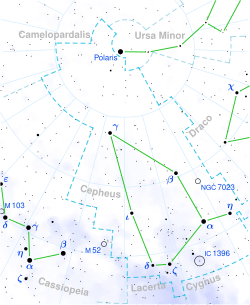
9 Cephei (9 Cep), also known as V337 Cephei, is a variable star in the constellation Cepheus. It is visible to the naked eye.

In 1967, Graham Hill announced his discovery that 9 Cephei is a variable star.[9] 9 Cephei was given the name V337 Cephei and classified as an α Cygni variable in 1979.[10] It varies irregularly between magnitude 4.69 and 4.78.[2] A study of the Hipparcos satellite photometry showed an amplitude of 0.56 magnitudes, but could find no periodicity.[11]
9 Cephei is considered to be a member of the Cepheus OB2 stellar association, a scattering of massive bright stars around a thousand parsecs away in the southern part of the constellation Cepheus.[3]
Calculations of the physical properties of 9 Cephei vary considerably even from broadly similar observational data. Modelling using the non-LTE line-blanketed CMFGEN atmospheric code gives a temperature of 18,000 K, radius of 40 R☉, luminosity of 151,000 L☉, and mass of 21 M☉.[3] Calculations using the FASTWIND model give gives a temperature of 19,200 K, radius of 32 R☉, luminosity of 129,000 L☉, and mass of 12 M☉.[7]
References
[edit]- ^ a b c d e van Leeuwen, F. (2007). "Validation of the new Hipparcos reduction". Astronomy and Astrophysics. 474 (2): 653–664. arXiv:0708.1752. Bibcode:2007A&A...474..653V. doi:10.1051/0004-6361:20078357. S2CID 18759600.Vizier catalog entry
- ^ a b c Samus, N. N.; Durlevich, O. V.; et al. (2009). "VizieR Online Data Catalog: General Catalogue of Variable Stars (Samus+ 2007-2013)". VizieR On-line Data Catalog: B/GCVS. Originally Published in: 2009yCat....102025S. 1. Bibcode:2009yCat....102025S.
- ^ a b c d e Searle, S. C.; Prinja, R. K.; Massa, D.; Ryans, R. (2008). "Quantitative studies of the optical and UV spectra of Galactic early B supergiants. I. Fundamental parameters". Astronomy and Astrophysics. 481 (3): 777. arXiv:0801.4289. Bibcode:2008A&A...481..777S. doi:10.1051/0004-6361:20077125. S2CID 1552752.
- ^ a b Ducati, J. R. (2002). "VizieR Online Data Catalog: Catalogue of Stellar Photometry in Johnson's 11-color system". CDS/ADC Collection of Electronic Catalogues. 2237. Bibcode:2002yCat.2237....0D.
- ^ Gontcharov, G. A. (2006). "Pulkovo Compilation of Radial Velocities for 35 495 Hipparcos stars in a common system". Astronomy Letters. 32 (11): 759–771. arXiv:1606.08053. Bibcode:2006AstL...32..759G. doi:10.1134/S1063773706110065. S2CID 119231169.
- ^ Pan, K.; Federman, S. R.; Cunha, K.; Smith, V. V.; Welty, D. E. (2004). "Cloud Structure and Physical Conditions in Star-forming Regions from Optical Observations. I. Data and Component Structure". The Astrophysical Journal Supplement Series. 151 (2): 313. arXiv:astro-ph/0312095. Bibcode:2004ApJS..151..313P. doi:10.1086/381805. S2CID 17367021.
- ^ a b Markova, N.; Puls, J. (2008). "Bright OB stars in the Galaxy. IV. Stellar and wind parameters of early to late B supergiants". Astronomy and Astrophysics. 478 (3): 823. arXiv:0711.1110. Bibcode:2008A&A...478..823M. doi:10.1051/0004-6361:20077919. S2CID 14510634.
- ^ "MAST: Barbara A. Mikulski Archive for Space Telescopes". Space Telescope Science Institute. Retrieved 23 April 2023.
- ^ Hill, Graham (August 1967). "Some New Variables in Nearby Associations and Galactic Clusters". Astrophysical Journal Supplement. 14: 301–306. Bibcode:1967ApJS...14..301H. doi:10.1086/190157. Retrieved 22 January 2025.
- ^ Kholopov, P. N.; Kukarkina, N. P.; Perova, N. B. (1979). "64th Name-List of Variable Stars". Information Bulletin on Variable Stars. 1581: 1. Bibcode:1979IBVS.1581....1K.
- ^ Lefèvre, L.; Marchenko, S. V.; Moffat, A. F. J.; Acker, A. (2009). "A systematic study of variability among OB-stars based on HIPPARCOS photometry". Astronomy and Astrophysics. 507 (2): 1141. Bibcode:2009A&A...507.1141L. doi:10.1051/0004-6361/200912304.
