


Community hub
Recent from talks
Contribute something
Nothing was collected or created yet.
MY Cephei
View on Wikipedia| Observation data Epoch J2000.0 Equinox J2000.0 | |
|---|---|
| Constellation | Cepheus |
| Right ascension | 22h 54m 31.698s[1] |
| Declination | +60° 49′ 38.97″[1] |
| Apparent magnitude (V) | 14.4–15.5[2] |
| Characteristics | |
| Evolutionary stage | Extreme[3] OH/IR red supergiant[4] |
| Spectral type | M3,[5] M7–7.5 I[6] (M6–7Iab[2]) |
| Apparent magnitude (G) | 10.225[1] |
| Apparent magnitude (H) | 2.98[7] |
| Apparent magnitude (K) | 2.14[7] |
| Variable type | SRc[2] |
| Astrometry | |
| Proper motion (μ) | RA: –2.637[1] mas/yr Dec.: –1.883[1] mas/yr |
| Parallax (π) | 0.3398±0.0708 mas[1] |
| Distance | 3,000+350 −290[8] pc |
| Details | |
| Mass | 14.5[9] M☉ |
| Radius | 1,028 ± 169 – 1,138 ± 387[5][a] R☉ |
| Luminosity | 159,000+60,000 −44,000 – 195,000+173,000 −92,000[5][b] L☉ |
| Temperature | 3,595±31[5] K |
| Age | 9[6] Myr |
| Other designations | |
| MY Cep, IRC +60375, 2MASS J22543171+6049388, IRAS 22525+6033, RAFGL 2987 | |
| Database references | |
| SIMBAD | data |

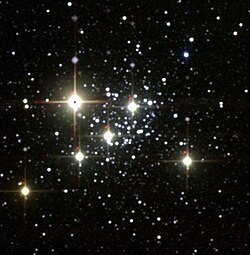
MY Cephei (IRC +60375) is a red supergiant located in the open cluster NGC 7419 in the constellation of Cepheus. It is a semiregular variable star with a maximum brightness of magnitude 14.4 and a minimum of magnitude 15.5.
Observations and variability
[edit]
Observations of the open cluster NGC 7419 in 1954 showed that four of its members were luminous red stars, most likely red supergiants. In addition, an unusually red star was found to be variable and probably an even more luminous supergiant.[11] This star was given the variable star designation MY Cephei in 1973 in the 59th name-list of variable stars.[12]
MY Cephei is classified as semiregular variable star of sub-type SRc, indicating it is a cool supergiant, although its pulsational period is not known. It has been observed as bright as magnitude 14.4 and as faint as magnitude 15.5.[2] The star, along with another late red supergiant star, S Persei, are sometimes considered prototypes for the class of M6–7 supergiants.[13]
Distance
[edit]The distance of MY Cephei is assumed to be around 9,780+1,140
−950 light years or 3,000+350
−290 parsecs based on it being a member of the NGC 7419 open cluster.[6][8] Gaia Early Data Release 3 gives a parallax of 0.3398±0.0708 mas for MY Cep,[1] implying a similar distance of 2,691+511
−419 pc.[14]
Stellar properties
[edit]The spectral type of MY Cephei is given in the General Catalogue of Variable Stars as M6–7 Iab, indicating the star is an intermediate-size luminous supergiant star,[2] although most authors gives M7–M7.5 I.[6] Classification is difficult because of the lack of comparable standard stars, but its spectrum appears to be later than M5, earlier than VX Sagittarii when at M9, and more luminous than M7 giant stars.[13] A 2021 study gives a spectral class of M3 based on infrared observations, and a correspondingly higher temperature.[5]
MY Cephei is a very luminous, cool and large extreme supergiant star, with a luminosity more than 100,000 times that of the Sun (L☉) and a radius in excess of a thousand times the Sun's radius (R☉). It is likely the most luminous, coolest, and the largest supergiant star in its open cluster,[6] and occupies the upper-right hand corner of the Hertzsprung–Russell diagram.
A 2018 paper gives the star a temperature of 3,400 K, corresponding a radius of 1,134 R☉ based on a luminosity of 155,000 L☉.[15] The mass of MY Cephei is uncertain, but expected to be around 14.5 times the Sun's mass (M☉).[9] Mass is being lost at (2.3±0.3)×10−5 M☉ per year, one of highest mass loss rates known for a supergiant star.[6]
A study from 2020 based on SED integration gives an unexpectedly higher bolometric luminosity of 310,000±70,000 L☉, close to the empirical upper luminosity limit of red supergiants (i.e. Humphreys–Davidson limit). This implies a higher radius of 2,061 ± 233 R☉ based on an effective temperature of 3,000 K derived using the DUSTY model, considerably larger than the upper radius limit of red supergiants at roughly 1,500 R☉ respectively.[16][6] Older studies frequently calculated even more lower temperatures and an estimated radius of 2,400 R☉.[13]
See also
[edit]- NML Cygni — another late-type red supergiant or hypergiant star.
- VY Canis Majoris — another large and luminous supergiant or hypergiant star.
Notes
[edit]- ^ Applying the Stefan-Boltzmann Law with a nominal solar effective temperature of 5,772 K:
- .
- .
- ^ Calculated using the following equation:
, where mbol is the star's apparent bolometric magnitude and d is the distance in parsecs. The values used for the mbol are 4.29±0.35 and 4.07±0.69, while the value used for the distance is 3,240 parsecs.


References
[edit]- ^ a b c d e f g Brown, A. G. A.; et al. (Gaia collaboration) (2021). "Gaia Early Data Release 3: Summary of the contents and survey properties". Astronomy & Astrophysics. 649: A1. arXiv:2012.01533. Bibcode:2021A&A...649A...1G. doi:10.1051/0004-6361/202039657. S2CID 227254300. (Erratum: doi:10.1051/0004-6361/202039657e). Gaia EDR3 record for this source at VizieR.
- ^ a b c d e "GCVS Query=MY Cep". General Catalogue of Variable Stars @ Sternberg Astronomical Institute, Moscow, Russia. Retrieved 2020-08-06.
- ^ Davies, Ben; Beasor, Emma R. (2019). "The distances to star clusters hosting Red Supergiants: χ per, NGC 7419, and Westerlund 1". Monthly Notices of the Royal Astronomical Society: Letters. 486: L10 – L14. arXiv:1903.12506. doi:10.1093/mnrasl/slz050. S2CID 88517447.
- ^ Beauchamp, Alain; Moffat, Anthony F. J.; Drissen, Laurent (1994). "The galactic open cluster NGC 7419 and its five red supergiants". Astrophysical Journal Supplement Series. 93: 187. Bibcode:1994ApJS...93..187B. doi:10.1086/192051.
- ^ a b c d e Messineo, Maria; Figer, Donald F.; Kudritzki, Rolf-Peter; Zhu, Qingfeng; Menten, Karl M.; Ivanov, Valentin D.; Chen, C. -H. Rosie (2021). "New Infrared Spectral Indices of Luminous Cold Stars: From Early K to M Types". The Astronomical Journal. 162 (5): 187. arXiv:2107.03707. Bibcode:2021AJ....162..187M. doi:10.3847/1538-3881/ac116b. S2CID 235765247.
- ^ a b c d e f g Humphreys, Roberta M.; Helmel, Greta; Jones, Terry J.; Gordon, Michael S. (August 2020). "Exploring the Mass Loss Histories of the Red Supergiants". The Astronomical Journal. 160 (3): 145. arXiv:2008.01108. Bibcode:2020AJ....160..145H. doi:10.3847/1538-3881/abab15. S2CID 220961677.
- ^ a b Cutri, Roc M.; Skrutskie, Michael F.; Van Dyk, Schuyler D.; Beichman, Charles A.; Carpenter, John M.; Chester, Thomas; Cambresy, Laurent; Evans, Tracey E.; Fowler, John W.; Gizis, John E.; Howard, Elizabeth V.; Huchra, John P.; Jarrett, Thomas H.; Kopan, Eugene L.; Kirkpatrick, J. Davy; Light, Robert M.; Marsh, Kenneth A.; McCallon, Howard L.; Schneider, Stephen E.; Stiening, Rae; Sykes, Matthew J.; Weinberg, Martin D.; Wheaton, William A.; Wheelock, Sherry L.; Zacarias, N. (2003). "VizieR Online Data Catalog: 2MASS All-Sky Catalog of Point Sources (Cutri+ 2003)". CDS/ADC Collection of Electronic Catalogues. 2246: II/246. Bibcode:2003yCat.2246....0C.
- ^ a b Davies, Ben; Beasor, Emma R. (March 2020). "The 'red supergiant problem': the upper luminosity boundary of Type II supernova progenitors". MNRAS. 493 (1): 468–476. arXiv:2001.06020. Bibcode:2020MNRAS.493..468D. doi:10.1093/mnras/staa174. S2CID 210714093.
- ^ a b Marco, A.; Negueruela, I. (2013). "NGC 7419 as a template for red supergiant clusters". Astronomy & Astrophysics. 552: A92. arXiv:1302.5649. Bibcode:2013A&A...552A..92M. doi:10.1051/0004-6361/201220750. S2CID 53723223.
- ^ "ASAS-SN Variable Stars Database". ASAS-SN Variable Stars Database. ASAS-SN. Retrieved 3 December 2022.
- ^ Blanco, V.; Nassau, J. J.; Stock, J.; Wehlau, W. (1955). "M-Type Stars in NGC 7419". The Astrophysical Journal. 121: 637. Bibcode:1955ApJ...121..637B. doi:10.1086/146029.
- ^ Kukarkin, B. V.; Kholopov, P. N.; Kukarkina, N. P.; Perova, N. B. (1973). "59th Name-List of Variable Stars". Information Bulletin on Variable Stars. 834: 1. Bibcode:1973IBVS..834....1K.
- ^ a b c Fawley, W. M.; Cohen, M. (1974). "The open cluster NGC 7419 and its M7 supergiant IRC +60 375". Astrophysical Journal. 193: 367. Bibcode:1974ApJ...193..367F. doi:10.1086/153171.
- ^ Bailer-Jones, C. A. L.; Rybizki, J.; Fouesneau, M.; Demleitner, M.; Andrae, R. (2021). "Estimating Distances from Parallaxes. V. Geometric and Photogeometric Distances to 1.47 Billion Stars in Gaia Early Data Release 3". The Astronomical Journal. 161 (3): 147. arXiv:2012.05220. Bibcode:2021AJ....161..147B. doi:10.3847/1538-3881/abd806. S2CID 228063812.
- ^ Beasor, Emma R; Davies, Ben; Arroyo-Torres, B; Chiavassa, A; Guirado, J. C; Marcaide, J. M; Alberdi, A; De Wit, W. J; Hofmann, K. -H; Meilland, A; Millour, F; Mohamed, S; Sanchez-Bermudez, J (2018). "The evolution of red supergiant mass-loss rates". Monthly Notices of the Royal Astronomical Society. 475 (1): 55. arXiv:1712.01852. Bibcode:2018MNRAS.475...55B. doi:10.1093/mnras/stx3174. S2CID 55822928.
- ^ Emily M. Levesque; Philip Massey; K. A. G. Olsen; Bertrand Plez; et al. (August 2005). "The Effective Temperature Scale of Galactic Red Supergiants: Cool, but Not As Cool As We Thought". The Astrophysical Journal. 628 (2): 973–985. arXiv:astro-ph/0504337. Bibcode:2005ApJ...628..973L. doi:10.1086/430901. S2CID 15109583.
