Community hub
Recent from talks
Contribute something
Nothing was collected or created yet.
W Cephei
View on Wikipedia| Observation data Epoch J2000 Equinox J2000 | |
|---|---|
| Constellation | Cepheus |
| Right ascension | 22h 36m 27.56307s[2] |
| Declination | +58° 25′ 33.9554″[2] |
| Apparent magnitude (V) | 6.83 - 9.20[3] |
| Characteristics | |
| Evolutionary stage | Red supergiant + non-supergiant B class star |
| Spectral type | K0ep-M2ep Ia + B0/B1[3] |
| Variable type | SRc[3] |
| Astrometry | |
| Radial velocity (Rv) | −44.64[4] km/s |
| Proper motion (μ) | RA: −3.176[2] mas/yr Dec.: −2.277[2] mas/yr |
| Distance | 2,427[5] pc |
| Absolute magnitude (MV) | −7[6] + −3.5[7] |
| Orbit[8] | |
| Period (P) | 2,075 d |
| Eccentricity (e) | 0.149 |
| Inclination (i) | 90° |
| Details | |
| Radius | 670+20 −10[2] R☉ |
| Luminosity | 292,000[9] L☉ |
| Surface gravity (log g) | 0.18[2] cgs |
| Temperature | 3,681[9] – 4,400[10] K |
| Metallicity | 0.0205[2] |
| Other designations | |
| W Cep, BD+57°2568, HD 214369, HIP 111592, GSC 03995-00937, SAO 34614, PPM 40864, GC 31569, UCAC3 297-183471, IRAS 22345+5809, 2MASS J22362757+5825340, AAVSO 2232+57 | |
| Database references | |
| SIMBAD | data |

W Cephei is a spectroscopic binary and variable star located in the constellation Cepheus. It is thought to be a member of the Cep OB1 stellar association at about 8,000 light years.[5][11]
Discovery
[edit]W Cephei was catalogued as BD+57°2568 in the Bonner Durchmusterung published in 1903, and HD 214369 in the Henry Draper Catalogue. It was discovered to be a variable star by T. H. E. C. Espin, in 1885.[12] It was described in 1896 as a red star varying from magnitude 7.3 to 8.3.[13]
In 1925, W Cep was included in a listing of Be stars. It was recognised as a cool star with spectral type Mep.[14] It was classified as K0ep Ia from a 1949 spectrum, but also recognised to have a small hot companion, plus an unusual infrared excess.[15][16] Ultraviolet spectra allowed absorption lines from the companion to be studied and it was given a spectral type of B0-1.[17]
System
[edit]The W Cephei system contains a luminous red supergiant star with a non-supergiant early B companion. The star has unusual emission lines including both permitted and forbidden FeII, produced by a circumstellar envelope containing dust and ionised gas.[6] The two components have been resolved at 0.262″ using speckle interferometry.[18] An orbital period of 2,090 days has been proposed.[11]
Variability
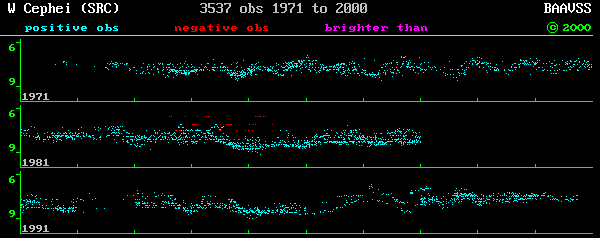
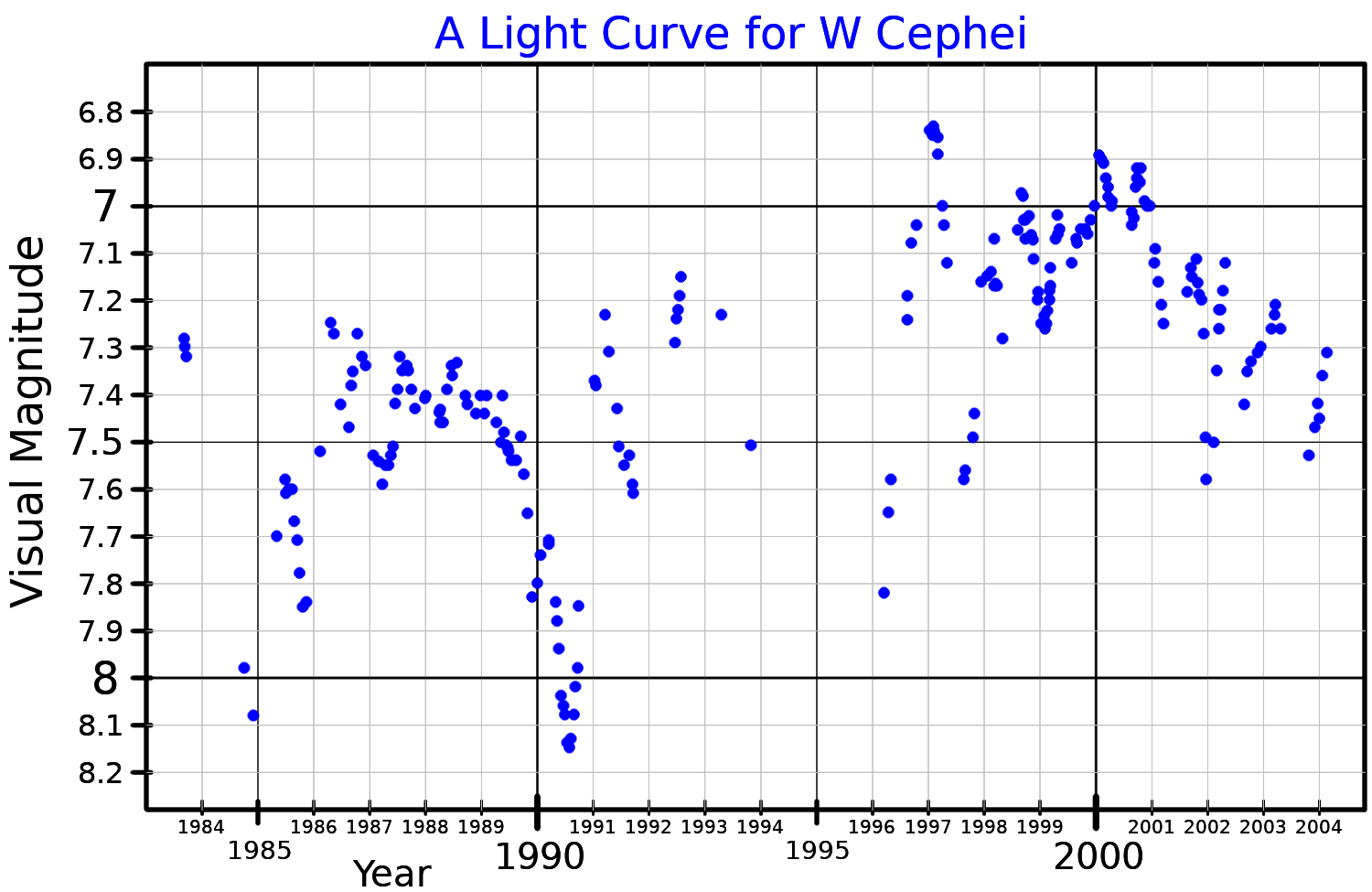
[edit]W Cephei varies in brightness from 7th to 9th magnitude. The General Catalogue of Variable Stars lists it as a semiregular variable with a period of 370 days, but later attempts to find a period have shown only random variations.[19][20] It has also been proposed that eclipses occur.[21]
References
[edit]- ^ Polyakova, T. A. (April 2006). "Variations in the brightness and polarization of W Cep". Astrophysics. 49 (2): 164–172. Bibcode:2006Ap.....49..164P. doi:10.1007/s10511-006-0017-z. S2CID 121041350. Retrieved 7 December 2021.
- ^ a b c d e f g Vallenari, A.; et al. (Gaia collaboration) (2023). "Gaia Data Release 3. Summary of the content and survey properties". Astronomy and Astrophysics. 674: A1. arXiv:2208.00211. Bibcode:2023A&A...674A...1G. doi:10.1051/0004-6361/202243940. S2CID 244398875. Gaia DR3 record for this source at VizieR.
- ^ a b c Samus, N. N.; et al. (2017). "General Catalogue of Variable Stars". Astronomy Reports. 5.1. 61 (1): 80–88. Bibcode:2017ARep...61...80S. doi:10.1134/S1063772917010085. S2CID 125853869.
- ^ Famaey, B.; Jorissen, A.; Luri, X.; Mayor, M.; Udry, S.; Dejonghe, H.; Turon, C. (2005). "Local kinematics of K and M giants from CORAVEL/Hipparcos/Tycho-2 data. Revisiting the concept of superclusters". Astronomy and Astrophysics. 430 (1): 165. arXiv:astro-ph/0409579. Bibcode:2005A&A...430..165F. doi:10.1051/0004-6361:20041272. S2CID 17804304.
- ^ a b Famaey, B.; Jorissen, A.; Luri, X.; Mayor, M.; Udry, S.; Dejonghe, H.; Turon, C. (2005). "Local kinematics of K and M giants from CORAVEL/Hipparcos/Tycho-2 data. Revisiting the concept of superclusters". Astronomy and Astrophysics. 430 (1): 165. arXiv:astro-ph/0409579. Bibcode:2005A&A...430..165F. doi:10.1051/0004-6361:20041272. S2CID 17804304.
- ^ a b Wallerstein, George (1971). "On the Infrared Excess of W Cephei and Similar Stars". Astrophysical Journal. 166: 725. Bibcode:1971ApJ...166..725W. doi:10.1086/150996.
- ^ Stickland, David J. (1988). "IUE and stars with composite spectra". In ESA. 281: 27. Bibcode:1988ESASP.281b..27S.
- ^ Petrova, A. V.; Orlov, V. V. (1999). "Apsidal Motion in Double Stars. I. Catalog". The Astronomical Journal. 117 (1): 587. Bibcode:1999AJ....117..587P. doi:10.1086/300671. S2CID 122386285.
- ^ a b Dorn-Wallenstein, Trevor Z.; Levesque, Emily M.; Neugent, Kathryn F.; Davenport, James R. A.; Morris, Brett M.; Gootkin, Keyan (2020). "Short Term Variability of Evolved Massive Stars with TESS II: A New Class of Cool, Pulsating Supergiants". The Astrophysical Journal. 902 (1): 24. arXiv:2008.11723. Bibcode:2020ApJ...902...24D. doi:10.3847/1538-4357/abb318. S2CID 221340538.
- ^ Garmany, C. D.; Stencel, R. E. (1992). "Galactic OB associations in the northern Milky Way Galaxy. I - Longitudes 55 deg to 150 deg". Astronomy and Astrophysics Supplement Series. 94: 211. Bibcode:1992A&AS...94..211G.
- ^ a b Polyakova, T. A. (2006). "Variations in the brightness and polarization of W Cep". Astrophysics. 49 (2): 164–172. Bibcode:2006Ap.....49..164P. doi:10.1007/s10511-006-0017-z. S2CID 121041350.
- ^ Cannon, Annie J. (1907). "Second catalogue of variable stars". Annals of Harvard College Observatory. 55: 1–94. Bibcode:1907AnHar..55....1C. Retrieved 22 December 2024.
- ^ Chandler, S. C. (1896). "Third catalogue of variable stars". Astronomical Journal. 16: 145. Bibcode:1896AJ.....16..145C. doi:10.1086/102484.
- ^ Merrill, P. W.; Humason, M. L.; Burwell, C. G. (1925). "Discovery and Observations of Stars of Class Be". Astrophysical Journal. 61: 389. Bibcode:1925ApJ....61..389M. doi:10.1086/142899.
- ^ Bidelman, William P. (1954). "Catalogue and Bibliography of Emission-Line Stars of Types Later than B". Astrophysical Journal Supplement. 1: 175. Bibcode:1954ApJS....1..175B. doi:10.1086/190007.
- ^ Woolf, N. J. (1973). "Infrared emission from unusual binary stars". Astrophysical Journal. 185: 229. Bibcode:1973ApJ...185..229W. doi:10.1086/152411.
- ^ Wing, R. F.; Carpenter, K. G. (1981). "Notes on the early-type components of W Cep, O Cet, CH Cyg, AR Mon, and BL Tel". In NASA. Goddard Space Flight Center the Universe at Ultraviolet Wavelengths: The First Two Yrs. Of Intern. Ultraviolet Explorer P 341-347 (SEE N81-25893 16-90). 2171: 341. Bibcode:1981NASCP2171..341W.
- ^ Prieur, J. L.; Aristidi, E.; Lopez, B.; Scardia, M.; Mignard, F.; Carbillet, M. (2002). "High Angular Resolution Observations of Late-Type Stars". The Astrophysical Journal Supplement Series. 139 (1): 249–258. Bibcode:2002ApJS..139..249P. doi:10.1086/338029.
- ^ Kiss, L. L.; Szabó, Gy. M.; Bedding, T. R. (2006). "Variability in red supergiant stars: Pulsations, long secondary periods and convection noise". Monthly Notices of the Royal Astronomical Society. 372 (4): 1721–1734. arXiv:astro-ph/0608438. Bibcode:2006MNRAS.372.1721K. doi:10.1111/j.1365-2966.2006.10973.x. S2CID 5203133.
- ^ Percy, John R.; Sato, Hiromitsu (2009). "Long Secondary Periods in Pulsating Red Supergiant Stars". Journal of the Royal Astronomical Society of Canada. 103 (1): 11. Bibcode:2009JRASC.103...11P.
- ^ Polyakova, T. A. (2006). "Variations in the brightness and polarization of W Cep". Astrophysics. 49 (2): 164. Bibcode:2006Ap.....49..164P. doi:10.1007/s10511-006-0017-z. S2CID 121041350.
External links
[edit]- AAVSO chart of comparison stars for W Cephei Archived 2011-06-14 at the Wayback Machine
- British Astronomical Association VSS light curves