Hubbry Logo
Abraham LakeAbraham LakeMain
Open search
Abraham Lake
Community hub
Abraham Lake
logo
8 pages, 0 posts
0 subscribers
Be the first to start a discussion here.
Abraham Lake
Abraham Lake
from Wikipedia

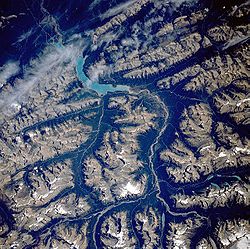
Abraham Lake, also known as Lake Abraham, is an artificial lake and Alberta's largest reservoir. It is located in the "Kootenay Plains area of the Canadian Rockies' front range", on the North Saskatchewan River in western Alberta, Canada.[1]

Key Information

Description

[edit]

Abraham Lake has a surface area of 53.7 km2 (20.7 sq mi) and a length of 32 km (20 mi).[2] Although man-made, the lake has the blue color of other glacial lakes in the Rocky Mountains, which is caused by rock flour.[3]

Abraham Mountain, Elliott Peak, and the Cline River Heliport are located on the western shore of the lake. Mount Michener is situated on the eastern shore. Mount Ernest Ross lies at the southern tip of the lake.

History

[edit]
Plaque found at Abraham Lake

Abraham Lake was created by the former Calgary Power Company, now TransAlta, in 1972, with the construction of the Bighorn Dam.[4] Planning of the dam involved no evaluation of the social and environmental effects it may have caused and no public hearings were held prior to the construction. Construction of the Bighorn Dam flooded the Kootenay Plains and stopped the livelihood (hunting and fur trapping) of the Bighorn band of the Stoney Nakoda First Nation that had lived in that area.  It had flooded their cabins, graves and pastures.[5]

The lake was built on the upper course of the North Saskatchewan River, in the foothills of the Canadian Rockies, and lines David Thompson Highway between Saskatchewan River Crossing and Nordegg.

The Government of Alberta sponsored a contest to name the lake in February 1972, during the final stages of construction of the Bighorn Dam. Students across the province were asked to submit names taking into consideration "historical significance, prominent persons, geography and topography, and the value of the lake."[6] It was eventually named after Silas Abraham (c. 1870 – 1964), of the Stoney Nakoda First Nation and originally from Morley, Alberta.[7] He was a farmer and hunter who lived in the Kootenay Plains and later on the Big Horn 144A reserve.[8][9]

Phenomenon

[edit]

Trapped methane causes frozen bubbles to form under the ice on the lake's surface. This phenomenon results when decaying plants on the lake bed release methane gas, which creates bubbles that become trapped within the ice, in suspended animation, just below the surface as the lake begins to freeze. The visual effects formed by the resulting stacks of bubbles, frozen while rising toward the surface, combined with the clear blue water, have made Abraham Lake a popular destination for photographers and nature observers.[10][11] The ice coverage of the lakes varies throughout the winter. Abraham Lake is usually frozen by late December. Ideal viewing of the ice bubble season is from mid-January to mid-February.[12]

Bubbles on frozen Abraham Lake

See also

[edit]

References

[edit]
[edit]
Revisions and contributorsEdit on WikipediaRead on Wikipedia
from Grokipedia

Abraham Lake is an artificial in the Kootenay Plains of western , , created in 1972 by the construction of the Bighorn Dam on the upper . As 's largest , it spans a surface area of approximately 53.7 square kilometers and stretches 32 kilometers in length, serving primarily for hydroelectric power generation managed by . The lake's defining visual characteristics include its striking hue in warmer months, resulting from suspended glacial silt known as , and in winter, the trapping of gas bubbles within layers of formed as the gas rises from decomposing on the lakebed. These bubbles, produced by bacterial of submerged and remains, create a unique frozen phenomenon that draws photographers and adventurers, though the underscores the reservoir's artificial submersion of valley ecosystems. Accessible via the David Thompson Highway, the lake supports seasonal including walks, , and , while its hydroelectric output contributes to regional energy needs without notable operational controversies in primary records.

Geography

Location and Dimensions

Abraham Lake is situated in western , , within the Kootenay Plains of the Canadian ' foothills, along the course of the . The reservoir lies east of , accessible via Highway 11, the David Thompson Highway, between the communities of Saskatchewan River Crossing to the west and to the east. It is approximately 200 kilometers west of and 250 kilometers northwest of . The lake measures approximately 32 kilometers in length with a surface area of 53.7 square kilometers, establishing it as Alberta's largest reservoir. Its elongated form follows the river valley, with widths varying narrowly along its extent, though maximum width reaches about 1 kilometer in broader sections. Average depth is around 34 meters, contributing to a total volume of roughly 1.77 cubic kilometers.

Hydrological Characteristics

Abraham Lake functions as a regulated on the , with inflows primarily from the river's headwaters in the Bighorn region, which contribute approximately 90 percent of the river's total flow volume. The reservoir's full storage capacity stands at 1,409,900 thousand cubic meters, enabling management for hydroelectric power generation, flood control, and downstream . As of October 18, 2025, storage levels were at 94 percent of capacity, reflecting operational adjustments to seasonal runoff and demand. The lake exhibits significant water level fluctuations tied to dam operations at Bighorn, with maximum depths reaching up to 91 meters corresponding to the dam's operating head. Inflows peak during spring snowmelt from the , while outflows are controlled via the Bighorn hydroelectric plant, which has an installed capacity of 120 megawatts and regulates discharge to maintain stable downstream flows on the , averaging around 241 cubic meters per second basin-wide. Reservoir drawdowns occur in winter to support power production, reducing surface levels and exposing shorelines, while refill targets higher elevations in summer for storage. Hydrological modeling indicates vulnerability to reduced inflows from glacier retreat in the source watersheds, potentially leading to summer shortages despite the reservoir's buffering role. The system's design prioritizes multi-use objectives, balancing energy output—annually around 408,000 megawatt-hours—with ecological and allocation needs under Alberta's water management framework.

Formation

Pre-Dam Landscape

Prior to the construction of the Bighorn Dam in 1972, the site of Abraham Lake encompassed the upper North Saskatchewan River valley within the Kootenay Plains of Alberta's Bighorn region, a transitional montane landscape in the eastern foothills of the Canadian Rockies. This area featured wide open valleys flanked by rolling hills, with active floodplains, alluvial fans, and river terraces shaped by glacial and fluvial processes. The terrain included rugged elements such as riverine dunes, cemented gravel and till cliffs, hoodoo formations, and waterfalls like those on the nearby Siffleur River, reflecting post-glacial deposition and erosion patterns. Vegetation in the valley consisted primarily of open dry grasslands dominated by species such as June grass, pasture sage, and prairie groundsel, interspersed with forests of aspen, lodgepole pine, and on higher slopes and terraces. These habitats supported diverse , including rare adapted to the semi-arid foothill conditions, and provided corridors for movement, with historical bison migrations utilizing the river valley for grazing and crossing. The itself meandered through the , fed by glacial melt from upstream sources like the , maintaining dynamic hydrological features such as seasonal flooding that enriched soil nutrients and sustained riparian ecosystems. Indigenous groups, including the Stoney Nakoda and Ktunaxa peoples, had long inhabited and stewarded the Kootenay Plains, relying on the landscape for hunting, trapping, gathering medicinal plants, and conducting ceremonies such as sundances at lodge sites along the river. The valley served as a key trade and kinship nexus, with trails extending westward over Rocky Mountain passes like Howse and Pipestone, integrating the area into broader networks across the Rockies. Archaeological evidence from pre-inundation surveys revealed human occupation sites on lower terraces, indicating sustained use tied to the river's resources and the surrounding . This pre-dam environment exemplified an intact foothill ecosystem with high ecological connectivity, prior to the flooding that submerged approximately 53.7 square kilometers of valley floor.

Bighorn Dam Construction

The Bighorn Dam was constructed by Calgary Power Ltd. as a multipurpose hydroelectric project on the North Saskatchewan River, approximately 20 miles southwest of Nordegg, Alberta, to generate power and augment winter river flows. Preliminary site investigations began in 1953 but were abandoned due to unfavorable bedrock conditions; they resumed between 1965 and 1969, with design finalization occurring in 1969. Construction commenced in 1969, starting with access roads, worker camps, and diversion tunnels. Key phases included building the access road and camp from May to August 1969, excavating and lining tunnels from August 1969 to October 1970 for river diversion, constructing the and initial dam works from October 1970 to June 1971, and installing the concrete cut-off wall from January to June 1971. The main dam contract was awarded to Co. Ltd. of in June 1970, with site work beginning in July; the project supported a of up to 400 personnel housed in on-site camps. Engineering challenges arose from the site's geology, including pervious sand and gravel deposits overlying bedrock 120 feet below the riverbed, fault lines, and a high-level buried channel necessitating a deep impermeable barrier. The dam is a 300-foot-high zoned earthfill structure featuring an impervious core, pervious shells, and a 216-foot-deep concrete diaphragm cut-off wall grouted into bedrock, with local glacial till, gravel, and rock used as fill materials; settlement issues during cut-off wall installation were addressed using bentonite cushions and steel plates. The associated powerhouse includes two 57 MVA Francis turbines in a concrete-lined power tunnel originally built as a diversion conduit. The total project cost reached $43 million, with the Alberta government contributing $5 million toward reservoir-related aspects for flow regulation. Construction concluded in late , with the dam and plant commissioned in December, impounding water to form Abraham Lake, Alberta's largest reservoir.

History

Indigenous and Early Exploration

The region now occupied by Abraham Lake, situated in the Kootenay Plains along the upper , served as traditional territory for Indigenous peoples, including the Stoney Nakoda (Îyârhe Nakoda), who utilized the area for hunting bison on the plains, fishing in the river, and gathering and foods in the foothills and watersheds. These activities supported semi-nomadic bands composed of extended families, with the plains providing a sheltered ecological reserve amid the for seasonal gatherings and resource exploitation over generations prior to European arrival. The Ktunaxa (Kootenay) also inhabited the Kootenay Plains until around 1810, engaging in similar subsistence practices before pressures from inter-tribal conflicts and encroaching dynamics prompted relocation. Archaeological and oral historical evidence indicates human presence in the broader valley for over 10,000 years, with the Kootenay Plains functioning as a key intersection for trade and mobility among groups like the and Blackfoot, though the Stoney Nakoda maintained primary stewardship in the immediate Bighorn backcountry. These Indigenous land uses emphasized sustainable , including controlled burns to maintain open grasslands for , contrasting with later colonial alterations to the landscape. European exploration of the upper river reaches commenced in the early 19th century amid the fur trade era. In October 1807, Anglo-Canadian surveyor and North West Company trader David Thompson became the first recorded European to access the Kootenay Plains, crossing the Continental Divide via Howse Pass after departing from Rocky Mountain House and descending approximately 30 miles along the North Saskatchewan River to observe its eastward flow. Thompson's astronomical observations and mappings during this expedition, conducted with Indigenous guides, documented the river's hydrology and surrounding terrain, facilitating subsequent fur trade routes despite challenging winter conditions that limited further immediate penetration. By 1810, Thompson had traversed additional segments of the upper North Saskatchewan, contributing to comprehensive cartography of the Saskatchewan River system that informed British claims in the region. Earlier fur trade activities along the lower river, initiated by Hudson's Bay Company explorers like Anthony Henday in the 1750s, relied on Cree intermediaries but did not extend to the remote upper plains until Thompson's ventures.

Modern Development and Naming

The Bighorn Dam and associated hydroelectric generating station were constructed on the between 1969 and 1972 by Power Company, now operating as . This project impounded the river to create Abraham Lake, Alberta's largest , with a surface area of approximately 32 square kilometers at full supply. The dam, a 150-meter-high earthfill structure, supports power generation capacity of 120 megawatts from three turbines, contributing to regional electricity supply. In February 1972, amid the final phases of dam construction, the organized a naming contest for school students to select a name for the new reservoir. The winning entry, "Abraham Lake," honored Silas Abraham (c. 1870–1964), a member known as a farmer, hunter, and guide who resided in the valley on land subsequently inundated by the reservoir. This designation preserved local Indigenous historical associations with the pre-reservoir landscape.

Natural Phenomena

Turquoise Coloration

The turquoise coloration of Abraham Lake arises from the suspension of , a fine glacial produced by the of in upstream glaciers within the . This sediment is transported via the , which feeds the reservoir, where the particles remain dispersed in the due to their micron-sized dimensions—typically under 20 micrometers. These suspended particles selectively scatter shorter wavelengths of , predominantly and , through a process akin to but enhanced by the sediment's reflective properties on mineral surfaces like carbonates and silicates prevalent in the region's . Longer red and yellow wavelengths are absorbed or transmitted deeper, resulting in the observed vivid appearance that mimics natural glacial lakes despite the reservoir's artificial origin. The intensity of the coloration varies seasonally, peaking in late summer (July to August) when glacial meltwater discharge maximizes sediment input, often reaching concentrations that yield a milky turquoise opacity; in contrast, lower flows during winter or drought periods can dilute the effect, rendering the water clearer or less vibrant. This dynamic is documented in hydrological studies of similar Rocky Mountain reservoirs, where sediment load directly correlates with optical properties measurable via remote sensing.

Methane Bubbles and Gas Dynamics

Methane bubbles in Abraham Lake originate from the anaerobic decomposition of organic matter, primarily submerged vegetation, logs, and sediments flooded following the 1972 construction of the Bighorn Dam. Methanogenic bacteria in the oxygen-poor lake bottom convert this biomass into methane gas (CH₄) through processes like acetoclastic and hydrogenotrophic methanogenesis. The reservoir's influx of organic-rich glacial runoff and silt from the North Saskatchewan River exacerbates this production, creating supersaturated conditions conducive to ebullition— the abrupt release of gas as discrete bubbles rather than diffusion. These bubbles, typically 1-5 in diameter, rise buoyantly through the at rates determined by their size, viscosity, and , often accumulating in shallower zones where is more pronounced. During winter, when surface temperatures drop below -20°C, forms rapidly from the top down, encapsulating the ascending bubbles in translucent layers up to 30-50 thick. The gas dynamics involve exceeding 200-300 times atmospheric levels, leading to bubble and coalescence; trapped remains stable under the ice due to low permeability and minimal dissolution in cold water. Upon spring thaw, the ice fractures, releasing accumulated in pulses that contribute to atmospheric concentrations, with CH₄'s 25-34 times that of CO₂ over a 100-year horizon. While visually striking due to the lake's clarity and minimal disturbance, these phenomena underscore reservoir-induced enhancements in biogenic gas emissions compared to pre-dam riverine systems, where organic decay was more aerobic and dispersed. Quantitative ebullition fluxes in similar systems range from 10-100 mg CH₄ m⁻² day⁻¹, though site-specific measurements for Abraham Lake remain limited.

Ecology and Environmental Impacts

Flora, Fauna, and Biodiversity

The terrestrial ecosystems surrounding Abraham Lake, situated in the montane zone of Alberta's Eastern Slopes, feature coniferous forests dominated by lodgepole pine (Pinus contorta) and Douglas fir (Pseudotsuga menziesii), with deciduous stands of trembling aspen (Populus tremuloides) and balsam poplar (Populus balsamifera) in moister valleys. Understory vegetation includes shrubs and forbs adapted to foothill conditions, though the ecosystem remains fragile, with trail adherence recommended to minimize soil compaction and plant disturbance. Fauna in the region reflects the transitional boreal-montane , with large ungulates such as (Cervus canadensis), (Odocoileus hemionus), (Ovis canadensis), and (Oreamnos americanus) frequenting open meadows, rocky outcrops, and shorelines for and mineral licks. Predators and scavengers include golden eagles (Aquila chrysaetos), red-tailed hawks (Buteo jamaicensis), and common ravens (Corvus corax), while ground birds like (Bonasa umbellus) inhabit forested edges. Aquatic and semi-aquatic species around the lake encompass occasional (Alces alces) along tributaries and waterfowl such as common loons (Gavia immer) and great blue herons (Ardea herodias) during migration or breeding seasons. The reservoir supports a sport fishery primarily composed of introduced and native salmonids, including (Salvelinus namaycush), (Salvelinus confluentus), (Oncorhynchus mykiss), (Salvelinus fontinalis), and (Salmo trutta), with (Prosopium williamsoni) more prevalent in inflowing rivers than the lake basin itself. Overall is shaped by the 1972 impoundment, which flooded pre-dam riparian zones and promoted anaerobic decomposition of submerged vegetation, potentially limiting benthic invertebrate diversity and altering food webs compared to the former free-flowing . Terrestrial habitats, however, sustain characteristic foothill assemblages, with seasonal influxes of migratory birds enhancing avian richness.

Reservoir Effects on Ecosystems

The construction of the Bighorn Dam in 1979–1980 impounded the upper , creating Abraham Lake as a that submerged approximately 32 square kilometers of valley bottom, converting dynamic riverine (lotic) habitats into standing lentic waters. This flooding drowned pre-existing forested ecosystems, with submerged tree roots and vegetation undergoing anaerobic decomposition at the bottom, fostering conditions for gas production and altering benthic cycling. The shift reduced diversity for river-adapted , favoring lake-tolerant organisms while eliminating riffles, pools, and meanders essential for lotic . Hydrological alterations from the reservoir include regulated outflows that dampen natural flood pulses and modify seasonal flow timing, though annual discharge volumes remain largely unchanged; these changes disrupt downstream sediment transport and nutrient delivery critical for riparian zones and aquatic food webs. Thermal stratification in the reservoir releases colder hypolimnetic water downstream during summer, potentially stressing warm-water species and altering primary productivity, while trapping sediments reduces aggradation in lower reaches, leading to channel incision and habitat simplification. Water quality monitoring highlights concerns from headwater tributaries flowing into the reservoir, where impoundment can concentrate minerals and organics, influencing dissolved oxygen levels and algal dynamics. Aquatic fauna have experienced community shifts, with studies documenting fish assemblages in Abraham Lake dominated by species adapted to reservoir conditions, such as lake whitefish and possibly introduced or tolerant forms, at the expense of strictly fluvial specialists. Migratory salmonids like bull trout (Salvelinus confluentus), listed as of special concern, face habitat fragmentation from the dam's barrier effect, limiting access to spawning and rearing grounds in tributaries and upstream reaches; telemetry research from 2002–2003 revealed seasonal concentrations in the upper river and lake, underscoring the need for management to mitigate isolation. Cumulative reservoir effects across the Saskatchewan system exacerbate these pressures, contributing to altered flow regimes that hinder reproductive cues and juvenile dispersal for potamodromous fishes. Terrestrial ecosystems along the reservoir margins have seen erosion from fluctuating water levels and high recreational traffic, degrading sensitive slopes and reducing riparian vegetation cover, which in turn affects pollinators, small mammals, and bird nesting sites dependent on dynamic shorelines. Overall, while the reservoir supports some novel lacustrine biodiversity, the net ecological outcome involves reduced heterogeneity and resilience compared to the pre-dam river continuum, with dams recognized for their broad negative influences on fluvial systems including habitat loss and flow disruption.

Methane Emissions and Climate Implications

Abraham Lake's stem from the anaerobic decomposition of submerged when the was formed in 1972 by the Bighorn Dam on the . Flooded and , previously decomposing aerobically on land, shift to -producing processes in oxygen-poor sediments, generating bubbles that rise toward the surface. This biogenic production is a common feature of hydroelectric , particularly in boreal regions where extensive and peatlands are inundated. During winter, rising methane bubbles become entrapped in the forming , creating the visually striking frozen bubble formations observed across the lake's surface. As temperatures rise in spring, the thaws, releasing accumulated directly into the atmosphere in concentrated bursts. Drawdown and fluctuation of water levels, typical for hydroelectric operations, can exacerbate emissions by exposing sediments to air, promoting further and creating hotspots of release. Methane's high —approximately 80 times that of over 20 years—amplifies the impact of these emissions compared to longer-lived gases. Reservoirs like Abraham Lake contribute to the underappreciated footprint of , with studies indicating that such systems can emit at rates rivaling plants in certain contexts, though overall lifecycle emissions remain lower than or gas. These emissions add to concentrations, which have risen sharply since the early , potentially accelerating near-term warming and influencing regional patterns in the Canadian Rockies. While the exact quantification for Abraham Lake requires site-specific measurements, the visible bubble phenomenon serves as empirical evidence of ongoing biogenic , underscoring reservoirs' role in the global budget.

Human Uses

Hydroelectric Generation

Abraham Lake serves as the primary for the Bighorn Hydroelectric Plant, impounding water from the to facilitate power generation. The lake was formed in 1972 upon completion of the Bighorn , a structure designed primarily for hydroelectric production and secondary flood control, with the dam standing 91 meters high and creating a of over 1.1 million acre-feet in its operating range. Operated by TransAlta Corporation, the facility draws gravitational feed directly from the lake to its turbines. The plant features two generating units with a combined installed capacity of 120 megawatts under the dam's operating head. It produces an average of 408 gigawatt-hours annually, making it Alberta's highest-output hydroelectric facility due to the consistent from the basin. This output equates to sufficient to power approximately 40,000 average Canadian households per year, based on typical residential consumption rates. Water management involves seasonal drawdowns and releases to optimize generation, with operations during high inflows to prevent overflow while maintaining downstream flows. The Bighorn system's reliability stems from its integration with upstream Brazeau Reservoir operations, allowing coordinated peaking and baseload power dispatch to Alberta's grid. Annual generation varies with precipitation and runoff, but the facility's design prioritizes efficient turbine utilization over maximum storage, contributing to TransAlta's portfolio of low-emission energy sources.

Tourism and Recreation

Abraham Lake attracts visitors primarily for its striking turquoise waters in summer and frozen methane bubbles in winter, which have become iconic for photography and guided tours. The site's remote location along Highway 11 in the Canadian Rockies limits mass tourism, emphasizing self-reliant outdoor pursuits over commercial facilities. Winter recreation centers on the lake's ice formations, where methane gas bubbles trapped beneath the surface create surreal patterns accessible via snowshoes or guided ice walks. Specialized tours, such as ice bubble adventures, operate from to , providing equipment and transportation for safe viewing and of these phenomena. Visitors must exercise caution due to variable ice thickness, with incidents of cracking reported during thaws. In summer, from June to August, activities include , , and on the reservoir's calm waters, alongside picnicking and wildlife observation for species like and bald eagles. trails such as the Crescent Falls (short, moderate with views) and Siffleur Falls (longer, featuring canyons and falls) branch from the lakeshore, offering day trips with elevation gains up to 275 meters. Camping options consist of rustic, dispersed sites along the shoreline and nearby areas like , which provide basic fire pits without amenities, requiring permits for overnight stays and adherence to fire bans. Fishing occurs in the North Saskatchewan River inflows, targeting and other species, though the reservoir's fluctuating levels from dam operations limit consistent angling success. Additional pursuits like on the and flights over the Rockies enhance the recreational appeal for adventure seekers.

Risks and Controversies

Safety Hazards from Ice and Water Levels

The ice cover on Abraham Lake, formed as a reservoir by the Bighorn Dam, poses significant risks due to its instability influenced by fluctuating water levels and underlying methane gas dynamics. Water levels can vary by 30 to 40 meters annually, with changes continuing even after surface freezing, potentially causing ice sheets to crack, shift, or collapse without warning. This instability is exacerbated near the dam, where controlled releases maintain hydroelectric operations, rendering those areas particularly hazardous for pedestrians or vehicles venturing onto the ice. Visitors drawn to view frozen methane bubbles—trapped gas rising from decaying organic matter—face heightened dangers, as multiple freeze-thaw cycles and currents weaken ice integrity, leading to thin or fractured sections that may appear solid but support little weight. In summer and transitional periods, rapid water level adjustments for dam management create additional perils, including sudden exposure of steep, slippery shorelines or submersion of trails, posing fall and risks to hikers and boaters. Unpredictable gusty , combined with level drops that can strand vessels on mudflats or sharp rocks, further endanger water-based recreation. Downstream from the , scheduled or water releases elevate hazards along the , with fast-flowing debris and elevated volumes presenting acute threats to river users, as noted in advisories from Environment and Parks. Official guidelines emphasize avoiding thinner than 10-15 cm for foot travel and monitoring for grey or honeycombed indicative of beneath, though enforcement relies on given the remote . No major publicized fatalities have been directly attributed to these hazards in recent records, but increased has amplified exposure, prompting repeated warnings from provincial authorities.

Debates on Dam Benefits versus Ecological Costs

The Bighorn Dam, operational since 1979, supplies Alberta with an average of 408 gigawatt-hours of annually from its 120-megawatt capacity, representing the province's highest hydro output and contributing to goals by displacing generation with minimal operational . Proponents highlight its reliability for baseload power, supported by Abraham Lake's storage of over 1.1 million acre-feet of water, which also enables flood mitigation and stable downstream flows during dry periods. Critics, including conservation groups like the Alberta Wilderness Association, contend that the dam's construction flooded extensive riparian habitats and wildlife corridors along the North Saskatchewan and Bighorn rivers, permanently altering dynamic river ecosystems essential for species migration and in the sensitive montane foothills. This loss, combined with regulated flow changes, has disrupted natural dynamics and aquatic food webs, potentially reducing populations and inverting trophic structures compared to free-flowing conditions observed in undammed western rivers. Debates intensify over long-term trade-offs, with dam operators emphasizing economic value—such as avoided fuel costs and energy exports—against documented increases in from heightened recreational traffic around the , which fragments remaining habitats. Emerging data on glacial melt projecting up to 70% reductions in inflows by mid-century underscore vulnerabilities, prompting questions on whether retrofits or removals could restore ecological functions without sacrificing power reliability, though empirical studies on similar indicate partial recovery of post-dam but persistent hotspots from submerged organics.

References

Add your contribution
Related Hubs
User Avatar
No comments yet.